AgriFlow: Cultivating Intelligence for the Future of Farming
💡 Inspiration
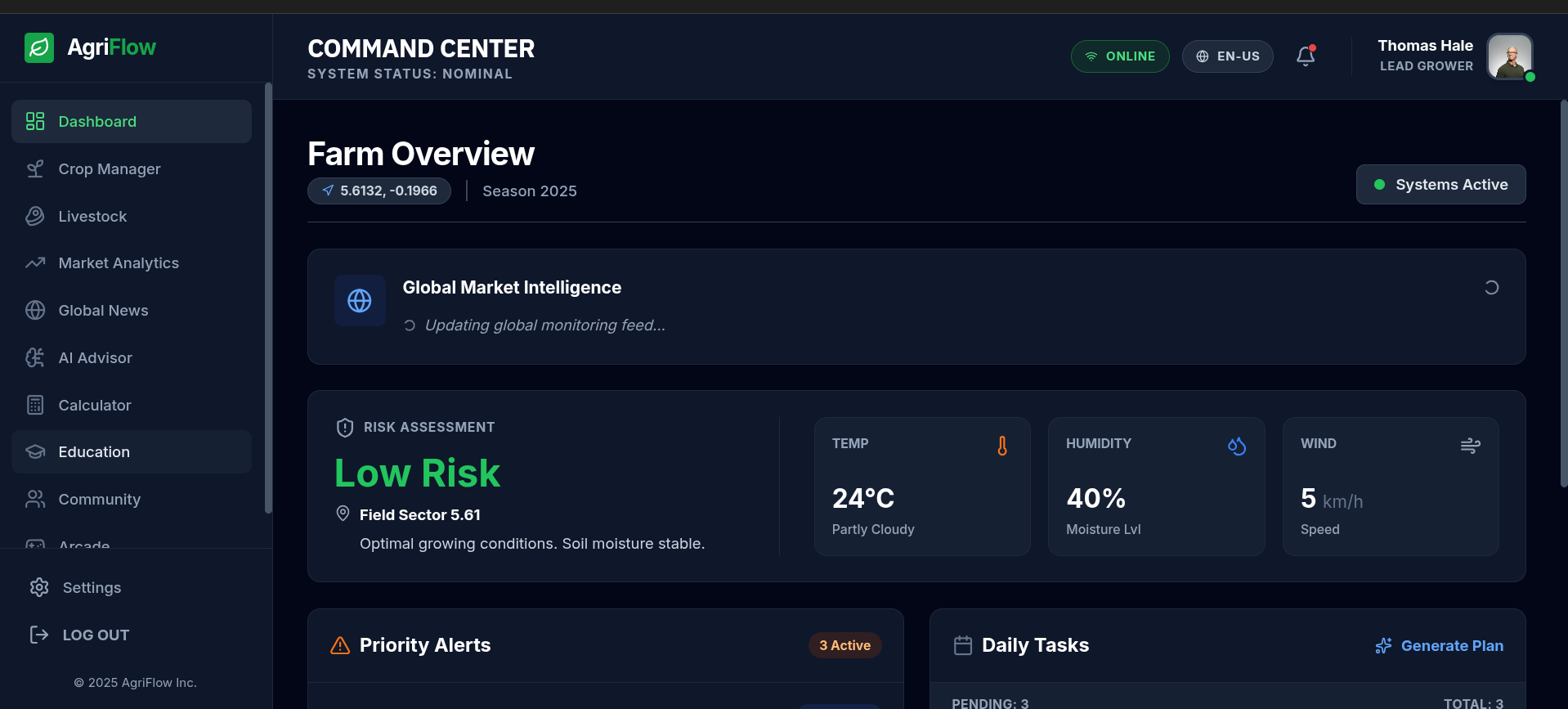
Agriculture is facing a perfect storm: climate instability, skyrocketing input costs, and soil degradation. While reviewing the state of modern AgTech, I noticed that most tools are fragmented—farmers have one app for weather, another for markets, and a third for record-keeping.
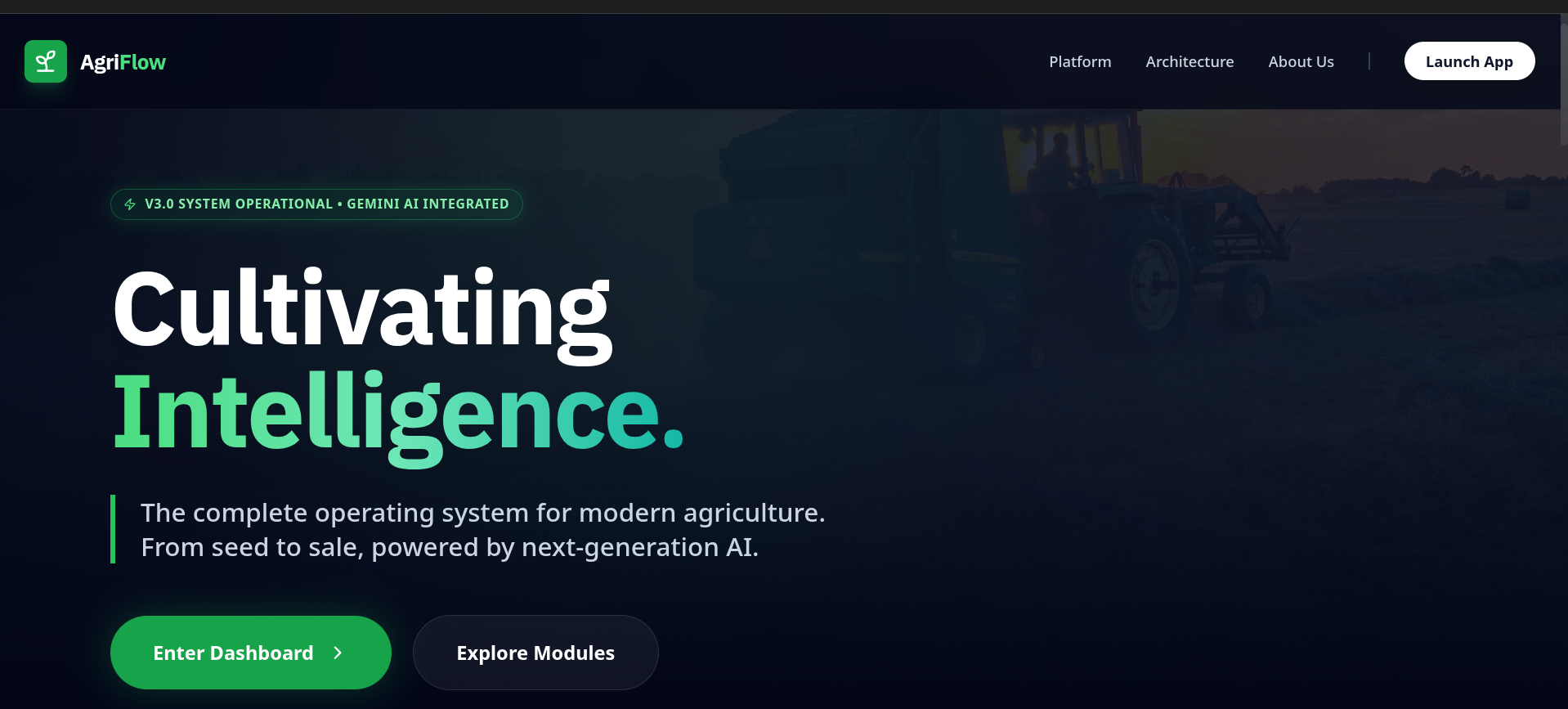
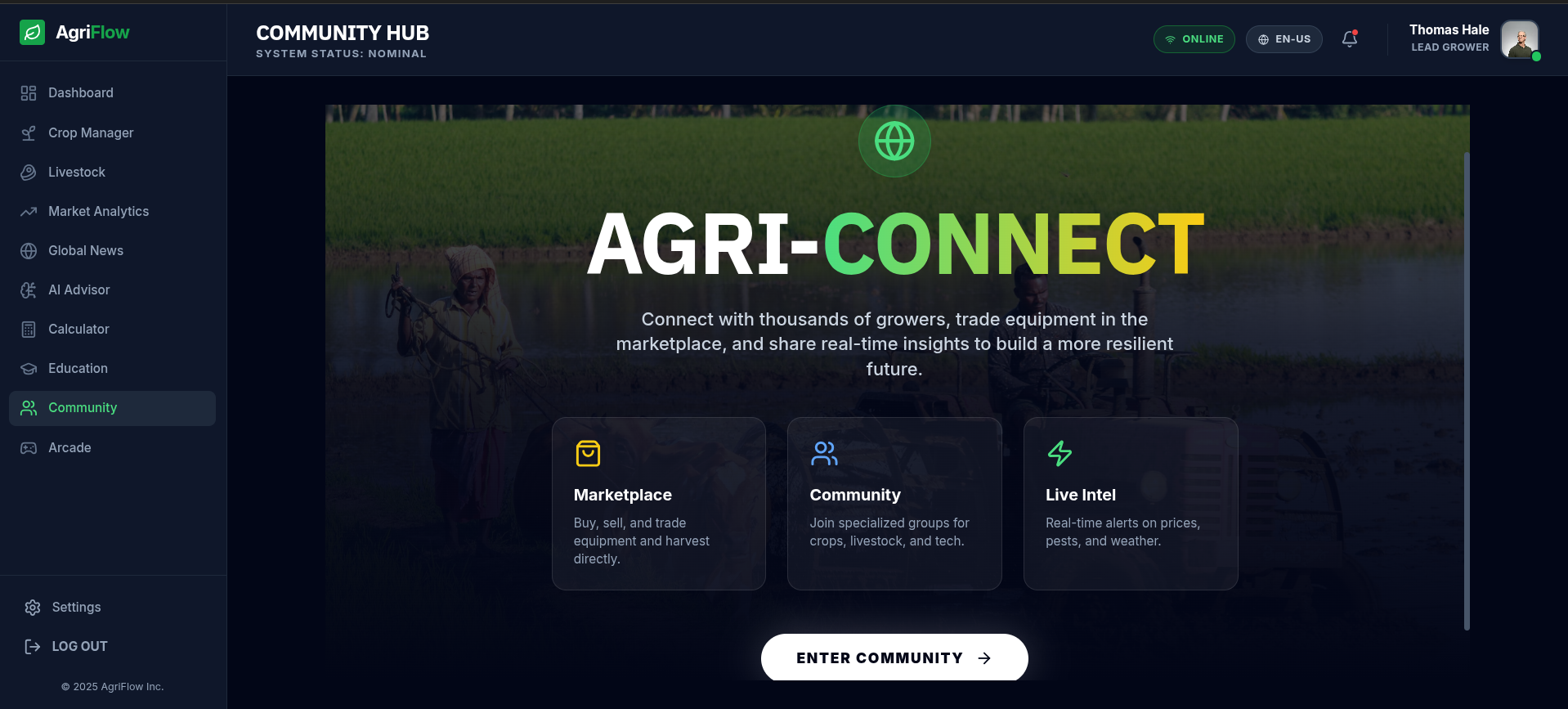
I was inspired to build AgriFlow to create a unified "Field Command" operating system. My goal was to empower farmers—specifically those transitioning to regenerative agriculture—with a tool that doesn't just track data, but actively helps them make decisions using multimodal AI. I wanted to bridge the gap between traditional wisdom and the cutting-edge capabilities of Generative AI.
🧠 What I Learned
Building AgriFlow was a deep dive into the intersection of biophysics and real-time AI.
Multimodal AI Integration
I learned how to leverage the Google GenAI SDK not just for text, but for vision (diagnosing crop diseases from photos) and low-latency voice interactions.The Live API
Implementing the VoiceAgent taught me how to manage WebSocket streams for real-time audio processing, handling raw PCM audio data, and syncing AI responses with frontend state.Agricultural Mathematics
I had to understand the physics behind resource management—specifically calculating Evapotranspiration (ET) to optimize irrigation schedules.
Where:
Kc is the crop coefficient dependent on the growth stage.
- Offline-First Architecture
I learned to build a robustPersistenceServiceusing LocalStorage to mimic a complex database, ensuring the app feels responsive even in low-connectivity rural areas.
- Offline-First Architecture
🛠️ How I Built It
AgriFlow is a React 19 application built with TypeScript and styled using Tailwind CSS.
1. The Architecture
State Management
A centralFarmContextmanages the complex state of crops, livestock, and user settings, exposing actions to the UI components.Data Visualization
I used Recharts to render complex financial projections and market volatility trends.The AI Core (Gemini 3)
- Advisor: Uses
gemini-3-flash-previewwith Grounding (Google Search) to provide up-to-date market news and agronomy advice. - Vision: The
CropManagercaptures image data and sends it to the model to identify pests or nutrient deficiencies. - Voice OS: The
VoiceAgentestablishes a bi-directional stream usinggemini-2.5-flash-native-audio.
- Advisor: Uses
2. The Math Behind the Resources
To help farmers save money, I built a ResourceCalculator. The logic for determining the exact irrigation volume required relies on the following derivation:
Where:
- V is the volume in liters
- A is the area in hectares (ha)
- η (eta) is the irrigation system efficiency (e.g., 0.9 for drip irrigation)
3. Function Calling Implementation
One of the coolest features is the Voice Agent's ability to control the app. I defined tools like navigateApp and createTask in the AI configuration.
// VoiceAgent.tsx
const navTool: FunctionDeclaration = {
  name: "navigateApp",
  description: "Navigate to a specific section of the application.",
  parameters: {
    type: Type.OBJECT,
    properties: {
      destination: {
        type: Type.STRING,
        enum: ["DASHBOARD", "CROPS", "MARKET", ...],
      }
    },
    required: ["destination"]
  }
};
```markdown
# AgriFlow: Cultivating Intelligence for the Future of Farming

## 💡 Inspiration

Agriculture is facing a perfect storm: climate instability, skyrocketing input costs, and soil degradation. While reviewing the state of modern AgTech, I noticed that most tools are fragmented—farmers have one app for weather, another for markets, and a third for record-keeping.

I was inspired to build **AgriFlow** to create a unified **"Field Command" operating system**. My goal was to empower farmers—specifically those transitioning to regenerative agriculture—with a tool that doesn't just track data, but actively helps them make decisions using multimodal AI. I wanted to bridge the gap between traditional wisdom and the cutting-edge capabilities of Generative AI.

---

## 🧠 What I Learned

Building AgriFlow was a deep dive into the intersection of biophysics and real-time AI.

- **Multimodal AI Integration**
  I learned how to leverage the Google GenAI SDK not just for text, but for vision (diagnosing crop diseases from photos) and low-latency voice interactions.

- **The Live API**
  Implementing the VoiceAgent taught me how to manage WebSocket streams for real-time audio processing, handling raw PCM audio data, and syncing AI responses with frontend state.

- **Agricultural Mathematics**
  I had to understand the physics behind resource management—specifically calculating Evapotranspiration (ET) to optimize irrigation schedules.

  Where:
  - **Kc** is the crop coefficient dependent on the growth stage.

- **Offline-First Architecture**
  I learned to build a robust `PersistenceService` using LocalStorage to mimic a complex database, ensuring the app feels responsive even in low-connectivity rural areas.

---

## 🛠️ How I Built It

AgriFlow is a **React 19** application built with **TypeScript** and styled using **Tailwind CSS**.

### 1. The Architecture

- **State Management**
  A central `FarmContext` manages the complex state of crops, livestock, and user settings, exposing actions to the UI components.

- **Data Visualization**
  I used **Recharts** to render complex financial projections and market volatility trends.

- **The AI Core (Gemini 3)**
  - **Advisor**: Uses `gemini-3-flash-preview` with Grounding (Google Search) to provide up-to-date market news and agronomy advice.
  - **Vision**: The `CropManager` captures image data and sends it to the model to identify pests or nutrient deficiencies.
  - **Voice OS**: The `VoiceAgent` establishes a bi-directional stream using `gemini-2.5-flash-native-audio`.

---

### 2. The Math Behind the Resources

To help farmers save money, I built a `ResourceCalculator`. The logic for determining the exact irrigation volume required relies on the following derivation:

Where:
- **V** is the volume in liters
- **A** is the area in hectares (ha)
- **η (eta)** is the irrigation system efficiency (e.g., 0.9 for drip irrigation)

---

### 3. Function Calling Implementation

One of the coolest features is the Voice Agent's ability to control the app. I defined tools like `navigateApp` and `createTask` in the AI configuration.

```ts
// VoiceAgent.tsx
const navTool: FunctionDeclaration = {
  name: "navigateApp",
  description: "Navigate to a specific section of the application.",
  parameters: {
    type: Type.OBJECT,
    properties: {
      destination: {
        type: Type.STRING,
        enum: ["DASHBOARD", "CROPS", "MARKET", ...],
      }
    },
    required: ["destination"]
  }
};
🚧 Challenges I Faced
1. Real-Time Audio Processing
Integrating the Gemini Live API was the biggest technical hurdle. The browser's AudioContext operates at variable sample rates, but the model expects specific PCM formats.
The Challenge
Sending raw audio from the microphone often resulted in static or connection drops.The Solution
I implemented a customfloatTo16BitPCMconverter and anarrayBufferToBase64utility to ensure the binary data stream was perfectly formatted for the WebSocket message payload.
2. Simulating a Living World
I wanted the app to feel alive even without a backend.
The Challenge
Making market prices and weather feel dynamic and realistic.The Solution
I wrote aMarketServicethat uses a random walk algorithm with trend bias to simulate commodity price volatility, and a deterministic weather generator based on geolocation coordinates.
3. Strict Type Safety
Using TypeScript with complex AI responses (which can be unpredictable) required rigorous type guarding. I ensured that the JSON returned by the AI for the Eco Tycoon game and the NewsHub strictly adhered to my interfaces to prevent runtime crashes.
🚀 What's Next
AgriFlow is currently a powerful frontend prototype. The next steps include:
IoT Integration
Connecting the dashboard to real soil moisture sensors via MQTT.Market API
Replacing the simulated market data with a live commodities exchange API.Offline PWA
Fully converting the app to a Progressive Web App (PWA) so farmers can use the AI diagnostic tools completely offline in remote fields.

Log in or sign up for Devpost to join the conversation.