Inspiration
I grew up around smallholder farmers in Uganda, and I kept seeing the same problem play out: a farmer notices something wrong with a leaf, but the nearest agricultural extension officer might be days away or covering more farms than they can realistically reach. By the time anyone with real expertise sees the plant, a treatable problem has often already spread through the field. At the same time, nearly every one of those farmers already carries a smartphone. That camera is the fastest access point to expert judgment that already exists — it just needed something smart enough sitting behind it. That gap is what I built AgriDoc AI to close.
What it does
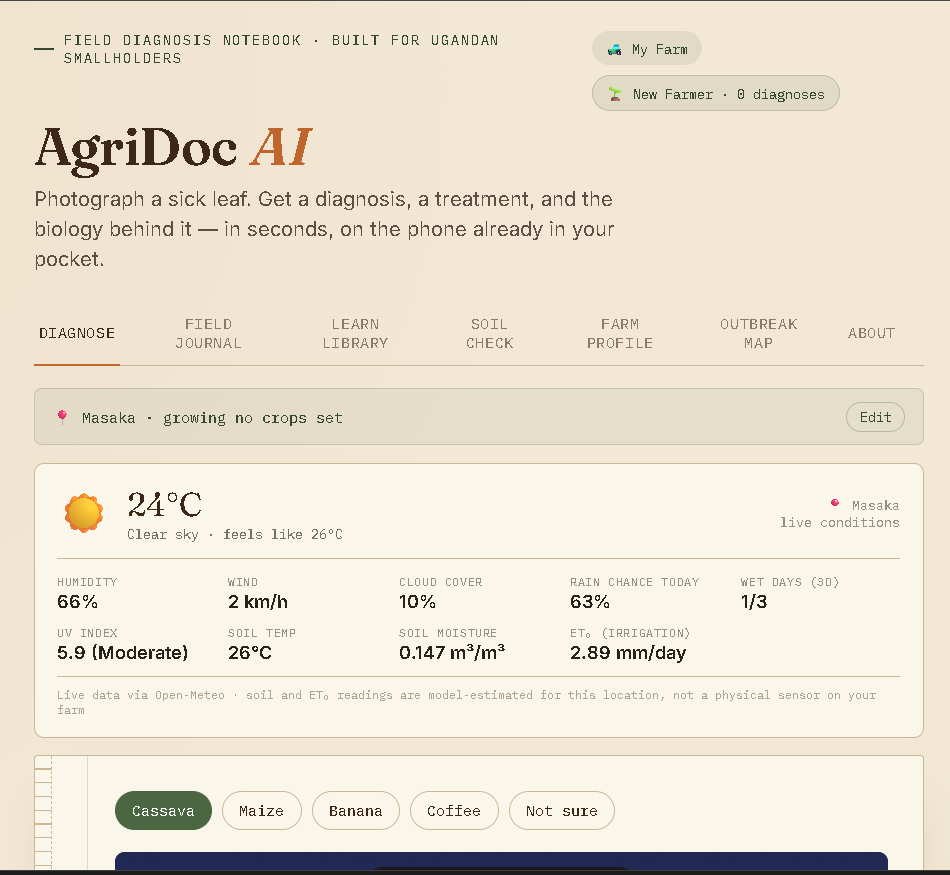
Point a phone camera at a cassava, maize, banana, or coffee leaf, and AgriDoc AI returns a diagnosis, a treatment plan shaped by that day's actual weather on the farm, and a plain-language explanation of the biology behind what's happening — all in seconds.
But I didn't want it to just hand over a verdict. So every diagnosis:
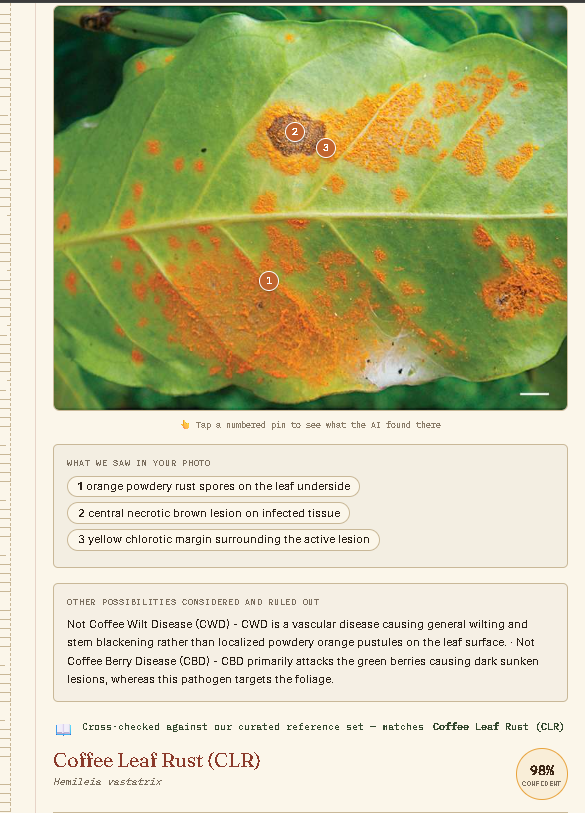
- Shows numbered pins landing directly on the farmer's own photo, pointing at exactly what the AI saw
- Lists what else was considered and ruled out, not just the final answer
- Comes with a confidence score that's actually checked against reality — a live dashboard tracks whether "90% confident" diagnoses are actually right 90% of the time, using real farmer-confirmed outcomes
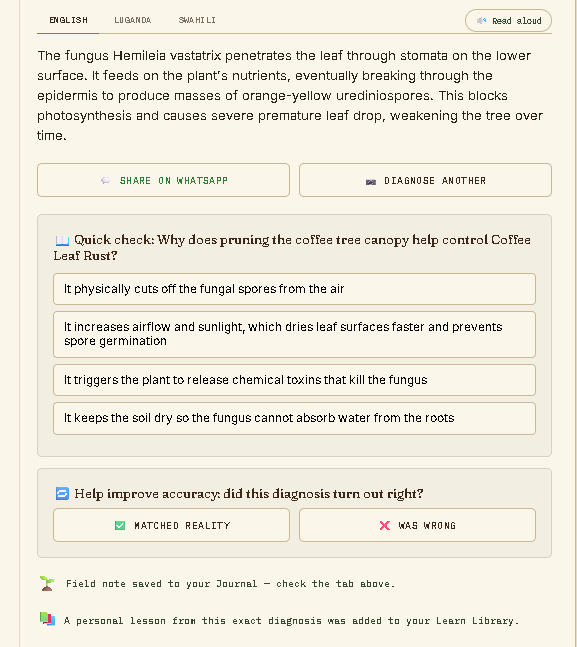
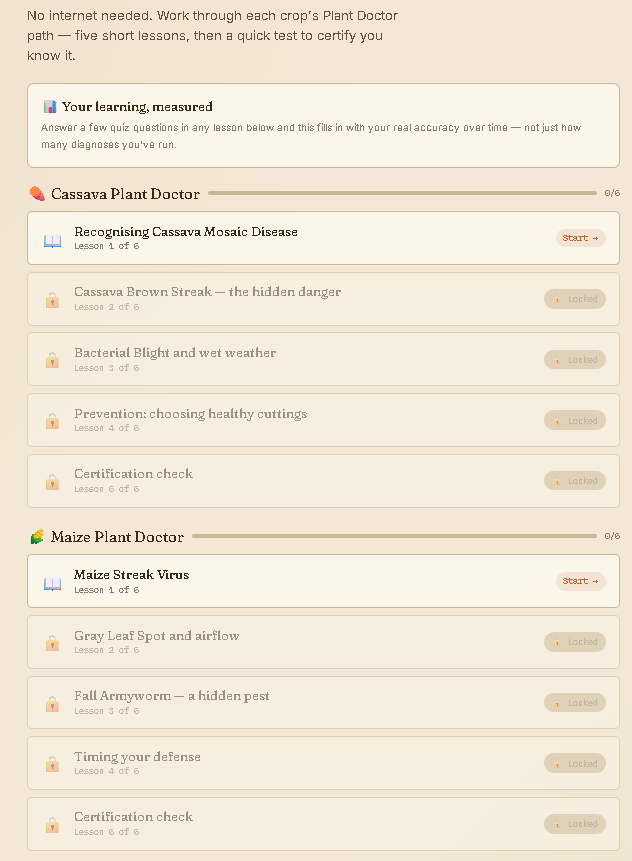
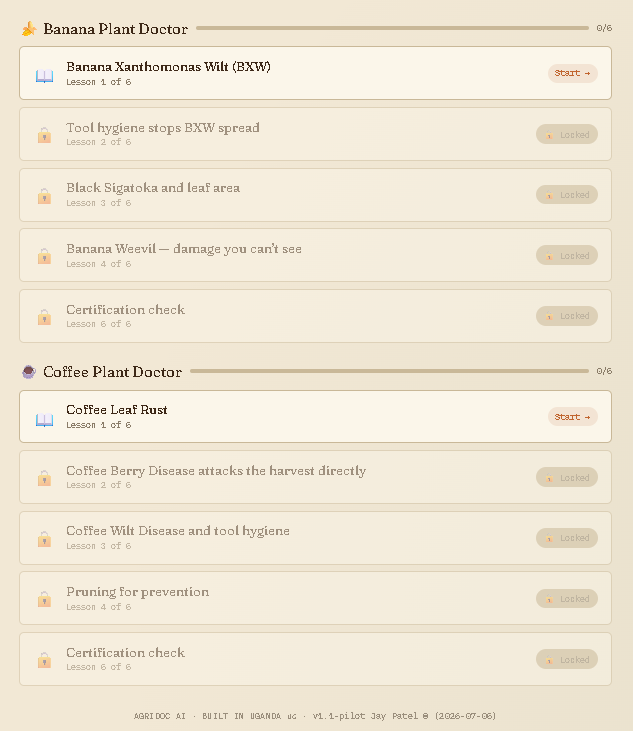
- Turns into a personal micro-lesson, filed into a curriculum that's built entirely from that farmer's own real cases over time
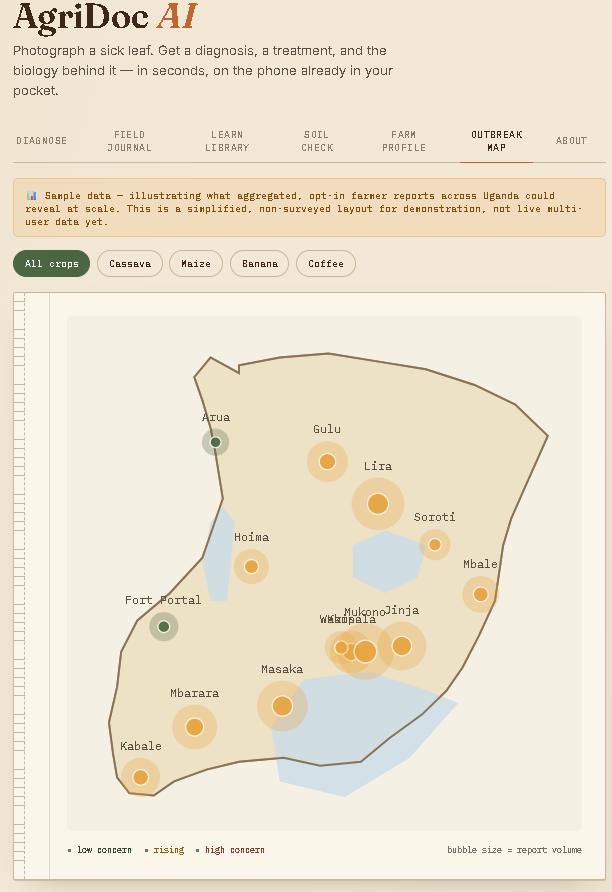
Around the core diagnosis engine, there's a live Outbreak Map (opt-in, aggregated across users), a Soil Check tool, a Field Journal, a full 5-lesson curriculum per crop, multilingual voice output in English, Luganda, and Swahili, and an Export for Expert Review feature that packages photos and diagnoses into a bundle an agronomist can actually validate.
How I built it
AgriDoc AI is a single self-contained HTML/CSS/JS file — no build step, no framework, deployable anywhere a browser runs, which mattered a lot given the low-infrastructure context I was designing for.
The diagnosis pipeline is layered, not a single API call:
- An on-device pixel analysis (HSV color-space thresholding, no AI) runs first, measuring what percentage of the leaf is green, yellowing, or necrotic — instantly, before any network request.
- That measurement, plus a curated reference set of the major documented diseases for the selected crop (summarized from published Uganda-focused agricultural research), gets fed into the prompt for a multimodal model — Gemini 3.5 Flash — as grounding context the model has to cross-check its visual read against.
- If that first pass comes back under a confidence threshold, a stronger model (Gemini 3.1 Pro) automatically reviews the same photo. Most diagnoses stay fast on the first model; genuinely uncertain cases get a real second opinion instead of a shrug.
- For the AI calls themselves, I built a hybrid architecture: direct calls to Google's Gemini API when a key is configured, with automatic fallback through Puter.js's free proxy if that fails — so the app stays fully functional on zero-cost infrastructure either way.
For data, I used Firebase's free tier (anonymous auth + Firestore) to power the live Outbreak Map and the confidence calibration dashboard, and Open-Meteo for real per-district weather that feeds directly into diagnosis reasoning and treatment timing.
Challenges I ran into
Getting reliable AI access on zero-cost infrastructure was harder than I expected. Puter.js's free proxy has a storage ceiling that a photo-heavy app runs into quickly, which is what pushed me toward the hybrid direct-API-plus-fallback architecture instead of relying on one path.
The harder challenge was resisting the pull toward features that look impressive but overclaim. Early on I considered faking cross-user data on the Outbreak Map to make it look more alive — I killed that and labeled it honestly as sample data instead, because a farmer making a real decision based on a fabricated outbreak signal is a genuinely bad outcome, not just a bad look. That same instinct shaped the confidence calibration dashboard: instead of just displaying a confidence percentage and hoping it's trustworthy, I built the plumbing to actually check it against farmer-reported outcomes over time, and to say plainly when there isn't enough data yet rather than showing a fabricated number.
Getting the AI to point at real coordinates on a farmer's own photo (for the symptom pins) also took real tuning — spatial grounding from a vision model isn't perfectly reliable, so I built a validation check that silently falls back to plain text if the returned coordinates don't line up with what was actually asked for, rather than ever showing a pin I couldn't stand behind.
What I learned
I started out planning a simultaneous multi-model ensemble for every diagnosis, and abandoned it for a confidence-triggered cascade instead — it's cheaper, faster for the common case, and easier to explain honestly to a farmer than "three AIs voted." That trade-off — cascade over ensemble — ended up teaching me more about designing AI systems for real constraints than the ensemble version ever would have.
I also came away convinced that a calibrated confidence score is worth more than a high one. A model that says 60% and is right 60% of the time is more useful, and more trustworthy, than one that says 95% and is right 70% of the time. Building the infrastructure to actually measure that, instead of just asserting it, was the single most technically interesting part of this project.
Accomplishments that I'm proud of
Building a full diagnosis pipeline — on-device pre-processing, retrieval-grounded reasoning, a confidence-triggered model cascade, live multi-user data, and an honest self-calibration loop — as a single-file, zero-cost-infrastructure app, solo, in a short build window. And doing it without cutting the corner that mattered most to me: every honesty-vs-impressiveness decision in this project went to honesty, even when the impressive version would have been an easier demo.
What's next for AgriDoc AI
The most important next step is formal validation — running the diagnosis engine against a labeled dataset with real agronomists, using the Export for Expert Review pipeline I already built for exactly that purpose. Beyond that: expanding the curated reference set as more crops and districts come online, an SMS/USSD fallback for farmers without reliable data access, and deeper district-level outbreak alerting as real usage — and real data — grows.
Built With
- css3
- firebase
- firestore
- gemini
- html5
- javascript
- open-meteo
- puter-js



Log in or sign up for Devpost to join the conversation.