-
-
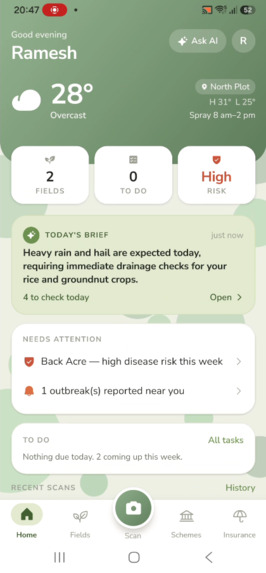
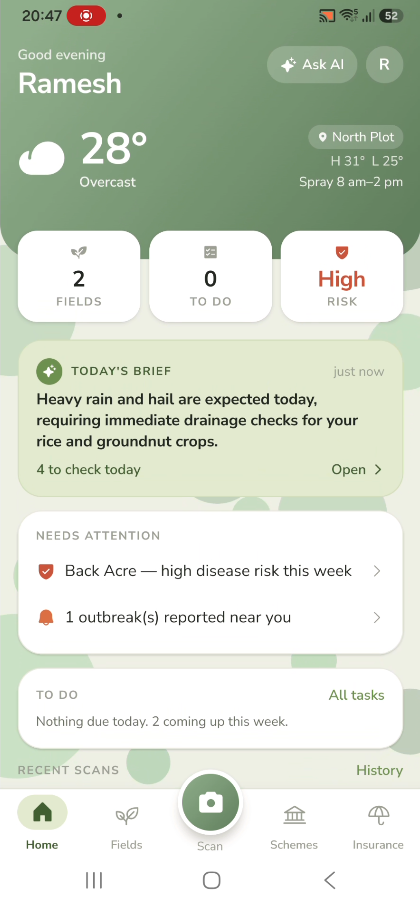
Farm dashboard shows weather alerts and disease risks.
-
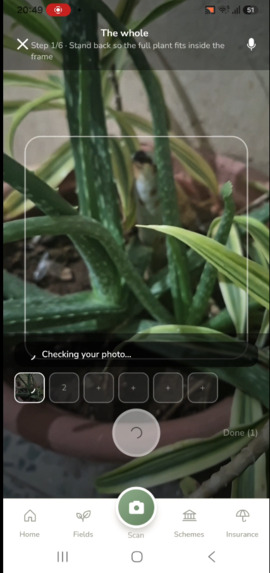
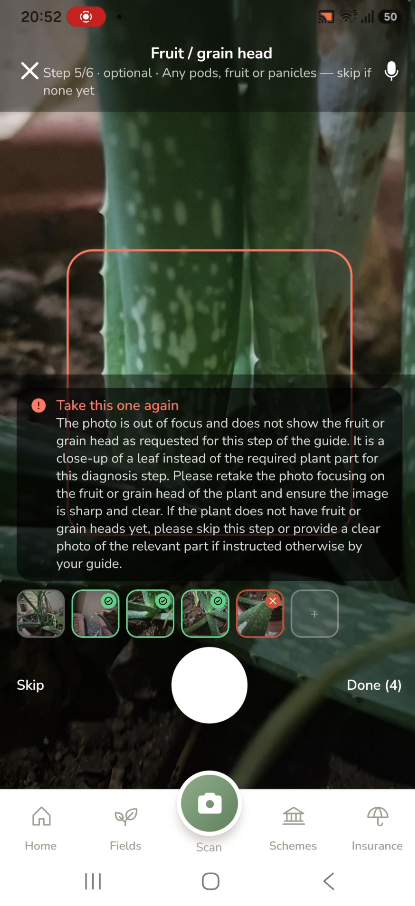
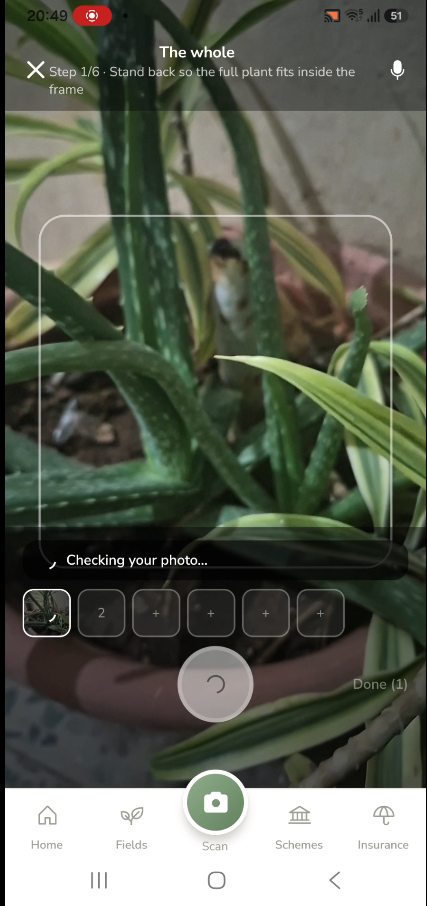
Farmer scans whole plant for AI disease diagnosis.
-
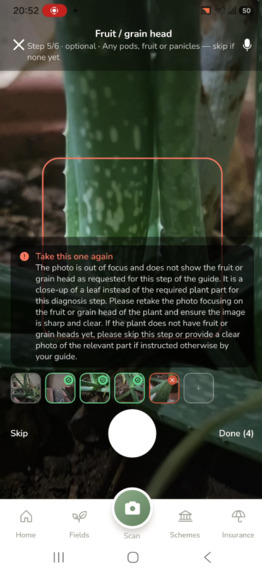
Camera requests a clear fruit or grain head photo.
-
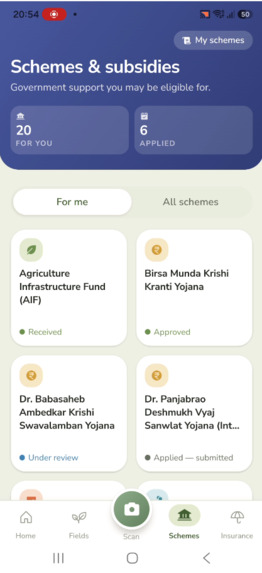
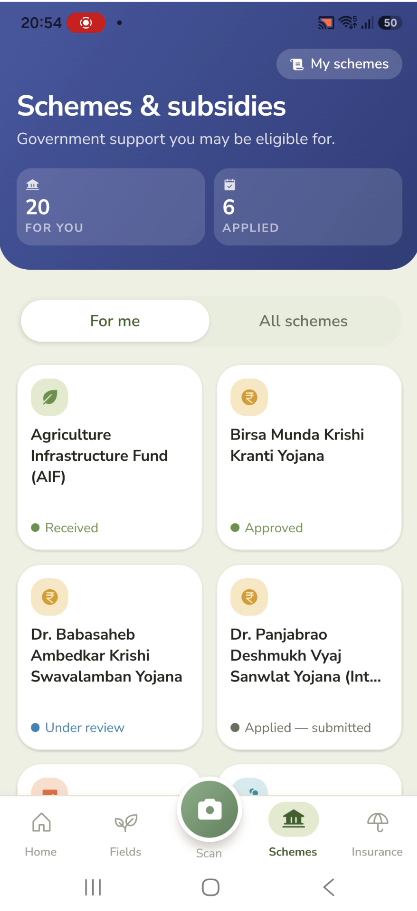
Government schemes and subsidy eligibility dashboard.
-
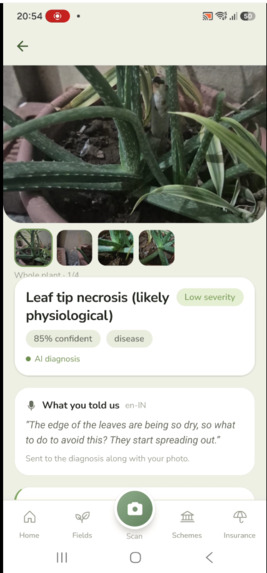
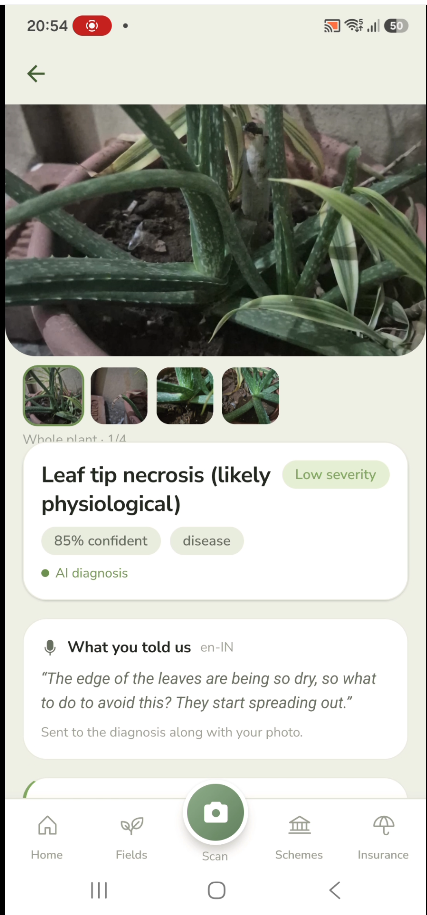
AI identifies leaf tip necrosis with low severity.
-
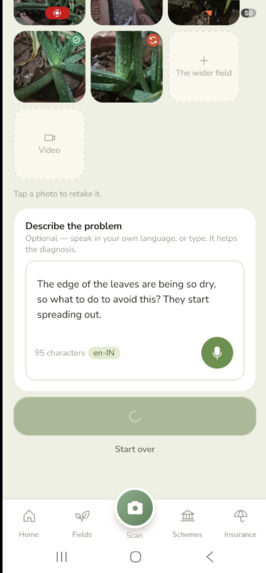
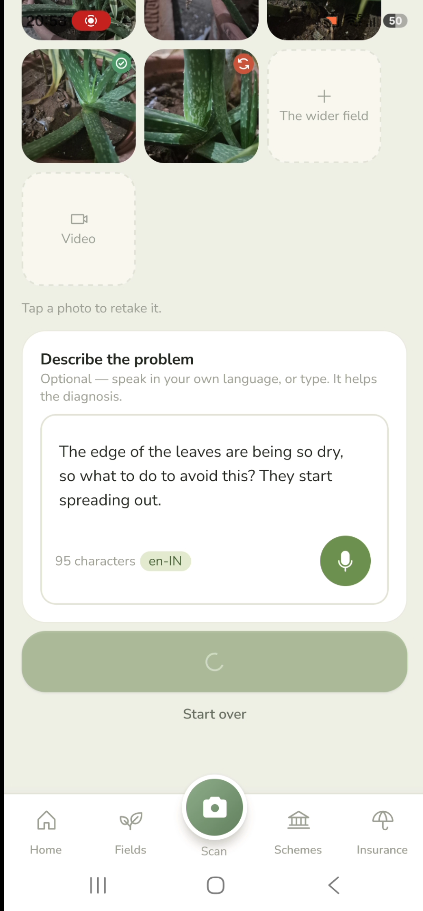
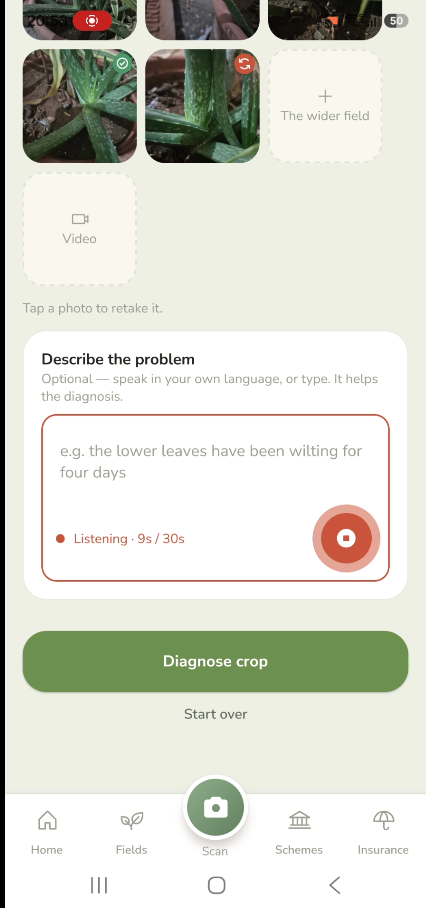
1. Farmer describes dry leaf edges for diagnosis.
-
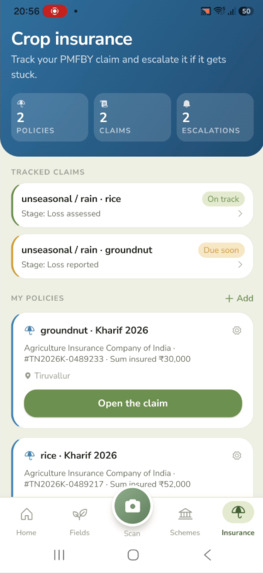
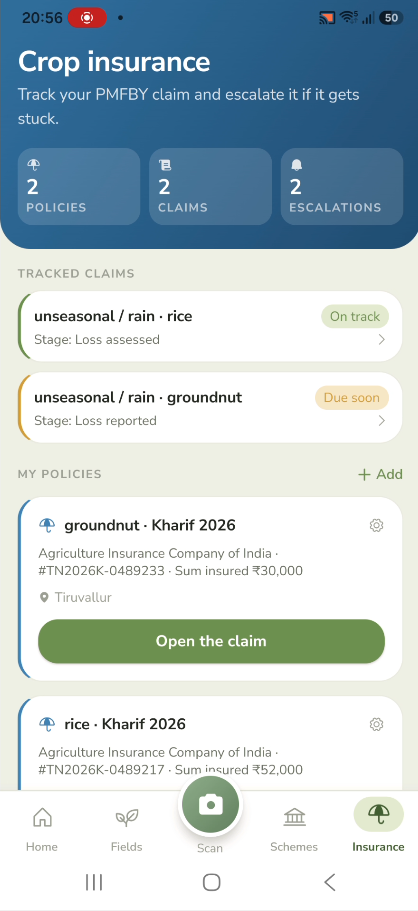
Crop insurance dashboard tracks policies, claims, and escalations.
-
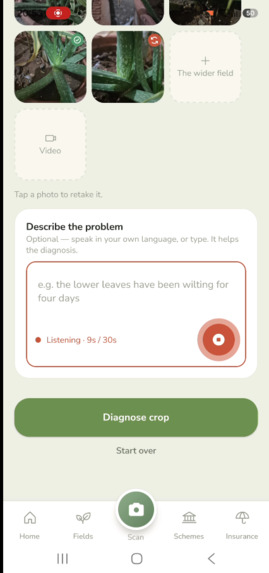
Farmer records crop symptoms using voice input.
-
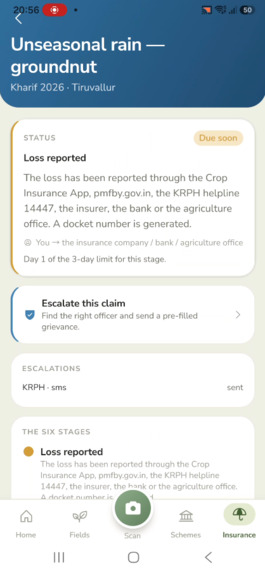
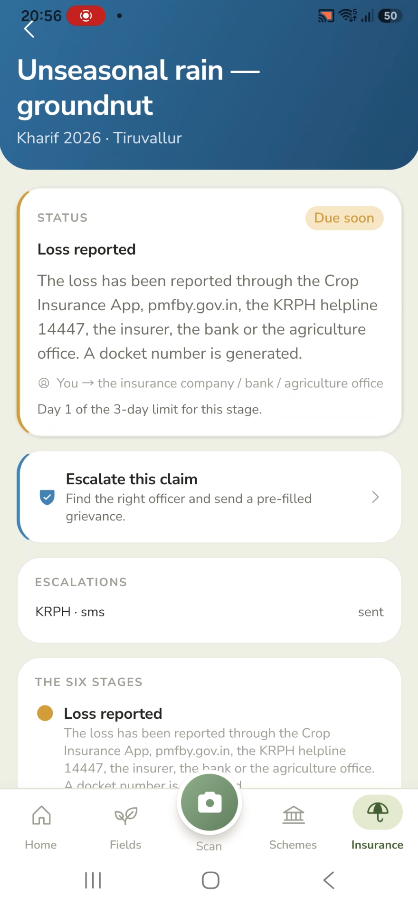
Crop insurance claim status for groundnut rain damage.
-
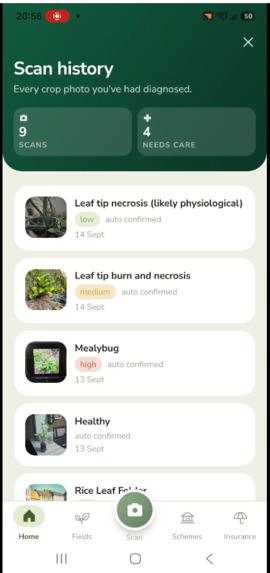
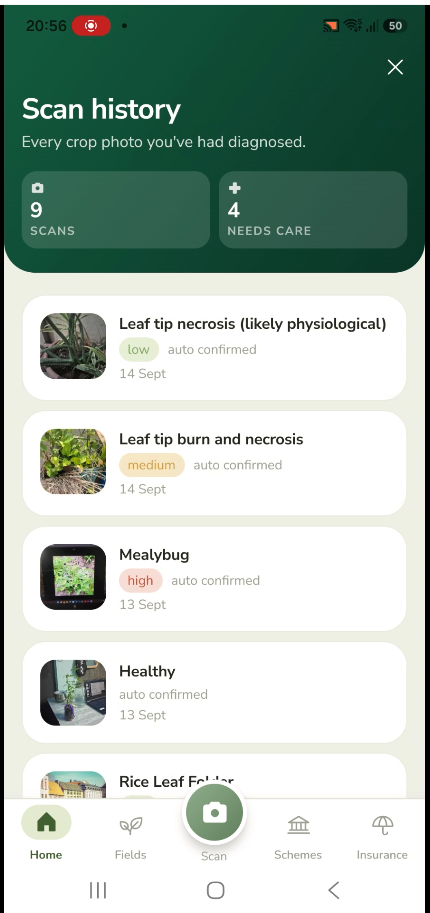
Scan history displays past crop diagnoses and severity.
What Inspired Us
It started in a paddy field in Tamil Nadu. We sat down with farmers and asked a simple question: How do you know when your crop is in trouble?
The answer was almost always the same: “When we can see it.”
By the time a leaf turns yellow or a lesion spreads, the damage is already done. The problem isn’t that farmers don’t care. It’s that they find out too late, with no one nearby to ask and advice that rarely comes in their own language.
Existing apps made it worse: upload a blurry photo, get a confident-sounding guess, and hope for the best.
We wanted to build something a farmer could actually trust. One farmer told us, “Guided Scanning is easy to use and very helpful.” That line became our north star.
What We Built
AGRIAN is an AI-powered smart agriculture platform that closes the entire crop-health loop, not just the detection step:
SCAN → ASSESS → ACT → DOCUMENT → MONITOR → SIMULATE → VALIDATE → VERIFY
- Guided Crop Scanning: Coaches farmers on distance, angle, and multiple views instead of accepting random photos.
- Trust-Gated AI: Escalates cases to experts when the model lacks confidence instead of making unreliable guesses.
- Safe Action: Provides treatment recommendations that consider crop growth stage and harvest safety.
- Community Outbreak Shield: Uses confirmed detections to warn nearby farmers and agricultural officials about potential outbreaks.
- Digital Crop Twin: Simulates how crop health may change with or without intervention.
- Insurance-Ready Evidence: Maintains verified field records to support fair claim assessments.
- Treatment Follow-Up: Prompts farmers to rescan their crops and confirm recovery.
AGRIAN supports 10+ Indian languages and includes an offline mode for areas where connectivity is limited.
How We Built It
On the Farm: IoT and Sensor Integration
We developed a modular IoT node powered by an ESP32, integrated with:
- Soil moisture sensor
- Soil pH sensor
- DS18B20 temperature sensor
- BME280 environmental sensor
- NEO-6M GPS module
The node reports sensor readings over Wi-Fi or LoRa, enabling field-level monitoring and location-aware agricultural insights.
In the Cloud: Backend and Geospatial Intelligence
Our backend uses Node.js, Express, and TypeScript, with Zod-validated endpoints and JWT authentication.
- Database: Neon PostgreSQL with PostGIS for geospatial data.
- Outbreak Detection: Geospatial queries using
ST_DWithinidentify nearby confirmed cases and potential hotspots. - Image Storage: Cloudinary stores crop images.
- Background Processing: A task queue keeps AI processing non-blocking and responsive.
The Intelligence: AI and Language Technology
- Crop Disease Detection: A Vision Transformer (ViT), trained using PyTorch and exported to ONNX, with district-wise fine-tuning to improve regional performance.
- AI Farm Assistant: Google Gemini powers daily farm briefs and conversational assistance.
- Multilingual Access: Sarvam AI supports translation and speech, allowing farmers to interact with AGRIAN in their preferred language.
The Interfaces
- Farmer Application: Built with React Native and Expo for mobile access in the field.
- Agricultural Officer Dashboard: Built with React and Vite, featuring Leaflet maps for validating scans, reviewing cases, and monitoring outbreak hotspots.
We also committed to a zero-simulation guarantee: the data presented as real comes from actual sensor readings and real crop scans, not fabricated sensor values or simulated field observations.
What We Learned
1. Trust Beats Accuracy
Our prototype achieved 85–90% detection accuracy in validation trials, but farmers cared about more than a percentage. They valued an application that could admit “I'm not sure” rather than confidently provide a potentially incorrect diagnosis.
2. Design for the Field, Not the Lab
Real-world conditions are unpredictable. Variable lighting, weather, and crop conditions showed us that static thresholds can trigger false alarms. We began moving toward adaptive thresholds that better reflect field conditions.
3. Experts Are Part of the System
Every correction from an agricultural extension officer helps strengthen local intelligence. The human feedback loop is a core feature, not a fallback.
4. Language Is Access
Advice that farmers cannot understand is advice they cannot use. Multilingual interaction is essential to making agricultural technology genuinely accessible.
Challenges We Faced
Messy Real-World Data
Lighting, weather, and crop varieties affected model performance, while models struggled to generalize across regions. We addressed this challenge through district-wise fine-tuning and region-aware validation.
Connectivity
Extreme weather and rural network dead zones highlighted the need for an offline-first design that remains useful when internet access is unreliable.
Hardware Reliability
Sensor failures can interrupt monitoring and reduce trust. This pushed us to consider hardware health checks and predictive maintenance early in the design.
Adoption
Even the best technology cannot help farmers who do not know how to use it. Practical training and phased deployment became integral to our implementation plan.
Data Privacy
Farmer and field data are sensitive. We designed AGRIAN with India's evolving digital agriculture and data-protection landscape in mind, including the Digital Agriculture Mission, AgriStack, and applicable data-protection requirements.
What's Next
Our pilot analysis suggests the potential for ₹4.5 crore–₹7.5 crore in annual savings across pilot districts, alongside a 40% reduction in field-visit costs, in a market projected to grow at a 17.6% CAGR.
These figures represent our current estimates and projections, not guaranteed outcomes.
However, the number we care about most is simpler:
How many farmers can catch a crop-health problem before they can see it?
We want to expand regional validation, strengthen expert verification, improve sensor reliability, and bring trustworthy, multilingual agricultural intelligence to more farming communities.
AGRIAN: Scan Early. Act Safely. Protect Together.
Built With
- esp32
- expo.io
- express.js
- google-gemini
- neon
- node.js
- onnx
- postgis
- postgresql
- pytorch
- react
- react-native
- sarvam-ai
- typescript
- vite

Log in or sign up for Devpost to join the conversation.