-
-
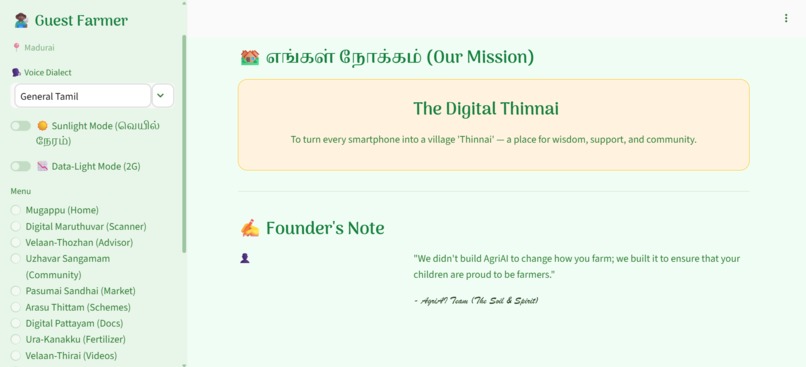
About us page
-
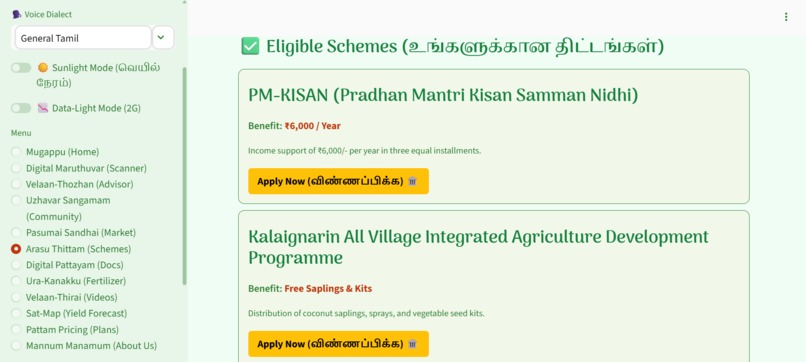
Govt Scheme page
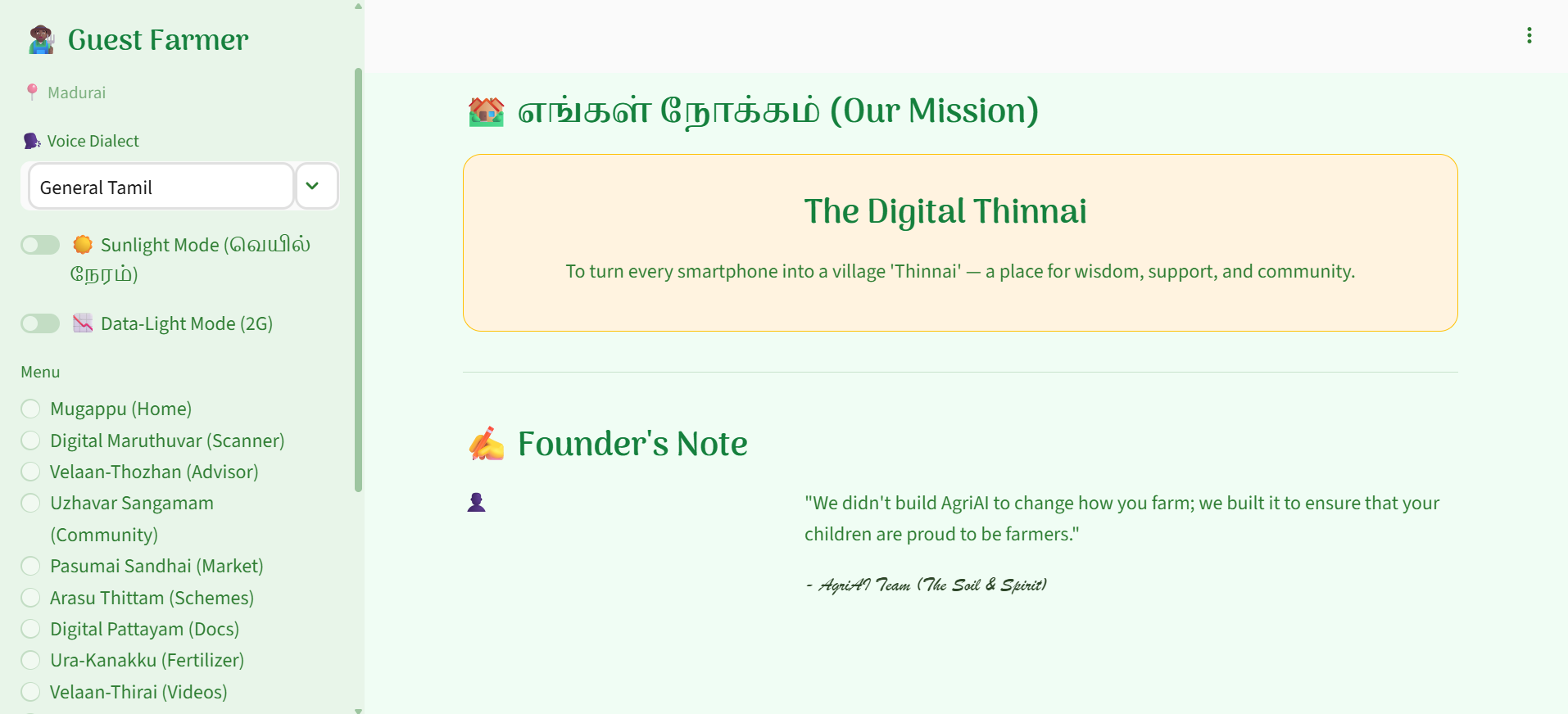
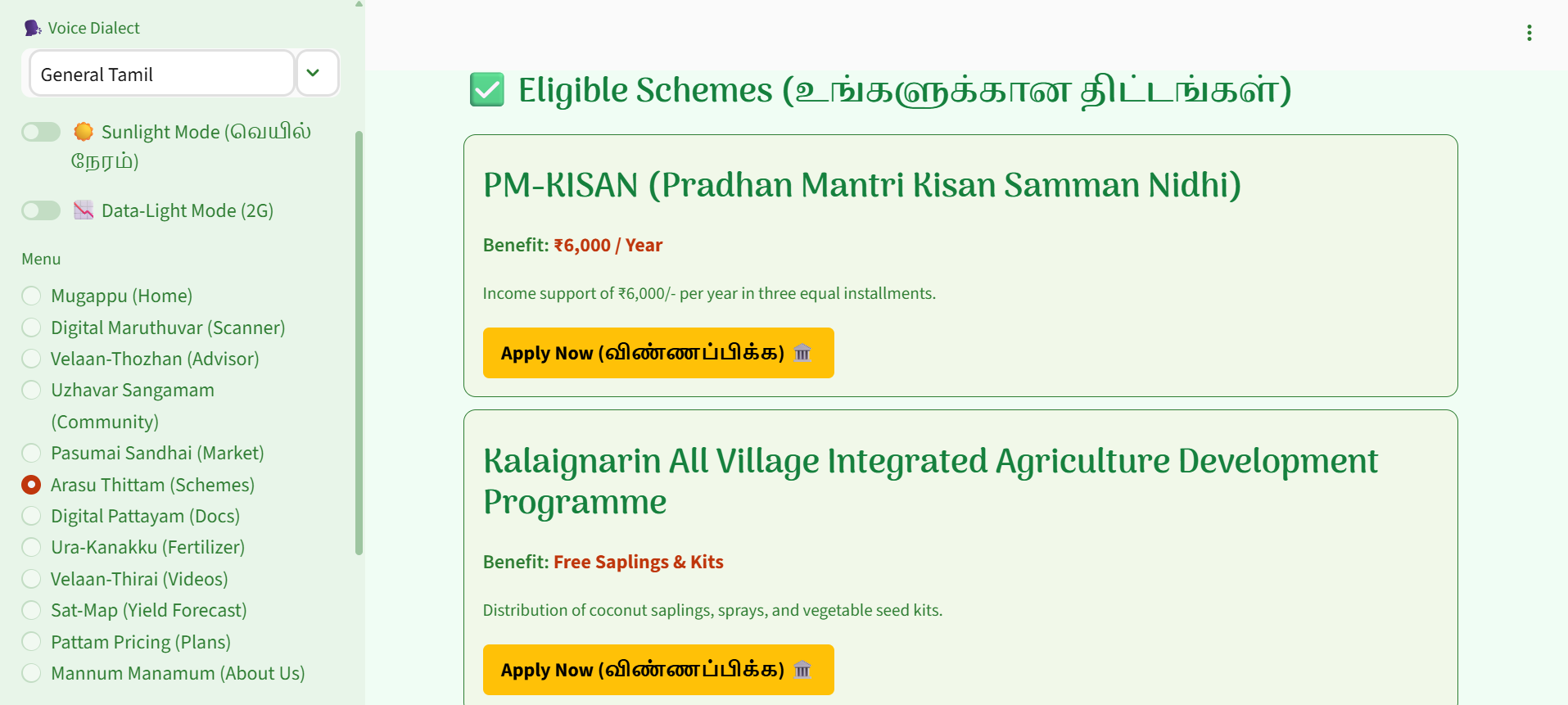
Inspiration
AgriAI was inspired by the unique challenges faced by small-scale farmers in Tamil Nadu. While the world discusses high-tech agriculture, local farmers often struggle with two fundamental issues: exploitation by middlemen who control market data and a lack of immediate access to expert crop diagnostics. Living in a region where farming is the backbone of the economy, we wanted to build a solution that wasn't just "cool tech" but was actually usable in a field—under harsh sunlight and on patchy 2G networks.
What it does
AgriAI is an integrated platform designed to give power back to the farmer through three core pillars:
Digital Maruthuvar (Scanner): An AI-powered diagnostic tool that identifies crop diseases from photos and provides instant treatment advice.
Pasumai Sandhai (Market): A direct-to-farmer marketplace for fertilizers and tools, cutting out exploitative middlemen to reduce costs.
Regional Yield Mapping: A satellite-driven forecasting system that helps farmers and local NGOs plan for the season based on real-time environmental data.
Localized Accessibility: To ensure no farmer is left behind, the platform supports regional Tamil dialects and features a "Sunlight Mode" for ultra-high contrast viewing in the field.
How we built it
We adopted a professional microservices architecture to ensure the platform was robust and scalable:
Frontend: Built with React and Tailwind CSS, focusing on a "Premium" but accessible UI with glassmorphism elements.
Core Backend: A Node.js and Express server manages user authentication, the marketplace, and secure transactions.
AI/ML Brain: A dedicated FastAPI service handles the heavy lifting, including disease classification and satellite data processing.
Data & DevOps: We used PostgreSQL for reliable data storage and containerized the entire ecosystem using Docker, ensuring that the project can be deployed easily in any environment.
Challenges we ran into
The biggest challenge was "Designing for the Field." We realized early on that a standard web app is useless if a farmer can't see the screen in the afternoon sun or if the images won't load on a slow connection. We had to pivot to build a "Data-Light Mode" that prioritizes text over heavy assets and developed a specific CSS theme for high-glare environments. Integrating disparate data sources—from satellite imagery to local market price lists—into a single cohesive dashboard also required significant data pipeline engineering.
Accomplishments that we're proud of
We are incredibly proud of our Localization Engine. Supporting regional Tamil dialects (like Madurai and Kongu) makes the tech feel "human" and trustworthy to the users who need it most. Additionally, achieving a high diagnostic accuracy with our mobile-optimized AI model while keeping the footprint small enough for 2G optimization was a major technical win for our team.
What we learned
This project taught us that empathy is a technical requirement. We learned that building for "real-world problems" means looking beyond the code to the physical environment of the user. We deepened our knowledge of full-stack orchestration, particularly in managing the communication between Node.js and Python-based ML services, and gained hands-on experience in localized UI/UX design.
What's next for AgriAI
Moving forward, we plan to integrate an Agentic Voice Assistant that allows farmers to interact with the platform entirely through voice commands in their native tongue. We also aim to expand our marketplace to include a "Community Lending" feature, allowing farmers to share high-cost machinery, further reducing the financial burden on small-scale landholders.

Log in or sign up for Devpost to join the conversation.