-
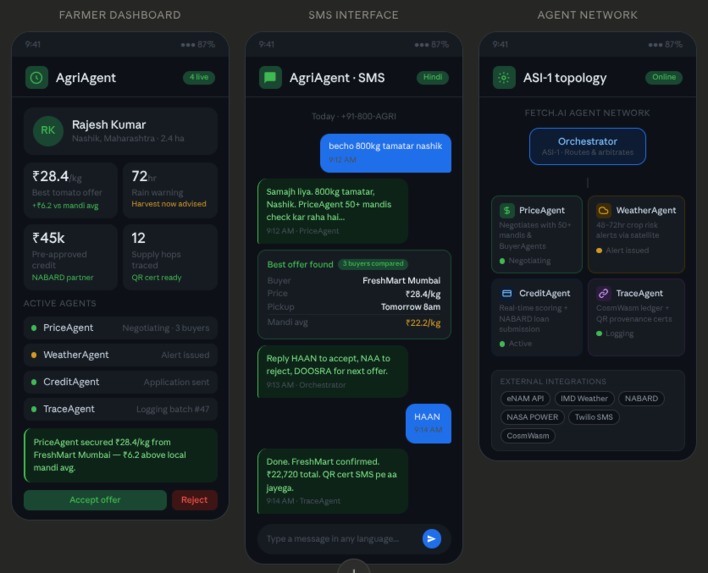
AgriAgent UI — farmer dashboard, SMS negotiation flow, and ASI-1 agent network topology
Inspiration
India has 140 million smallholder farmers who produce over 50% of the nation's food — yet most live near or below the poverty line. The culprit isn't productivity; it's information asymmetry. A farmer sells tomatoes at ₹2/kg while the same tomatoes reach city markets at ₹40/kg. Weather disasters destroy harvests that could have been saved with 48-hour warnings. Formal credit is inaccessible, pushing farmers into 60% interest debt traps.
I wanted to build something that doesn't just inform farmers — but acts for them.
What it does
AgriAgent deploys four specialized autonomous agents powered by ASI-1 that work as a farmer's invisible economic team:
- 🤝 PriceAgent — Scans 50+ mandis in real time and negotiates the best price with registered buyers on the farmer's behalf
- 🌦️ WeatherAgent — Delivers hyperlocal crop-specific alerts 48–72 hours before actionable decisions are needed
- 💰 CreditAgent — Generates a real-time creditworthiness score and automatically submits micro-loan applications to partner lenders
- 🔗 TraceAgent — Records every supply chain handoff and generates a scannable QR provenance certificate for each harvest batch
The entire system is accessible via SMS — no smartphone app required.
How I built it
The architecture is built around ASI-1's multi-agent framework (Fetch.ai uAgents). Each agent is autonomous and communicates peer-to-peer over the Fetch.ai network. The orchestrator agent parses farmer intent from SMS, routes to the appropriate specialist agent, and returns a plain-language response.
ASI-1 was central to the ideation process itself — I used it to validate the agent architecture, stress-test edge cases (what happens when WeatherAgent and CreditAgent give conflicting advice?), design the negotiation protocol, and generate multilingual SMS templates.
Challenges I faced
The hardest design challenge was making the system accessible without internet. The SMS-first approach solves the connectivity problem, but required designing agents that can operate on cached/delayed data and still make reliable recommendations.
Building trust was another challenge — farmers are skeptical of automated systems that affect their livelihoods. The solution: every agent action is explained in plain language, and human override is always one SMS away.
What I learned
Working with ASI-1 taught me that the real power of autonomous agents isn't just automation — it's economic representation. A farmer with an ASI-1 agent negotiating on their behalf has the same market intelligence as a large agricultural corporation. That's a fundamental shift in power dynamics.
What's next
- Satellite field monitoring via computer vision agents
- Cross-border expansion to Bangladesh, Nigeria, Kenya
- Carbon credit marketplace for regenerative farming practices
- Virtual cooperative formation for bulk negotiation leverage ```
Built With
- asi-1
- fastapi
- fetch.ai
- postgresql
- python
- react
- redis
- rest
- twilio

Log in or sign up for Devpost to join the conversation.