-
-
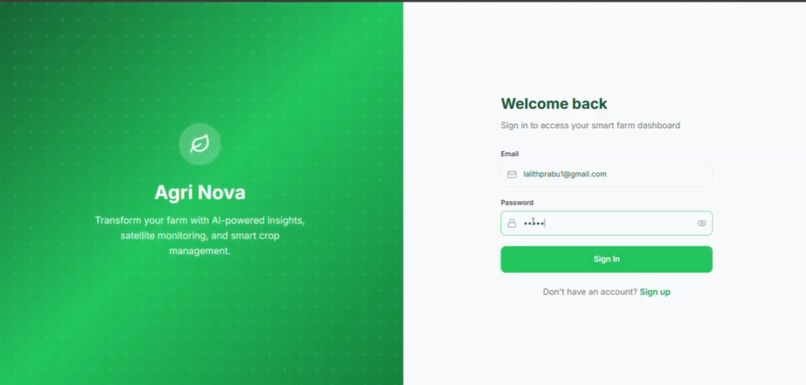
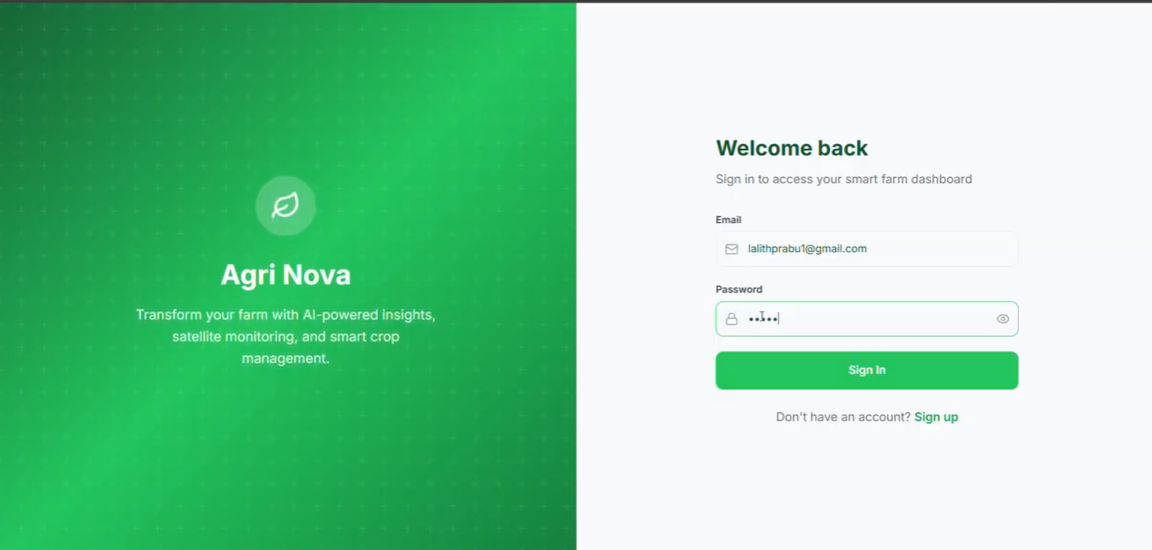
Login page to provide authorised and personalised farming experience by providing user specific data
-
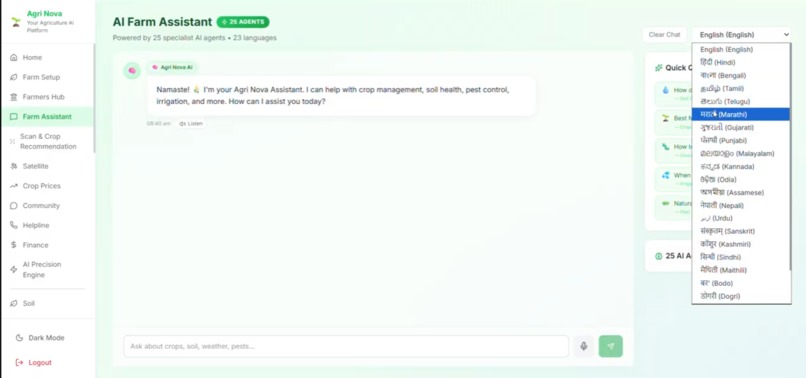
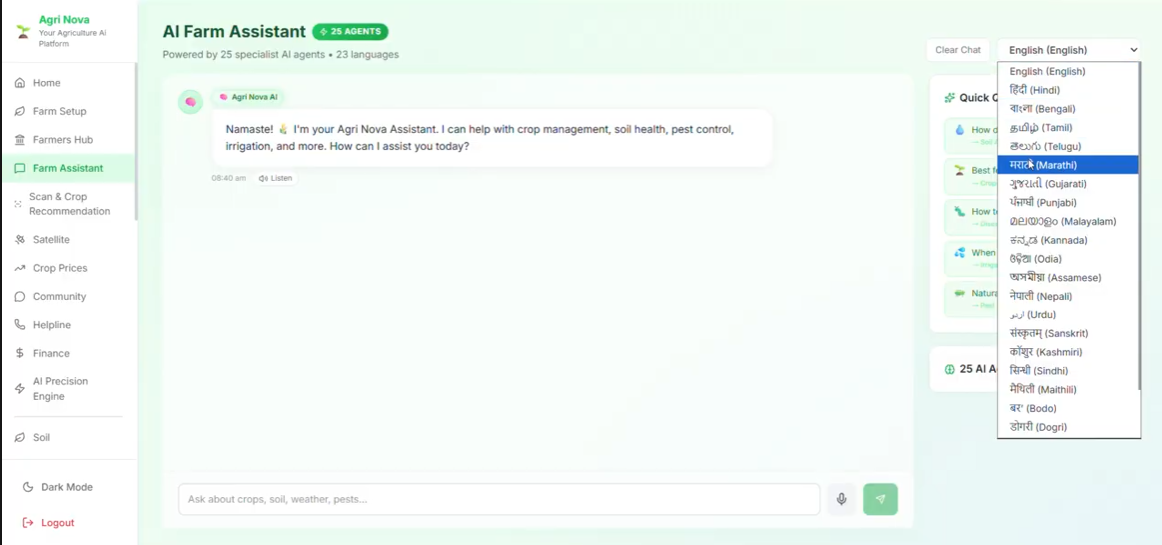
Multi lingual AI farm assistant - About 22 Indian languages with voice input support
-
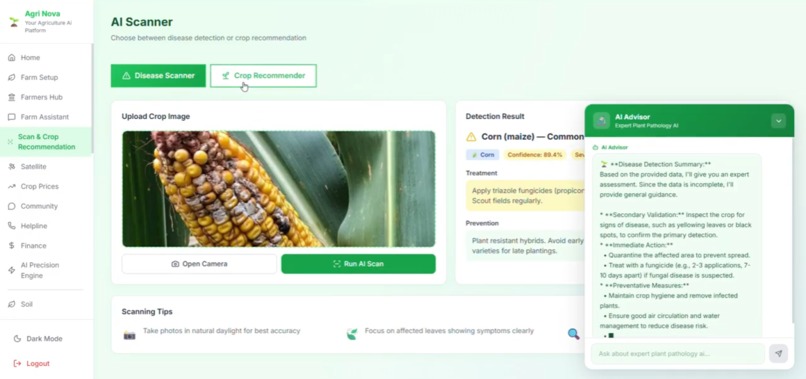
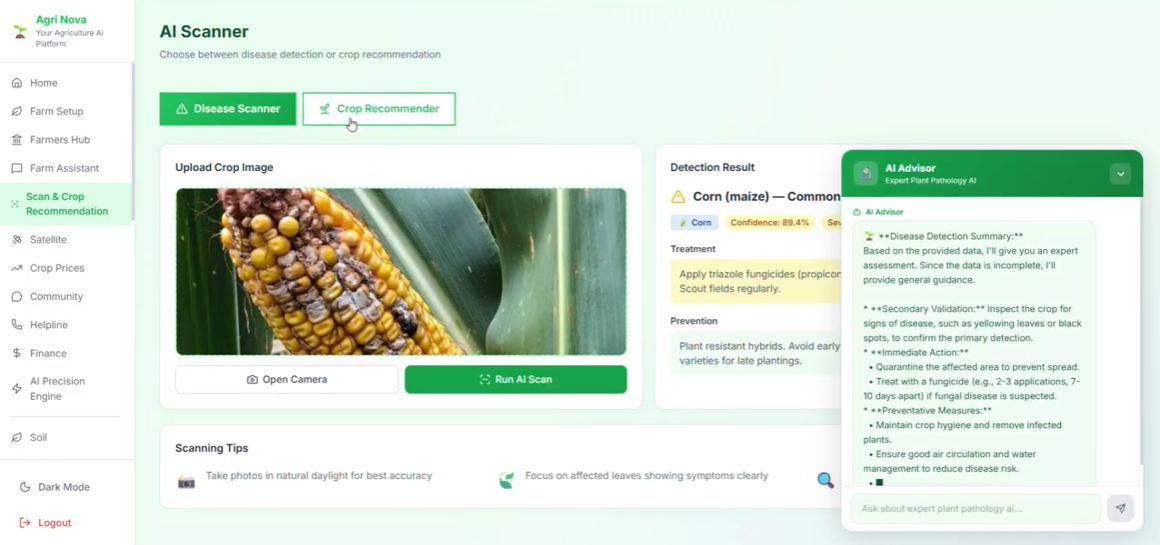
Crop disease detection with the help of live capturing of the image
Inspiration
India is home to over 600 million farmers, yet most still make critical decisions — what to plant, when to irrigate, how to fight a pest outbreak — based on guesswork or advice that arrives too late to matter. We kept coming back to the same story: a farmer loses an entire season's crop to a disease that could have been caught in its first week, or sells produce at a rock-bottom price simply because they didn't know the market rate three villages over.
What struck us most was how fragmented the existing solutions were. There are separate apps for weather, separate apps for market prices, government portals for subsidy schemes — and none of them talk to each other, and almost none of them speak the farmer's language. We wanted to build something different: not another single-purpose app, but one intelligent ecosystem that brings every piece of agricultural expertise a farmer needs into one place, in their own language, through whatever device they already have.
What it does
AgriNova is an AI-powered smart agriculture ecosystem built around 25 specialized AI agents working together under a meta-intelligence orchestration layer (Orchestrator, Reasoning, Memory, Validator, and Optimizer agents). Each domain-specialist agent — Crop Advisor, Disease Diagnostician, Soil Scientist, Weather Advisor, Market Analyst, Pest & IPM, Irrigation Engineer, and 17 more — focuses on one piece of the farming puzzle, and the orchestration layer combines their outputs into a single, coherent, explainable recommendation.
On top of this intelligence layer sits:
- 🗣️ A multilingual voice assistant supporting all 22 official Indian languages, so literacy or English proficiency is never a barrier
- 📷 AI-powered crop disease detection using computer vision
- 🛰️ Satellite-based farm monitoring (NDVI/EVI/LST imagery)
- 🌦️ Real-time weather forecasting and alerts
- 📈 AI-driven yield prediction and soil health analysis
- 💰 Live market price tracking
- 🗺️ Interactive farm mapping
- 🏦 Farm finance advice and government scheme recommendations
- 👨🌾 A Farmers Hub community forum and a dedicated helpline
Everything is delivered through whatever channel a farmer already uses — web, mobile app, voice, or offline SMS — so the technology adapts to the farmer, not the other way around.
How we built it
We started by mapping the actual decision points in a farmer's season: what to plant, how to protect it, when to water it, when to sell it. That map became our data pipeline.
Data layer: We designed ingestion pipelines that pull from satellite imagery, IoT sensor data (soil moisture, pH, temperature), real-time weather feeds, market data, historical crop records, and GIS/land-use maps. This raw data passes through validation, fusion, and feature-engineering stages before landing in a unified Agriculture Data Lake (MongoDB for structured data, dedicated storage for imagery and documents).
Intelligence layer: Rather than building one monolithic model, we split responsibilities across 25 purpose-built agents, each an expert in a narrow domain — much like how a real agricultural extension office has separate specialists for soil, pests, and irrigation. A Meta-Intelligence layer (Orchestrator, Reasoning, Memory, Validator, Optimizer) coordinates these agents, resolves conflicting recommendations, and keeps every output explainable — a farmer should always be able to see why the system is telling them to do something.
For yield prediction, we combine soil, weather, and historical crop features into a weighted model, where the predicted yield $$\hat{Y}$$ for a given plot is estimated as:
$$ \hat{Y} = \beta_0 + \sum_{i=1}^{n} \beta_i X_i + \epsilon $$
where each \( X_i \) represents a feature such as soil moisture, NDVI index, or rainfall, \( \beta_i \) its learned weight, and \( \epsilon \) the residual error term refined continuously as new farm data arrives.
Application layer: We built a Next.js/React web app, native mobile clients, a voice pipeline covering 22 languages, and an offline-friendly SMS advisory channel for low-connectivity areas, all sitting behind a common API gateway with authentication, monitoring, and alerting built in from day one.
We treated the whole system as cloud-native and API-first from the start, so it could scale from a single pilot farm to district-, state-, and national-level deployment without a rewrite.
# Simplified orchestration logic — one agent, one responsibility
class OrchestratorAgent
  def resolve(recommendations)
    validated = ValidatorAgent.check(recommendations)
    ReasoningAgent.reconcile(validated)
  end
end
Challenges we ran into
- Coordinating 25 agents without chaos. The hardest engineering problem wasn't building any single agent — it was making sure their recommendations didn't contradict each other. A Pest agent suggesting one treatment and a Soil agent flagging fertilizer sensitivity to that same treatment is exactly the kind of conflict a farmer can't be left to resolve alone. Our Validator and Reasoning agents exist specifically to catch and reconcile this.
- 22 languages is not "translate the UI." True multilingual support meant handling regional dialects, agricultural terminology that doesn't translate literally, and voice input in noisy outdoor environments — not just running English strings through a translator.
- Designing for low connectivity and low digital literacy. A large share of our target users may not have reliable data access or smartphone fluency. Building a genuinely useful SMS/offline fallback, without stripping away the intelligence behind it, took real design discipline.
- Keeping AI explainable. It's easy to build a black box that says "plant this." It's much harder to build a system that says "plant this, because soil moisture is 12% below optimal and the 10-day forecast shows no rain" — but that explainability is what actually earns a farmer's trust.
Accomplishments that we're proud of
- Designed and coordinated a 25-agent AI ecosystem with a working meta-intelligence orchestration layer that resolves conflicting recommendations rather than just stacking outputs.
- Built genuine 22-language voice accessibility, not just interface translation — making the platform usable by farmers regardless of literacy or English proficiency.
- Architected a system that is cloud-native, modular, and API-first from day one, so it can scale from a single farm to a national deployment without re-engineering.
- Kept explainability at the core of every recommendation, so the platform earns trust instead of asking for blind faith.
- Brought together satellite imagery, IoT, weather, market, and government data into a single unified data lake feeding one coherent decision-making layer.
What we learned
We learned that the hardest part of "AI for social good" isn't the AI — it's the access. A brilliant disease-detection model is useless to a farmer who can't reach it in their language, on their device, with their internet connection. Designing AgriNova pushed us to think as much about multilingual voice pipelines and SMS fallbacks as we did about model accuracy.
We also learned a lot about multi-agent system design: how to give each agent a narrow, well-defined responsibility, how to structure communication between agents so the system stays debuggable, and why a dedicated orchestration and validation layer isn't optional once you pass a handful of agents — it's the difference between a coordinated team and 25 experts shouting over each other.
What's next for AgriNova
We want to pilot AgriNova with a small group of real farmers to validate our recommendations against actual field outcomes, expand our agent network to cover more region-specific crops and livestock practices, and deepen our integration with official government scheme databases so subsidy recommendations stay current automatically. Long-term, we see AgriNova as infrastructure — a data and intelligence layer that AgriTech startups, insurers, and supply-chain partners can build on top of, not just an app farmers use directly.
Built With
- android
- anthropic-api
- computer-vision
- deep-learning
- ios
- javascript
- llm
- machine-learning
- natural-language-processing
- next.js
- python
- react
- rest-api
- scikit-learn
- speech-to-text
- tensorflow
- text-to-speech
- typescript
- web-speech-api

Log in or sign up for Devpost to join the conversation.