-
-
Pitch Deck Slide 1
-
Pitch Deck Slide 2
-
Pitch Deck Slide 3
-
Pitch Deck Slide 4
-
Pitch Deck Slide 5
-
Pitch Deck Slide 6
-
Pitch Deck Slide 7
-
Pitch Deck Slide 8
-
Pitch Deck Slide 9
-
Pitch Deck Slide 10
-
Pitch Deck Slide 11
-
Pitch Deck Slide 12
-
Pitch Deck Slide 13
-
Pitch Deck Slide 14
-
Pitch Deck Slide 15
-
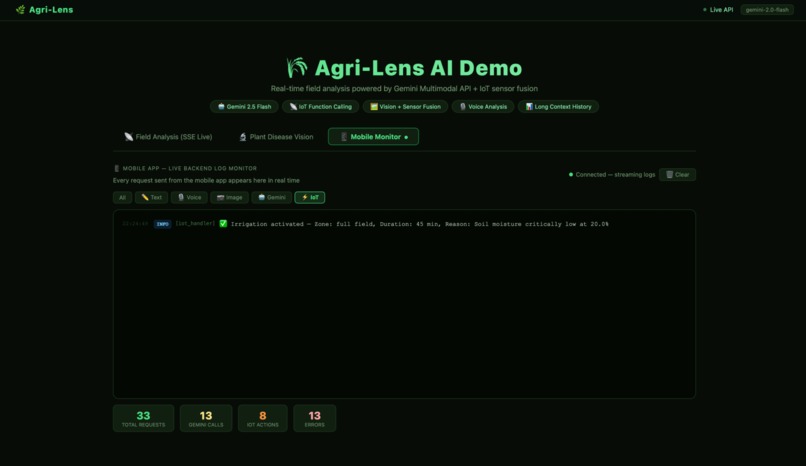
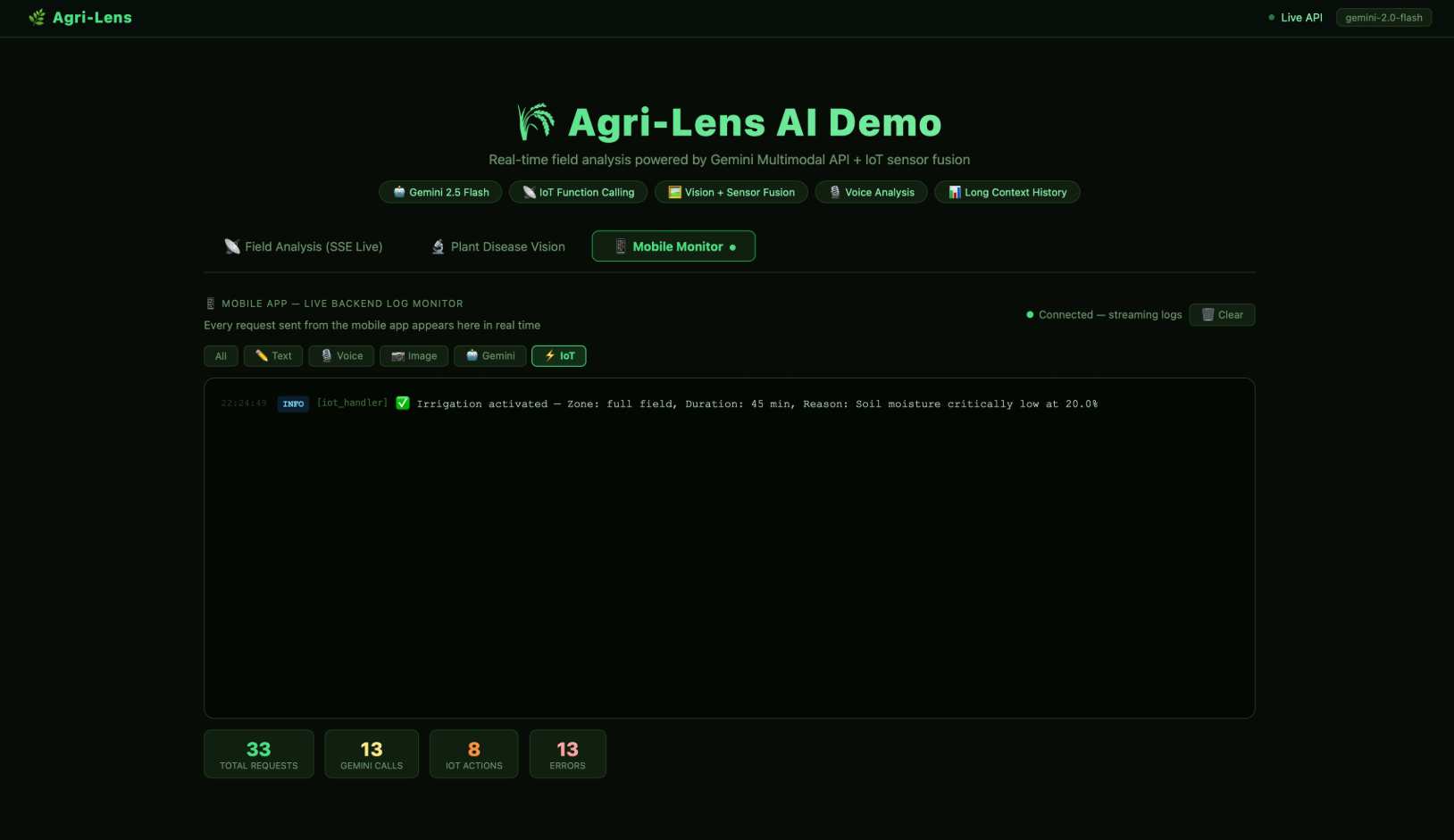
Live Backend Log Monitor
-
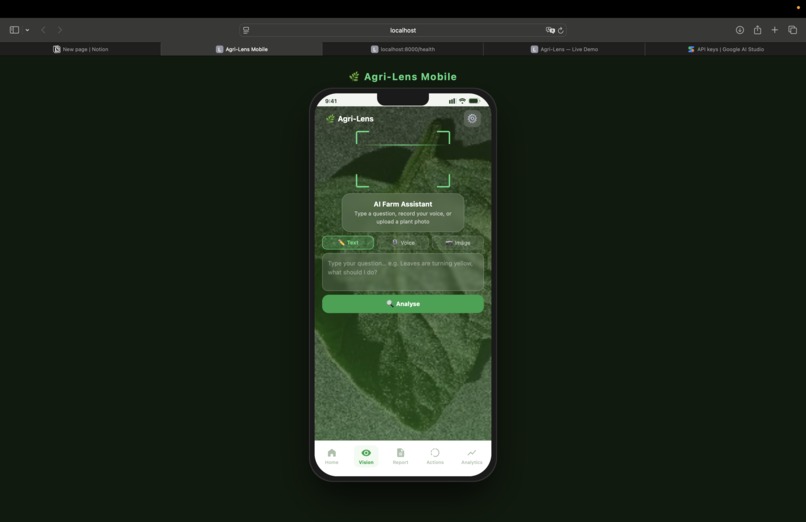
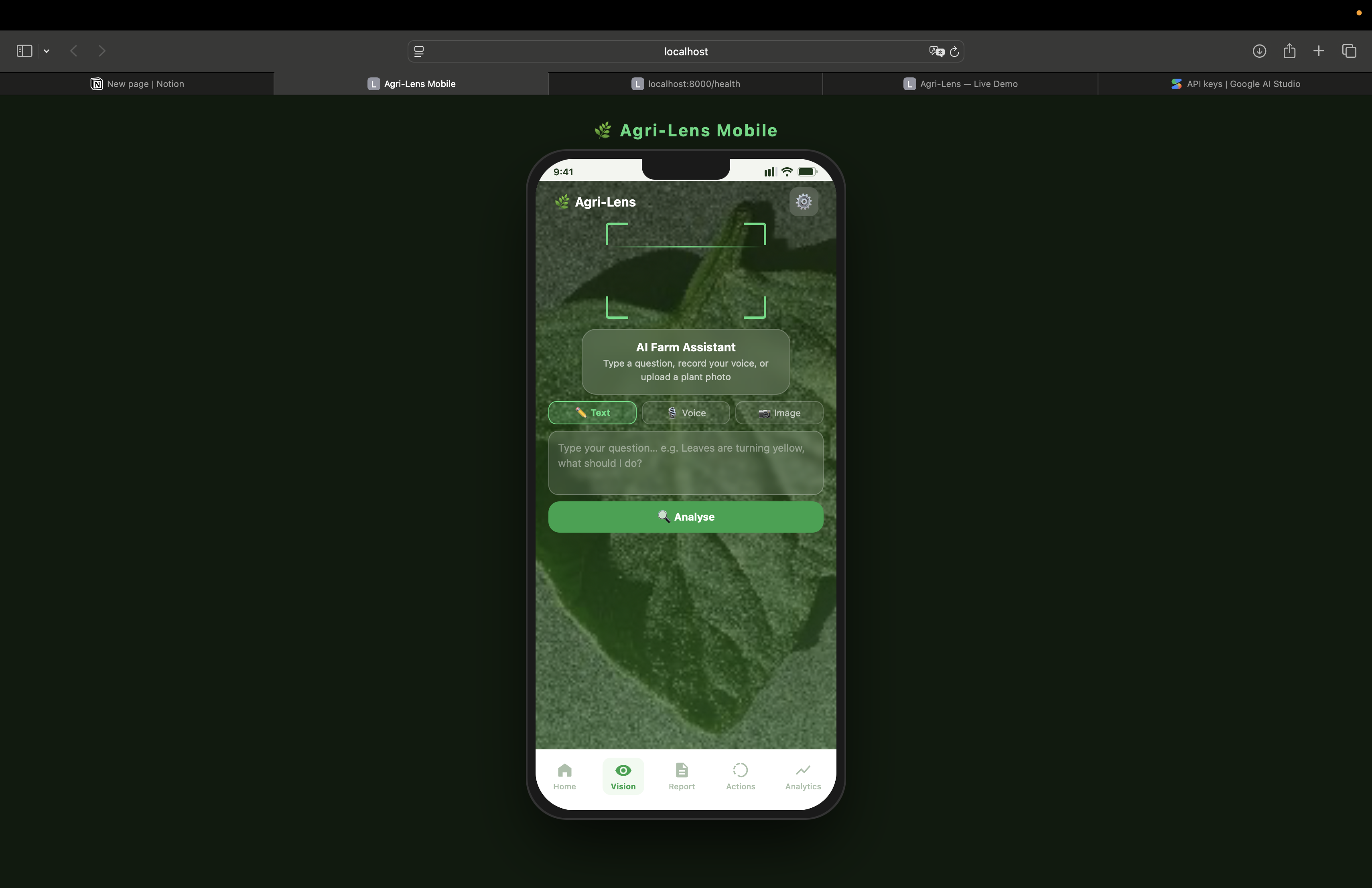
screen where video, audio, or image inputs are received
-
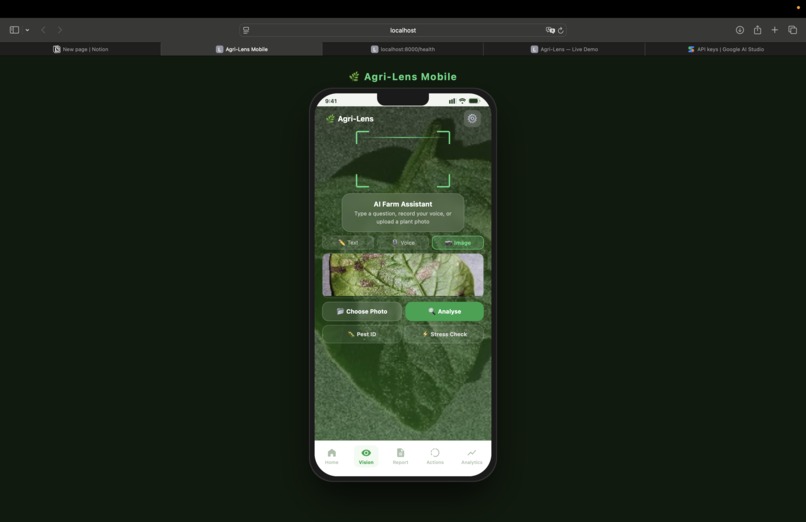
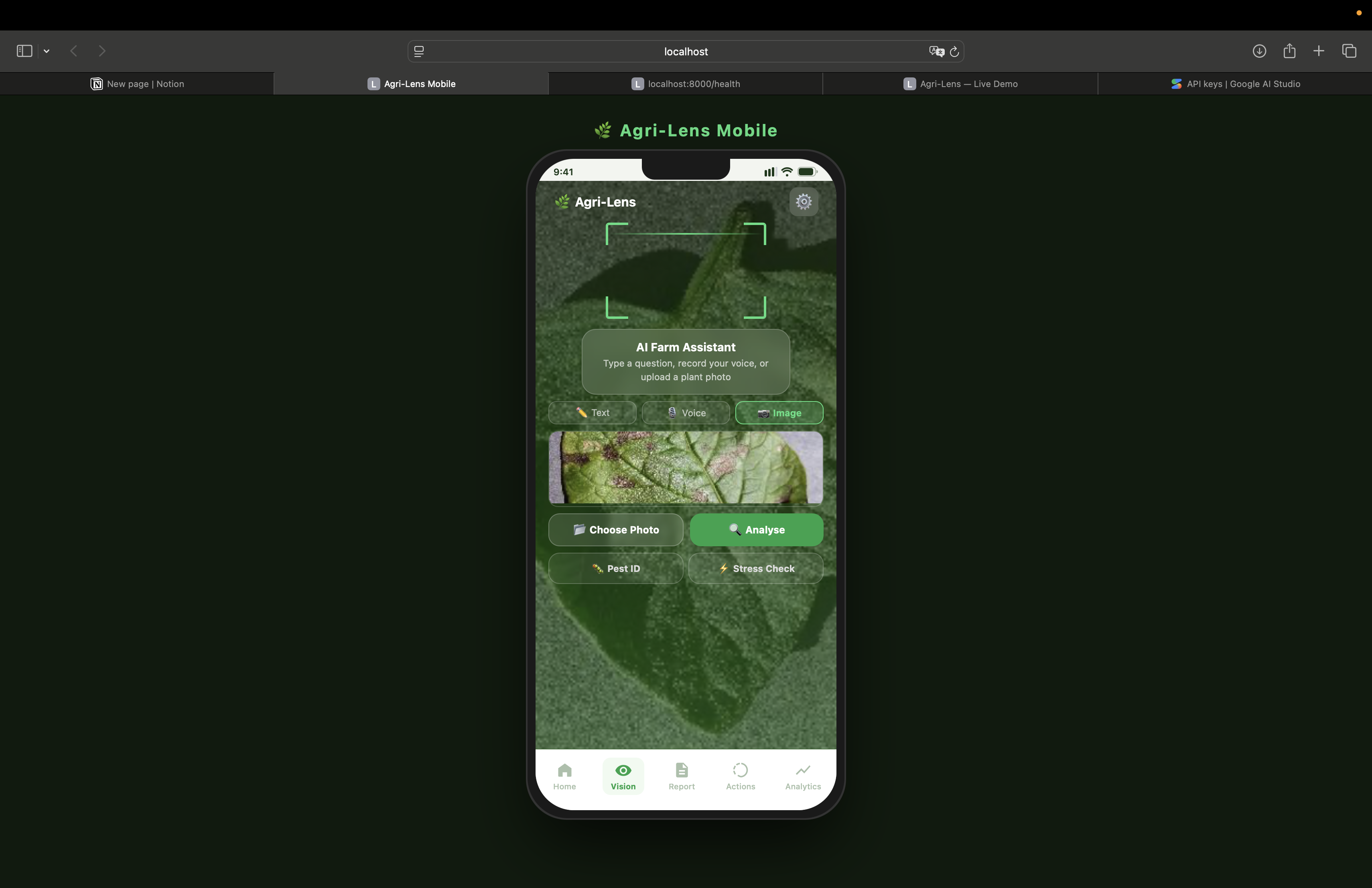
uploaded leaf picture
-
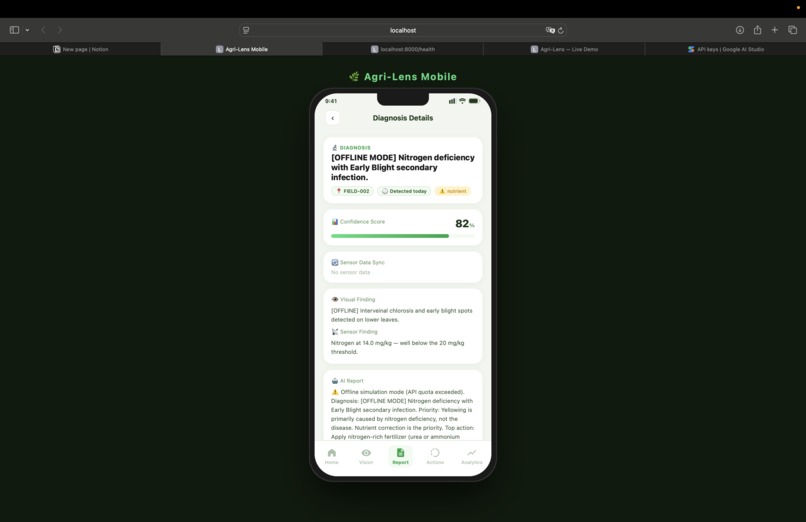
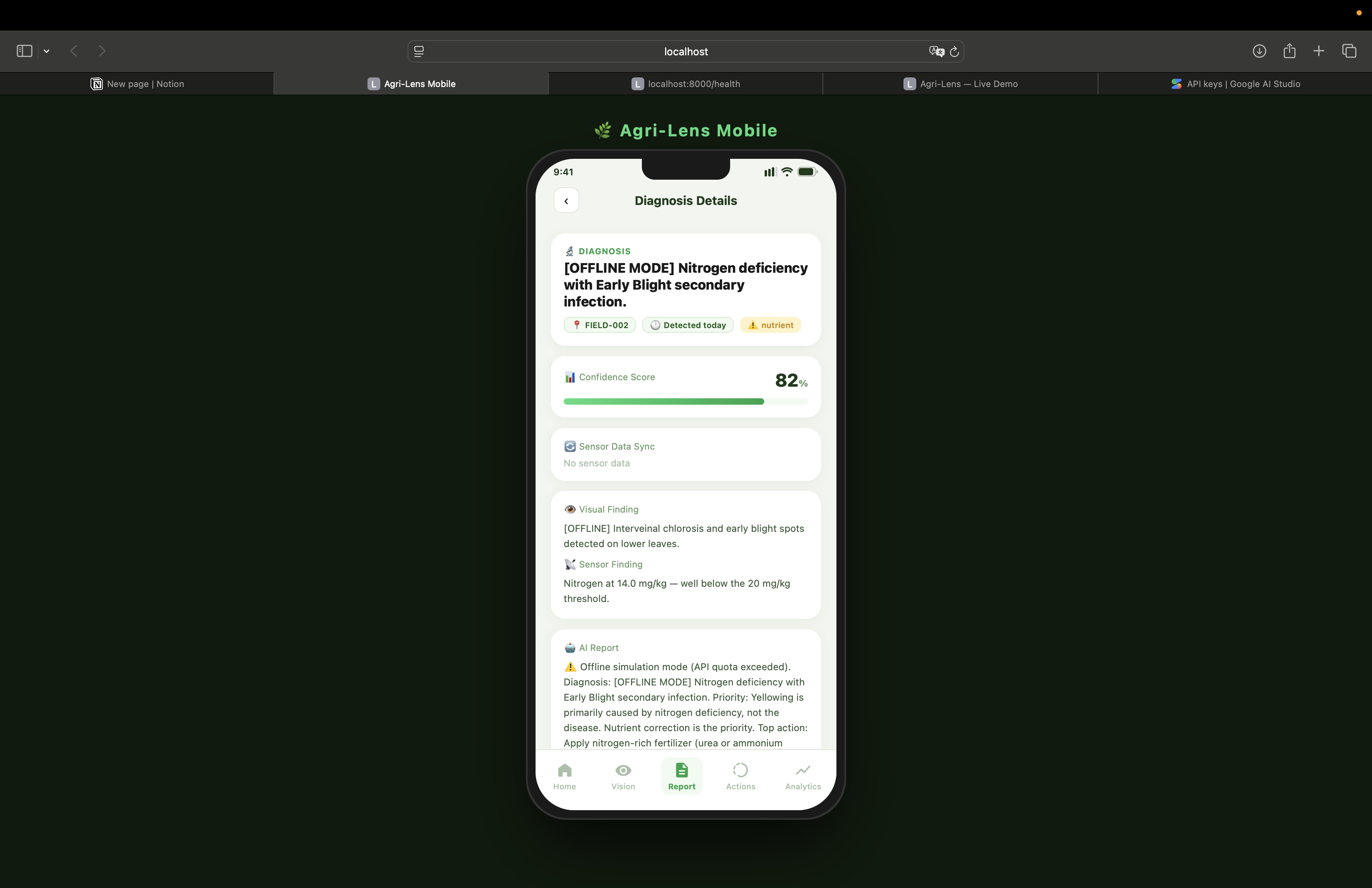
Gemini's cross-query diagnosis with confidence score, visual finding, and sensor data in one unified report.
-
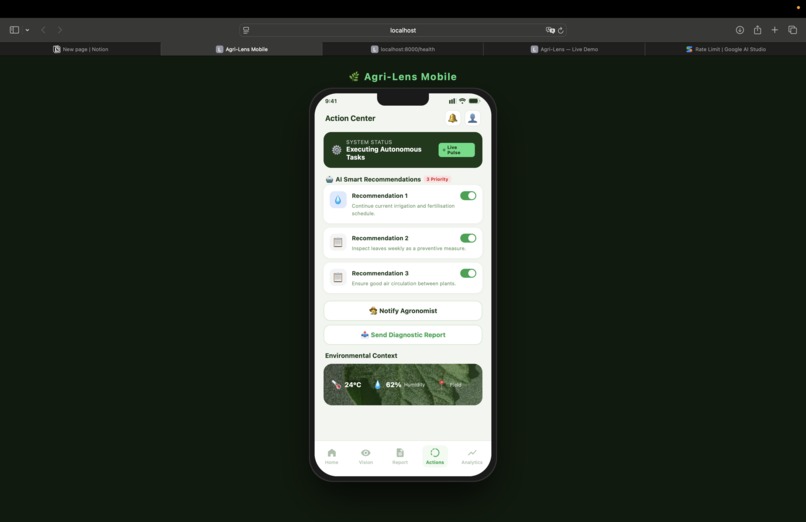
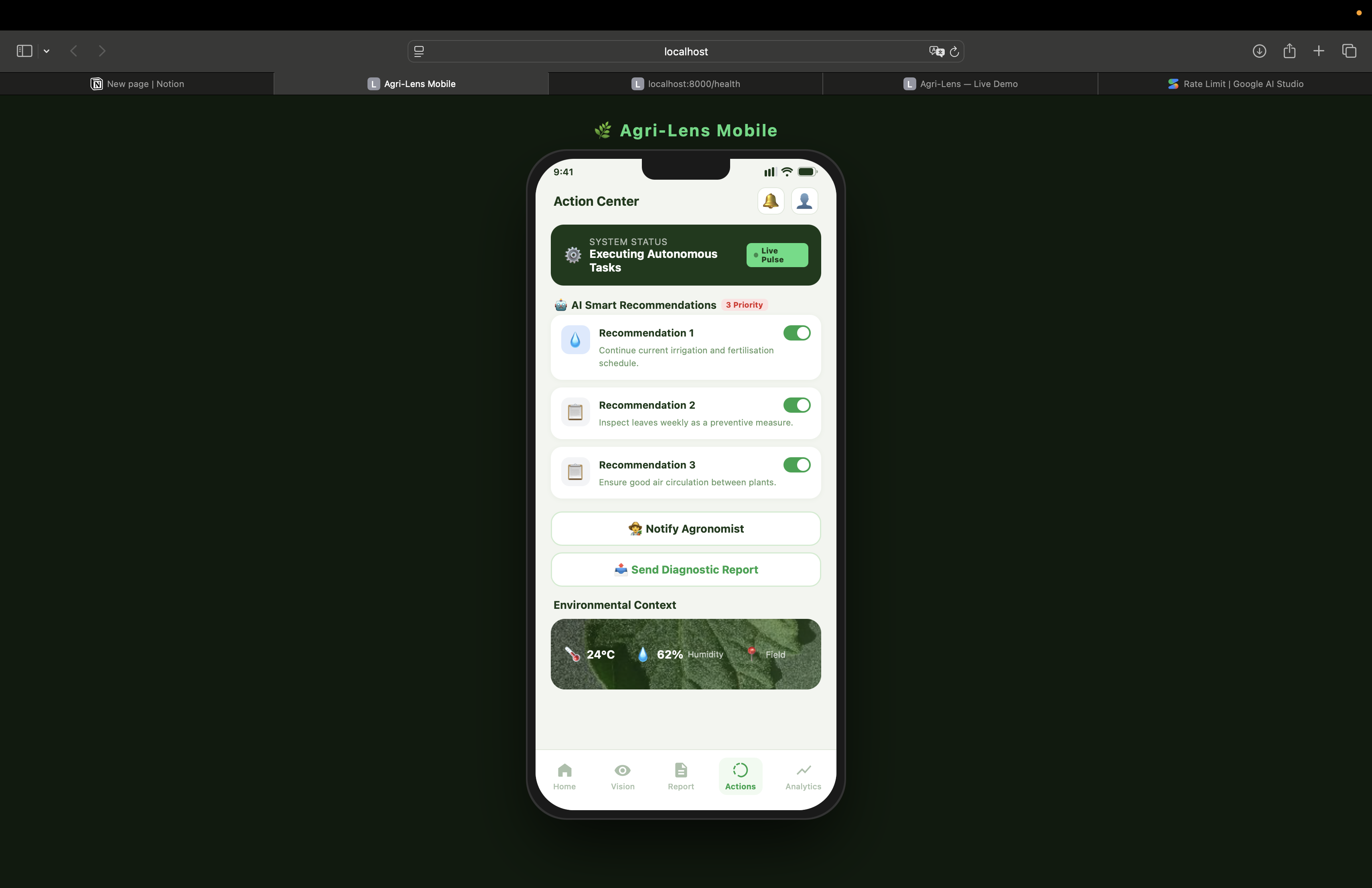
AI recommendations with one-tap IoT controls, agronomist notification, and live environmental sensor context.
🌱 Inspiration
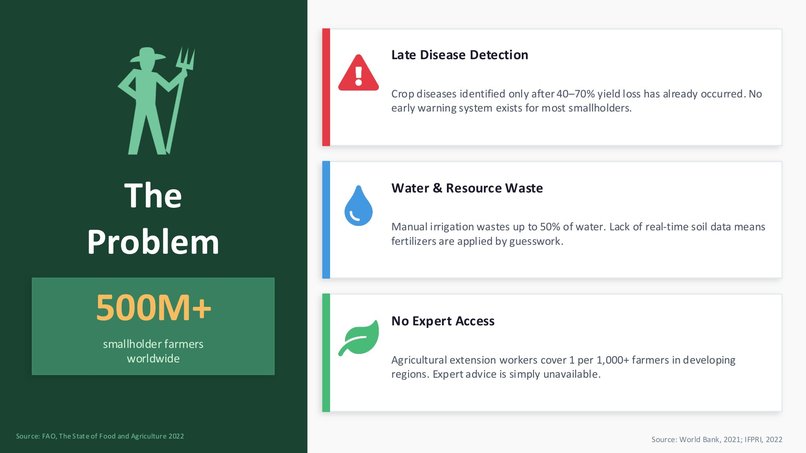
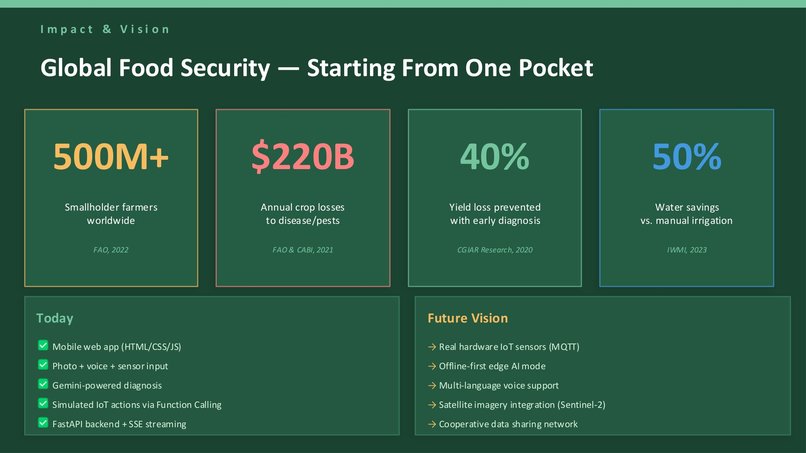
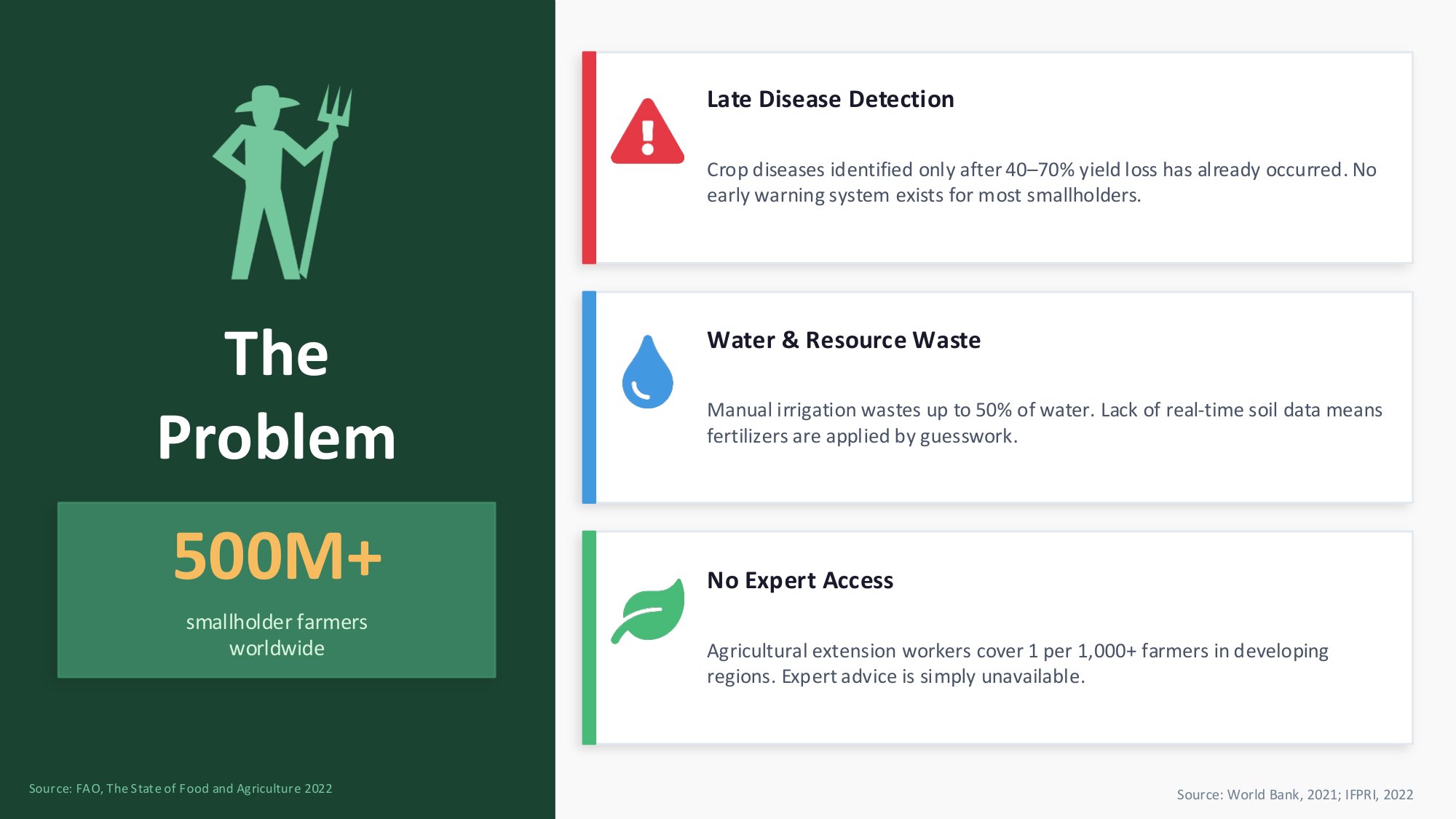
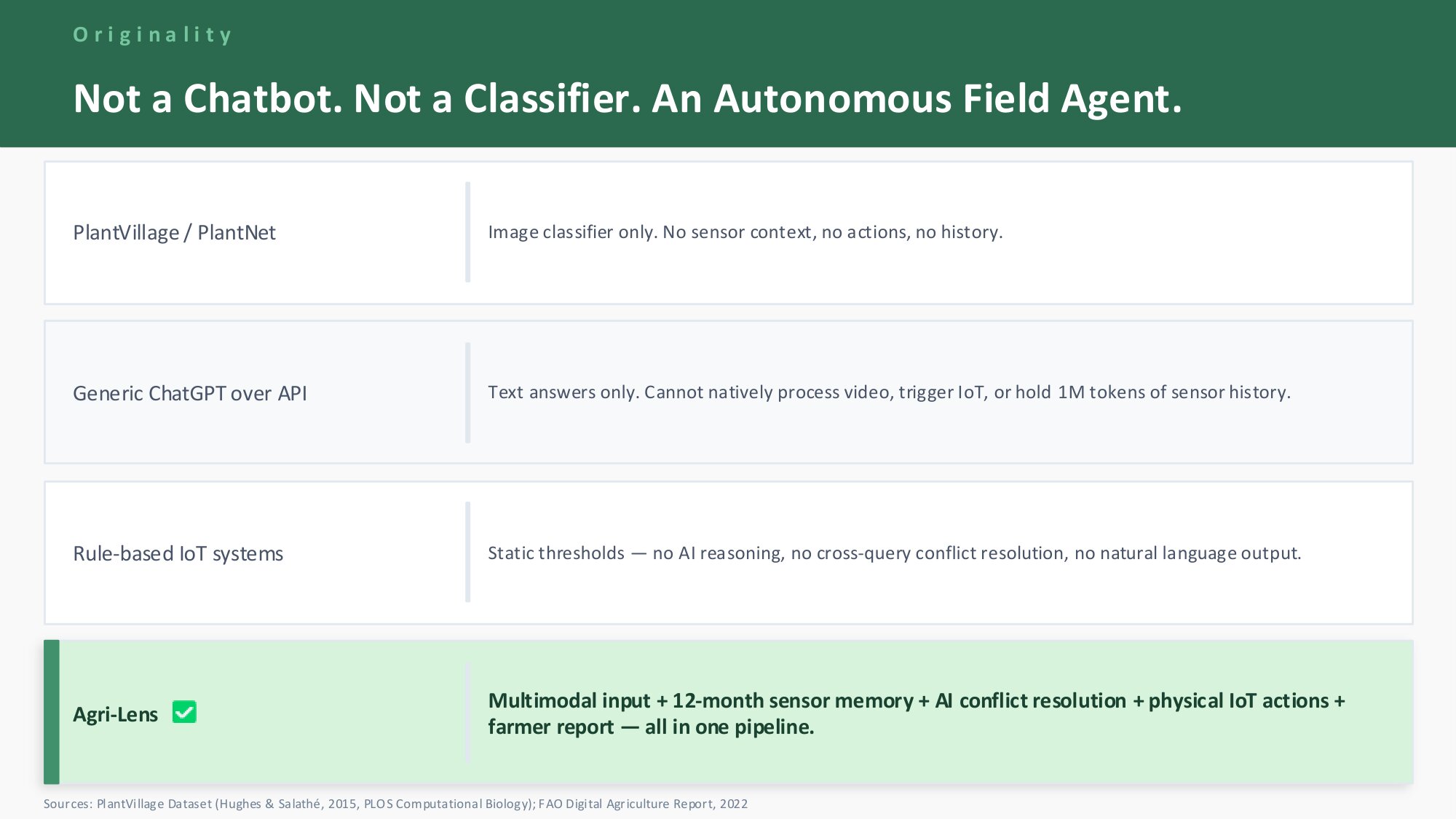
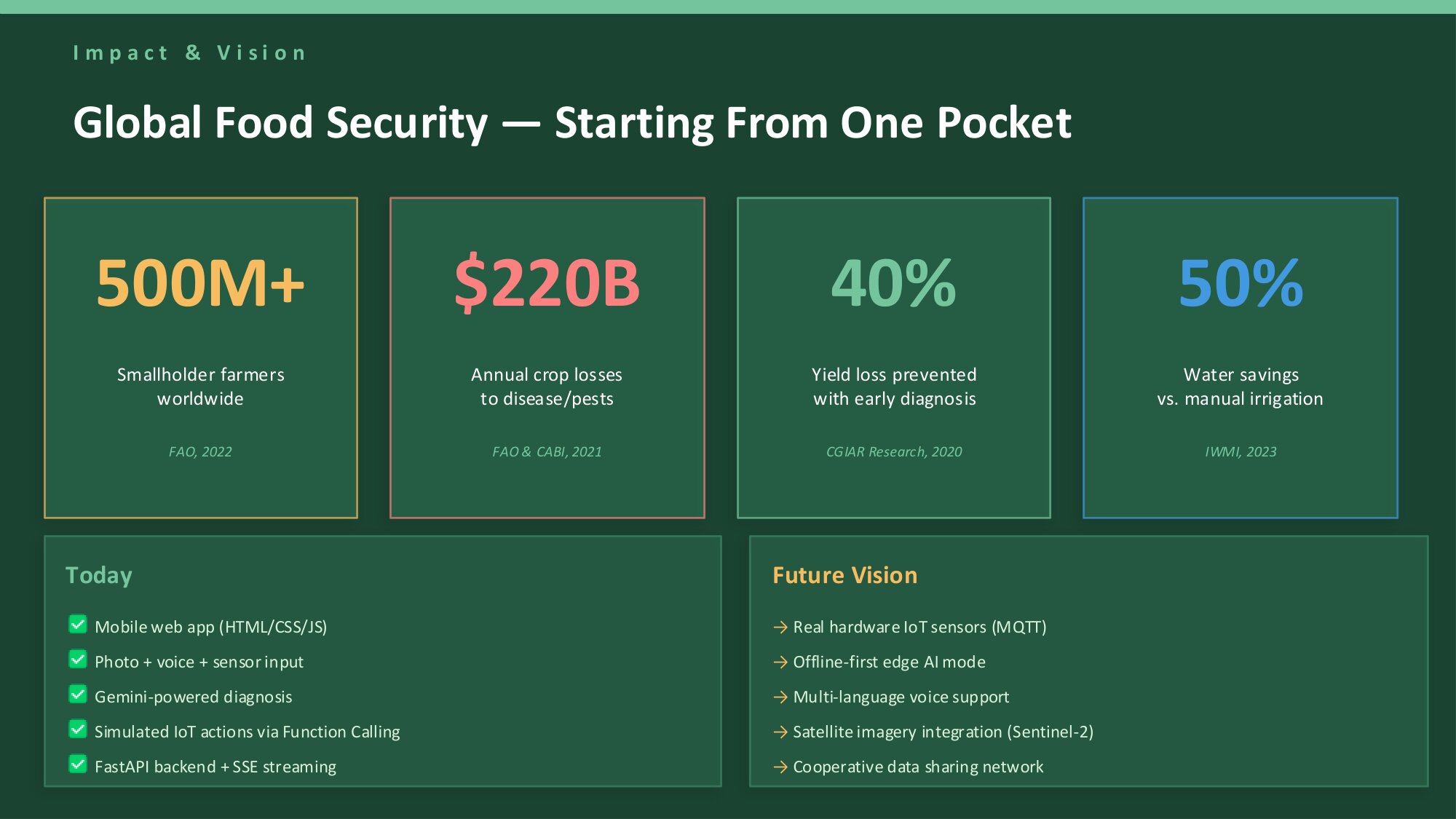
500 million smallholder farmers worldwide have no access to agronomists. Crop diseases are typically identified only after 40–70% of yield is already lost. Manual irrigation wastes up to 50% of water. We asked: what if every farmer had a PhD-level agronomist in their pocket — one that could see, listen, remember a full year of field history, and act autonomously?
🤖 What it does
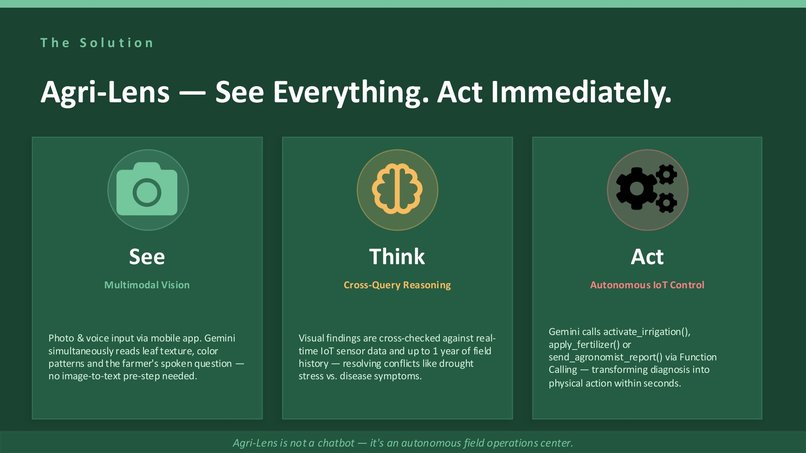
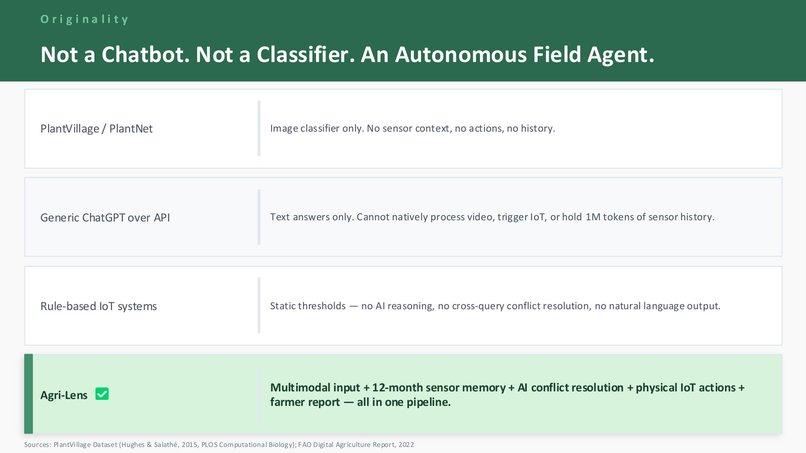
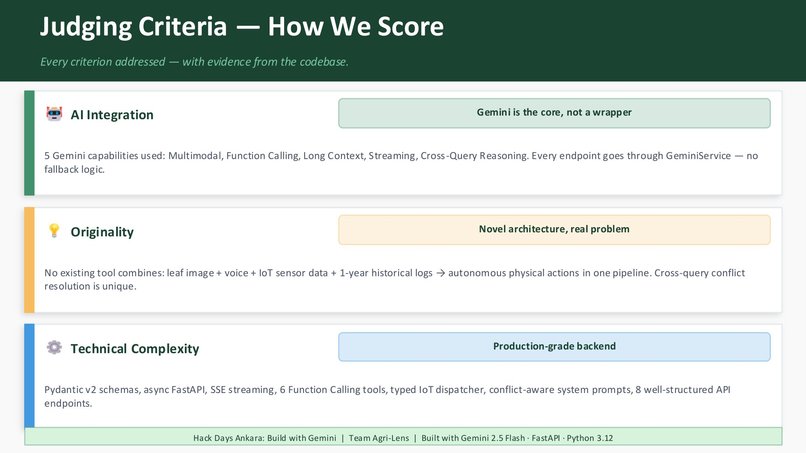
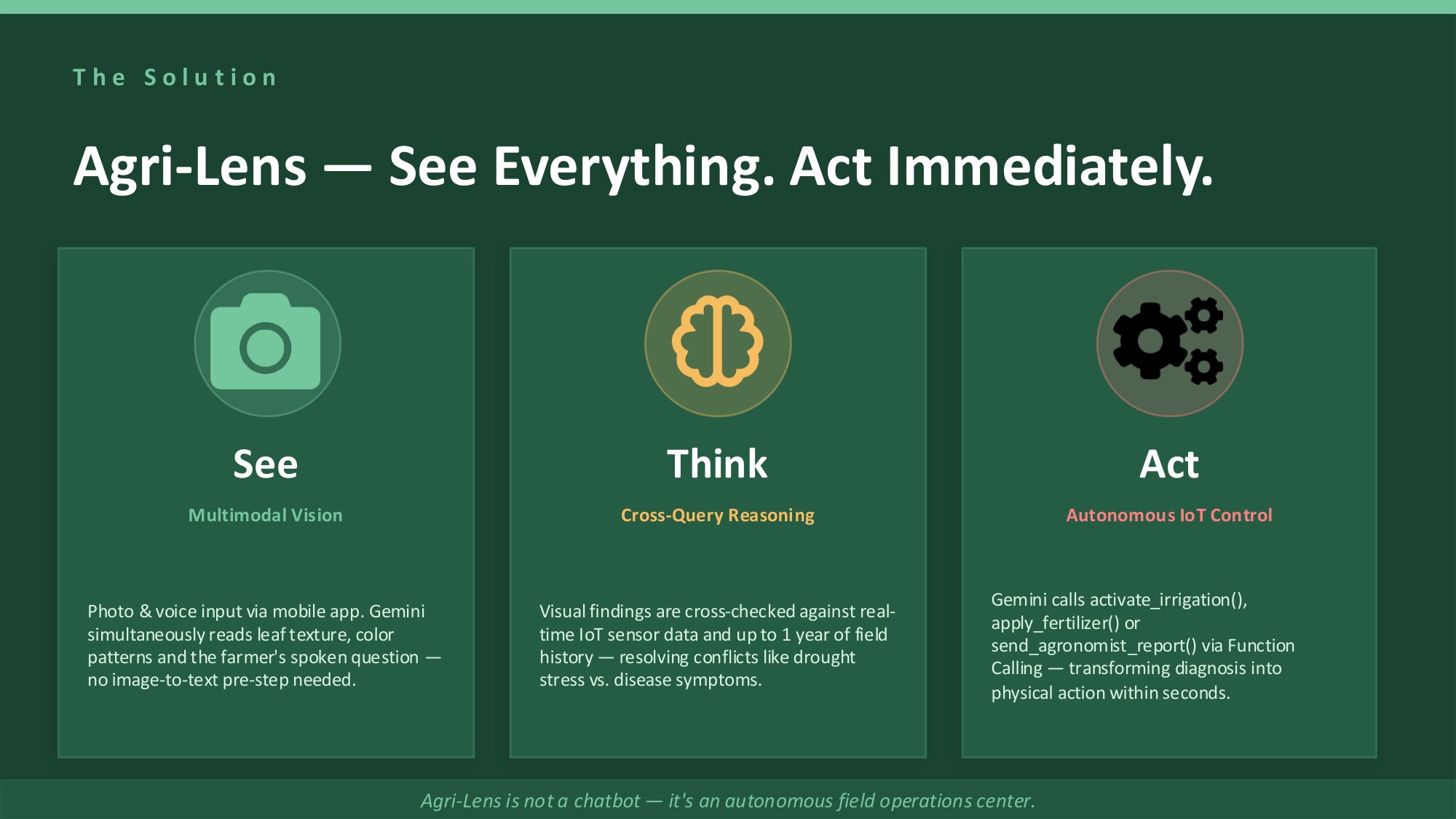
Agri-Lens is a multimodal AI field agent powered by the Gemini API.
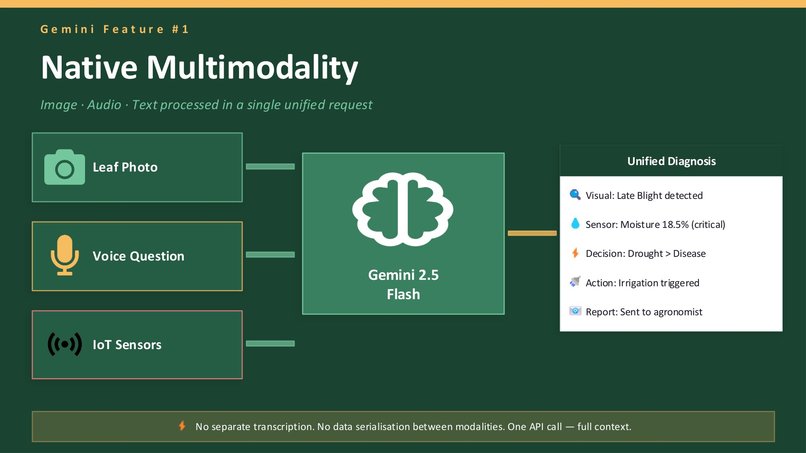
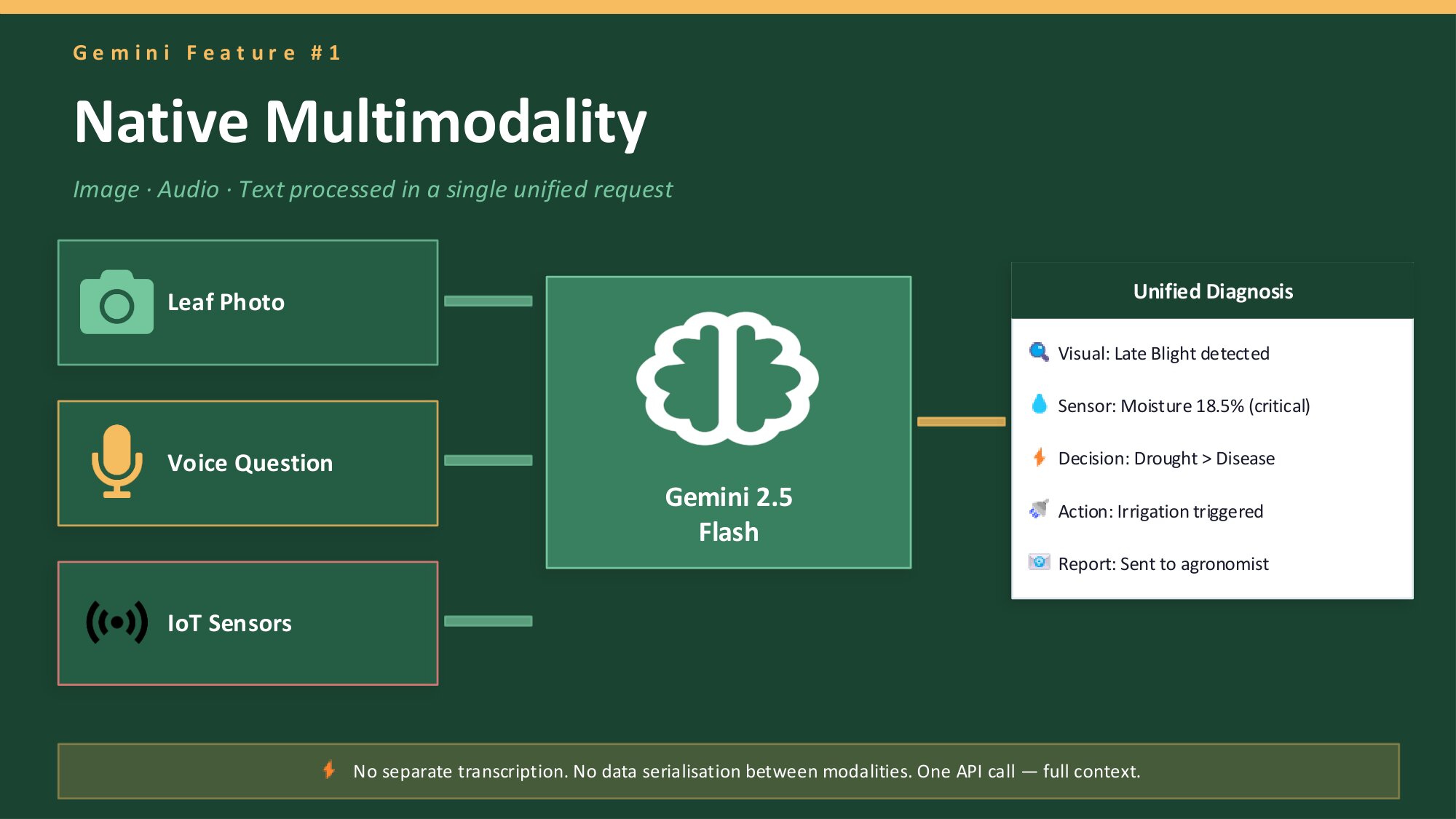
- Sees — the farmer takes a photo of a diseased leaf or records a voice question; Gemini processes both simultaneously in a single API call
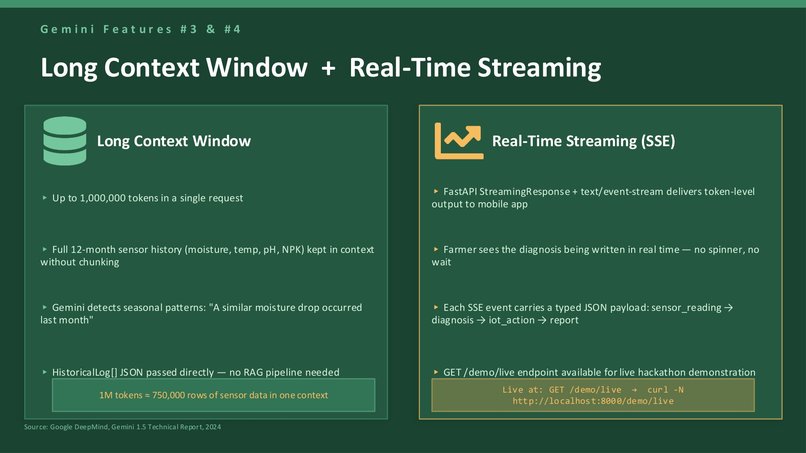
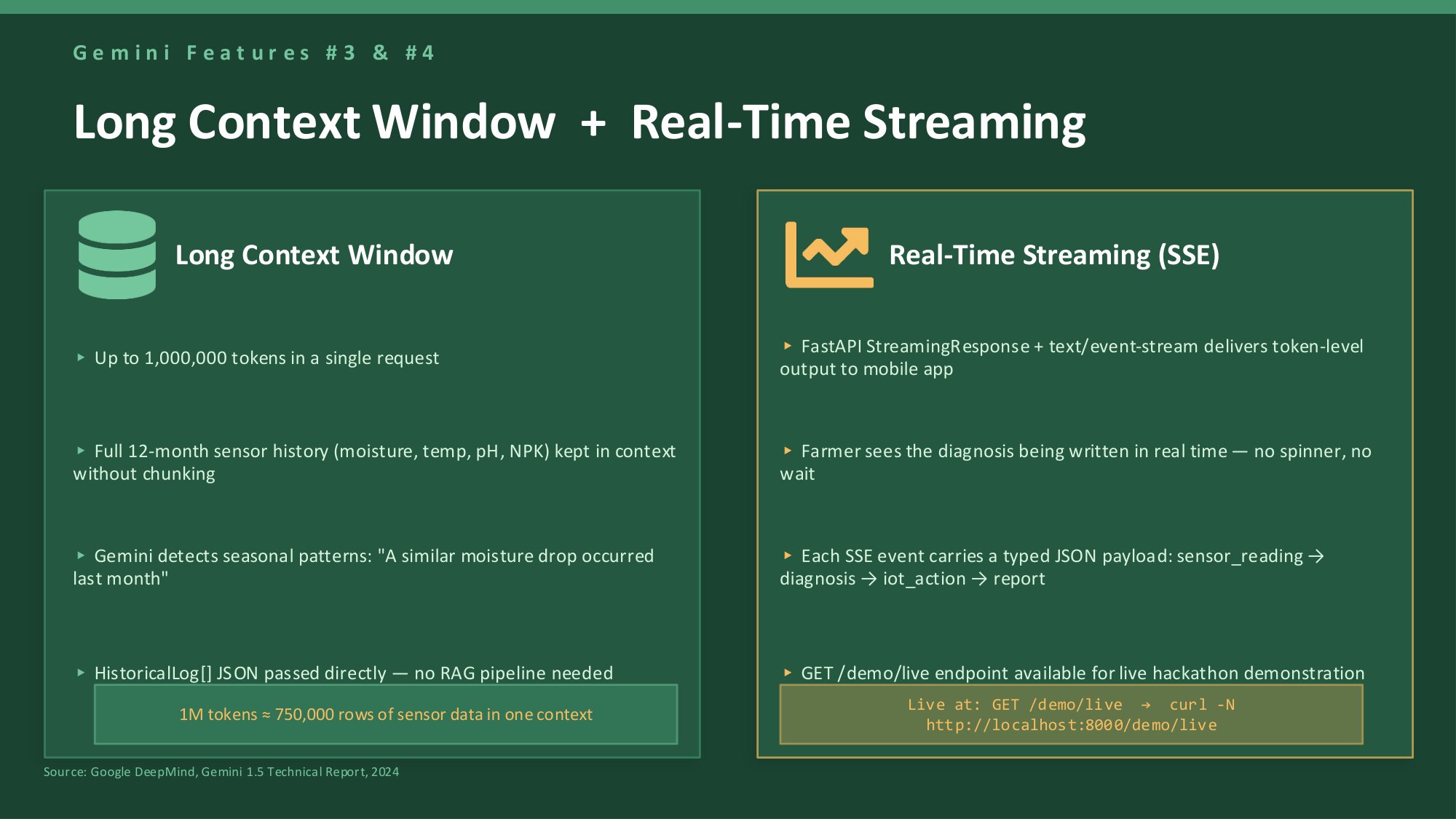
- Thinks — visual findings are cross-checked against real-time IoT sensor data (soil moisture, temperature, pH, NPK) and up to 12 months of historical field logs using Gemini's 1M-token Long Context window
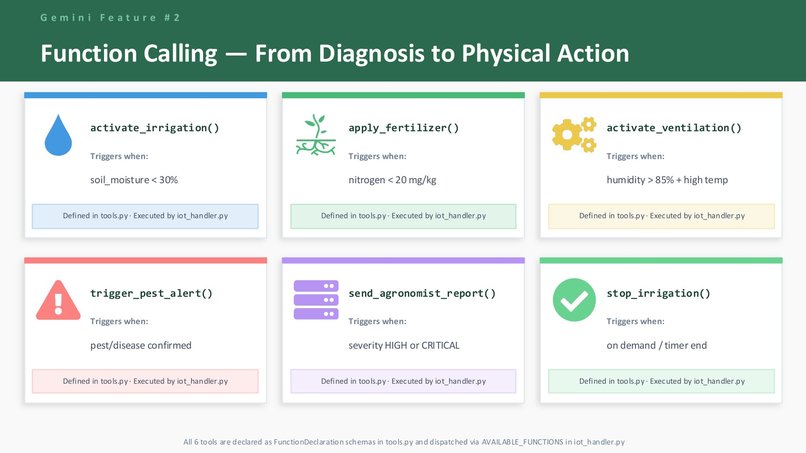
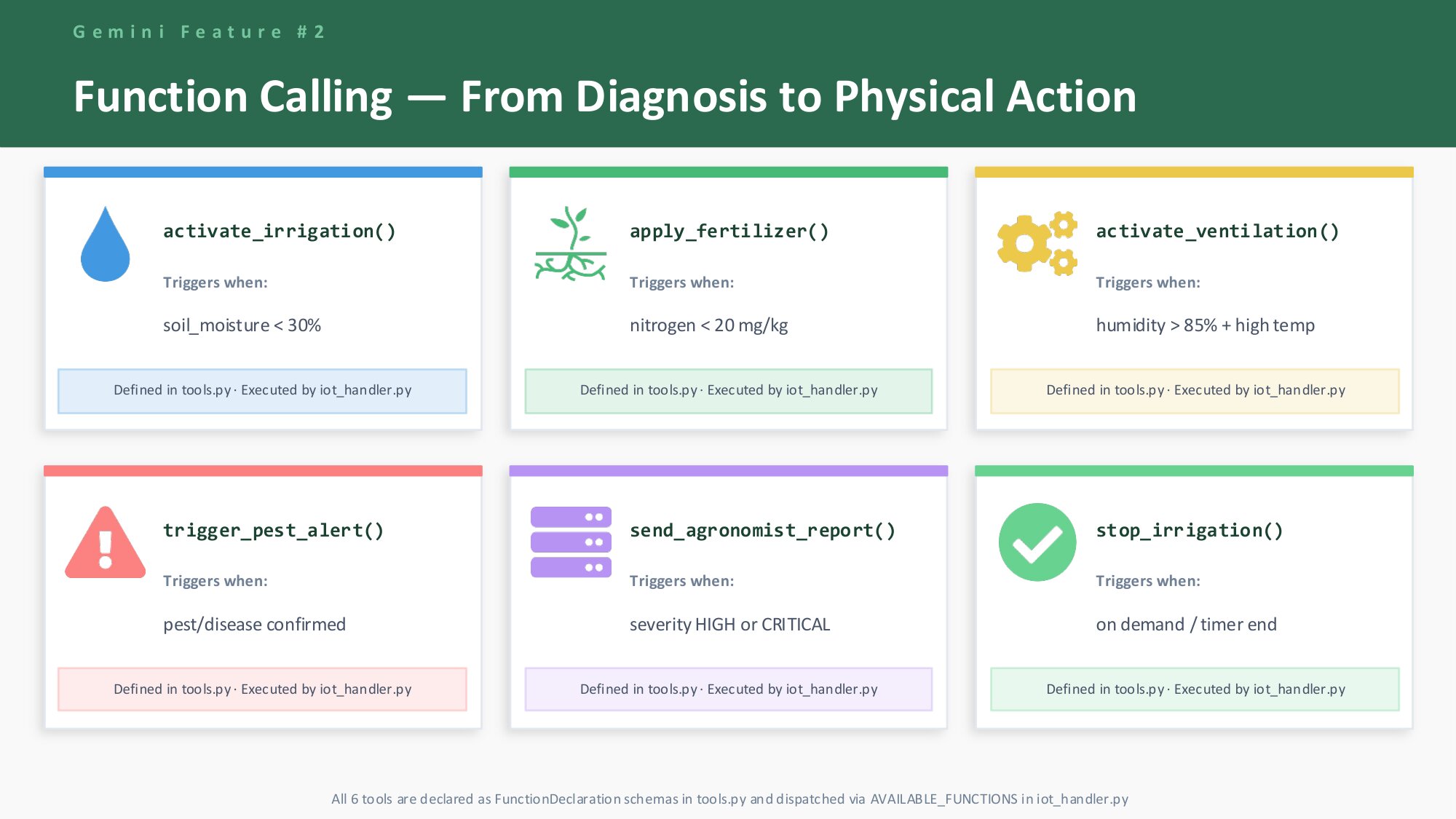
- Acts — Gemini uses Function Calling to autonomously trigger physical
IoT actions:
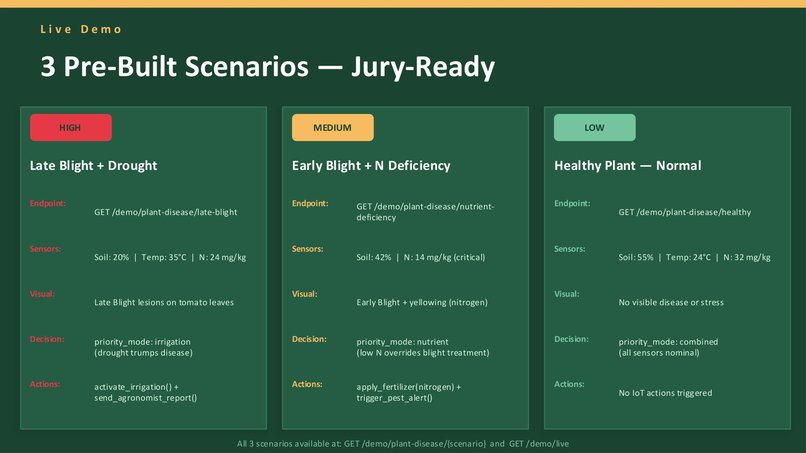
activate_irrigation(),apply_fertilizer(),trigger_pest_alert(),send_agronomist_report()
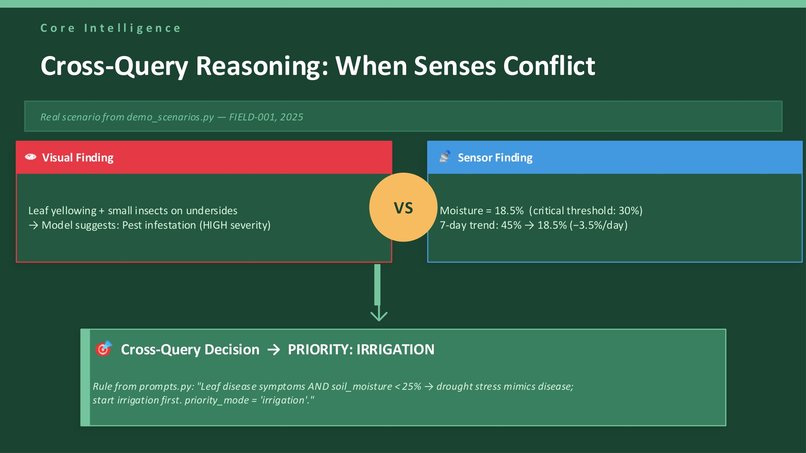
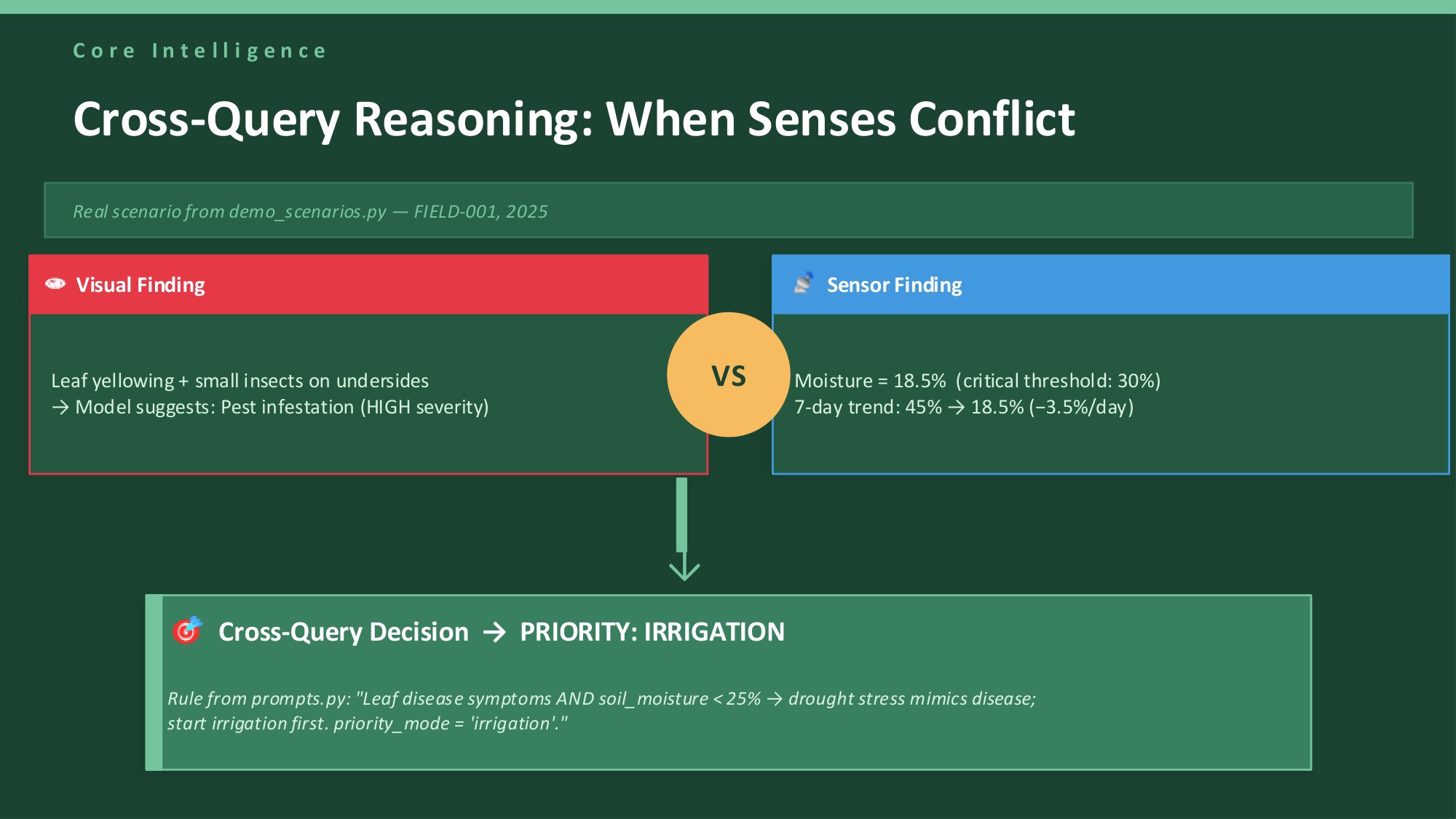
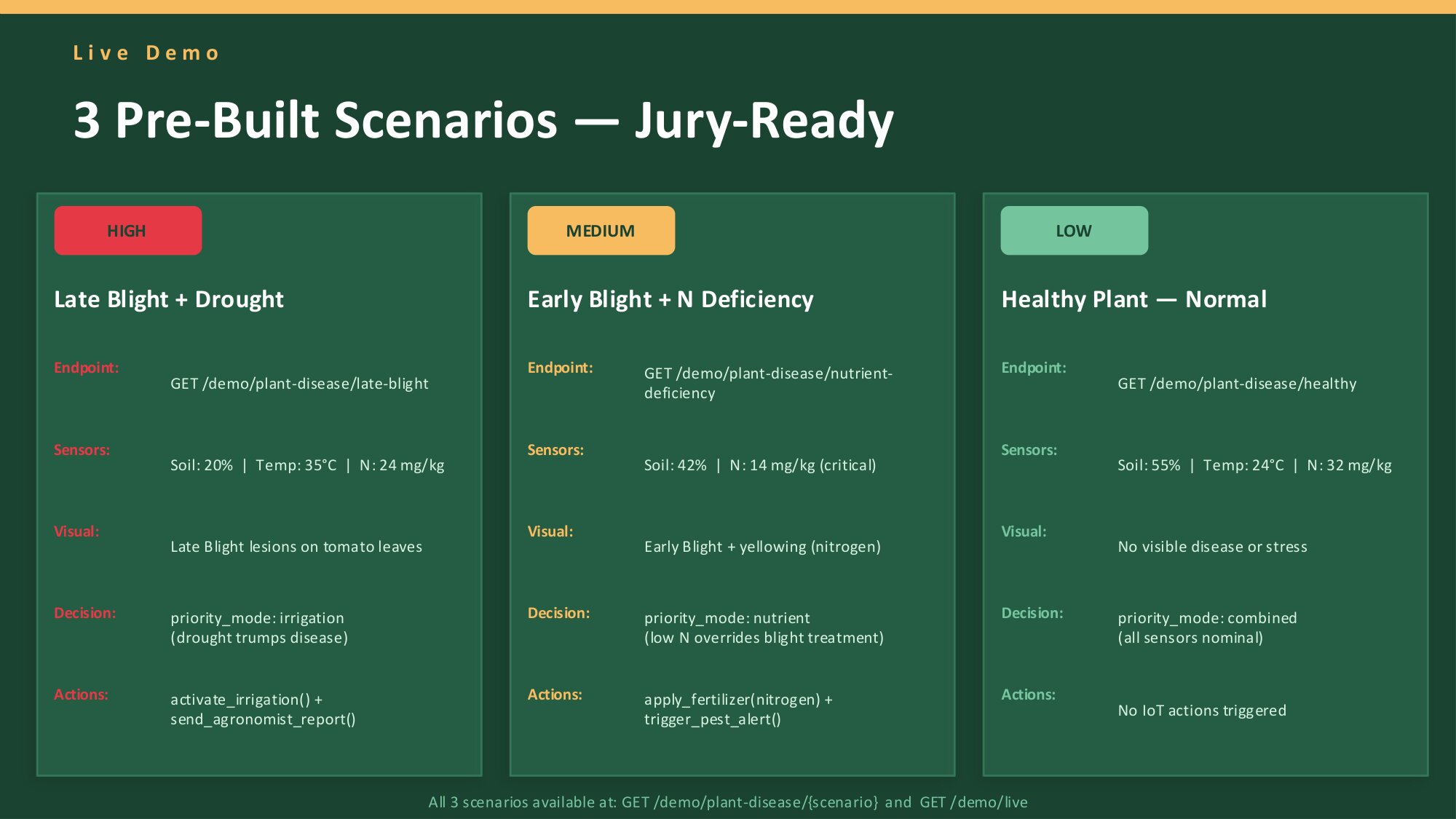
The core intelligence is Cross-Query Reasoning: when visual symptoms conflict with sensor data (e.g. leaf yellowing looks like disease, but soil moisture is critically low), Agri-Lens resolves the conflict and prioritizes the root cause — drought stress over disease treatment.
🔧 How we built it
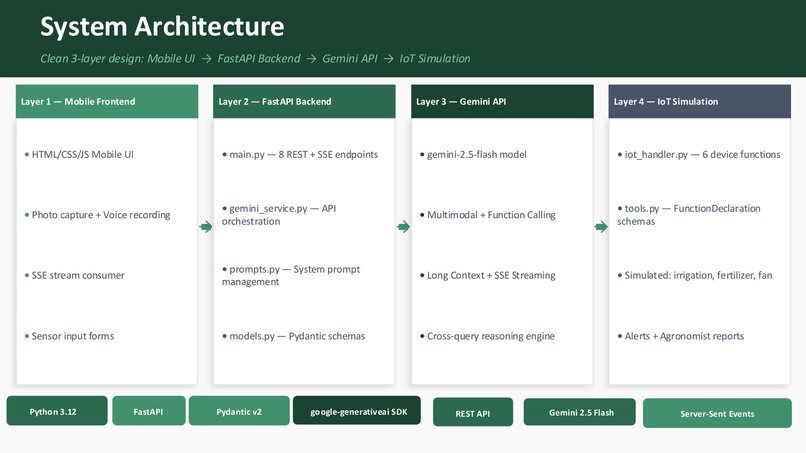
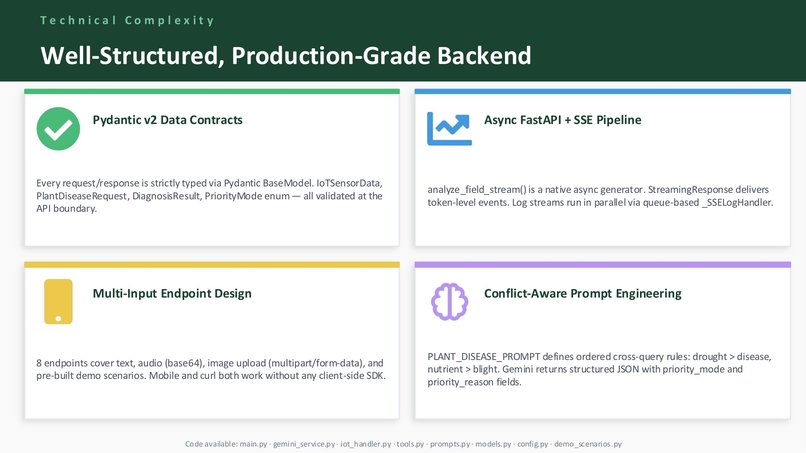
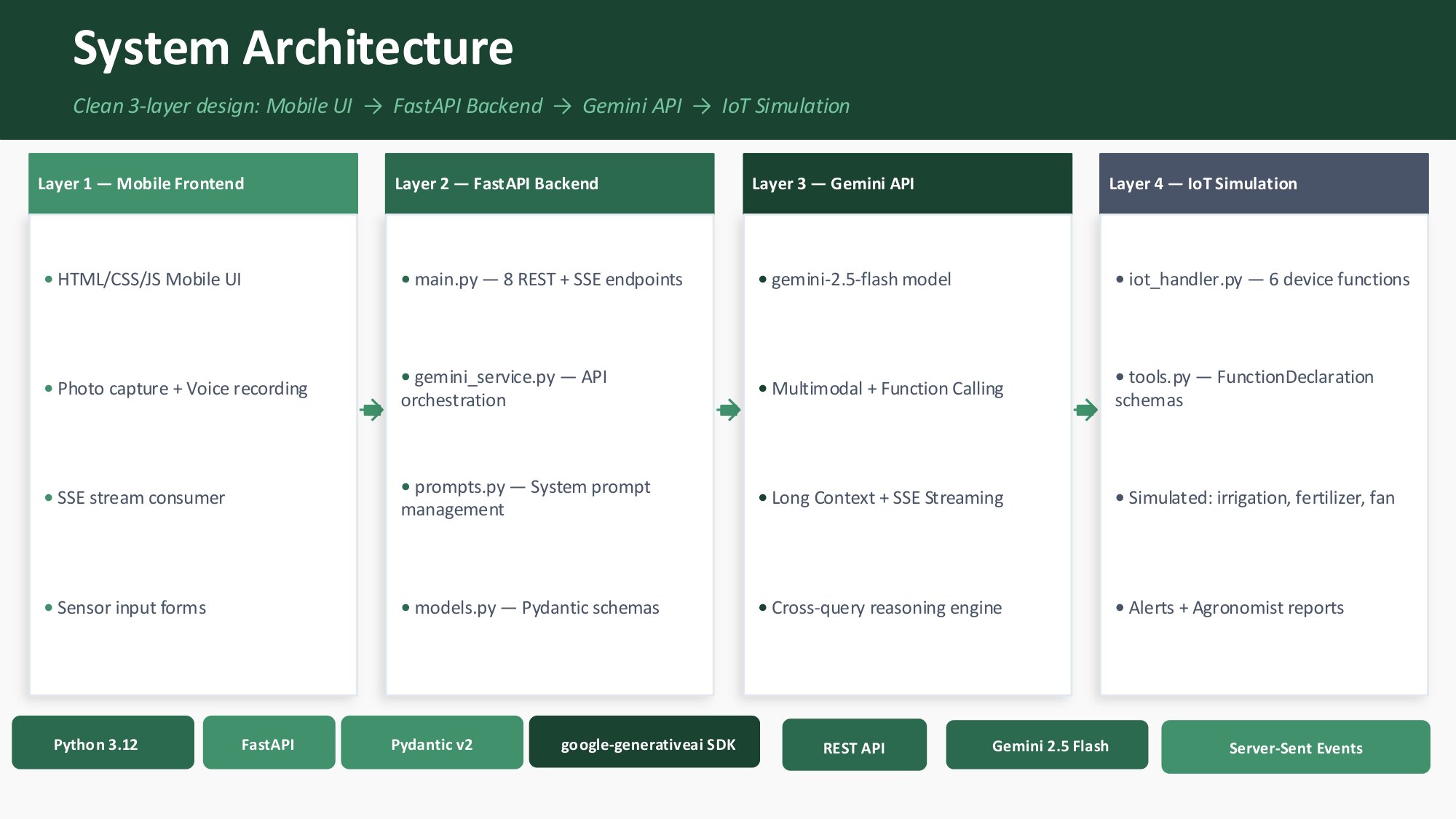
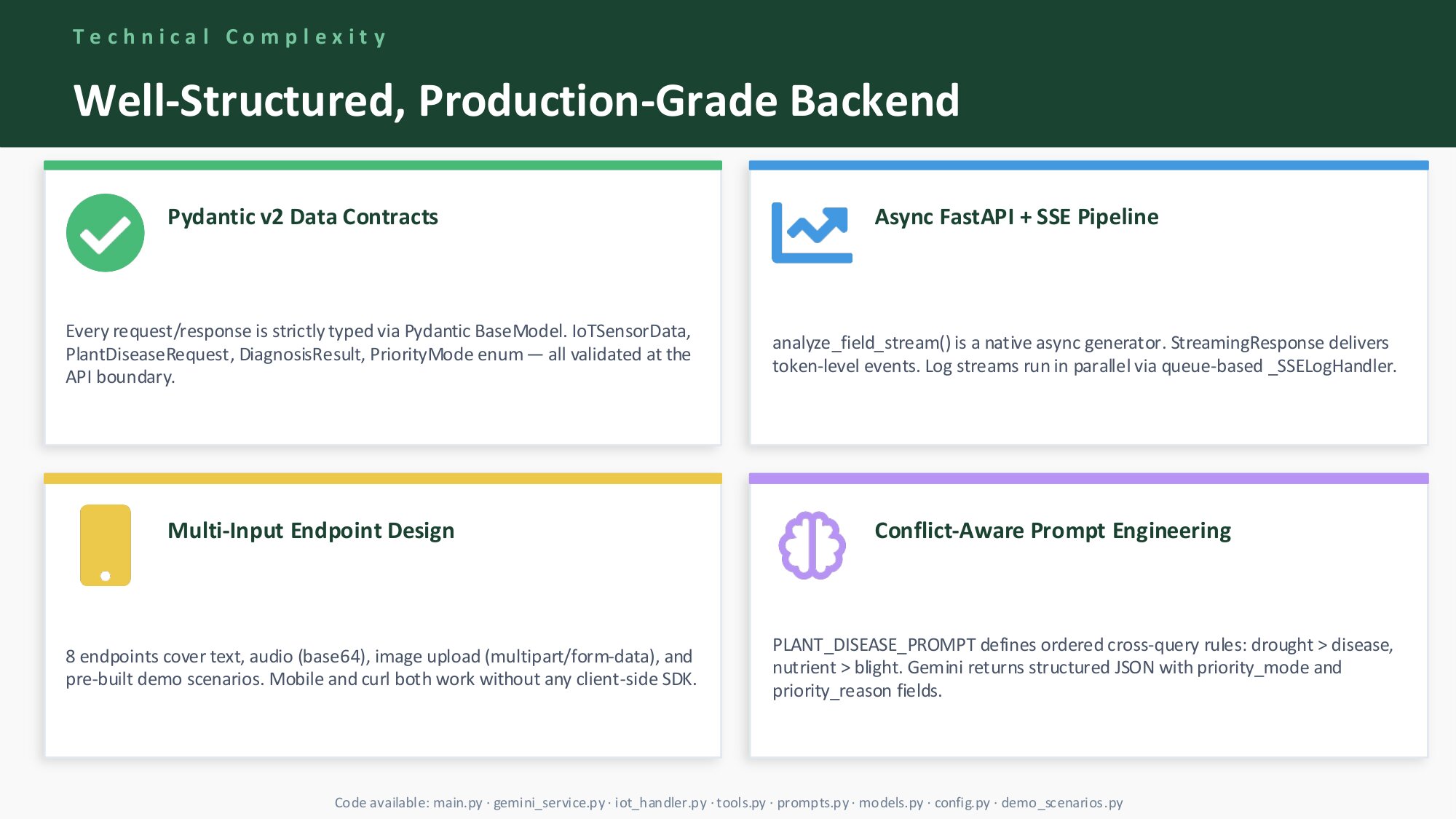
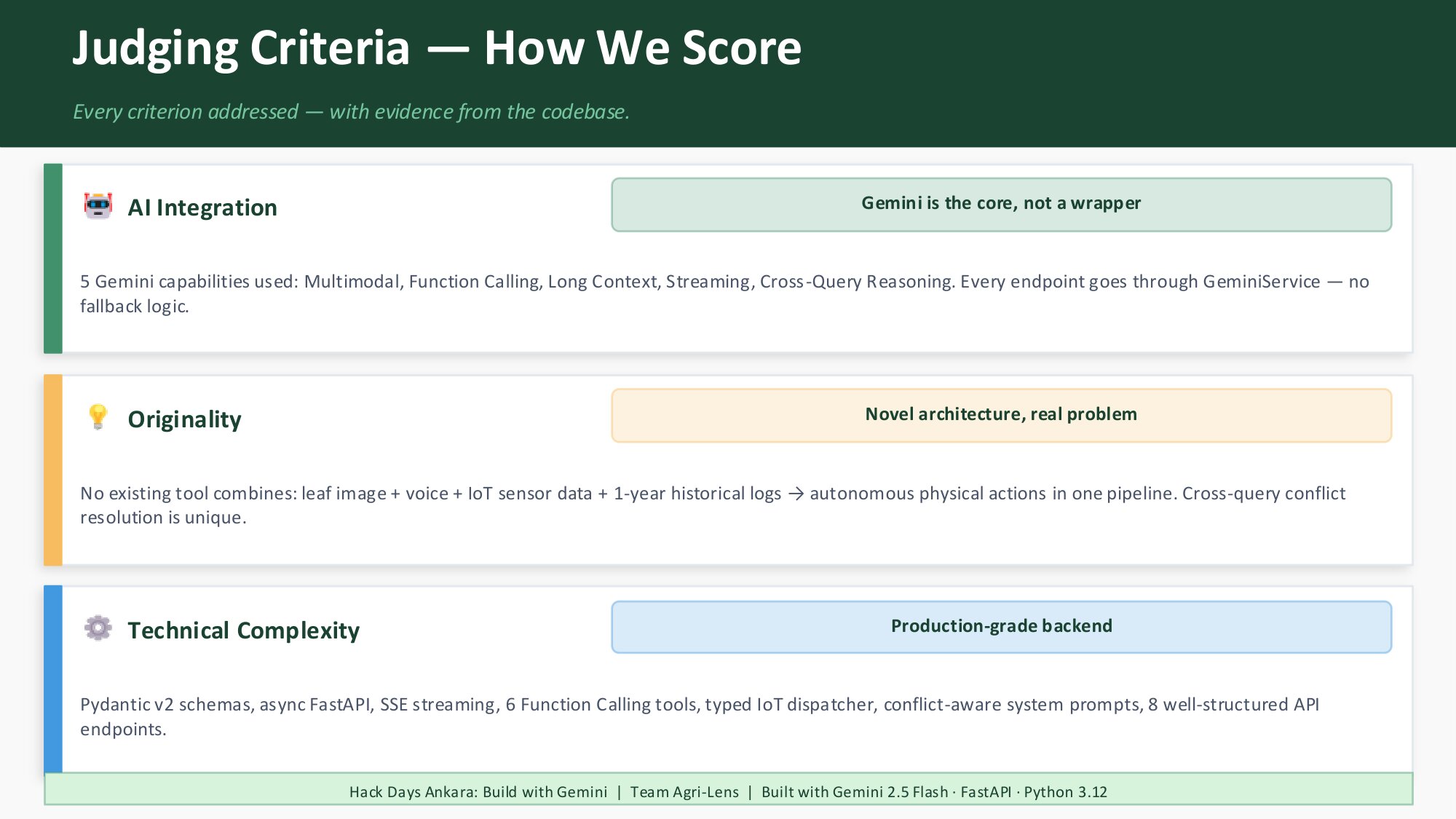
Backend: FastAPI (Python 3.12) with 8 REST + SSE endpoints.
All requests flow through GeminiService, which orchestrates multimodal
inputs, function calling, and streaming responses.
Gemini Integration:
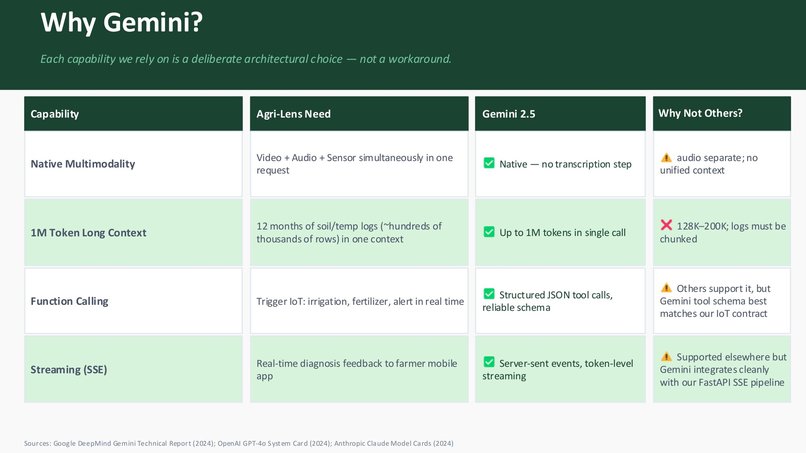
gemini-2.5-flashmodel viagoogle-generativeaiSDK- 5 capabilities used: Native Multimodality, Function Calling, Long Context Window, SSE Streaming, Cross-Query Reasoning
- System prompts in
prompts.pydefine ordered conflict-resolution rules (PLANT_DISEASE_PROMPTwith priority_mode: disease / irrigation / nutrient / combined)
IoT Layer: 6 FunctionDeclaration schemas in tools.py, dispatched
via AVAILABLE_FUNCTIONS in iot_handler.py — fully simulated but
architected for real MQTT hardware integration.
Data Models: Pydantic v2 — IoTSensorData, PlantDiseaseRequest,
DiagnosisResult, PlantDiseaseResult, PriorityMode enum — all
validated at the API boundary.
Frontend: Mobile-first HTML/CSS/JS with SSE stream consumer, voice recording, and photo capture.
🧠 Challenges we ran into
The hardest problem was conflict resolution: a leaf that looks diseased
and a sensor that screams drought stress should not trigger both treatments
simultaneously — that wastes resources and can harm the crop. We solved
this by encoding an explicit priority hierarchy into the system prompt
and validating the output against a PriorityMode enum.
Streaming structured data (typed JSON events over SSE) while Gemini was mid-generation required careful chunking logic to keep the mobile UI responsive without waiting for the full response.
📚 What we learned
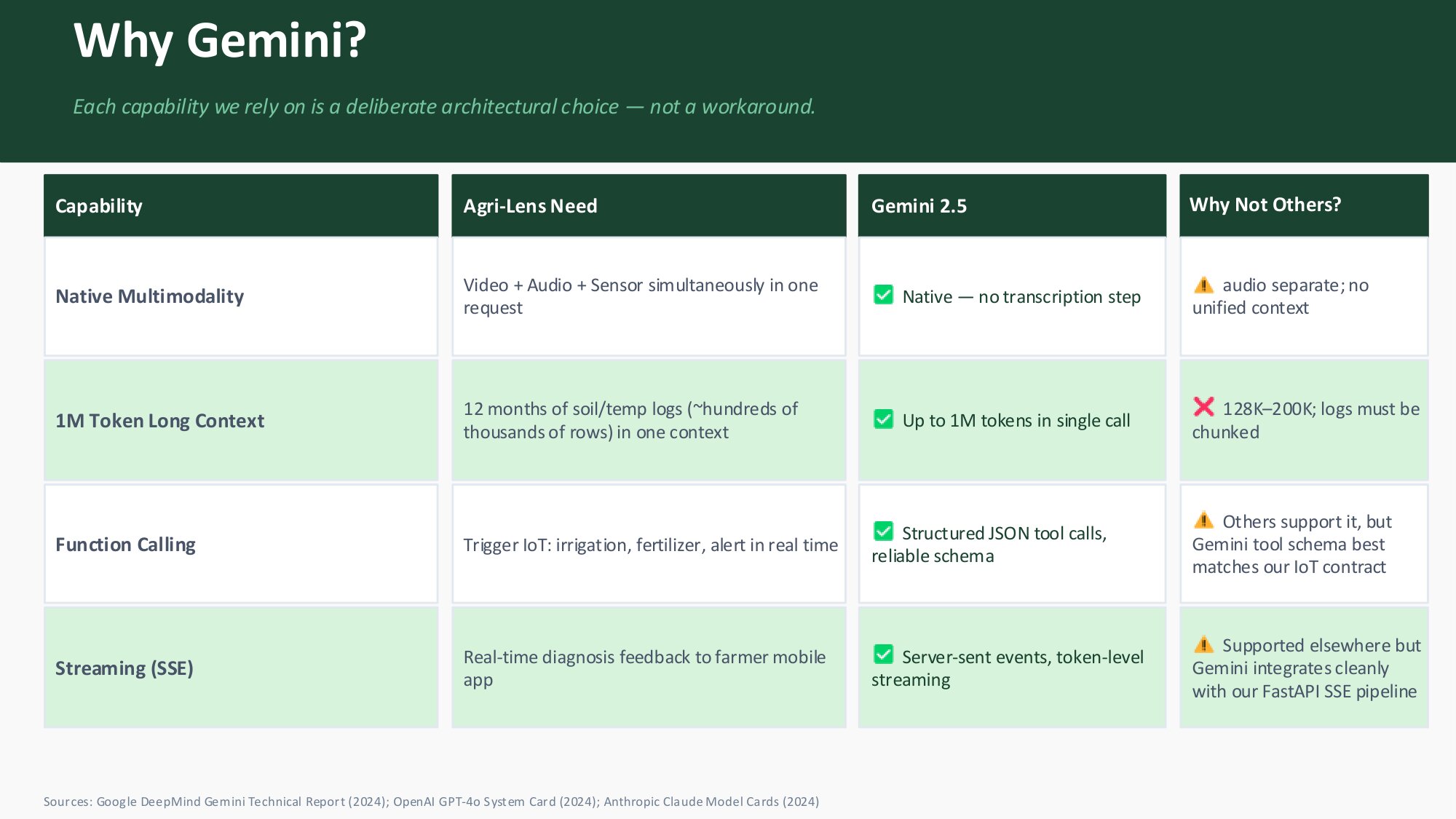
- Gemini's native multimodality eliminates the transcription bottleneck entirely — no Whisper, no intermediate step, one unified context
- 1M token Long Context makes RAG pipelines unnecessary for time-series sensor data at farm scale
- Function Calling is the bridge between language model reasoning and real-world physical action — this is what separates an AI assistant from an AI agent
🚀 What's next
- Real hardware IoT sensors via MQTT protocol
- Offline-first edge AI mode for low-connectivity regions
- Multi-language voice support (Swahili, Hindi, Turkish, Spanish)
- Satellite imagery integration (Sentinel-2) for field-level crop mapping
- Cooperative data network for seasonal pattern sharing between farms
Built With
- css
- fastapi
- gemini-2.5-flash
- geminiapi
- google-generativeai-sdk
- html
- javascript
- pydantic
- python
- server-sent-events


Log in or sign up for Devpost to join the conversation.