-
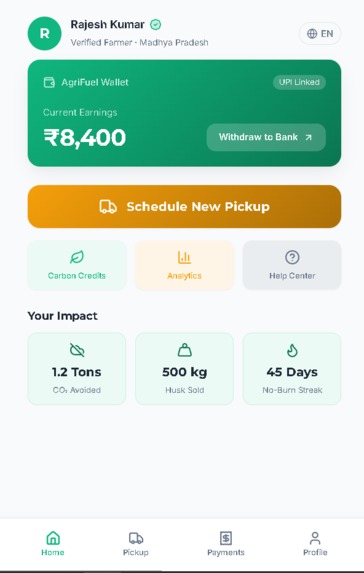
home screen
-
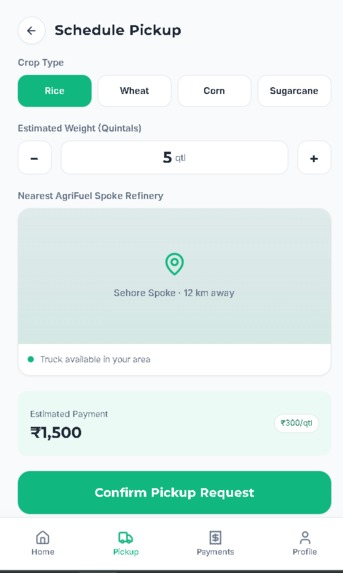
pickup screen
Inspiration
Every winter, the "Great Smog" of North India turns a seasonal change into a health emergency. As a Computer Engineering student, I saw a massive data disconnect: while farmers were burning millions of Tonnes of "waste" husk to clear fields, India was simultaneously struggling to find enough ethanol to meet its E20 (20% blending) mandate.
I was inspired by a simple question: Why are we burning a resource we desperately need? The inspiration for AgriFuel India was to bridge this gap turning a respiratory hazard into a high-grade energy commodity.
What it does
AgriFuel India is a decentralized 2G Bio-Refinery network that converts non-food agricultural waste (crop husk) into high-purity ethanol. For Farmers: It provides a digital platform to sell crop residue, turning "garbage" into a secondary income stream. For the Environment: It eliminates stubble burning, significantly reducing PM₂.₅ and CO₂ emissions. For the Economy: It produces anhydrous ethanol for fuel blending and USP-grade ethanol for the pharmaceutical and cosmetic industries, helping India close its 2025 energy gap.
How we built it
The project was built on a foundation of chemical engineering logic and financial modeling: The Conversion Engine: We modeled a biochemical process using enzymatic hydrolysis and fermentation. To ensure technical accuracy, we calculated the Actual Ethanol Yield (Ya): $$Y_a = m_{bio} \cdot f_{cell} \cdot \eta_{hyd} \cdot \eta_{ferm} \cdot 0.511$$ Market Validation: We used official Lok Sabha data (30.11.2023) to identify a 320 Crore Liter supply shortfall by 2025. The Platform: We designed a "Hub-and-Spoke" logistics model where a mobile app manages rural procurement while decentralized modular plants handle processing at the source.
Challenges we ran into
The Logistics Hurdle: Crop husk is bulky and low-density, making transport expensive. We solved this by designing localized 5 TPD (Tonnes Per Day) plants within a 20km radius of farms, slashing transport costs by 60%. The Purity Paradox: Fuel ethanol requires 99.6% purity, while Pharma-grade requires specific chemical profiles. Engineering a system that could toggle between these using molecular sieve dehydration was our toughest technical climb.
Accomplishments that we're proud of
Financial Resilience: Developing a model that achieves a 43% EBITDA margin by Year 5 by "arbitraging" high margin pharma sales.
Regulatory Alignment: Successfully integrating the PM JI-VAN Yojana and the 6% Interest Subvention Scheme into our CAPEX plan, making a "hard-asset" business viable for seed investors.
The "Waste-to-Wealth" Loop: Creating a system where the byproduct (lignin/compost) is sold back to farmers, regenerating the soil for the next crop cycle.
What we learned
We learned that Sustainability is only sustainable if it is profitable. Initially, we viewed this as a purely environmental play. However, through deep research, we learned that the government's need for installed capacity is growing from $1,380 to $1,700 Crore Liters. We learned that "waste" is simply a misplaced resource, and that the most effective way to help a farmer is to give their waste a market value.
What's next for Agri-Fuel
Pilot Implementation: Securing a site in the Punjab/Haryana rice belt for our first 5 TPD refinery. Carbon Credit Integration: Utilizing the Carbon Credit Trading Scheme (CCTS) 2026 to monetize "Avoided Burning" credits. Scaling the Network: Expanding from 1 pilot to 12 decentralized units to capture 0.2% of the national supply gap, proving that decentralized 2G ethanol is the future of Indian energy.
Built With
- across-communications
- cloud
- css
- cssw3
- html
- json
- loveablecloude
- radix
- react
- router
- service
- typescript

Log in or sign up for Devpost to join the conversation.