-
-
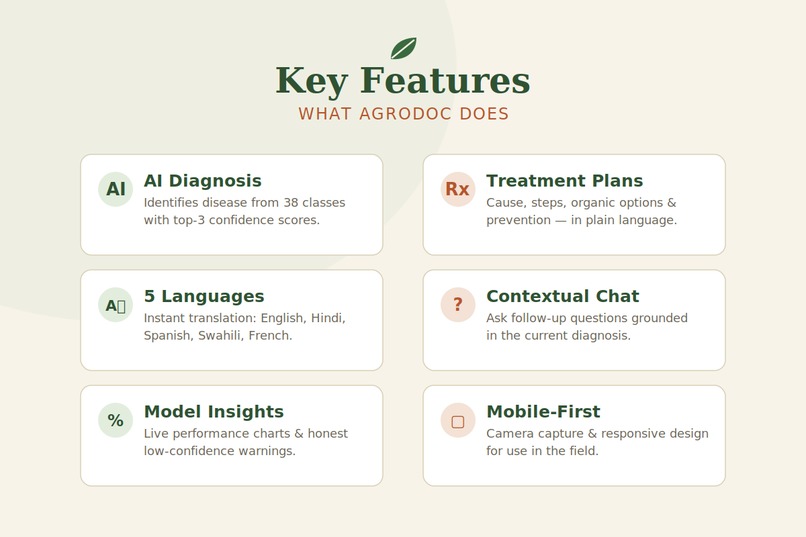
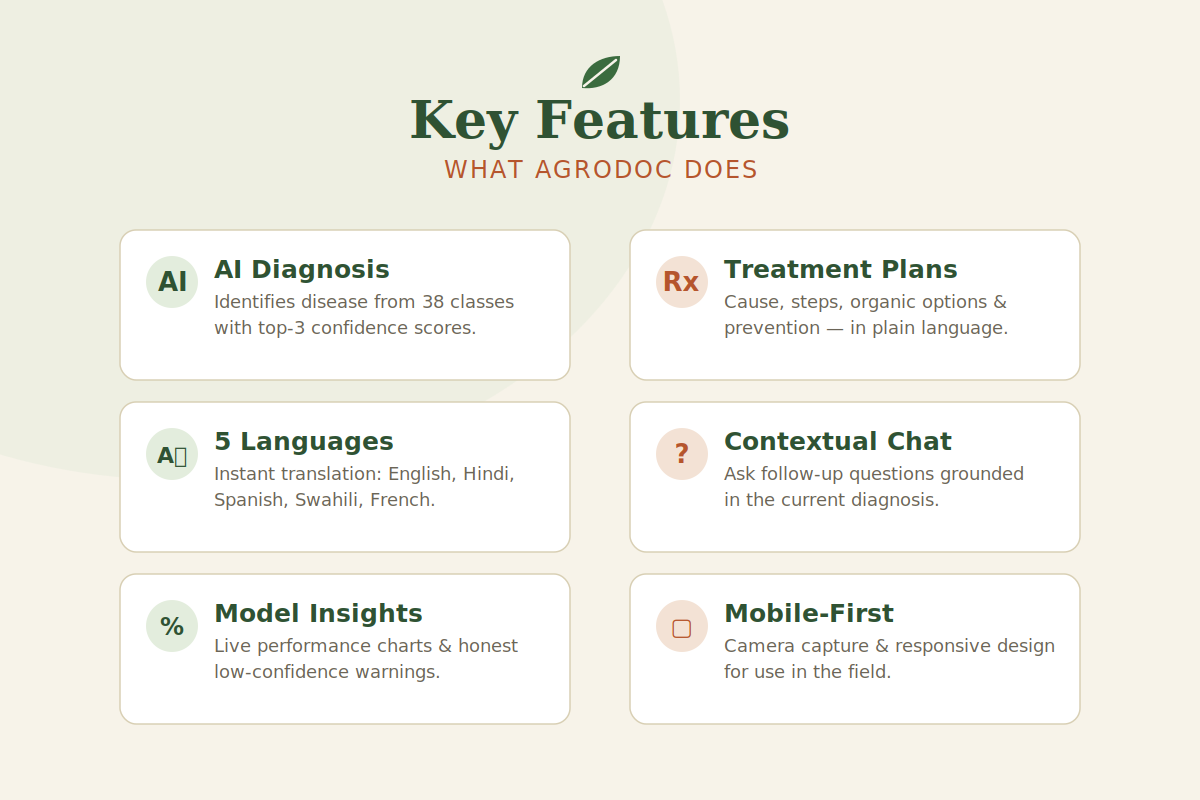
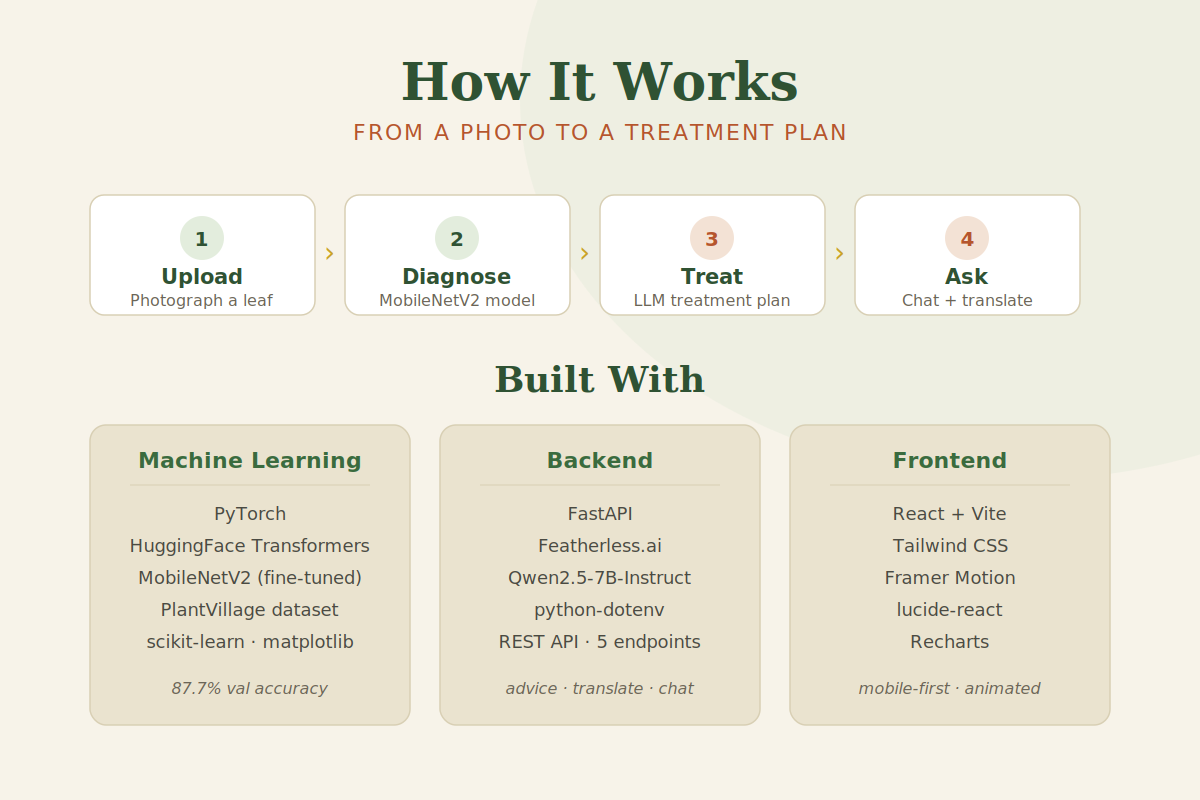
Six core features: AI diagnosis, treatment plans, 5 languages, contextual chat, model insights, and mobile-first design.
-
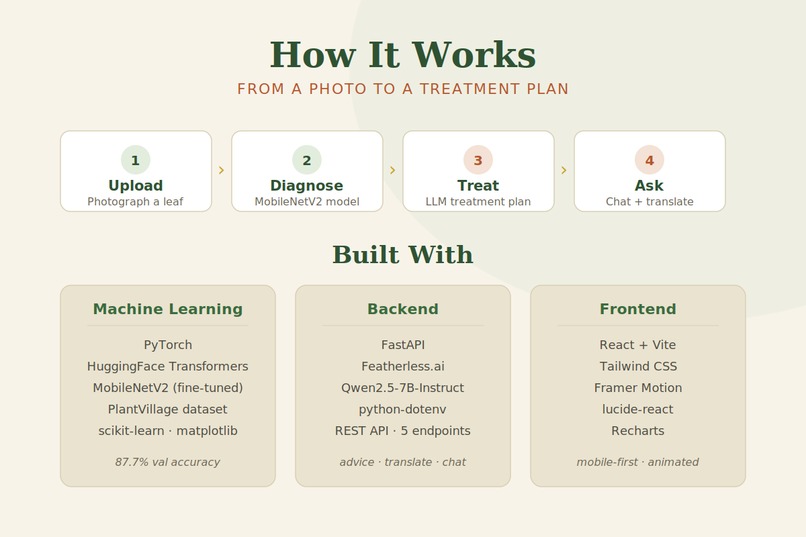
How it works: Upload, Diagnose, Treat, Ask built with PyTorch, FastAPI, React, and Featherless.ai.
-
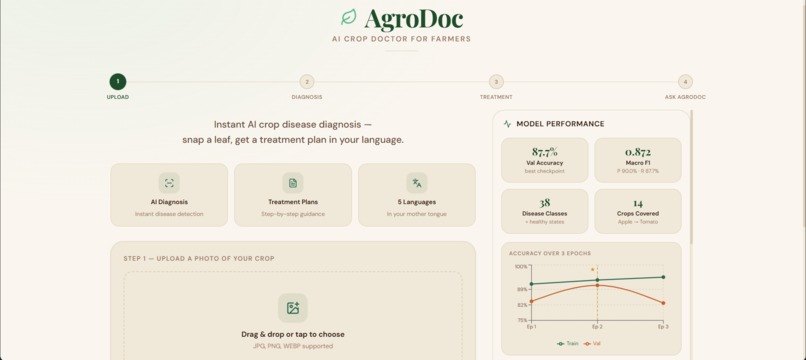
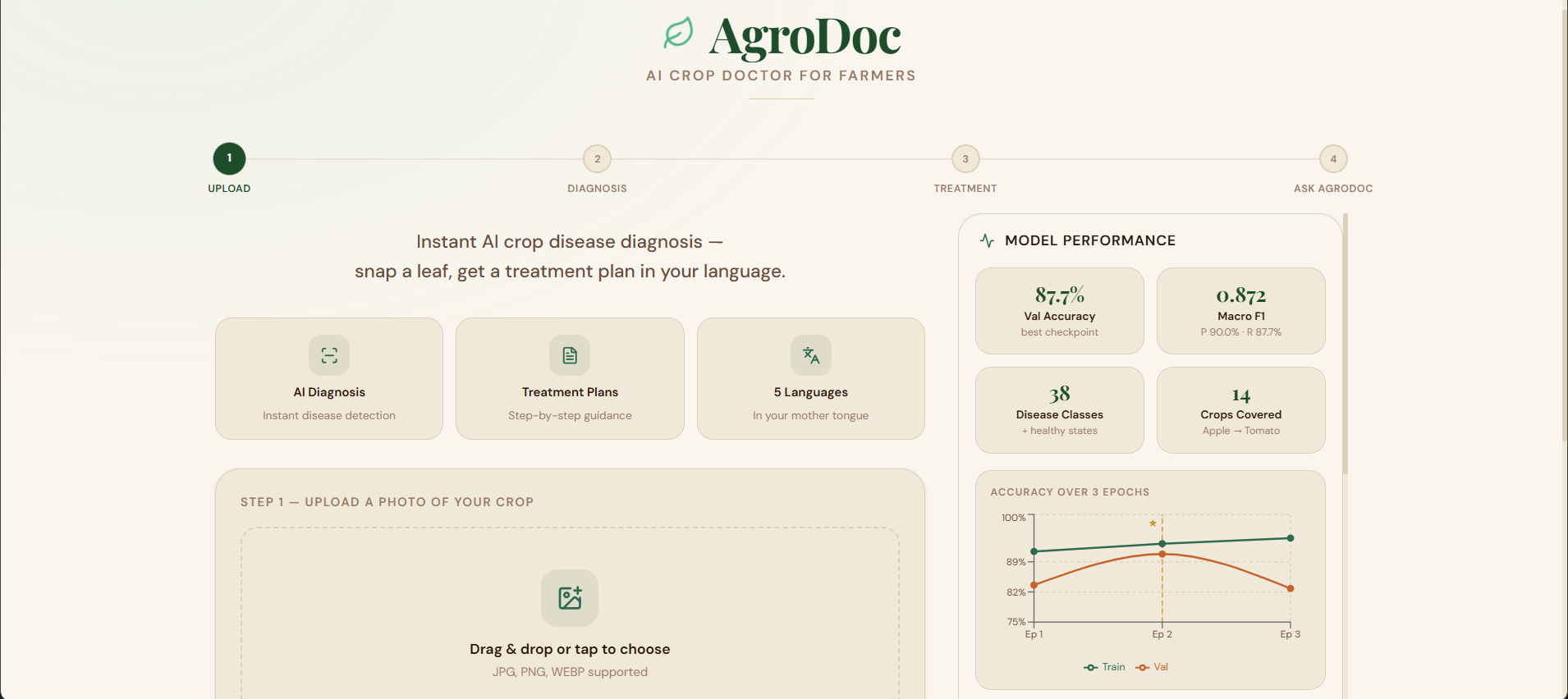
AgroDoc home diagnose a crop disease in one tap, with live model performance shown right alongside the tool.
-
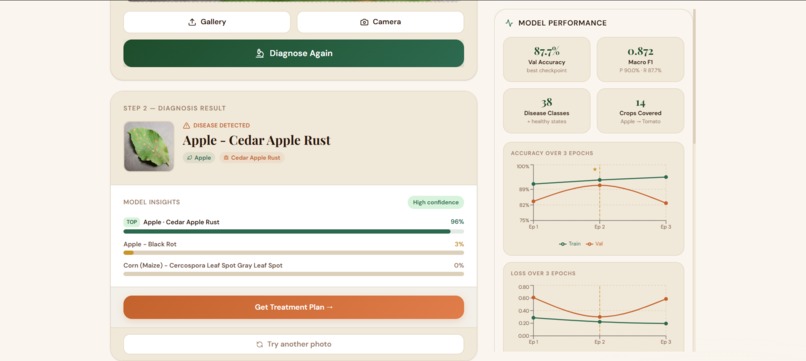
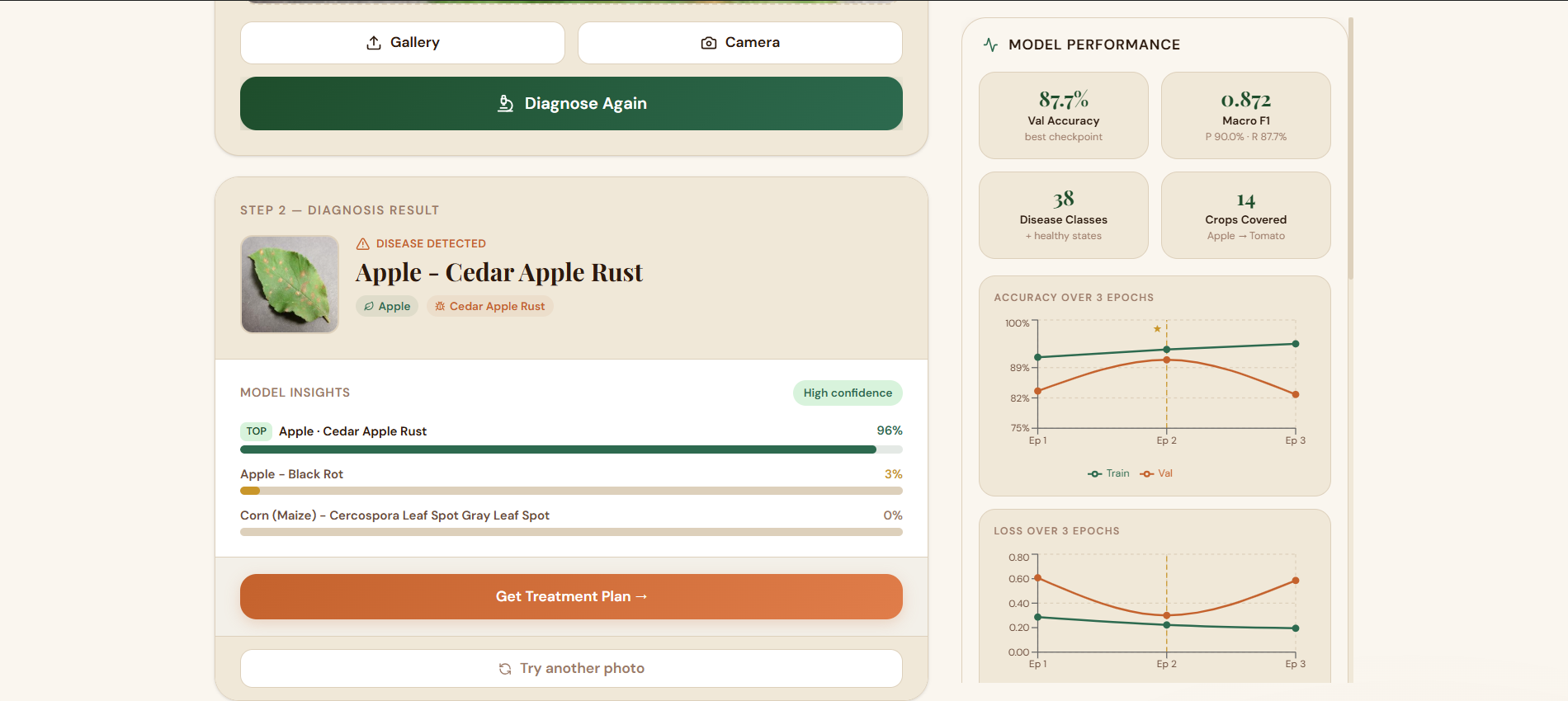
AI diagnosis: Apple Cedar Apple Rust detected at 96% confidence, with top-3 predictions shown as confidence bars.
-
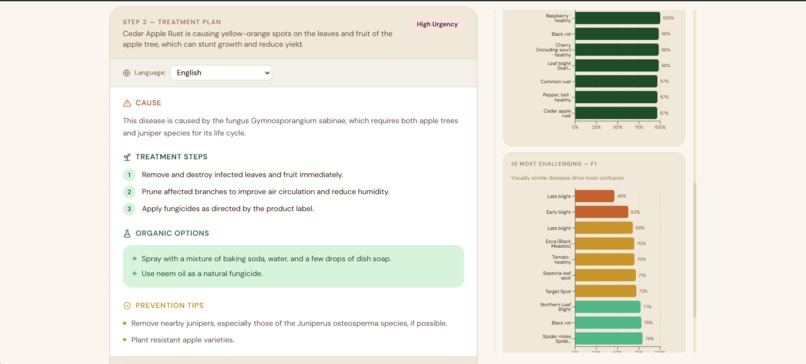
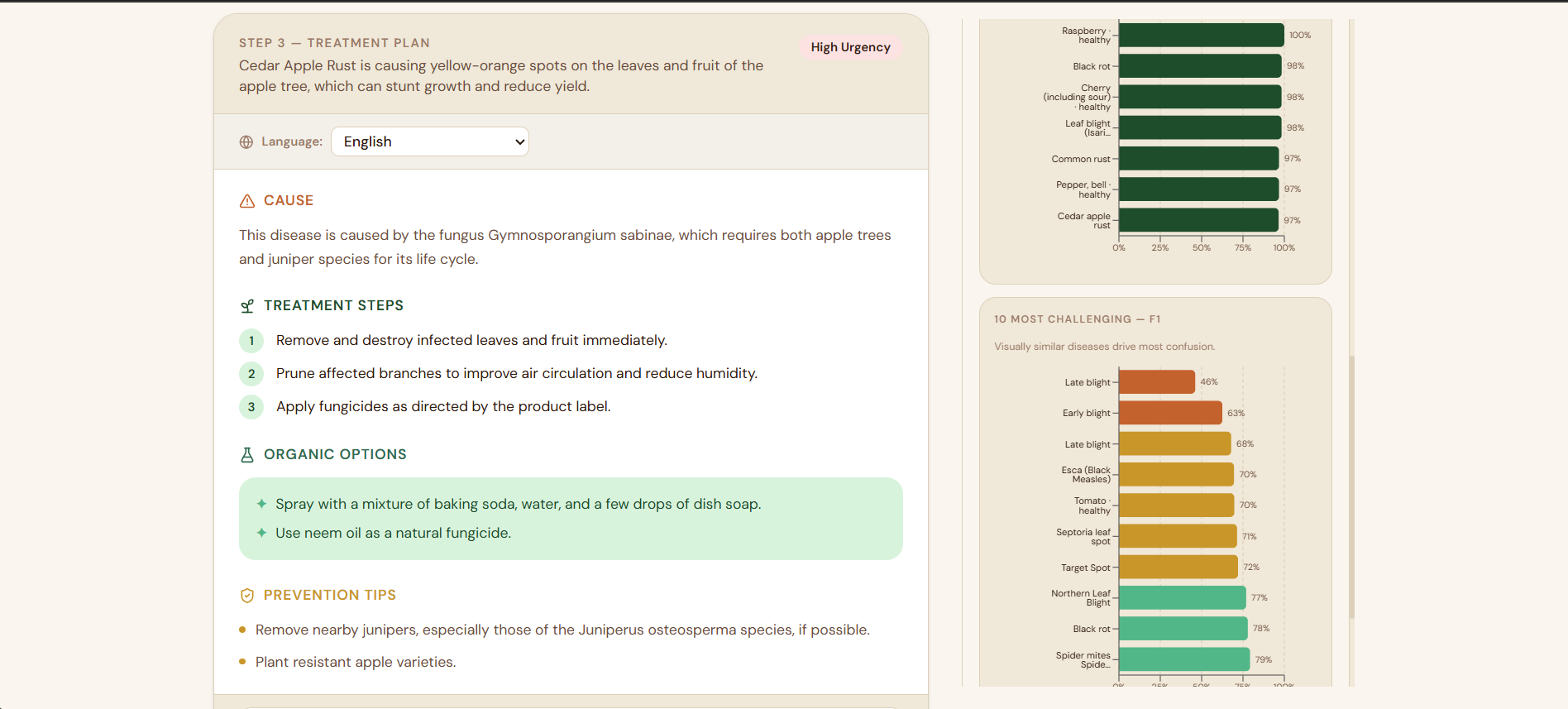
Plain-language treatment plan: cause, steps, organic options, and prevention tips with an urgency flag.
-
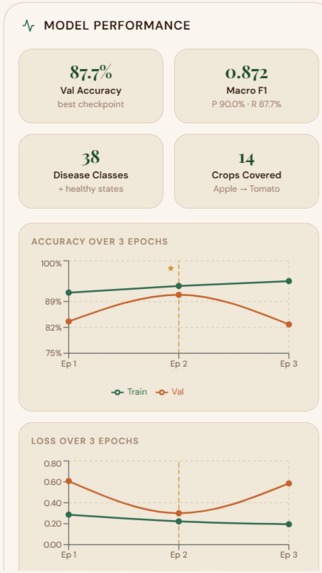
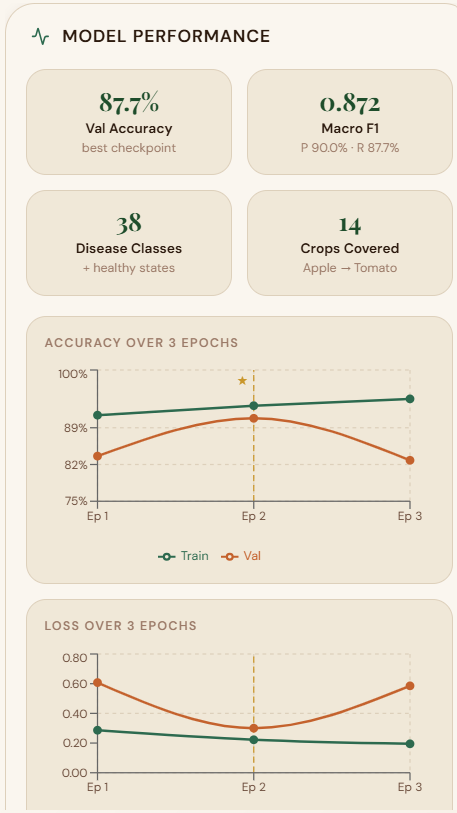
Real model metrics: 87.7% validation accuracy, 0.872 macro F1, across 38 disease classes and 14 crops.
-
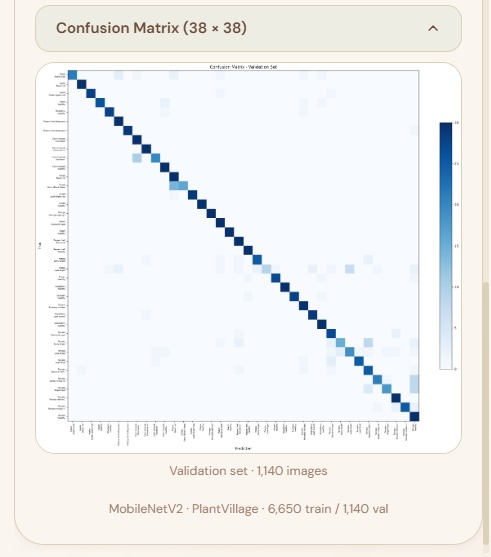
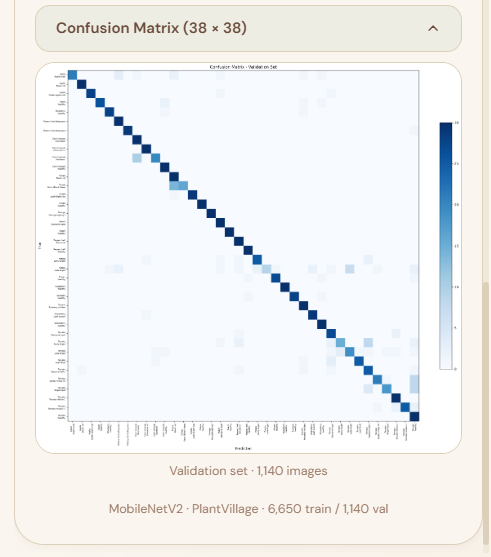
38x38 confusion matrix on 1,140 validation images a strong diagonal shows reliable per-class predictions.
Inspiration
Smallholder farmers lose 20–40% of their annual crop yield to plant diseases and pests that go undiagnosed until it's too late. The real bottleneck isn't a lack of solutions — it's access. Certified agronomists are concentrated in cities, extension services are stretched thin, and a single farm visit can cost more than a week's income. By the time a farmer reaches an expert, the infection has already spread. We wanted to put an expert in every farmer's pocket — and crucially, one that speaks their language.
What it does
AgroDoc lets a farmer photograph a diseased crop leaf and instantly get:
- A diagnosis — a fine-tuned MobileNetV2 model identifies the disease from 38 classes across 14 crops, showing the top-3 predictions with confidence scores.
- A treatment plan — an LLM generates a structured, plain-language plan: the root cause, step-by-step treatment, organic alternatives, prevention tips, and an urgency level (low / medium / high).
- Answers — a contextual chat lets the farmer ask any follow-up question grounded in their specific diagnosis.
- In their language — every piece of advice translates instantly into Hindi, Spanish, Swahili, or French with one click.
The whole experience is a simple 4-step flow: Upload → Diagnosis → Treatment → Ask AgroDoc.
How we built it
Machine Learning: We fine-tuned a MobileNetV2 model (pre-trained on plant-disease data) on a balanced subset of the PlantVillage dataset — 6,650 training and 1,140 validation images across all 38 classes — using PyTorch and HuggingFace Transformers. We used best-checkpoint selection, saving the model whenever validation accuracy improved, which gave us 87.7% validation accuracy and a 0.872 macro F1.
Backend: A FastAPI server exposes four endpoints — /predict (image classification), /advice (treatment plan generation), /translate (batch translation), and /chat (contextual Q&A). The LLM features are powered by Featherless.ai using Qwen2.5-7B-Instruct.
Frontend: A React + Vite single-page app styled with Tailwind CSS and animated with Framer Motion. It includes a live "Model Performance" panel showing our real training metrics, a step-progress indicator, and a mobile-first design with in-field camera capture.
Challenges we ran into
- A CORS error that was really a 500. Our
/translateendpoint kept failing with a CORS error in the browser. The real cause was an unhandled backend exception — when FastAPI crashed, the error response bypassed the CORS middleware, so the browser only saw a missing CORS header. We fixed it with broader exception handling and a global error handler that always returns proper JSON. - Model overfitting. Validation accuracy peaked at epoch 2 (87.7%) then dropped at epoch 3. We added best-checkpoint saving so the model keeps the best-performing weights, not just the final ones.
- Slow translation. Translating the whole treatment plan was sluggish. We switched from five separate API calls to a single batched call and added client-side caching, so re-selecting a language is instant.
- A broken layout. Leftover Vite default CSS was pinning all content to the left of the screen. Tracking it down to the
#rootandbodystyles inindex.cssfixed the centering.
Accomplishments that we're proud of
- A real, fine-tuned ML model — not just an API wrapper — with honest, reproducible metrics (87.7% accuracy, full confusion matrix and per-class F1 scores) shown live in the app.
- Genuine accessibility — multilingual support that puts expert advice in the farmer's mother tongue, which is the real barrier for our target users.
- A polished, production-feeling UI with a transparent "Model Performance" panel, so the model isn't a black box — judges and farmers alike can see exactly how well it performs.
- An end-to-end working product built from scratch: data prep, training, backend, frontend, and documentation.
What we learned
- How to fine-tune a vision transformer/CNN and read training dynamics — recognizing overfitting from the validation curve and responding with best-checkpoint selection.
- A subtle but important debugging lesson: a CORS error in the browser can actually be a hidden server-side 500, because crashed responses skip the CORS middleware.
- How to design AI UX that builds trust — showing confidence scores, model metrics, and honest "low confidence" warnings instead of pretending the model is always right.
- Practical LLM integration: structured JSON prompting, batching calls for speed, and caching results client-side.
What's next for AgroDoc
- Offline / edge deployment — export the model to TFLite or ONNX for on-device inference in regions with no connectivity.
- More crops and pests — expand beyond 14 crops to cassava, rice, and legumes critical to Sub-Saharan Africa and South Asia, and add insect-pest identification.
- Voice interface — speech-to-text and text-to-speech for farmers who aren't comfortable typing.
- Severity scoring — estimate how far an infection has spread from the image.
- WhatsApp / SMS channel — meet farmers on platforms they already use.
- Outbreak mapping — aggregate anonymized diagnoses to surface regional disease patterns in real time.
Built With
- fastapi
- featherless.ai
- huggingface
- mobilenetv2
- plantvillage
- python
- pytorch
- react
- scikit-learn
- tailwindcss
- transformers
- vite


Log in or sign up for Devpost to join the conversation.