-
-
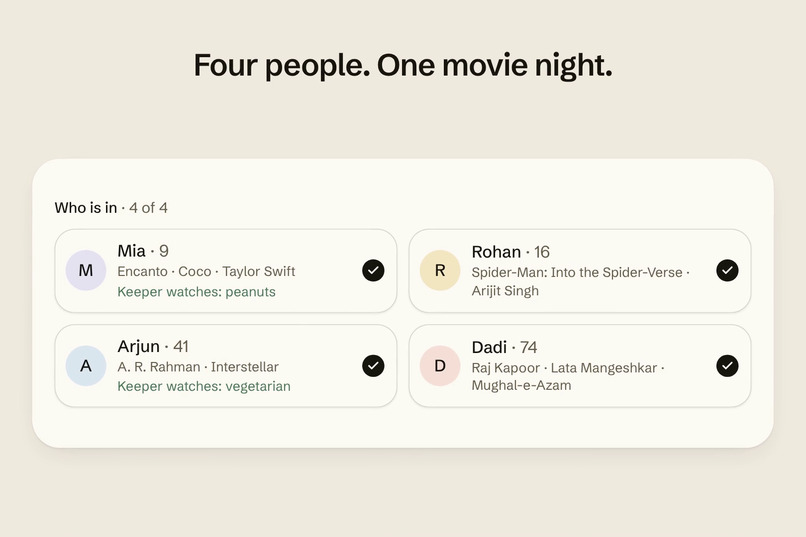
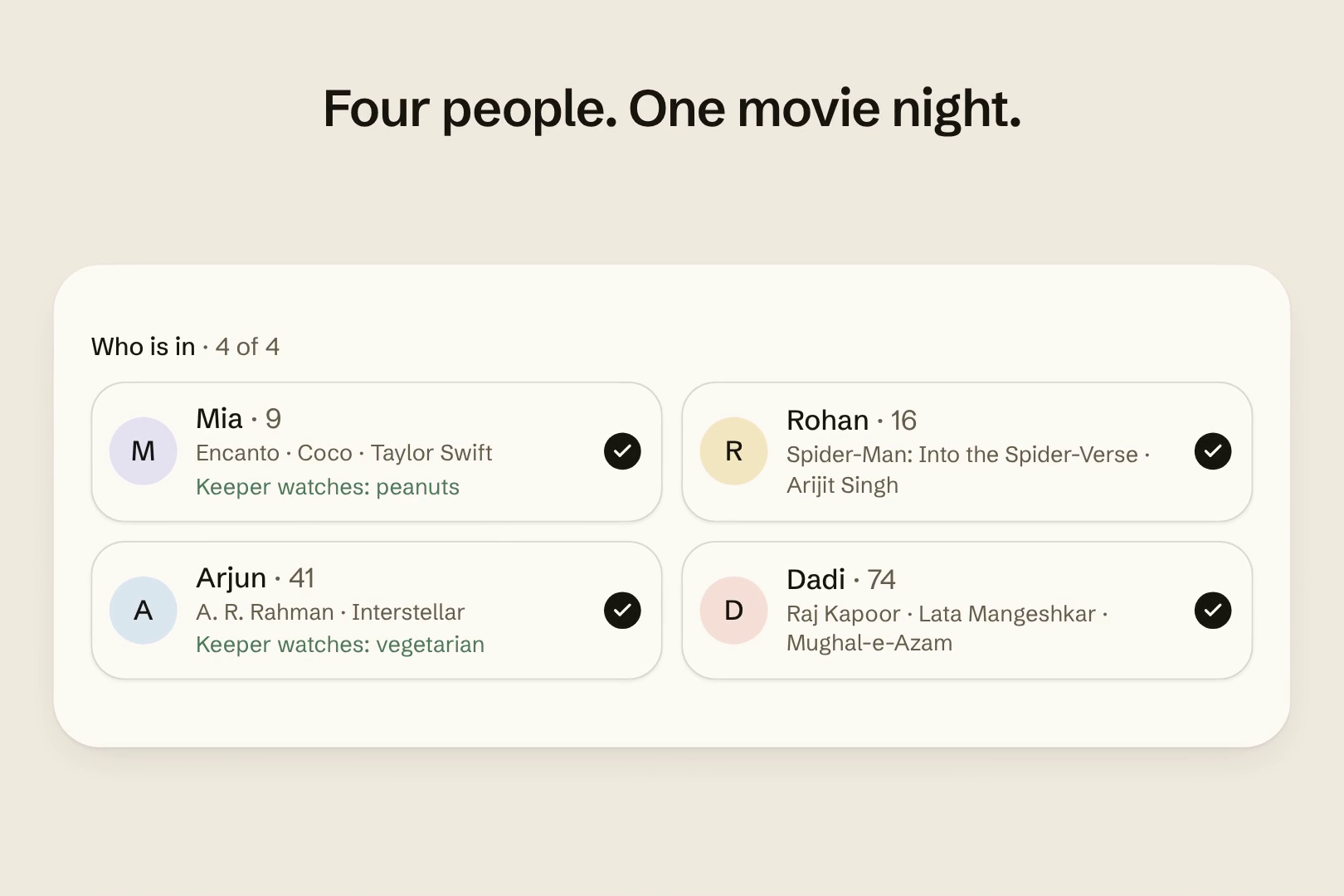
The family’s tastes
-
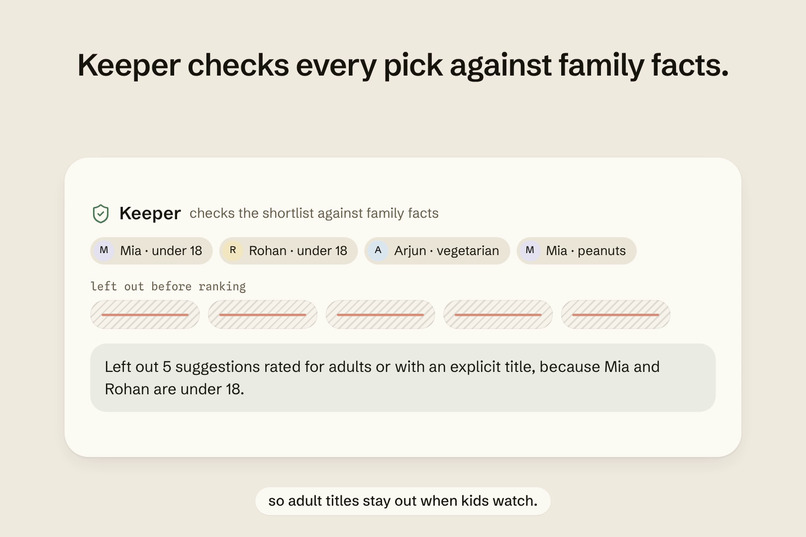
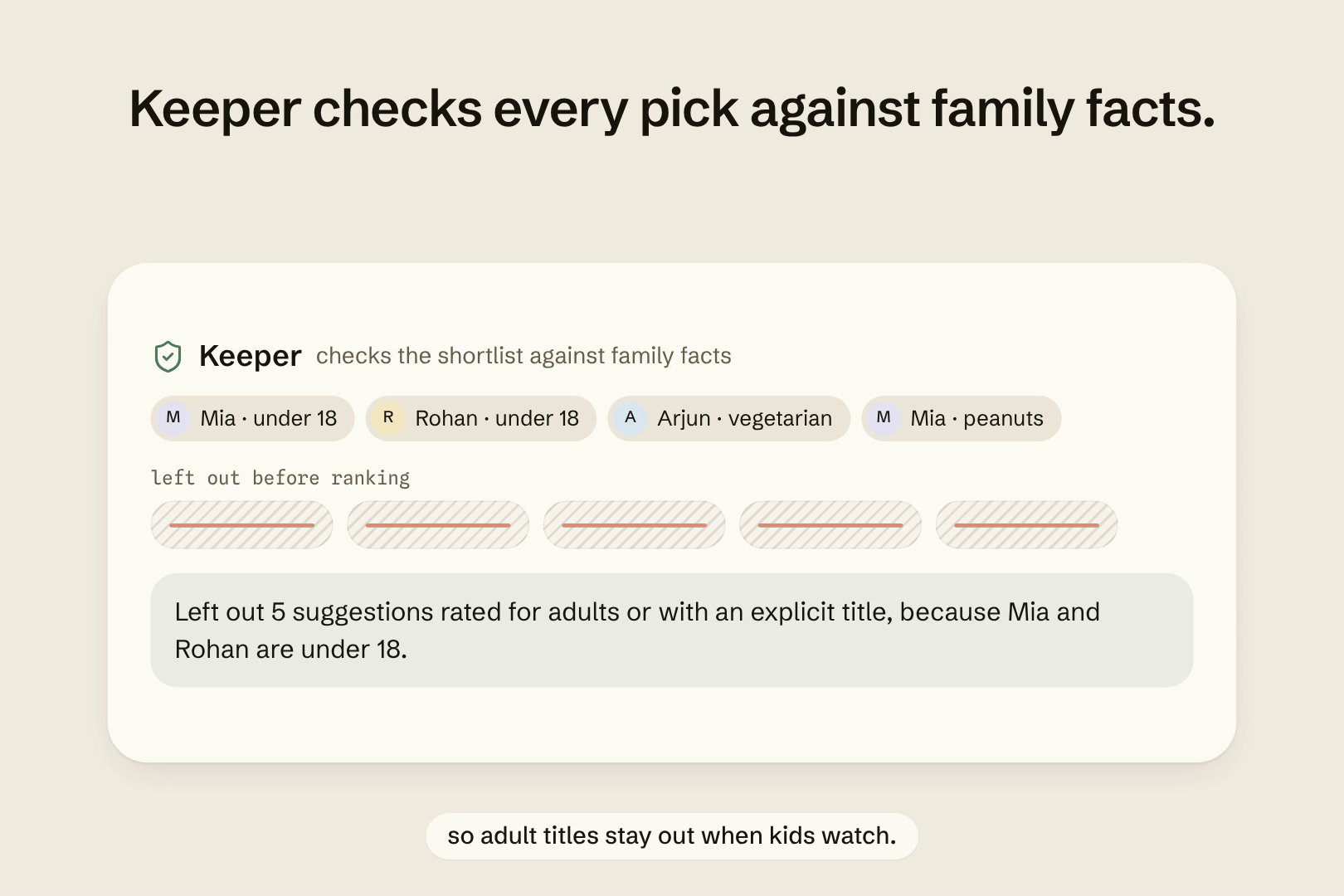
Keeper’s family-facts check
-
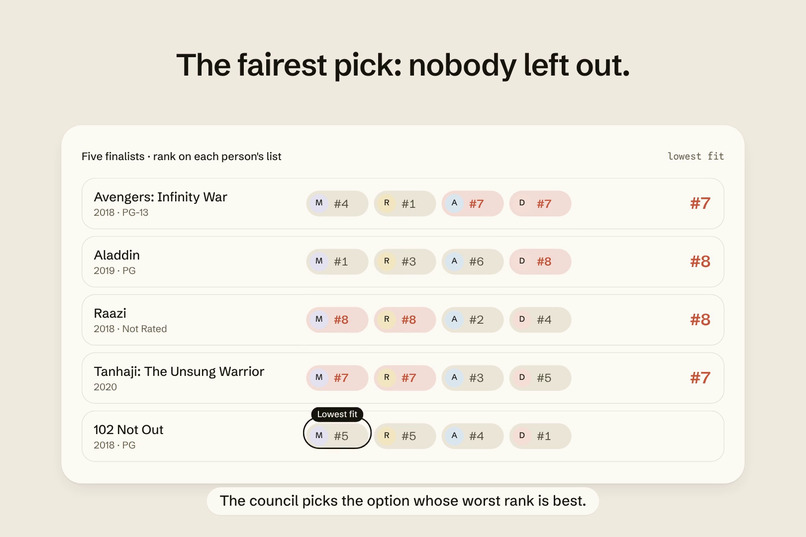
The fairest pick (maximin)
-
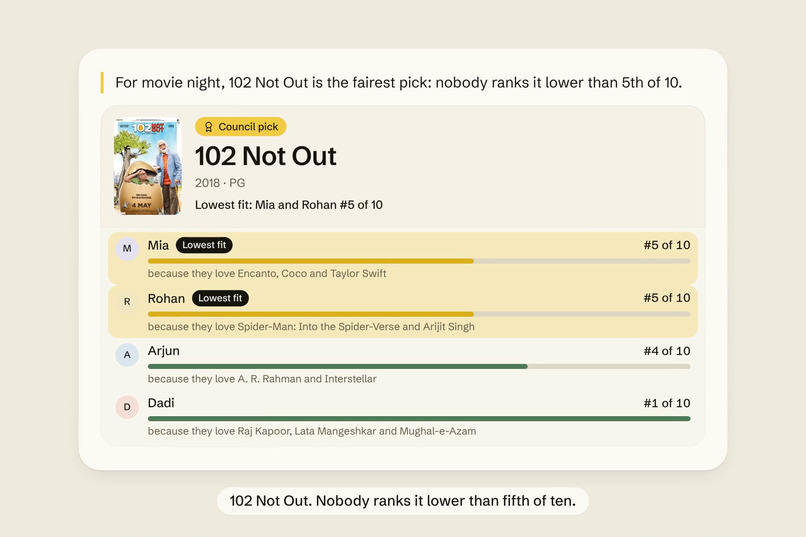
The winner card
-
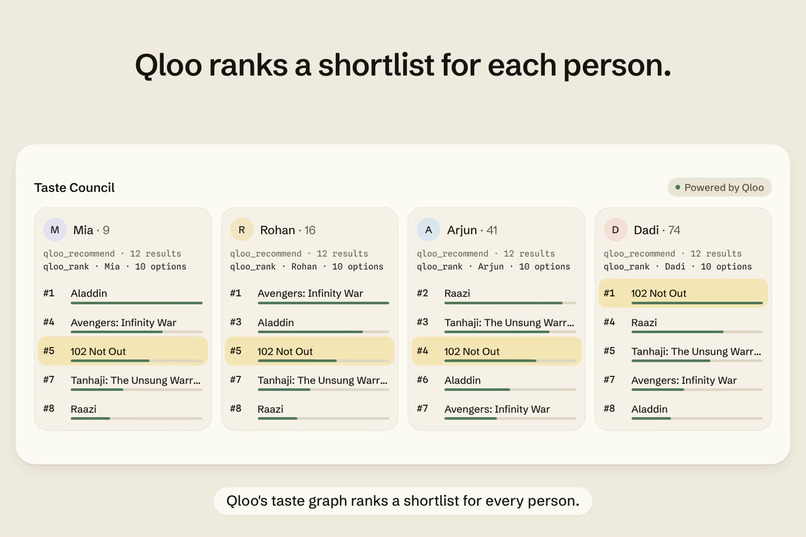
Qloo ranks a shortlist per person
-
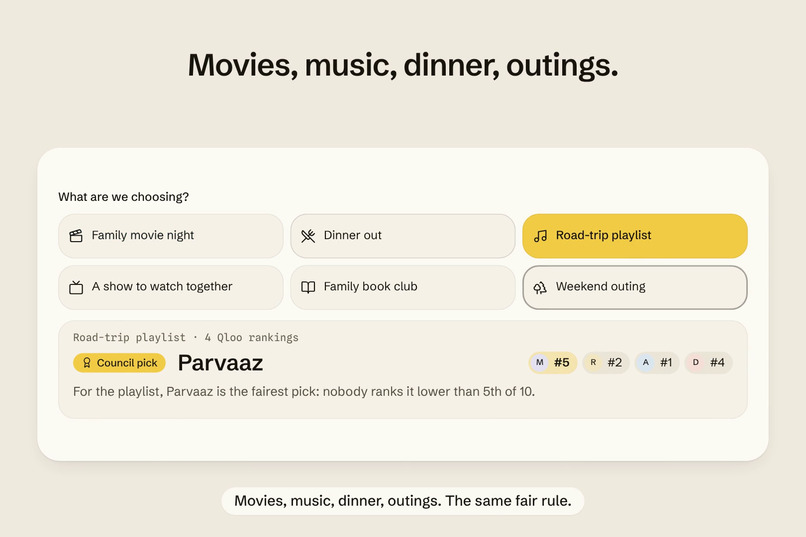
The same rule for playlists
Try it: https://agora-plus-295478535981.us-central1.run.app (tap Enter the demo; a fictional family is preloaded, then press Ask the council)
Code: https://github.com/Ritesh-Root/agora-taste-council (MIT)
Inspiration
Our household assistant, AGORA+, already remembered things about each family member: Mia is 9 and loves Encanto, Dadi is 74 and loves Raj Kapoor films, Arjun is vegetarian. Then someone asked it "what should we watch tonight?" and it guessed. It suggested something generic, or something for whoever had spoken last.
In a multigenerational home, which is common in India and in many other places, that question comes up every week: movie night, dinner out, a road-trip playlist, a show to watch together. A language model can list films. It cannot tell you how a grandmother and a 9-year-old would each rank the same five films. Qloo can.
What it does
The Taste Council picks something a whole family will share, and shows why.
- It reads each person's taste from household memory: what they love, what they like, their age band, and their allergies, diets and "no horror" rules. Plain code does this, with no model.
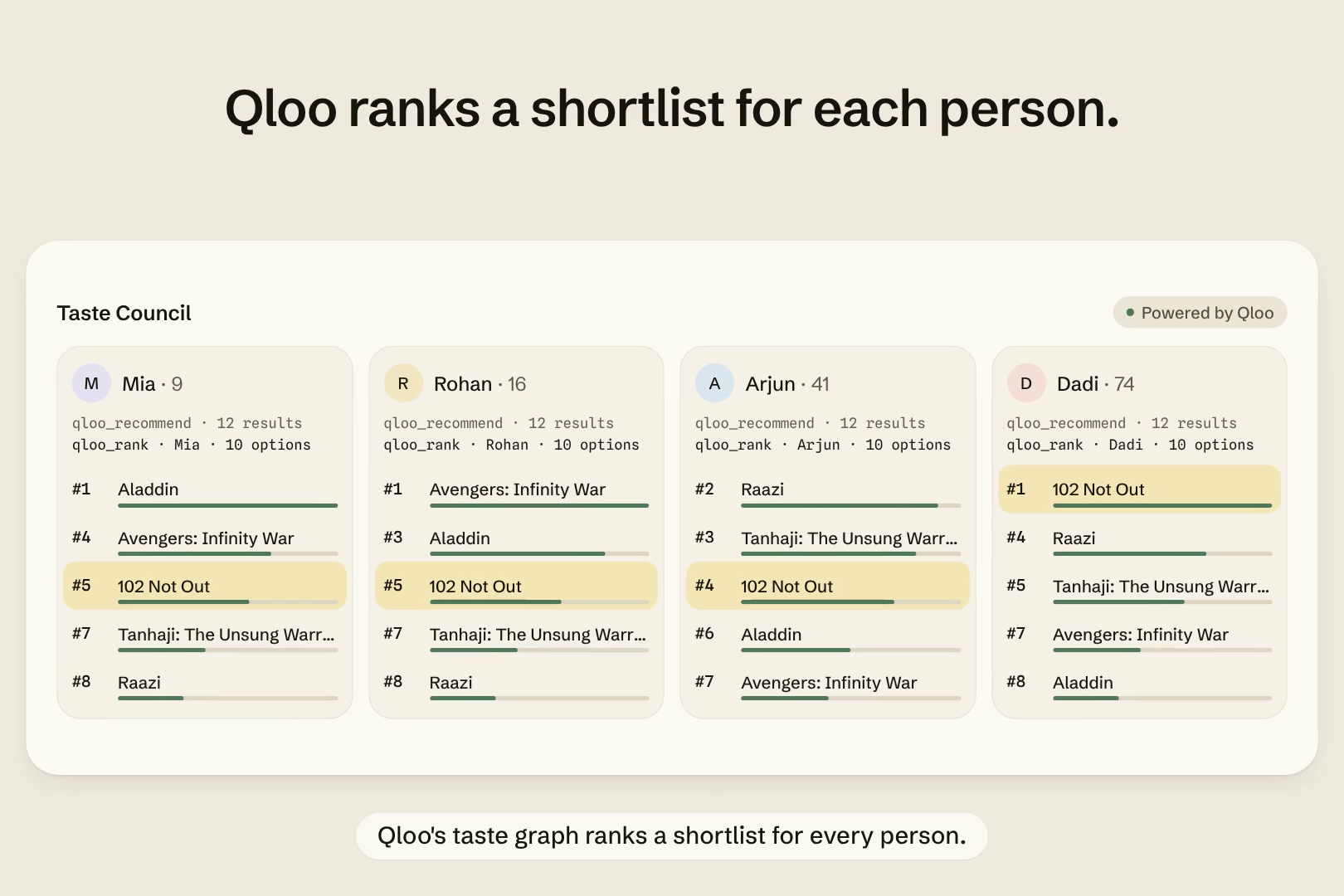
- For each person it asks Qloo's
qloo_recommendfor candidates of the right type: films, shows, artists, books, or places. Dinner asks for restaurants, and for a vegetarian, restaurants Qloo lists with vegetarian options. With a child in the family, adult-rated films, shows, music and books are left out, and the result says so. - It merges those into one shortlist of at most 10, taking turns between people so nobody's picks crowd out the others.
- For each person it asks Qloo's
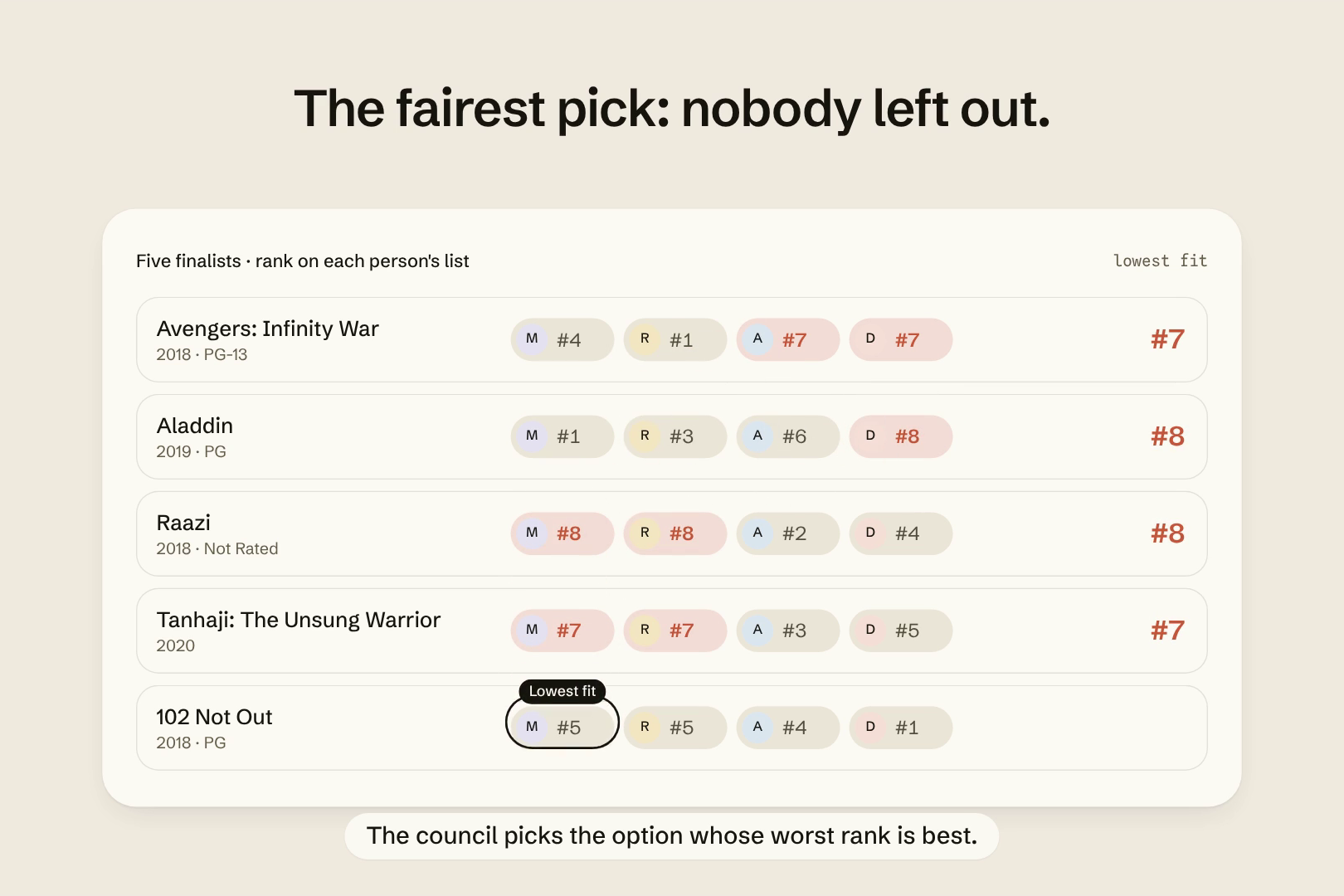
qloo_rankto put that same shortlist in order. - It picks by maximin: the option whose worst rank across the family is best. Nobody gets their 9th choice so someone else can have their 1st.
- Keeper removes anything that clashes with a household fact, such as a kebab place when Arjun is vegetarian, and quotes the fact.
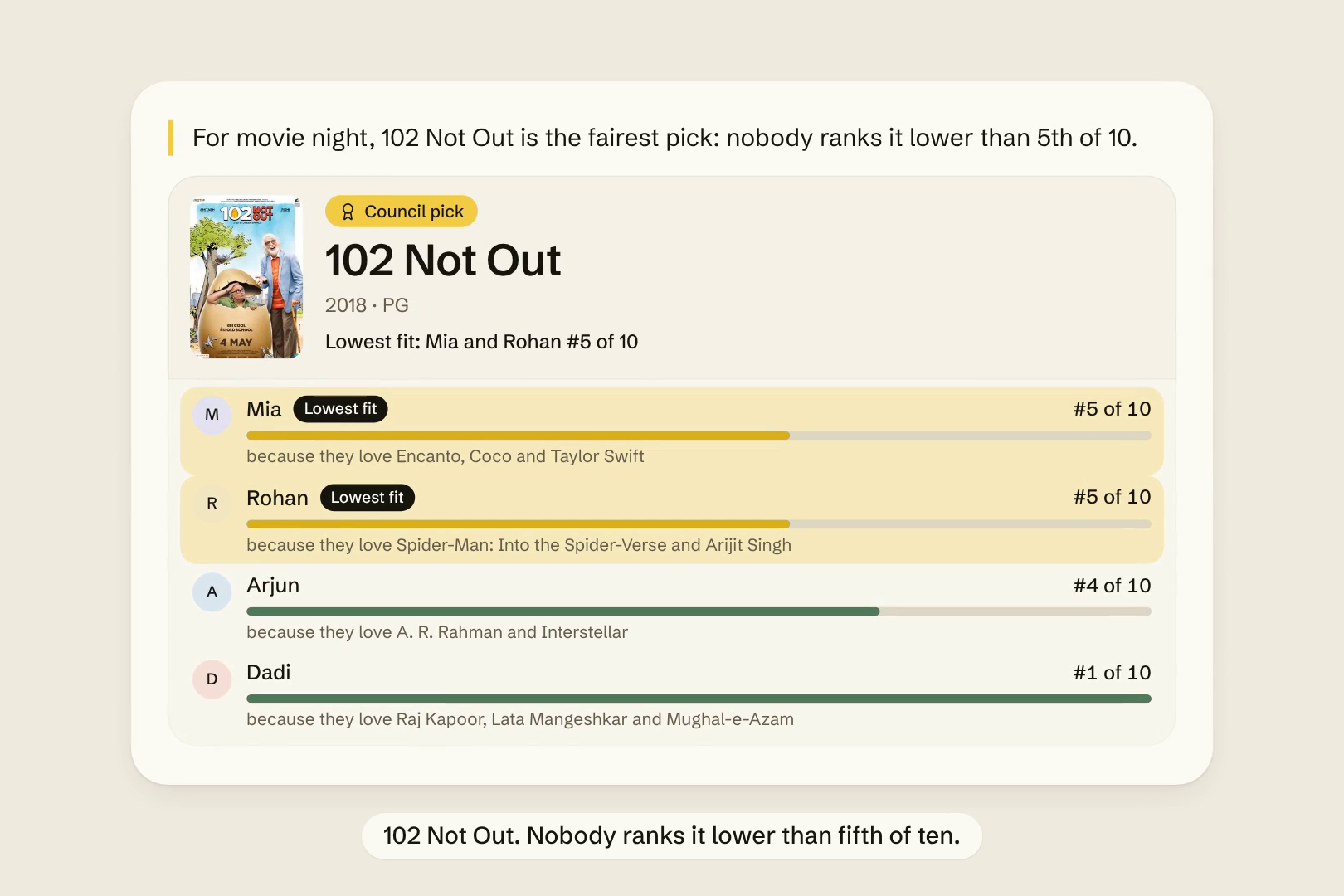
- It speaks one sentence ("For movie night, B works for everyone: it ranks in the top 3 for Arjun, Dadi, Mia and Rohan."), naming only the people Qloo actually ranked it for, and shows each person's rank, the runner-ups, and every Qloo call with its arguments, status and time.
You can use it three ways: the Ask the council button on the Home page, the voice and text assistant on that page (Gemini on Vertex AI decides to call the council), or any MCP client such as Claude or ChatGPT through the taste_council tool.
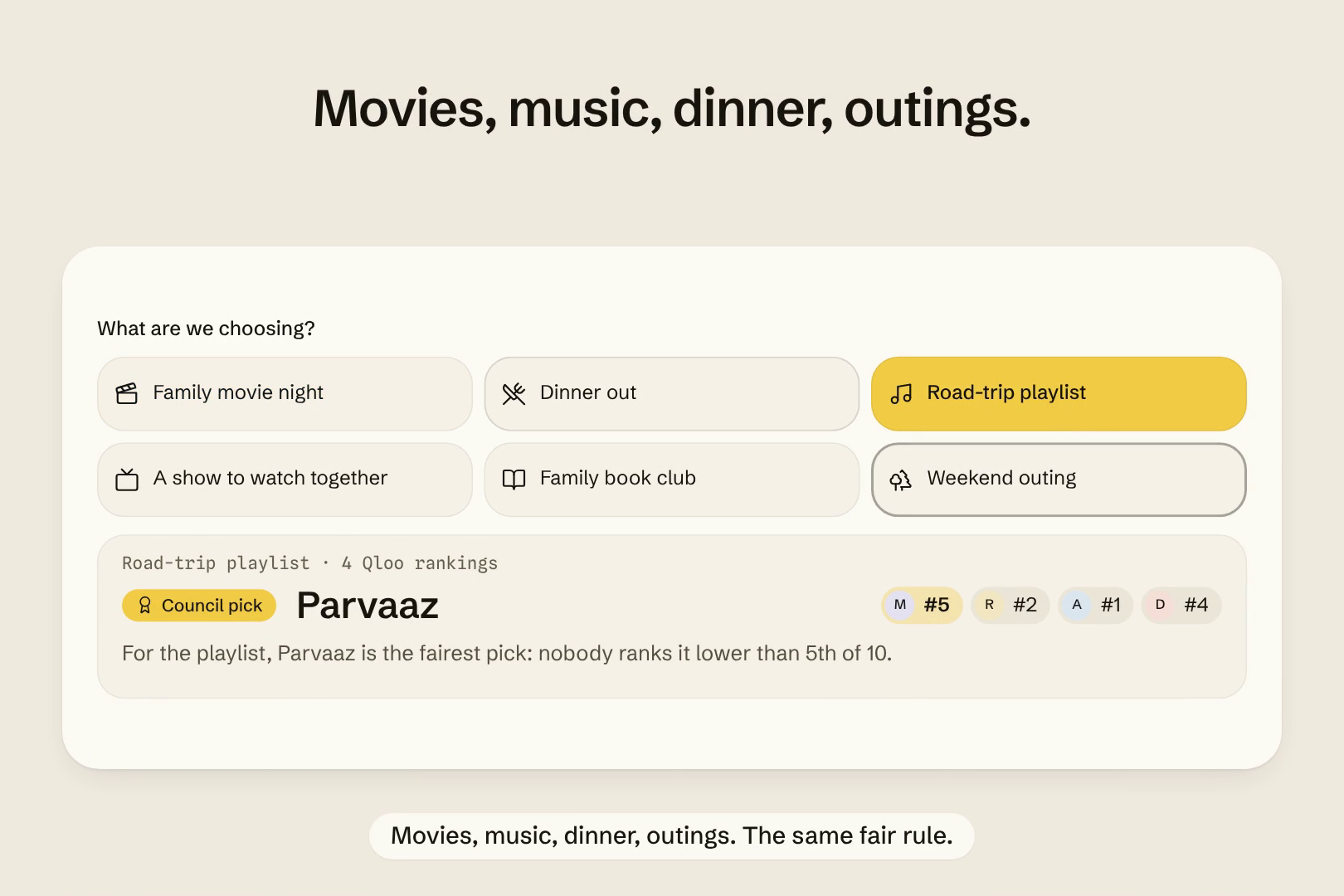
Occasions: family movie night, a show to watch together, a road-trip playlist, a family book club, dinner out, and a weekend outing.
How we built it
- Qloo through its official harness. The server starts
qloo mcpfrom@qloo/[email protected]as a child process and talks to it over MCP stdio. That is the route Qloo's hackathon kit recommends. The harness resolves names like "Encanto" to Qloo entities, and returns a normalised envelope with a status (ok,needs_input,error, ...). - Three Qloo tools.
qloo_recommendfor candidates per person,qloo_rankfor each person's order of the shared shortlist, andqloo_capabilitiesto check readiness without calling Qloo. - Signals from memory. A person's named favourites become
signals. Concepts like "thrillers" becomesignal_tags. An age band becomes a demographic phrase ("teens", "adults 35-44", "seniors"), sent withsignal_locationwhen a location is known. Places also getfilter_location: "Bandra, Mumbai" filters to Bandra and signals Mumbai. Dinner uses Qloo's restaurant genre; an outing uses place categories such as parks and museums, excluding restaurants. A vegetarian's or vegan's dinner calls carry Qloo's vegetarian or vegan options tag, so places without them rank last for that person. - Names resolved once. The harness answers
needs_inputfor most names ("Coco" is a film and three albums). The council chooses a film or artist over an album, remembers the Qloo id intaste-entities.json, and sends the id from then on. The demo family starts out resolved. - Deterministic decision. The shortlist, maximin, tie-breaks, Keeper's vetoes and the spoken sentence are plain TypeScript. No model chooses the winner.
- Provenance in the UI. Every Qloo call is recorded with tool, arguments, status, result count and milliseconds, and shown under "Qloo calls" on the result.
- MCP tools.
taste_councilandtaste_profilejoin the household server's other tools, so any MCP agent can call them. Streamable HTTP, OAuth, and approval-before-action were already there. - Gemini on Vertex AI.
AGORA_SERVER_LLM=vertexruns the assistant's tool loop on Gemini (defaultgemini-3.8-flash, andgemini-3.5-flash-litefor spoken turns) through Vertex AI's OpenAI-compatible endpoint, authenticated with Application Default Credentials. - Cloud Run. One instance, the Qloo key from Secret Manager, the harness installed in the Docker image, and a fictional demo family written into empty memory at start-up.
- Tests. The council is tested against a scripted stand-in for
qloo mcp, so tests make no Qloo calls. Theserver/tastetests (92) pass, as do the MCP, Home page and Vertex provider tests. - Live. On the deployed demo (31 Oct 2026), each of the six occasions answered
okwith 8 Qloo calls and noneeds_input, in 1.5 to 3 seconds warm (18 seconds cold). The picks and ranks are in QLOO.md.
Challenges we ran into
qloo_ranktakes at most 10 options. Four people times eight candidates is up to 32. We cut the shortlist to 10, taking candidates round-robin so every person is represented.- Scores from separate calls are not comparable. Qloo says so in the tool description. We use only each person's ordinal rank, which is also what makes maximin meaningful.
- A demographic needs a location. Age signals are sent only when the request or
AGORA_TASTE_LOCATIONgives one. Without it the council still works, with no age signal. - "Children" is not a recognised demographic. We map age bands to phrases Qloo's harness understands: teens, young adults 18-24, adults 25-34 through 45-54, seniors. A 9-year-old is sent as "teens", which the harness maps to its youngest bucket (24 and younger).
- One unresolved entity fails the whole call. If one of Dadi's favourites is ambiguous, the call returns
needs_input. We choose a match by type (a film or artist over an album of the same name), retry once with its id, show both calls, and remember the id so the next council does not ask again. - Gemini 3 thought signatures. Gemini returns a signature on each function call and rejects the next request with HTTP 400 unless that signature comes back on the call. Our tool loop uses the Messages shape, which has no slot for it, so we carry it on the tool-use block and send it back. For older history with no signature we send Google's documented placeholder.
- Thinking budgets. Gemini 3's thinking tokens count against
max_tokens. The voice loop asked for 400 tokens and got empty answers. We set a 2048-token floor and a low reasoning effort. Flash rejectsminimalwith HTTP 400, so Flash getslowand Flash-Lite getsminimal. - Quota. A four-person council is eight Qloo calls, and the harness turns each call into several requests of its own. We run one call at a time by default, retry a 429 after 1.5 s and 4 s within a 40-second council deadline, and cache results for 30 minutes.
Accomplishments that we're proud of
- The decision is fair by construction, and you can see why: each person's rank is on screen, and so is the person the pick suits least.
- Every Qloo call is visible, with its arguments. Nothing is hidden behind "the AI decided".
- Qloo became a tool for any agent. Claude, ChatGPT, or our own Gemini assistant can call
taste_counciland get the same grounded answer. - No personal data goes to Qloo. First names, exact ages, allergies and diets stay on the server.
- The Home card works with no language model at all. A model is only needed to understand a spoken question.
What we learned
- Qloo is strongest across domains. A singer and a filmmaker are good signals for ranking films, and that is exactly what a family's mixed favourites look like.
qloo_rankis the right tool for group decisions. Recommending for a blended profile hides whose taste won. Ranking one fixed list per person makes that visible.- An agent-facing tool needs honest statuses.
needs_input,degradedanderroreach lead to a different next step, and an agent can only act well if it is told which one happened. - Keep the model out of the decision. Gemini is good at hearing "something for me and Dadi" and calling the tool with the right arguments. Code is better at a rule the family can check.
What's next for AGORA+ Taste Council
- Ask the person when
needs_inputoffers several matches, instead of choosing for them. - Use more of Qloo's tools:
qloo_describeandqloo_entity_tagsto explain a pick in words the family uses,qloo_find_tagsto turn "street food" into a Qloo tag before it is sent, andqloo_compare_audiencesto show where two people's tastes overlap. - A finer age filter for children: today only adult ratings are left out, so TV-14 and PG-13 still pass for a 9-year-old.
- Let the family weight the rule: maximin by default, with an option to favour the person whose turn it is.
- Learn from outcomes: "we watched B and Dadi loved it" becomes a new memory fact and a new signal.
Responsible use
- Qloo results are aggregate cultural affinities, not predictions about a person. The app says so under every result.
- What goes to Qloo: entity names, tags, an age-band phrase, a location, and Qloo entity ids. What stays local: names, exact ages, allergies, diets, and the fact text.
- Keeper's allergy and diet check is a keyword check on Qloo's metadata, not a menu check. The diet tag only says whether Qloo lists vegetarian or vegan options.
- Nothing is booked or bought.
- The demo family is fictional.
Built With
- docker
- gemini
- google-auth-library
- google-cloud-run
- model-context-protocol
- node.js
- playwright
- qloo
- qloo-harness
- react
- secret-manager
- tailwindcss
- typescript
- vertex-ai
- vite
- vitest
- zod


Log in or sign up for Devpost to join the conversation.