-
-

Agora
-
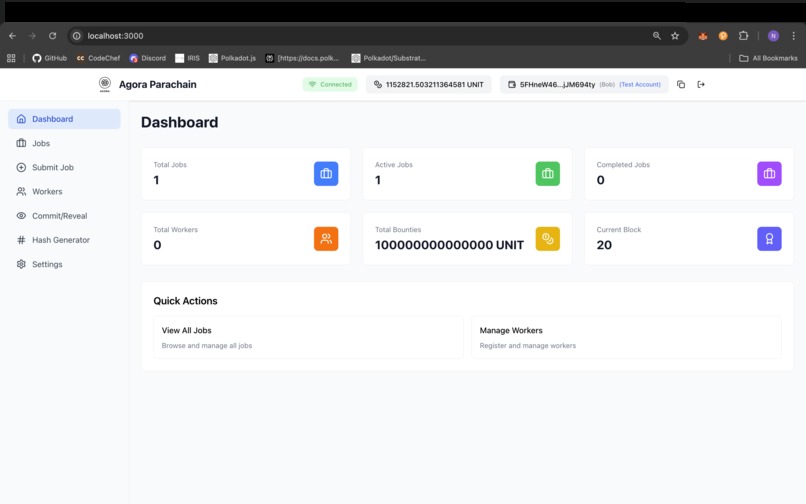
UI Dashboard
-
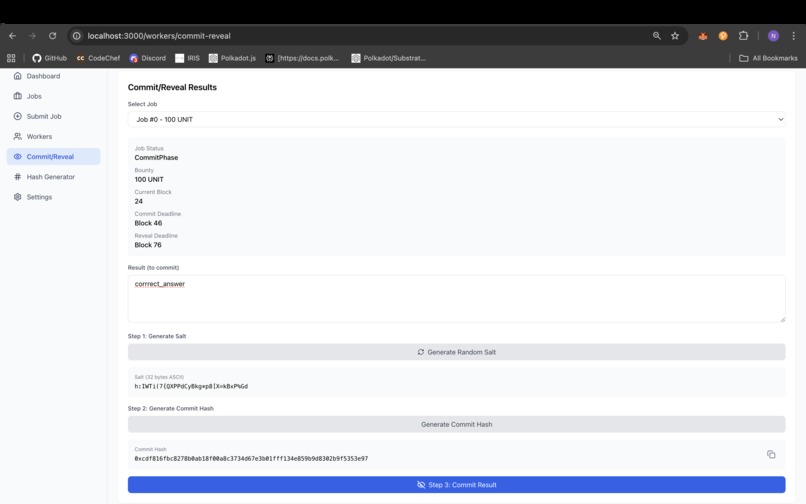
Commit Result

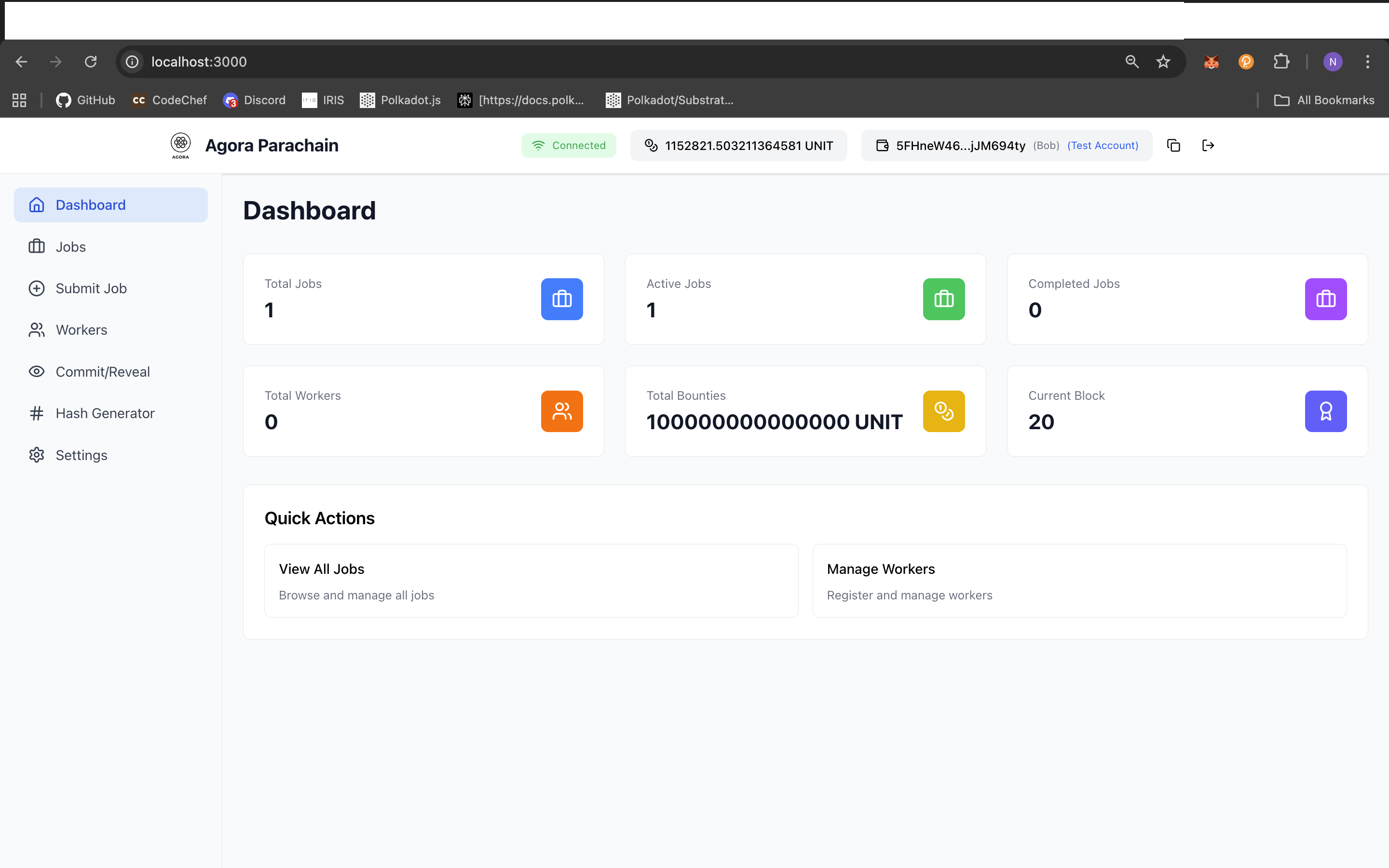
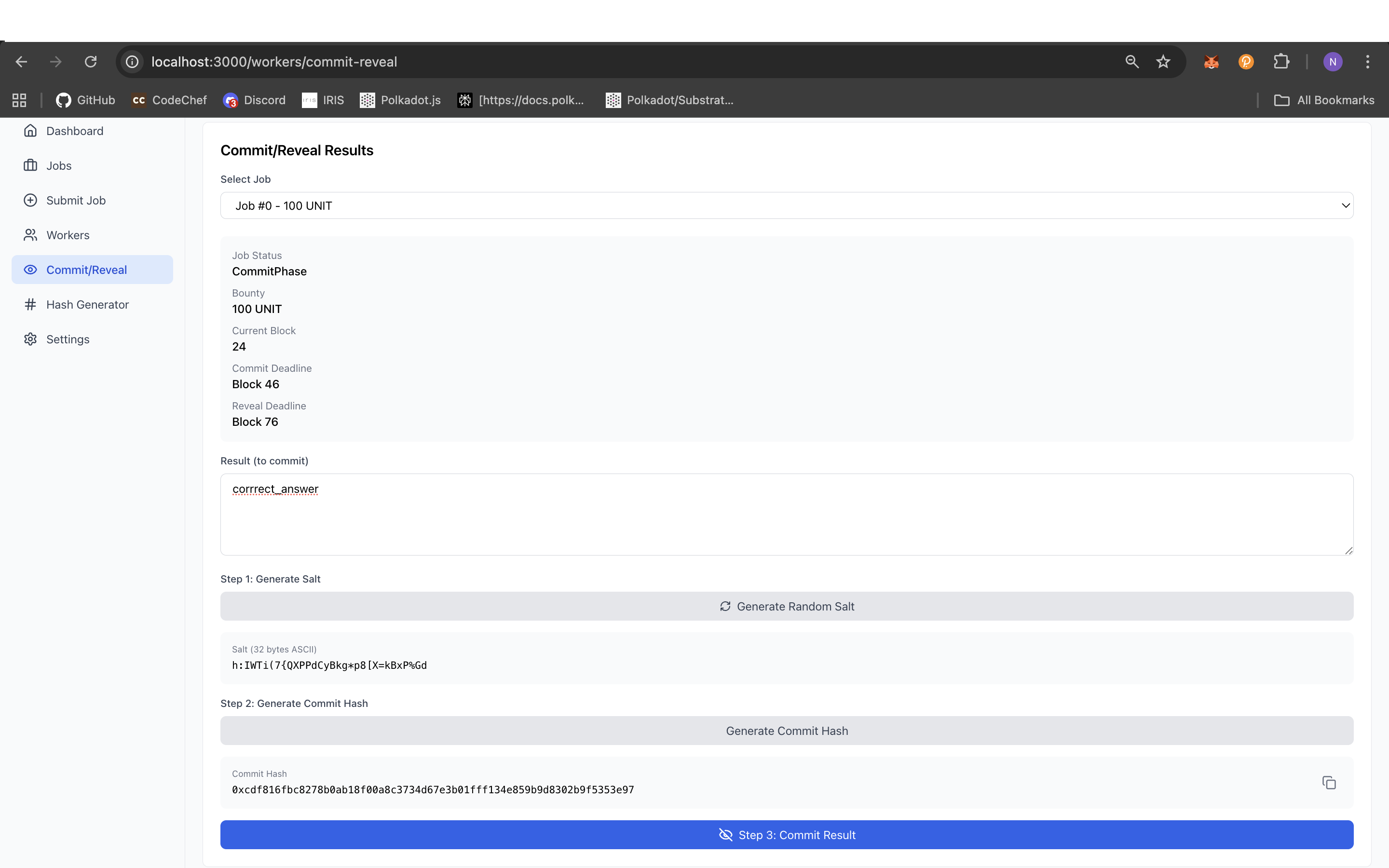
Agora
Verifiable Off‑Chain Computation via Commit‑Reveal and XCM
Agora is a Polkadot parachain template extended with a verifiable computation marketplace. It enables parachains to outsource off‑chain jobs (API fetches, computations) to a network of staked workers. Results are verified on‑chain using a crypto‑economic commit‑reveal game. Cross‑parachain requests and result delivery use XCM. This instance has been obtained with paraid 5024 on the Paseo test network.
Why Agora
- Verifiable correctness without trusted hardware: commit–reveal with on‑chain verification ensures results are independently checkable.
- Decentralized worker marketplace: staked workers compete to execute jobs; dishonest actors are slashed, honest majority is rewarded.
- XCM‑native interoperability: submit from one parachain, execute on another, and receive results back seamlessly.
- Flexible execution off‑chain: leverage OCWs and external infrastructure for low‑latency IO and scalable compute.
- Deterministic on‑chain settlement: rewards, slashing, and consensus resolution are transparent and reproducible.
Use Cases:
• Oracle data aggregation: Request external API data (price feeds, weather, sports scores) from multiple workers, reach consensus on the correct value, and deliver verified results to DeFi protocols.
• Decentralized computation: Offload intensive computations (cryptographic operations, data processing, ML inference) to a distributed worker network without relying on a single centralized service.
• Cross-chain data verification: Enable parachains to request computation from other chains in the Polkadot ecosystem, leveraging specialized compute resources while maintaining trust through majority consensus.
• API reliability: When a single API endpoint is unreliable, multiple workers can fetch from different sources or endpoints, with the majority result being the canonical answer.
Why Polkadot Architecture is Ideal:
• Native cross-chain communication: XCM (Cross-Consensus Message Format) enables seamless job submission and result delivery between parachains without bridges or wrapping. Agora leverages this to create a truly interoperable computation marketplace.
• Shared security model: Parachains inherit security from the relay chain validators, eliminating the need for Agora to bootstrap its own validator set. This reduces costs and increases trust for users submitting jobs.
• Sovereign execution environment: As a parachain, Agora can customize its runtime specifically for computation marketplace logic (commit-reveal timing, reward distribution, slashing parameters) without constraints from other chains.
• Economic interoperability: Polkadot's native asset transfer via XCM allows job creators to pay bounties in their own parachain's token, while workers receive rewards in Agora's native token—all atomic and trustless.
• Scalability through specialization: Dedicated parachain slot allows Agora to optimize for high-throughput job processing without competing for block space with other applications. OCWs can process jobs off-chain and only submit commits/reveals on-chain.
• Future-proof upgrades: Runtime upgrades enable Agora to evolve its consensus mechanism, add new job types, or adjust economic parameters without hard forks, maintaining backward compatibility.
Live Walkthough
High‑Level Architecture
- Runtime (
runtime/): FRAME‑based runtime with balances, collator pallets, XCM helpers, and theagorapallet. XCM is configured for local testing with permissive filters. - Node (
node/): Collator binary that runs the runtime, exposes RPC, and connects to the relay chain. - Agora Pallet (
pallets/agora/):- Job lifecycle: submit -> commit -> reveal -> finalize
- Staking and bounty holds; rewards/slashing; simple reputation
- Off‑Chain Worker (OCW) helpers for job execution and commit/reveal guidance
- XCM client/handler for cross‑parachain job requests and result notifications
- Zombienet configs (
zombienet-*.toml): Local networks with relay chain + 2 parachain instances for XCM demos. - Scripts (
JS/): Utilities to fund sovereign accounts, open HRMP channels, and run a cross‑chain job demo.
Repository Layout
node/– Collator service (AURA consensus, networking, RPC)runtime/– Runtime types, pallet composition, XCM config (runtime/src/configs/xcm_config.rs)pallets/agora/– Verifiable computation palletlib.rs– Storage, events, errors, extrinsics, hooksfunctions.rs– Consensus, rewards/slashing, lifecycle processingocw.rs– Off‑chain worker execution helpers (simulated HTTP/compute), commit/reveal guidancexcm_job_client.rs– Build/send XCM job requests, receive resultsxcm_handler.rs– Handle incoming XCM job submissions, send results backtypes.rs– Job, worker, commit/reveal, OCW types
zombienet-xcm.toml– Relay + two parachains (IDs 1000, 2000) with XCM tracing enabledJS/setup-hrmp.js– HRMP channel setup, sovereign funding, andagora.requestRemoteJobdemo
Build
Prereqs: Rust toolchain (nightly as per rust-toolchain.toml), wasm32 target, Node.js (for scripts), and a polkadot relay binary.
# From repo root
 cargo build --release -p parachain-template-node --bin parachain-template-node

# Optional: install the collator binary somewhere on PATH
sudo cp target/release/parachain-template-node /usr/local/bin/

# Ensure a polkadot relay node is available on PATH (or provide absolute path in Zombienet)
sudo cp polkadot /usr/local/bin/polkadot
Run: Local Multi‑Chain Network (Zombienet)
This repo includes zombienet-xcm.toml to boot a relay chain (rococo‑local) and two parachain instances for XCM testing.
# Example with zombienet (ensure you have it installed)
zombienet -p native spawn zombienet-xcm.toml
Key ports (from zombienet-xcm.toml):
- Relay RPC/ws: 9944/9988
- Para 1000 RPC/ws: 9946/9990
- Para 2000 RPC/ws: 9947/9991
HRMP + XCM Demo
Use the provided Node.js script to fund sovereign accounts, open HRMP channels, and dispatch a cross‑chain job request.
pnpm i || npm i
node JS/setup-hrmp.js
The script performs:
- Funds sovereign accounts (relay and cross‑parachain)
- Opens HRMP channels 1000 ↔ 2000 using XCM
Transact - Debug.js to verify the status of the parachains.
Agora Pallet – On‑Chain API
Extrinsics (selected):
agora.submitJob(job_type_id, input_data, bounty,reputation)– Submit a local job with a bounty holdagora.registerWorker(stake)/agora.unregisterWorker()– Worker enrollment with stakingagora.commitResult(job_id, salt, result_hash)– Commit phaseagora.revealResult(job_id, result)– Reveal phase; pallet verifies salted hashagora.finalizeJob(job_id)– Finalizes by consensus (auto‑finalization also runs inon_initialize)agora.requestRemoteJob(dest_para_id, input_data, bounty, reputation)– Send cross‑para job via XCM
Events include job submission, commits/reveals, finalization, rewards/slashing, and XCM‑related notifications.
Storage highlights:
Jobs,Workers,Commits,Reveals,Results,PendingJobs,RemoteJobInfo,NextJobId,JobNonce.
Consensus and rewards:
- Majority of reveals determine the canonical result.
- Honest workers split the bounty; dishonest workers lose reputation and have stake reduced.
Off‑Chain Worker (OCW)
- Scans for pending jobs and simulates execution for:
- API requests: returns simulated payloads (upgradeable to real HTTP with proper signing/validation)
- Computation jobs: hash/math/crypto/json toy tasks
- Generates salted commits and logs ready‑to‑submit
commitResult/revealResulttransactions. - Automation of signed extrinsic submission can be enabled in future work.
Configuration and Parameters
Runtime (runtime/src/lib.rs) sets:
- Block time: 6s; weight/fee mapping
Agoraconstants:MinWorkerStake,MinJobBounty, commit/reveal durations, limits- XCM router: Parent UMP + XCMP; permissive
BarrierandEverythingfilters for local testing
Harden for production:
- Restrict XCM execute/send filters; require paid execution with proper fee trading
- Tighten
LocationToAccountIdconversions and origins - Replace simulated OCW HTTP with a secure, signed, and verifiable approach


Log in or sign up for Devpost to join the conversation.