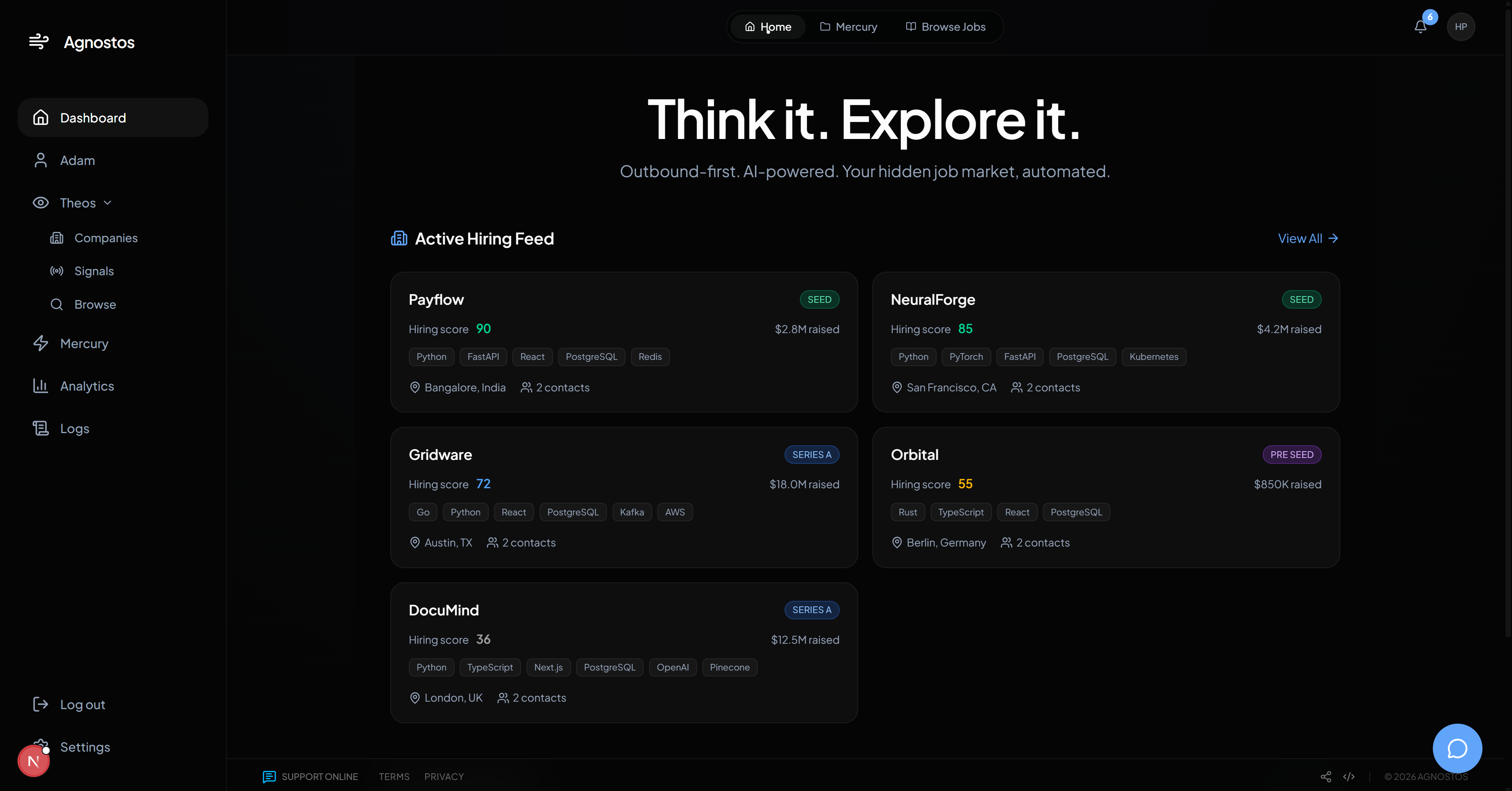
Agnostos
Hidden research opportunities, decoded by AI.
Inspiration
In academia, the most prestigious opportunities are rarely found on job boards. Over 70% of Research Assistantships, Post-docs, and Summer Internships are never publicly advertised on sites like LinkedIn or Indeed. They exist in the "Hidden Research Market"—circulating through departmental mailing lists, grant approval notices, and private faculty discussions.
We watched brilliant students spend months mass-applying to generic portals, only to be met with silence. Meanwhile, the best roles went to those who knew exactly when a Principal Investigator (PI) received new funding or when a lab was pivoting to a new experimental focus. We asked ourselves: what if an AI could act as a world-class academic advisor? One that scans ArXiv, ResearchGate, and University directories to find the perfect lab match before the vacancy is even written.
What it does
Agnostos is an AI-powered platform that automates the discovery of research opportunities through three specialized agents:
- Adam (The Scholar Architect): Builds a "Research Vector" of the user. It parses CVs, GitHub repositories, and past lab reports to understand technical niches (e.g., Muon g-2 measurements or CV-based particle tracking).
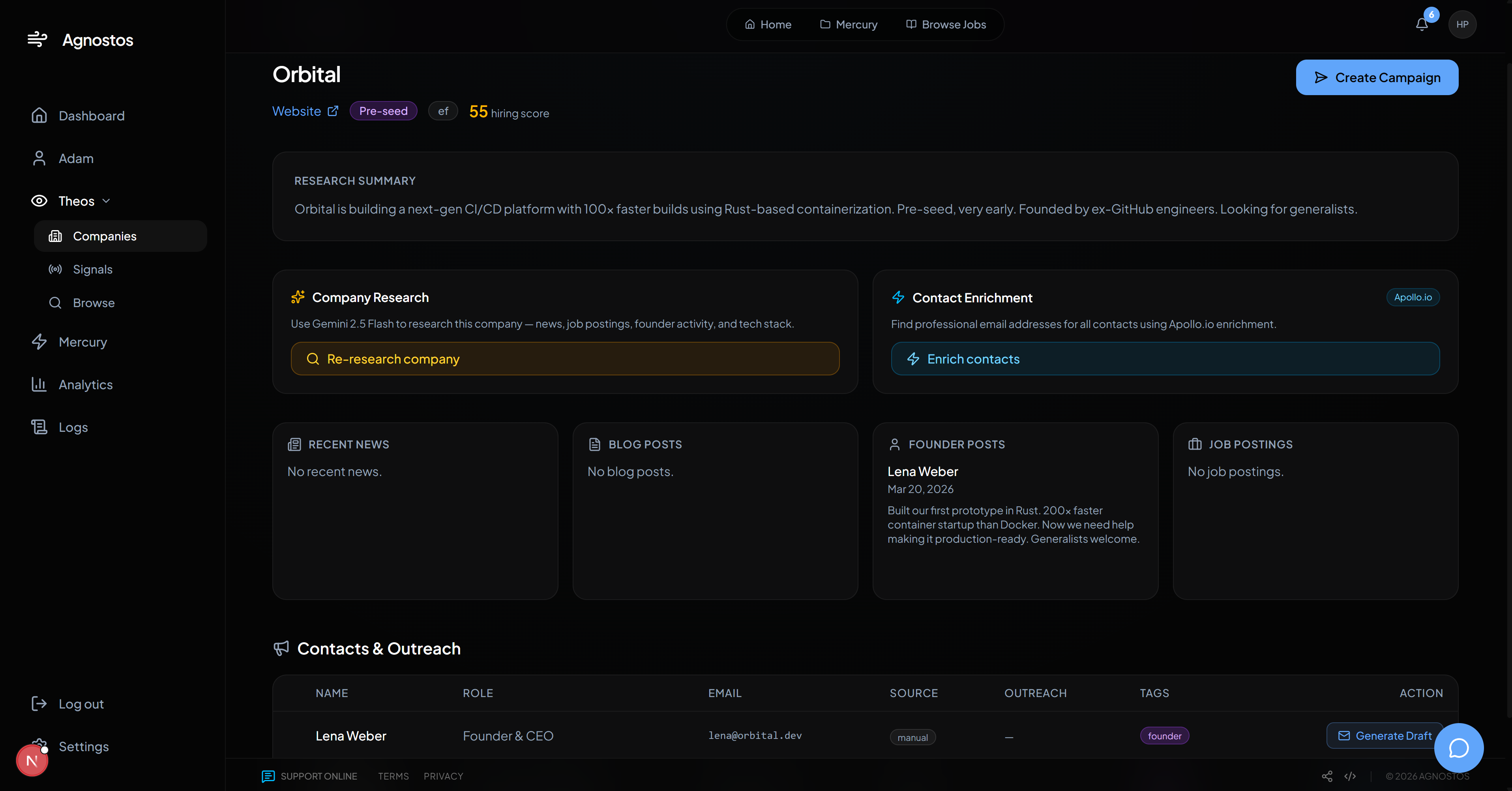
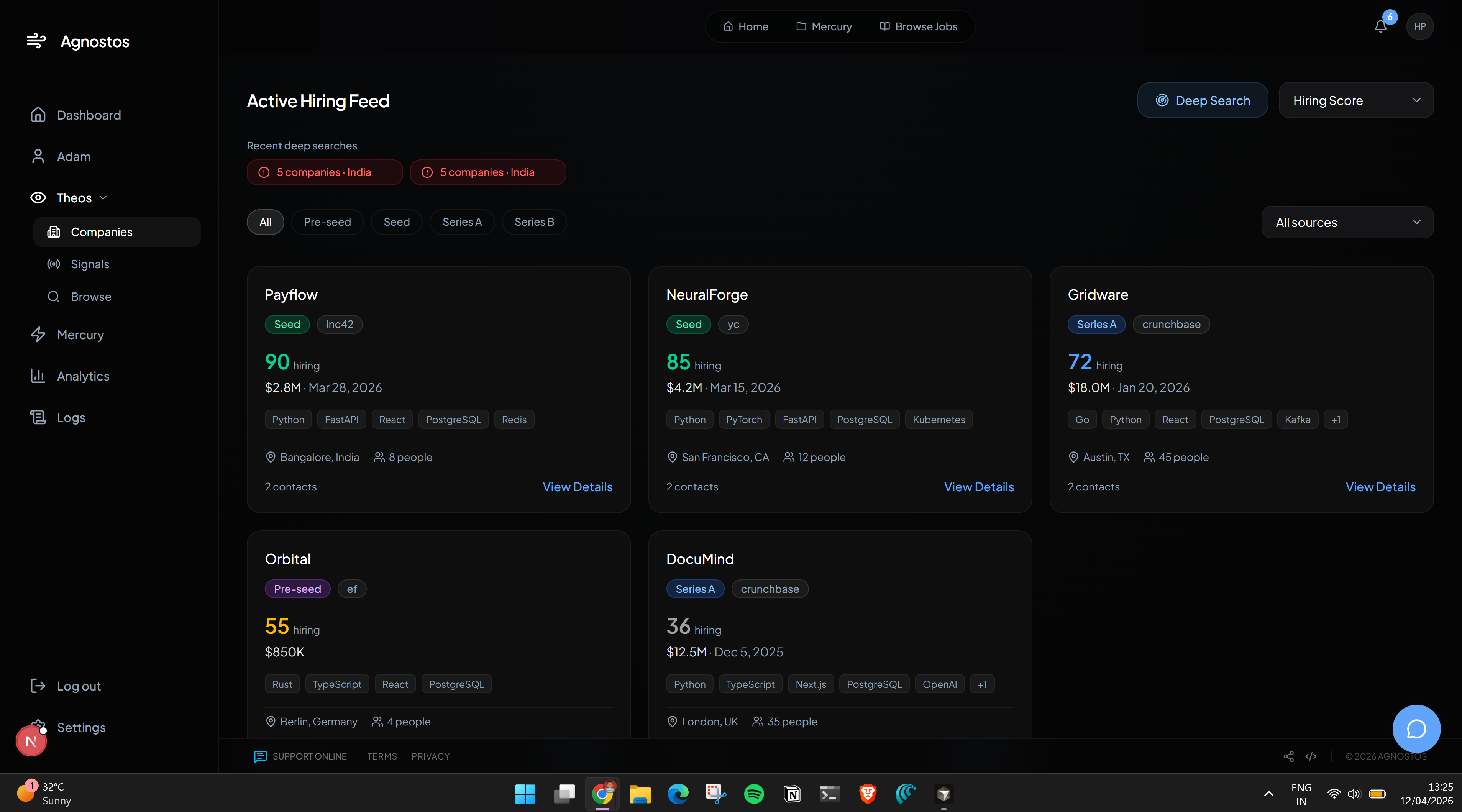
- Theos (The Opportunity Engine): Conducts autonomous "Deep Search" missions across Google Scholar, ArXiv, ResearchGate, and University faculty pages. It identifies "Intellectual Signals"—tracking who just got a grant, who just published a breakthrough, and which labs are expanding.
- Mercury (The Outreach Commander): Drafts hyper-personalized academic inquiries. It references the PI’s latest paper and explains exactly how the user's specific skill set (e.g., Python-based scientific simulations) can contribute to the lab’s current goals.
How we built it
- Frontend: Next.js 16, React 19, and Tailwind CSS 4. A Kanban pipeline tracks the journey from "Paper Identified" to "Interview Secured."
- Backend: FastAPI with SQLAlchemy 2 (async). We implemented a custom DNS-to-IPv4 resolution workaround for database stability.
- AI Layer: Google Gemini 2.0 Pro for reasoning and 768-dimensional text embeddings. LangGraph orchestrates Theos’s multi-step research missions, allowing the agent to "think" through a PI's publication history before suggesting a contact.
- Vector Search: pgvector on Supabase stores academic abstracts and user profiles, enabling semantic matching between a student's skills and a lab's research direction.
- Integrations: Nylas for direct Gmail/Outlook integration to manage high-stakes academic correspondence; Deepgram for voice-based profile building.
Challenges we ran into
- Scraping Non-Standard Portals: University websites are notoriously poorly structured. We had to build a robust scraper using Selenium and lxml that could navigate nested faculty directories without getting blocked.
- Academic Sentiment Analysis: Identifying whether a PI is "hiring" based on a publication or grant notice is difficult. We tuned Gemini to look for specific "expansion signals" in research abstracts.
- Async Database Quirks: Overcoming asyncpg DNS resolution issues on local Windows development environments required low-level network overrides.
Accomplishments that we're proud of
- True End-to-End Discovery: Not just a search engine, but a system that connects the dots between a GitHub commit and a CERN research vacancy.
- Agent Autonomy: The Theos agent can autonomously decide to pivot its research strategy if a specific university's portal is restricted, seeking alternative contact info via Scholarly APIs.
- Zero-Config Dev: The entire platform runs with mock data fallbacks, allowing developers to test the complex agent workflows without burning API credits.
What's next
- Grant Funding Tracker: Integrating with NSF and ERC databases to predict hiring 6 months in advance.
- ArXiv Recommendation Feed: A daily curated list of new papers that perfectly align with the user's "Research Vector."
- Collaborative Lab Hubs: Allowing research groups to use Agnostos to find the perfect undergraduate talent.
Built With
- alembic
- asyncpg
- deepgram-sdk-data-/-parsing:-pymupdf
- eslint
- frontend:-next.js-16
- google-genai
- httpx
- langchain
- langchain-google-genai
- langgraph
- lucide-react
- lxml
- numpy-ai-/-ml:-google-gemini
- passlib/bcrypt
- pgvector-infrastructure:-supabase
- postcss-backend:-fastapi
- postgresql
- pydantic
- python-jose
- python-multipart
- react-19
- selenium
- sqlalchemy-(async)
- tailwind-css-4
- tanstack-react-query
- typescript-5
- uvicorn
- websockets
- zustand

Log in or sign up for Devpost to join the conversation.