-
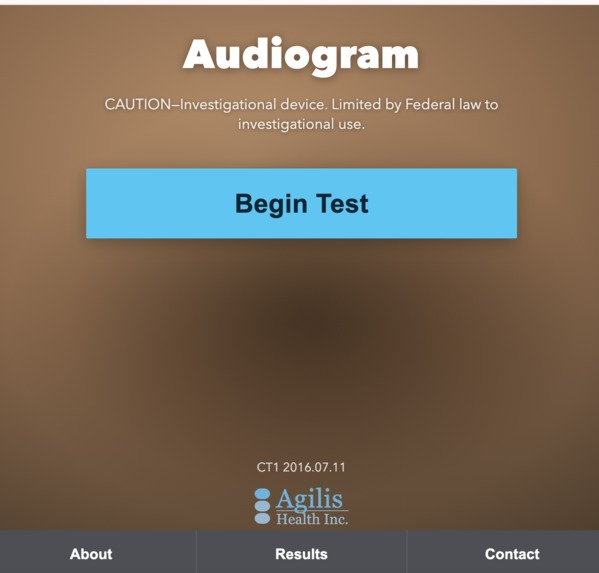
Agilis Home Page
Inspiration
Hearing loss affects around 1 in 5 people, yet most cases go undetected for years — because getting tested means a clinic, an appointment, and a $300 calibrated audiometer. We knew there had to be a better way, especially since almost everyone already owns a pair of headphones. The push got personal: our team's hearing-science research (published in the peer-reviewed literature, rooted in earlier clinical work at Agilis Health) showed a self-administered test could be accurate. And when Apple recently got FDA clearance for a hearing test — but locked it to a single product, AirPods Pro 2 — it confirmed both the demand and the gap: hearing screening should work on any headphones, not one $250 device.
What it does
Agilis Audiogram is a self-administered hearing screener that runs on the headphones you already own:
- Auto-detects your connected headphones and loads that model's calibration.
- Runs a quiet check — the microphone measures background noise and warns you if the room is too loud.
- Verifies your left/right earbuds are in correctly.
- Plays calibrated pure tones; you tap LEFT or RIGHT for the ear you hear each tone in.
- Produces a standard audiogram (250–8000 Hz, red = right / blue = left) with your pure-tone average (PTA) and a plain-language summary.
About six minutes, no clinic, no equipment beyond your headphones.
How we built it
The front end is a single-file web app using the Web Audio API: a pure-tone generator, a modified Hughson-Westlake threshold staircase (down 10 dB on a response, up 5 dB on a miss, threshold confirmed on 2 ascending responses), an ambient-noise octave-band analyzer (ANSI S3.1), and a canvas-rendered clinical audiogram.
The core is the calibration engine. Every headphone converts a digital amplitude to a different loudness, so we built a per-model calibration database driven by:
\( amplitude(f, ear, dBHL) = 10^{(dBHL - fullScaleLevel[f][ear])/20} \)
We seeded it with real, published data — Apple's FDA-cleared RETSPL and attenuation values for AirPods Pro 2, and peer-reviewed JASA values for EarPods — and verified the model reproduces a real 2014 clinical calibration workbook to ~1.8%.
For the App Store path, we wrapped the web app in Capacitor with a native Swift/AVAudioSession plugin that reads the connected headphone route and the system volume — the two things a browser can't do.
Challenges we ran into
The hardest problem: a phone has no idea how loud a given headphone actually is, and iOS exposes no calibrated-tone API to third parties (which is exactly why Apple locked their test to one device). We solved it two ways — real published calibration data for known models, plus a no-hardware calibration method that uses normal-hearing users as the reference, so accuracy improves as more people use it.
Along the way we had to make the science honest: scaling the ambient-noise limits by each headphone's passive attenuation, and — caught by our own Monte-Carlo testing — de-biasing both the calibration (a half-step correction for 5 dB quantization) and the Hughson-Westlake test (a +3 dB correction), which took our end-to-end error from biased to unbiased. We also hit the browser's limits (can't read the headphone model, can't lock volume) and moved those into the native plugin.
Accomplishments that we're proud of
- ~2.5 dB mean audiogram error, unbiased, in end-to-end Monte-Carlo simulation — on par with a sound booth's own ±3 dB tolerance.
- Calibration model that reproduces real clinical data to ~1.8%.
- Works across many headphones (AirPods, EarPods, Beats, Sony, Bose, generic), not just one product.
- A complete flow and a real App Store path (Capacitor + native plugin), not just a mockup.
- We stayed honest: it's a screening tool, not a diagnosis, and we're upfront about which models are calibrated vs. estimated.
What we learned
A crash course in real audiometry — RETSPL reference levels, maximum permissible ambient noise, and the Hughson-Westlake procedure — plus the hard platform realities of calibrated audio on consumer devices. Most of all: with a hardware-limited problem, validation and simulation are everything. Testing our own math is what surfaced the biases we'd otherwise have shipped.
What's next for Agilis Health
Coupler-verified calibration for the top ~10 headphone models, TestFlight → App Store submission, a lightweight crowd-calibration backend so every model gets more accurate with use, and a formal clinical validation study to back real accuracy claims.
Built With
- capacitor
- html
- ios
- javascript
- swift
- web-audio-api


Log in or sign up for Devpost to join the conversation.