-
-
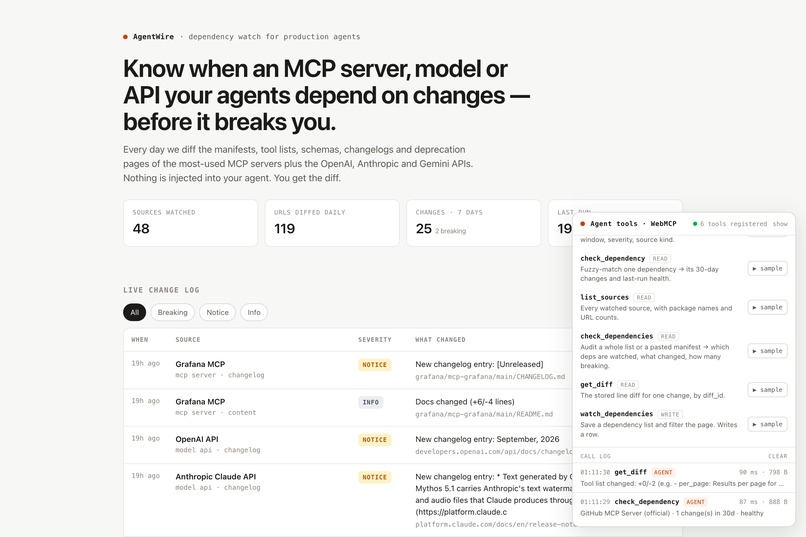
Six WebMCP tools on document.modelContext. Every agent call is logged with its arguments, latency and result, beside the human log.
-
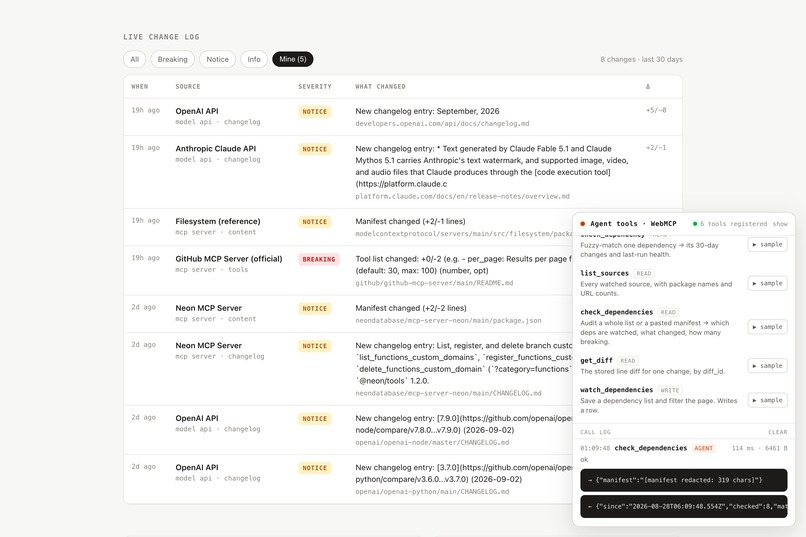
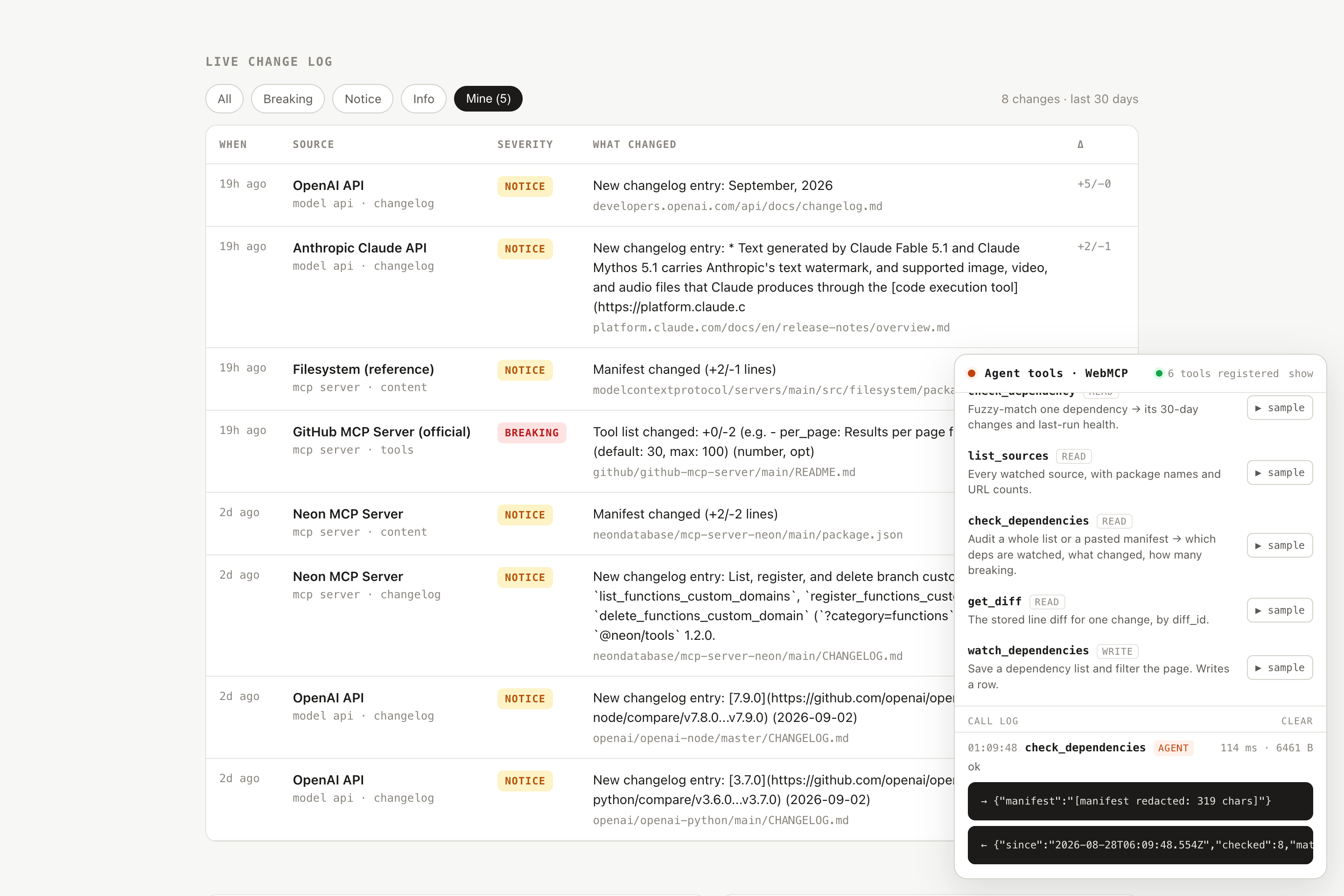
check_dependencies audits a pasted mcp.json in one call: 8 deps matched, 1 breaking. The page filters to that list, manifest redacted.
-
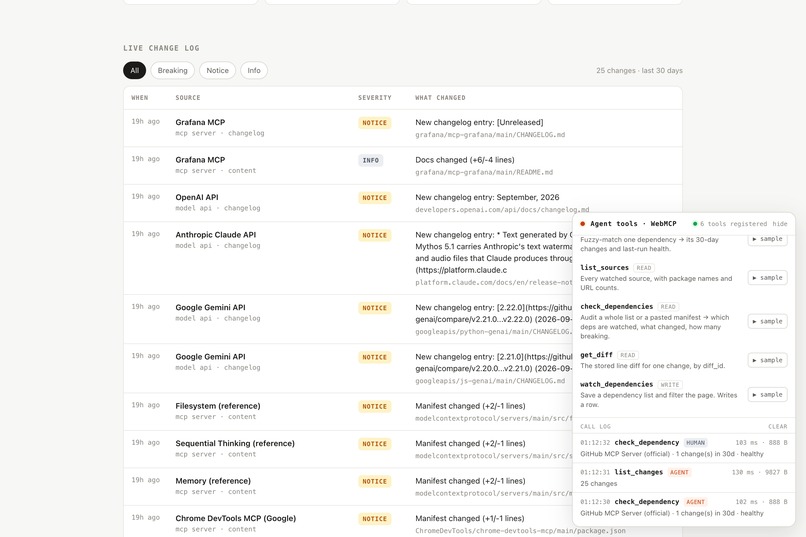
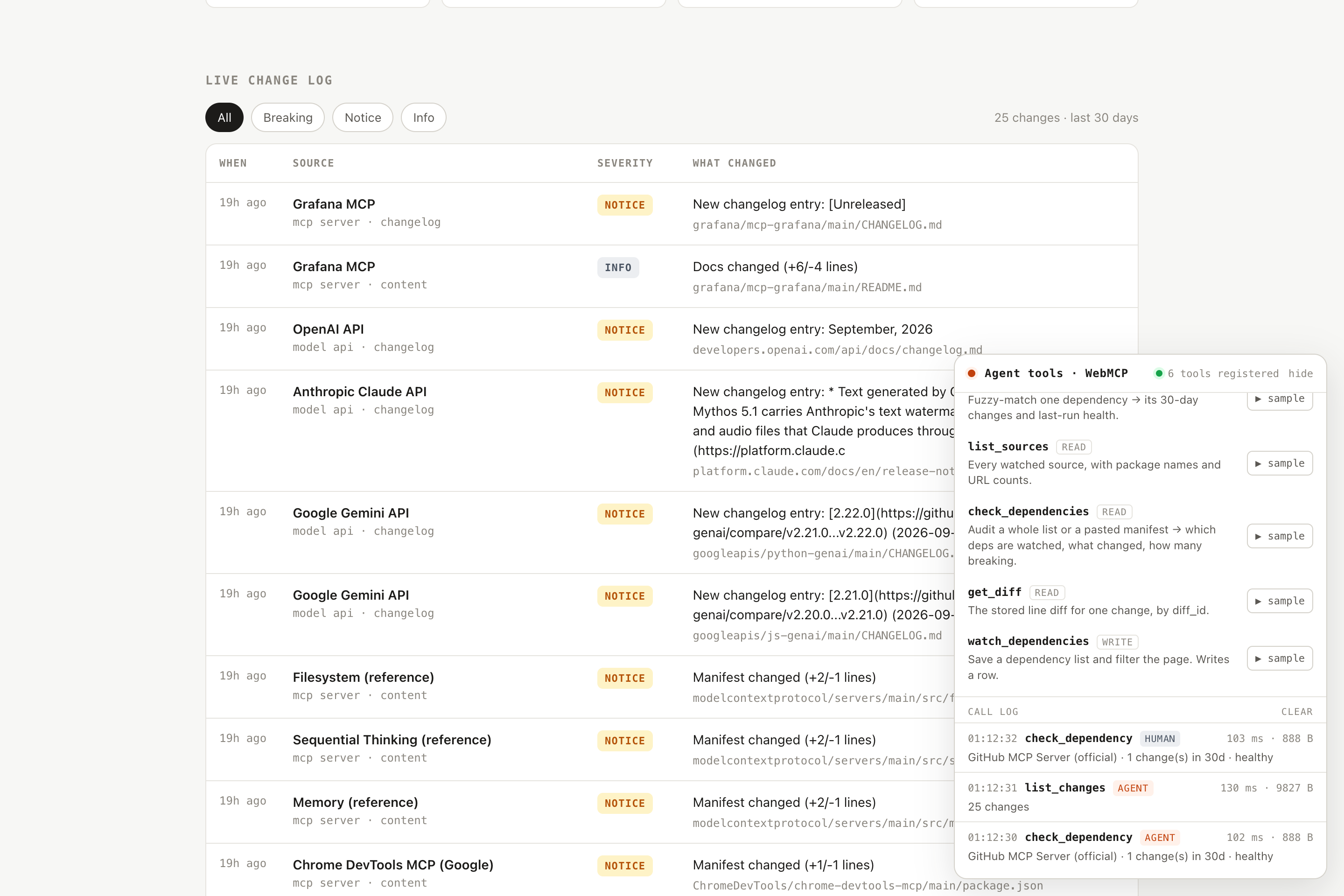
The same function, called by an agent and by a person one click apart. Identical result, tagged HUMAN and AGENT in one log.
What it is
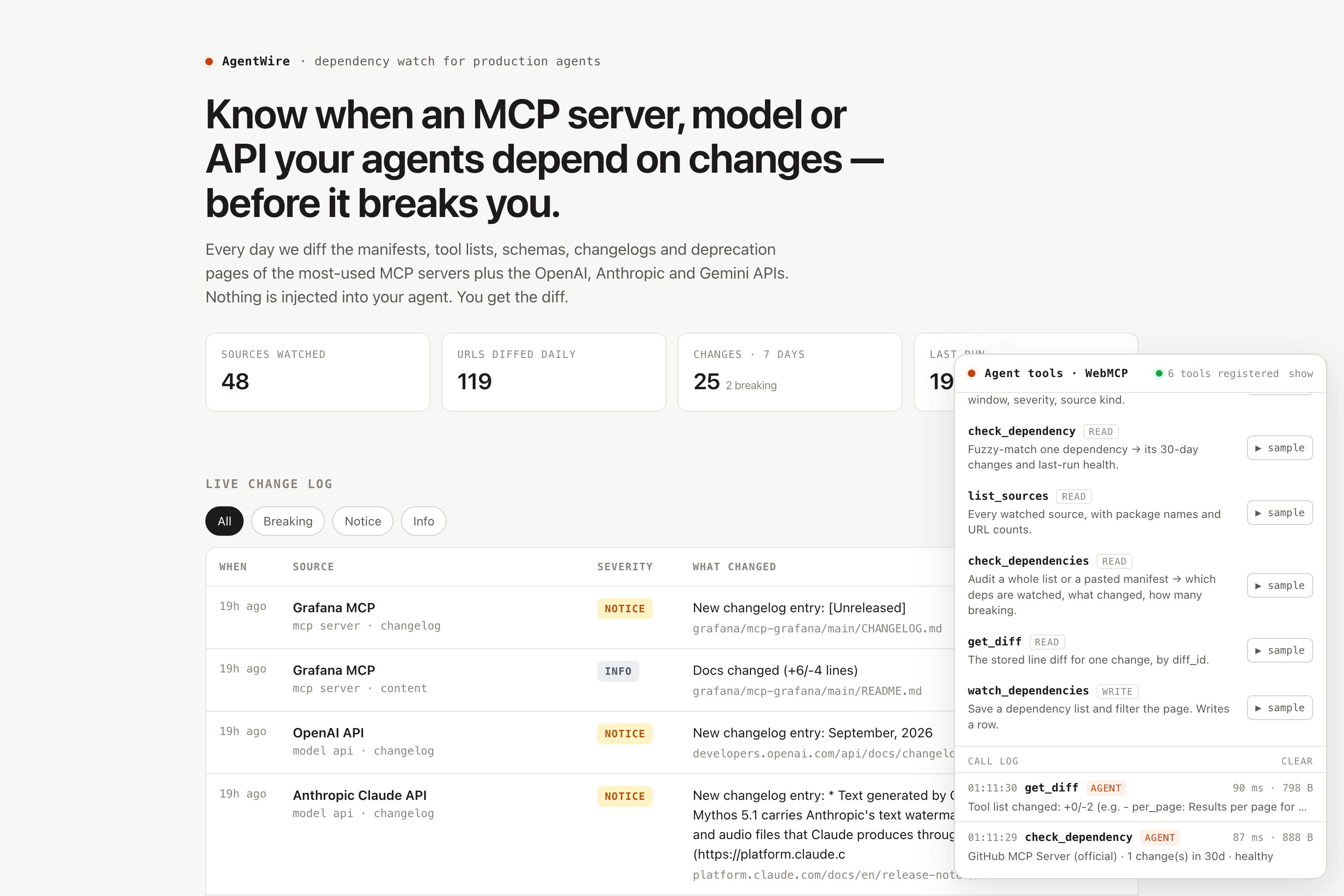
AgentWire watches the things production agents silently depend on — 48 MCP servers, the OpenAI, Anthropic and Gemini APIs, and the MCP spec, SDK and registry, 119 URLs in total — and diffs them every day: package manifests, tool lists in READMEs, JSON schemas, changelogs, deprecation pages. Each change is classified (version bump / schema / tools / changelog / content; info / notice / breaking) and stored with the line-level diff. Humans get a live change log and can save their own dependency list; the page immediately filters to its matches. Alert delivery ships with the pilot. With WebMCP, the agent running in your browser gets the same thing, from the same page, without an API key, an MCP server, or scraping.
Why this use case fits WebMCP
The people who need this data are already running agents, and the question they ask is naturally conversational and contextual: "did anything I depend on change since Friday?", "is the Neon MCP server safe to bump?", "show me the diff, then save this list." That is a tool-calling conversation, not a form-filling one. WebMCP lets the page itself be the tool surface: the six functions are registered on document.modelContext with JSON Schemas, use the same loaded data and PostgREST helper as the human UI, and the browser mediates the call. No separate MCP server to host, no credentials to hand out, no DOM scraping, and the page keeps working as a normal website for everyone without an agent.
The read/write split also maps cleanly onto WebMCP's annotations: five tools are readOnlyHint: true and can be called freely; watch_dependencies is a write, is annotated as such, and its description tells the agent to confirm the email and list with the person before calling it.
How it improves the user experience
- Audit your whole config in one call. The agent pastes your
mcp.jsonintocheck_dependenciesand gets back, per server, whether it is watched, what changed this week, and how many changes are breaking. The page filters itself to your list at the same time, so the person sees exactly what the agent is reasoning about. - Fuzzy dependency lookup instead of scanning a table.
check_dependency("claude-sonnet-4-5")resolves to the Anthropic API source;"github mcp"resolves to the official GitHub MCP server. The agent gets the last 30 days of changes and whether the most recent daily run fetched that source's URLs successfully, so "no changes" is distinguishable from "we couldn't check". - Diff on demand.
list_changesreturns summaries;get_diffreturns the stored-/+lines only when the agent decides a change matters. The agent can read the diff and tell you whether it affects your code path. - Save and filter in one sentence. "Save these for me" becomes a
watch_dependenciescall with the deps the agent already knows you use. The list is stored and the page immediately filters to matching sources; alert delivery is not live yet and ships with the pilot. - The page reacts to the agent. Tool calls mirror the relevant work into the UI: the severity chip flips, the matched source lights up, the diff row expands and scrolls into view, and a saved list fills the form and filters the change log. A small "Agent tools" panel lists the registered tools and logs every call live — tool, arguments, result, latency — so the person always sees what the agent did.
What humans and agents can do together that wasn't possible before
Before: a person opens the site, scans a table, copies package names into a form. Or an engineer builds a separate MCP server and API-key flow so an agent can query the data outside the browser, where the human can't see it.
Now: person and agent share one page and one state. The person asks their browser agent "what changed in the MCP servers we use this week, and is any of it breaking?"; the agent passes the project's config to check_dependencies, reads anything important with get_diff, and the person watches each call land in the panel while the Mine filter shows the same list. The person decides, the agent saves their list with watch_dependencies, and the form shows exactly what was stored while the change log stays narrowed to matching sources. The panel's "▶ sample" buttons let a person run the same functions by hand, so both sides use one code path and one log.
Potential impact
The evidence pack records 25 changes across 13 sources since the Sept 1 baseline, including 2 classified breaking. One was change #19 for the official GitHub MCP Server, a tool-list change. The latest recorded daily run fetched all 119 watched URLs successfully with zero errors.
Implementation
- Front end: a single static
site/index.html(no build step). Data comes from Supabase PostgREST with a read-only publishable key; the only write is one insert intodependency_lists, guarded by row-level security. - WebMCP: on load the page feature-detects
document.modelContext(withnavigator.modelContextas a fallback for older previews) and registers six tools withregisterTool({ name, description, inputSchema, annotations, execute }). Input schemas use JSON Schema with enums, ranges andadditionalProperties: false;executereturns plain objects, which the browser serializes for the agent. Each tool'sexecuteis wrapped so the call, arguments (with pasted manifest bodies redacted), result size and latency are appended to the on-page log, and so the tool can sync the UI (filter chips, Mine list, highlighted source, expanded diff, pre-filled form). - Tools:
list_changes({since_hours?, severity?, kind?}),check_dependency({name})(bigram + token-weighted fuzzy match across source name, id, npm and PyPI package names and model aliases; returns confidence and alternatives),list_sources({kind?}),check_dependencies({deps?, manifest?, since_hours?}),get_diff({diff_id}),watch_dependencies({email, deps[], workflow?}). - Backend (unchanged for this challenge): a Deno edge function on Supabase fetches every watch URL daily via pg_cron, normalizes (npm/PyPI/registry JSON, HTML→text), hashes, multiset-line-diffs against the stored snapshot, classifies, and writes
diffsrows. - Testing:
scripts/webmcp-smoke.mjsis a dependency-free script that launches Chrome with WebMCP enabled, asserts all six names, and has the browser invoke the five read tools plus structured-error cases through the DevToolsWebMCP.invokeToolcommand — the same channel an agent uses.evidence/smoke_live_2026-09-03_final.txtis the current production transcript;docs/webmcp-test-log.mdis historical four-tool evidence.
Challenges
The WebMCP docs disagreed on the namespace (document.modelContext vs older navigator.modelContext), so the page feature-detects both and was verified against Chrome 152 directly. Chrome's execute return value is JSON-serialized by the browser, which shaped the tools to return plain objects. Fuzzy matching model IDs like claude-sonnet-4-5 to an API source needed alias tables plus length-weighted token scoring so short tokens like "pro" don't outrank "gemini". Chrome also does not enforce a tool's inputSchema at runtime, so every tool re-validates its own arguments before building a query rather than trusting the declared enums and ranges.
Prior work vs. work in the submission window
The diff engine (supabase/functions/run/index.ts), schema (supabase/migrations/0001_init.sql, applied 2026-09-01 per its header comment; the Supabase project was created 2026-09-01 22:36 UTC and took its first snapshots at 22:53 UTC, after the Aug 25 window start), the 48-source list and the original human page were built first. The WebMCP work is everything that touches an agent: the six current tools registered on document.modelContext, the UI mirroring and Mine filter, the Agent tools panel with its call log, the scripts/webmcp-smoke.mjs proof that has Chrome itself invoke the tools, and the real-agent demo pipeline in demo/. All of it is in this repository's dated commit history, which starts 2026-09-02 10:38 CDT (evidence/git_history.txt).
Limitations
- Severity is heuristic. "Breaking" is inferred from major version bumps, removed tools or schema fields, and changelog wording; it can over- or under-call. Every change links to the source line so a person can check.
- Fuzzy matching returns a confidence, not a guarantee.
check_dependencypicks the best of 48 sources and lists alternatives; a name that matches nothing returns the watched list instead of a guess. - Alert delivery is not live yet.
watch_dependenciesstores the list (row-level security allows only that insert) and filters the page to matching sources. Email and Slack delivery ship with the pilot. - Coverage is the 48 sources / 119 URLs in
data/sources.json. Private or unpublished dependencies are not watched. - WebMCP is pre-release. The tools register in Chrome 149+ with
chrome://flags/#enable-webmcp-testing(the production origin also carries a WebMCP origin-trial token, so no flag is needed there) and in ChatGPT's browser; other browsers see the page with the panel explaining what an agent would get. - Three daily runs exist so far (Sept 1 baseline, Sept 2, Sept 3), so the history judges can query is days, not months.
See a real agent drive it
The demo uses a real Gemini agent on the production site. Gemini reads the six schemas registered on document.modelContext, invokes all five read tools through Chrome's WebMCP DevTools channel, and updates the same page state the person sees. When asked to save the list without an email, it does not invoke the consent-gated write; it asks for the missing confirmation instead. Model waits are removed; cards and captions make the evidence legible. The harness is in the repo as demo/capture-agent.mjs (Node 22 + Chrome 149+, no npm install) and demo/README.md explains the pipeline. The Agent tools panel on the live site logs any agent's calls the same way, so a judge in ChatGPT's browser — or in Chrome 149+, which needs no flag on this origin because it carries a WebMCP origin-trial token — sees the same log.
Built With
- deno
- firebase
- html5
- javascript
- postgresql
- supabase
- webmcp

Log in or sign up for Devpost to join the conversation.