-
-
Sashboard
-
Additiona details
Inspiration
Inspiration
Modern cloud engineering and DevOps workflows are bogged down by repetitive alert triage, complex multi-step debugging, and time-consuming log analysis. When cloud infrastructure fails or deployment pipelines break, engineers lose valuable hours manually tracing errors across clusters, logs, and configuration files.
We were inspired to build AgentWave to solve this operational bottleneck. By harnessing the massive context windows and advanced multi-agent capabilities of Google’s Gemini models, our goal was to create an autonomous DevOps copilot that can instantly ingest sprawling pipeline logs, diagnose the root cause of a cloud failure, and generate precise infrastructure fixes or Terraform configurations on the fly.
What it does
AgentWave acts as an autonomous AI orchestrator for cloud and DevOps teams:
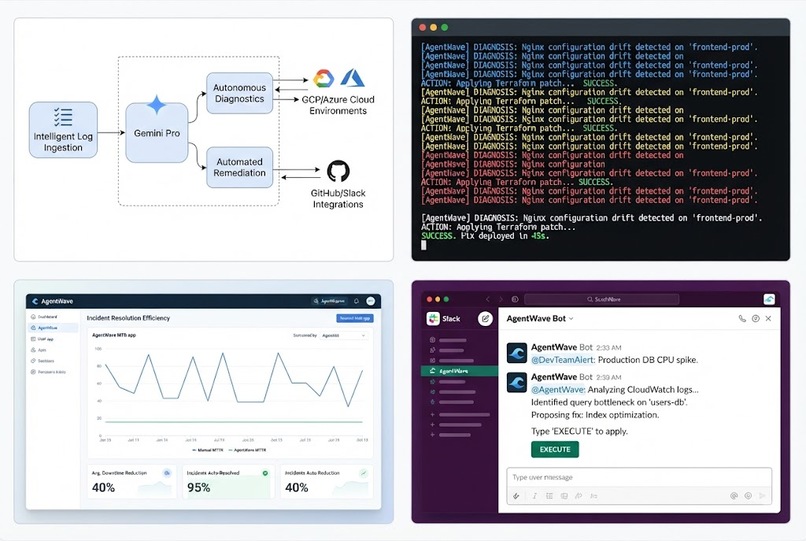
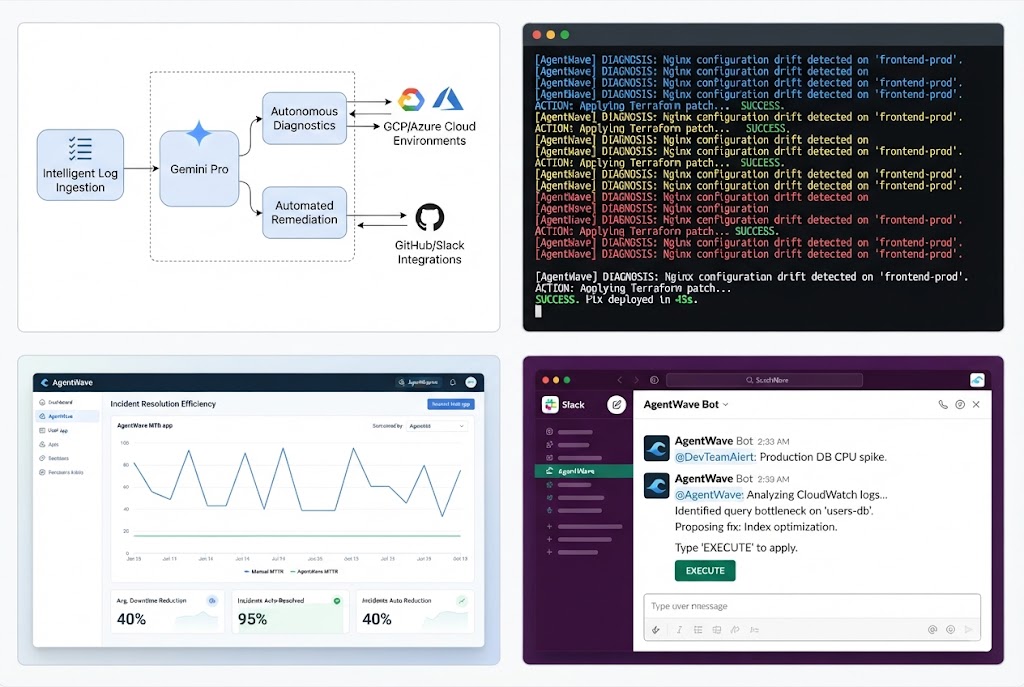
- Intelligent Log Ingestion: Parses massive, unstructured deployment and container logs using Gemini's large context window.
- Autonomous Diagnostics: Identifies failure patterns, configuration drifts, or IAM permission blocks across cloud environments (GCP/Azure).
- Automated Remediation: Generates targeted infrastructure fixes, patches, or secure Terraform snippets directly within the developer's workflow.
- Natural Language Control: Allows engineers to query pipeline statuses and execute diagnostic workflows via simple conversational prompts or webhook alerts.
How we built it
- AI Core: Powered by Google Gemini API for advanced text comprehension, multi-step reasoning, and structured JSON output generation.
- Backend & Orchestration: Built with Python and modern agentic workflow frameworks to handle asynchronous task delegation and tool calling.
- Cloud & Infrastructure: Integrated with containerization tools (Docker) and infrastructure-as-code platforms (Terraform) to simulate real-world DevOps environments.
Challenges we ran into
- Managing Token Limits & Context Windows: While Gemini's context window is massive, optimizing how raw multi-megabyte log files are structured and fed into the model required careful preprocessing to maintain high response accuracy and speed.
- Deterministic Output Formatting: Ensuring that the AI-generated infrastructure patches or Terraform scripts strictly adhered to valid syntax and schema requirements required rigorous prompt engineering and fallback validation handlers.
Accomplishments that we're proud of
- Successfully building a functioning multi-agent pipeline that can parse messy production logs and output valid, production-ready infrastructure remediation steps in seconds.
- Demonstrating a real-world use case where Generative AI directly reduces Mean Time to Resolution (MTTR) for cloud engineering teams.
What's next for AgentWave
- Expanding native webhook integrations for Slack, Jira, and GitHub Actions to automate incident ticket creation and PR patching.
- Enhancing multi-cloud support to provide deeper predictive analytics for preemptive cost and security optimization. ## What it does

Log in or sign up for Devpost to join the conversation.