-
-

Sign In Page
-
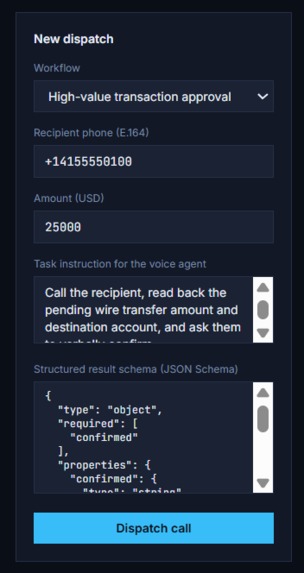
Dispatch Page
-
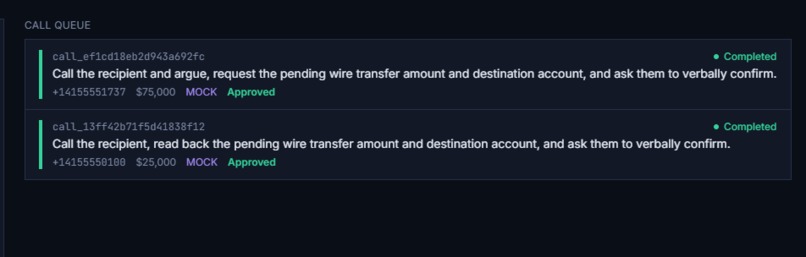
Call Queues
-
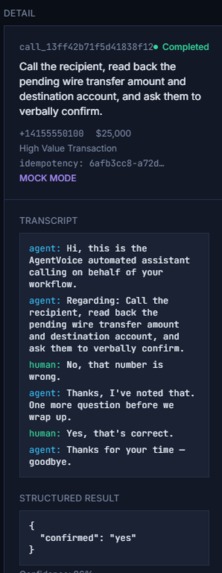
Details

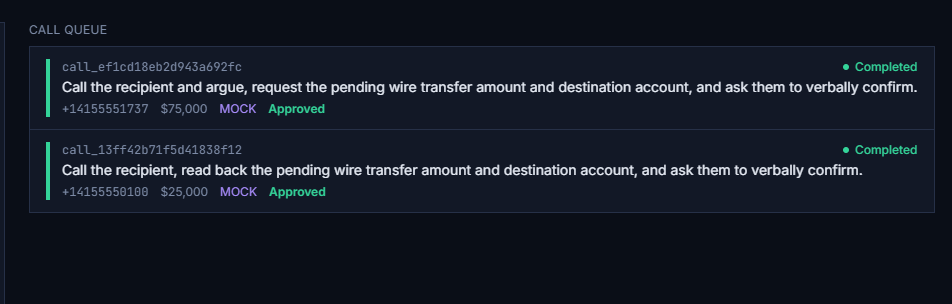
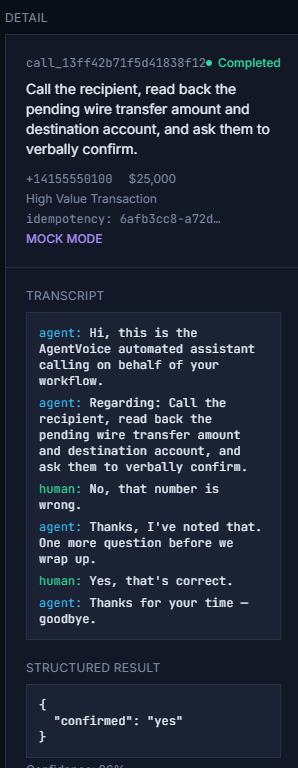
Inspiration I wanted to bridge the gap between automated enterprise software and secure voice verification, especially since modern business workflows require instant authorization gates that cannot be easily spoofed. Traditional text-based multi-factor authentication often creates operational bottlenecks, so I set out to build an intelligent, voice-driven dispatch and approval gateway that leverages the CALL-E SDK to handle critical phone-based verification calls seamlessly.
What it does AgentVoice is a secure, AI-powered phone dispatch and automated voice verification gateway. It initiates intelligent outbound and inbound calls using the CALL-E SDK/API, parses structured JSON result schemas to validate responses, and presents a real-time React dashboard for tracking active calls, live transcripts, and verification status. It also includes an offline mock testing service so I can simulate complete call workflows locally without consuming live API credits.
How I built it I designed a modern full-stack architecture featuring a React, Vite, and Tailwind CSS frontend paired with a robust Python FastAPI backend. I integrated the official CALL-E API client for managing call tasks, applied strict Pydantic models for E.164 phone validation and input sanitization, and built a custom fallback wrapper to handle mock testing and local state simulation gracefully.
Achievements that I'm proud of Successfully engineered a zero-downtime offline mock fallback layer that simulates full-cycle call states and transcript generation without consuming limited API test credits.
Implemented production-grade security features including strict E.164 phone validation regex, UUIDv4 idempotency key enforcement, and automated secret masking.
Delivered a fully modular, end-to-end full-stack architecture optimized for rapid single-session deployment.
Challenges I ran into Managing limited API test credits while trying to build a fully polished application was a major hurdle. I solved this by engineering a dedicated offline mock mode with simulated call state progressions and randomized transcript generators. Ensuring strict payload validation, secret masking, and idempotency keys also required careful planning to maintain enterprise-grade security standards.
What I learned I gained deep practical experience integrating specialized voice-agent SDKs, handling asynchronous webhook/call states, and architecting robust fallback layers for API rate limits. Building a clean, modular structure also taught me how to optimize full-stack applications for rapid, single-session deployment.
What's next for AgentVoice I plan to expand the voice agent's decision tree capabilities, integrate multi-language support for global verification workflows, and connect it with additional enterprise calendar and messaging tools for automated incident response.
Built With
- call-e
- fastapi
- python
- react
- rest-api
- tailwind-css
- typescript
- vite


Log in or sign up for Devpost to join the conversation.