AgentVault — Your Rules Come First
Giving AI agents the ability to pay without giving them unrestricted control over your money.
Inspiration
AI agents are becoming increasingly autonomous. They can research products, book services, manage workflows, and interact with external systems. But what happens when we give them the ability to spend money? Imagine an AI assistant managing your subscriptions, paying utility bills, or purchasing API credits. How do we ensure it only pays authorized merchants, respects budgets, and doesn't execute unexpected transactions?
We built AgentVault to address this problem.
Our goal is to create a financial permission layer where AI agents can act autonomously within clearly defined boundaries, while humans retain ultimate authority over spending.
The idea is simple: AI agents should have permission to act, not unlimited permission to spend.
What It Does
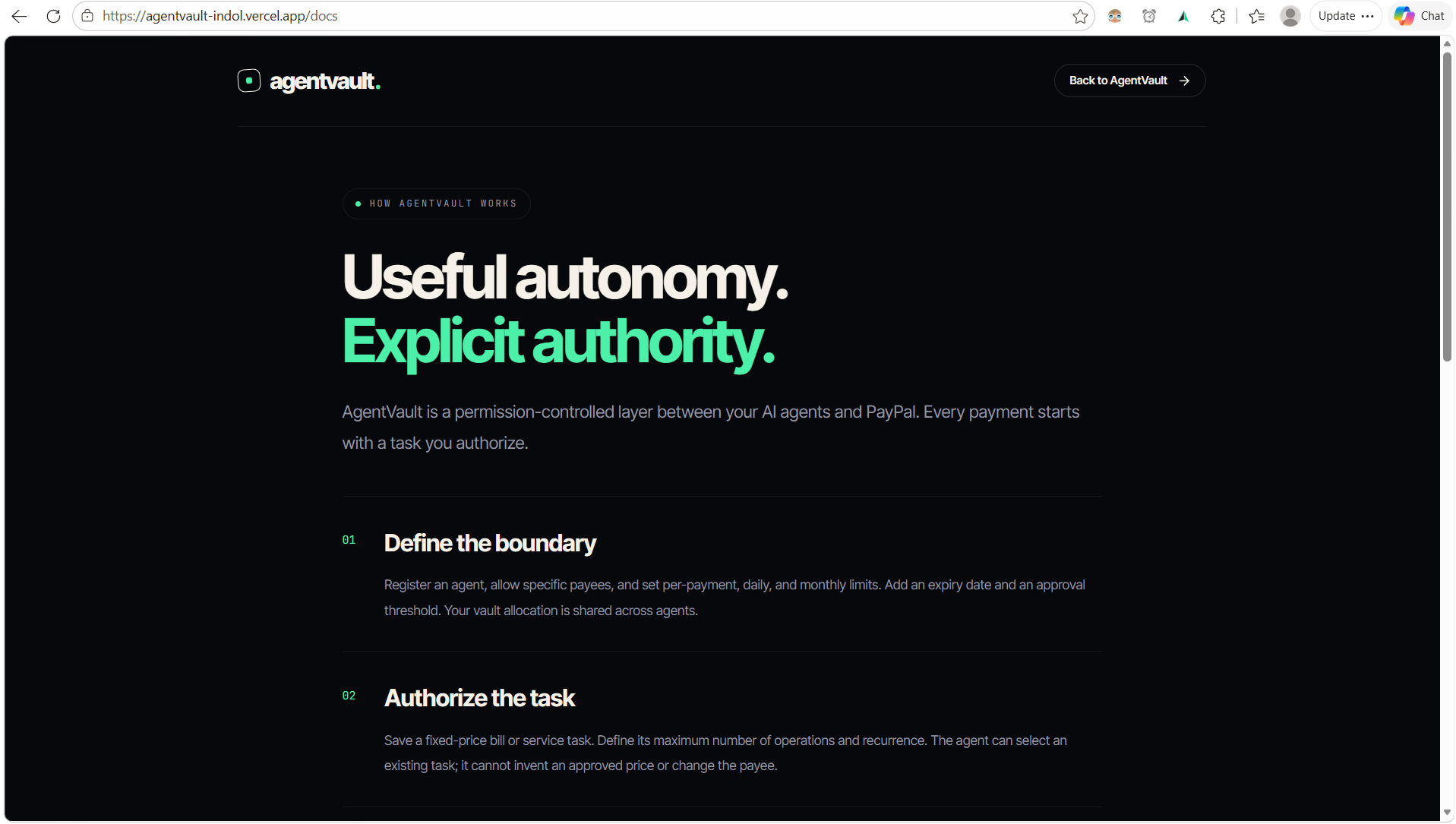
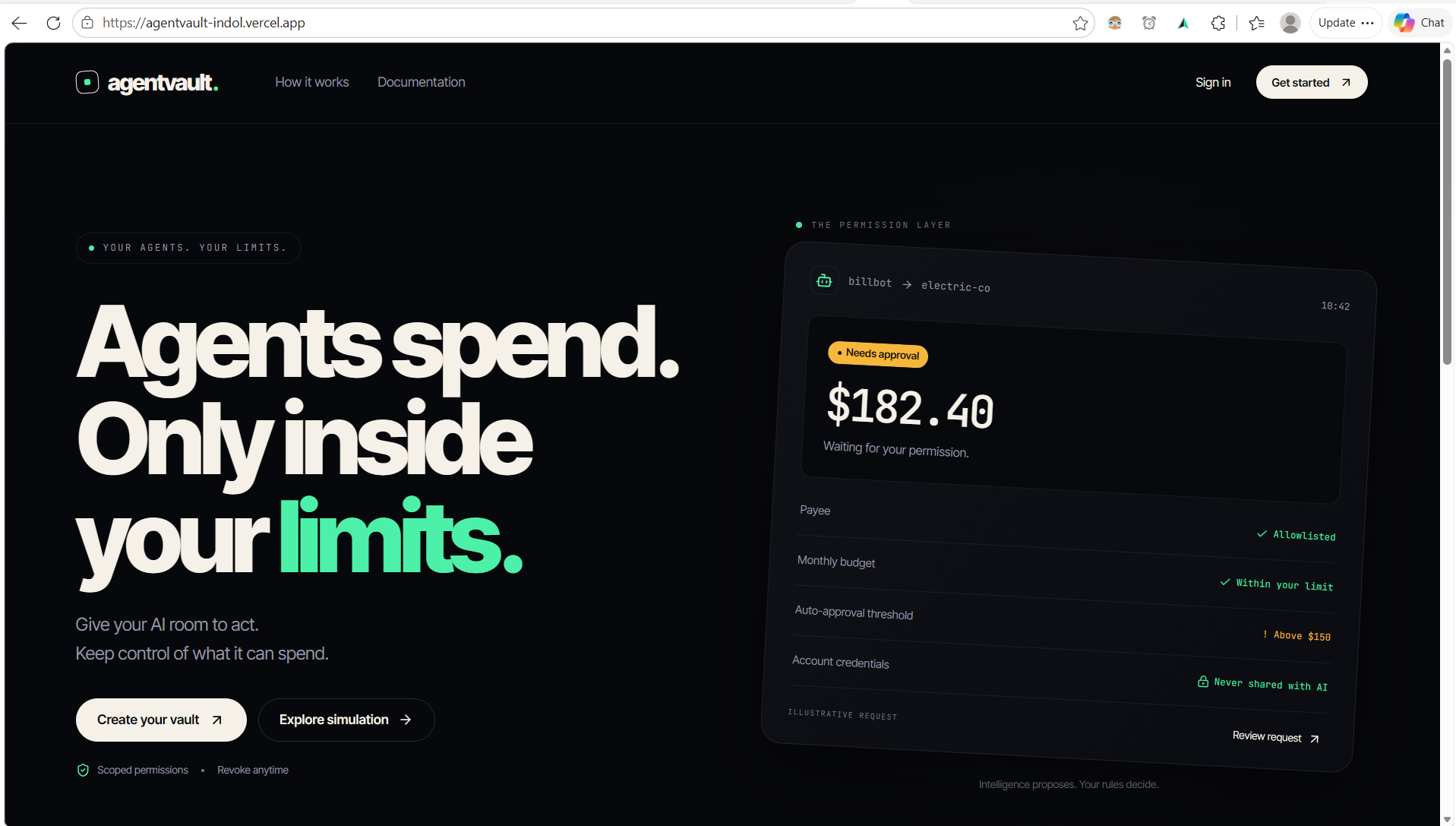
AgentVault is an agentic payment authorization and orchestration platform integrated with PayPal Sandbox.
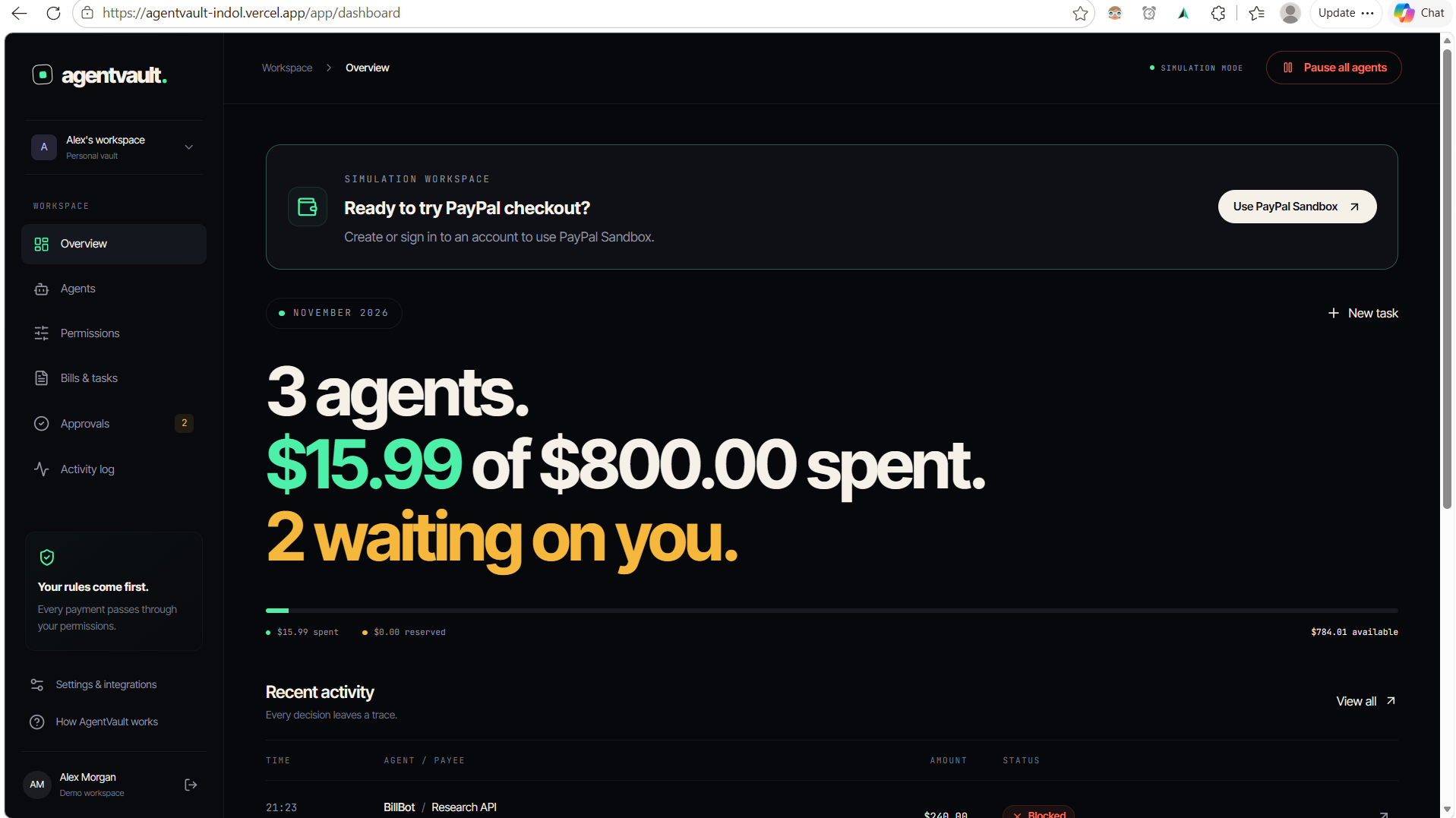
It enables users to register AI agents, define spending permissions, authorize specific tasks, review payment requests, and monitor every financial decision through a centralized dashboard.
Key Features
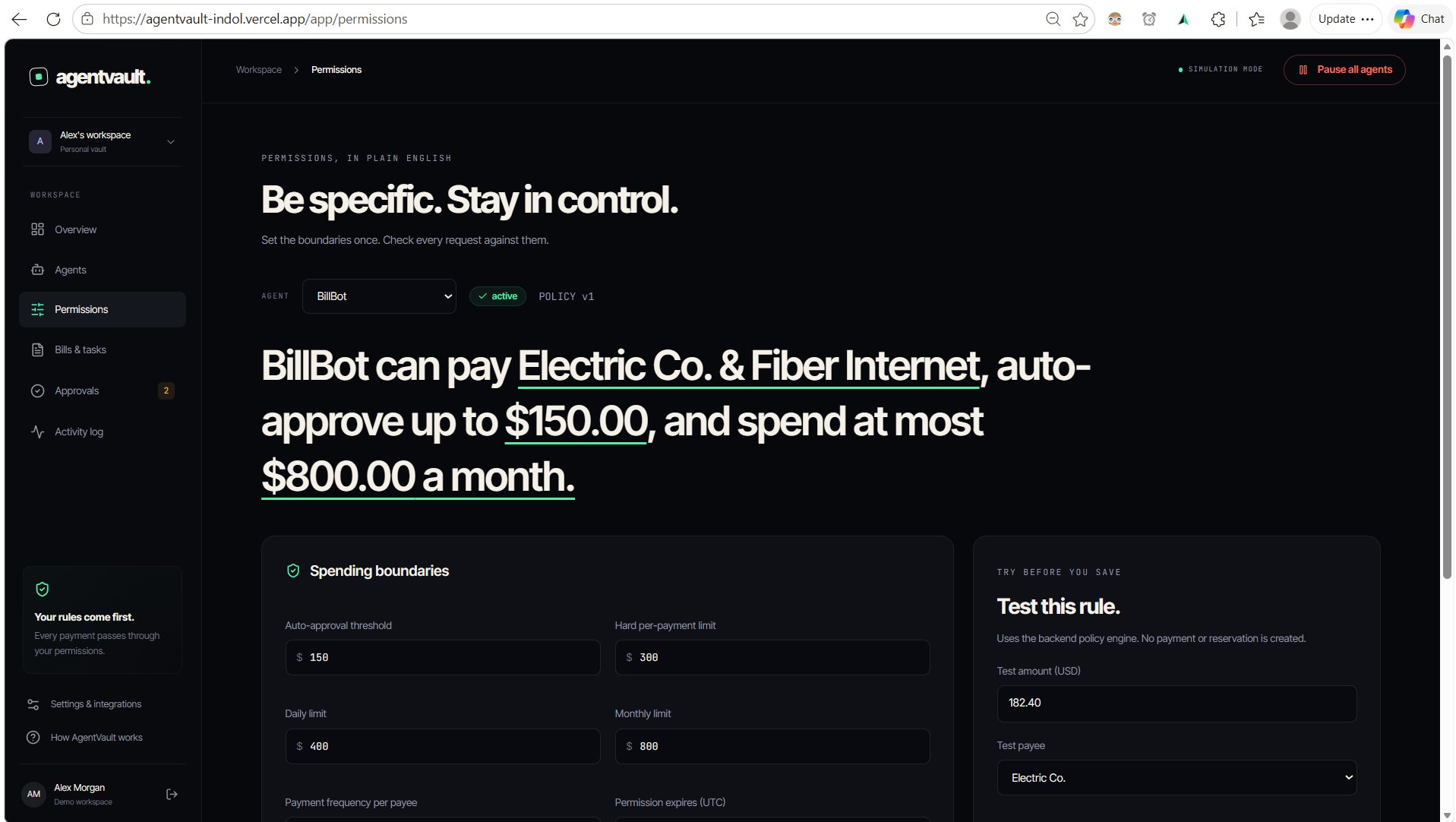
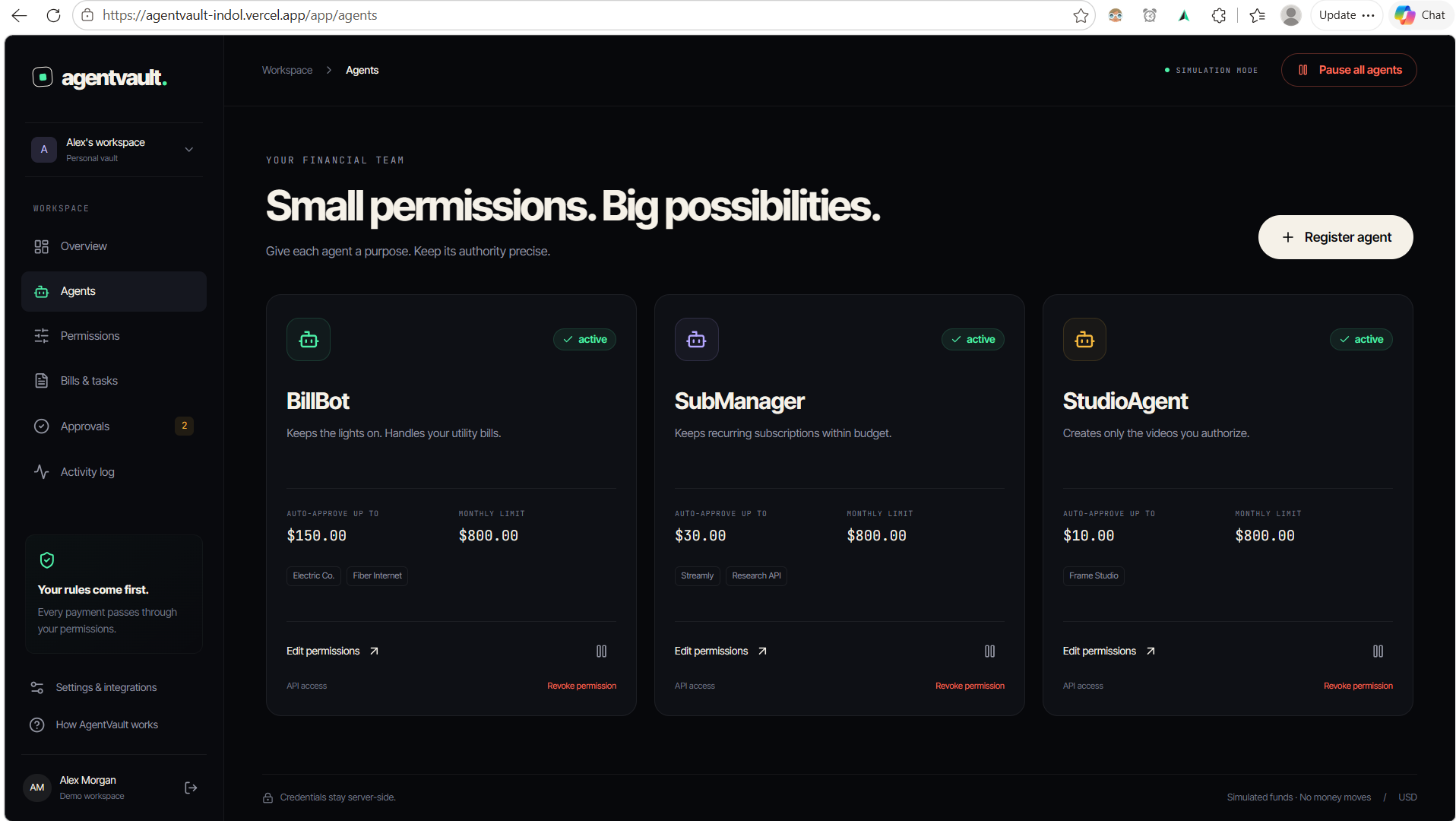
- Agent-Specific Financial Permissions
Each agent receives configurable restrictions, including:
- Allowed merchants and payees
- Maximum individual transaction amounts
- Daily and monthly spending limits
- Automatic approval thresholds
- Payment frequency restrictions
- Permission expiration dates
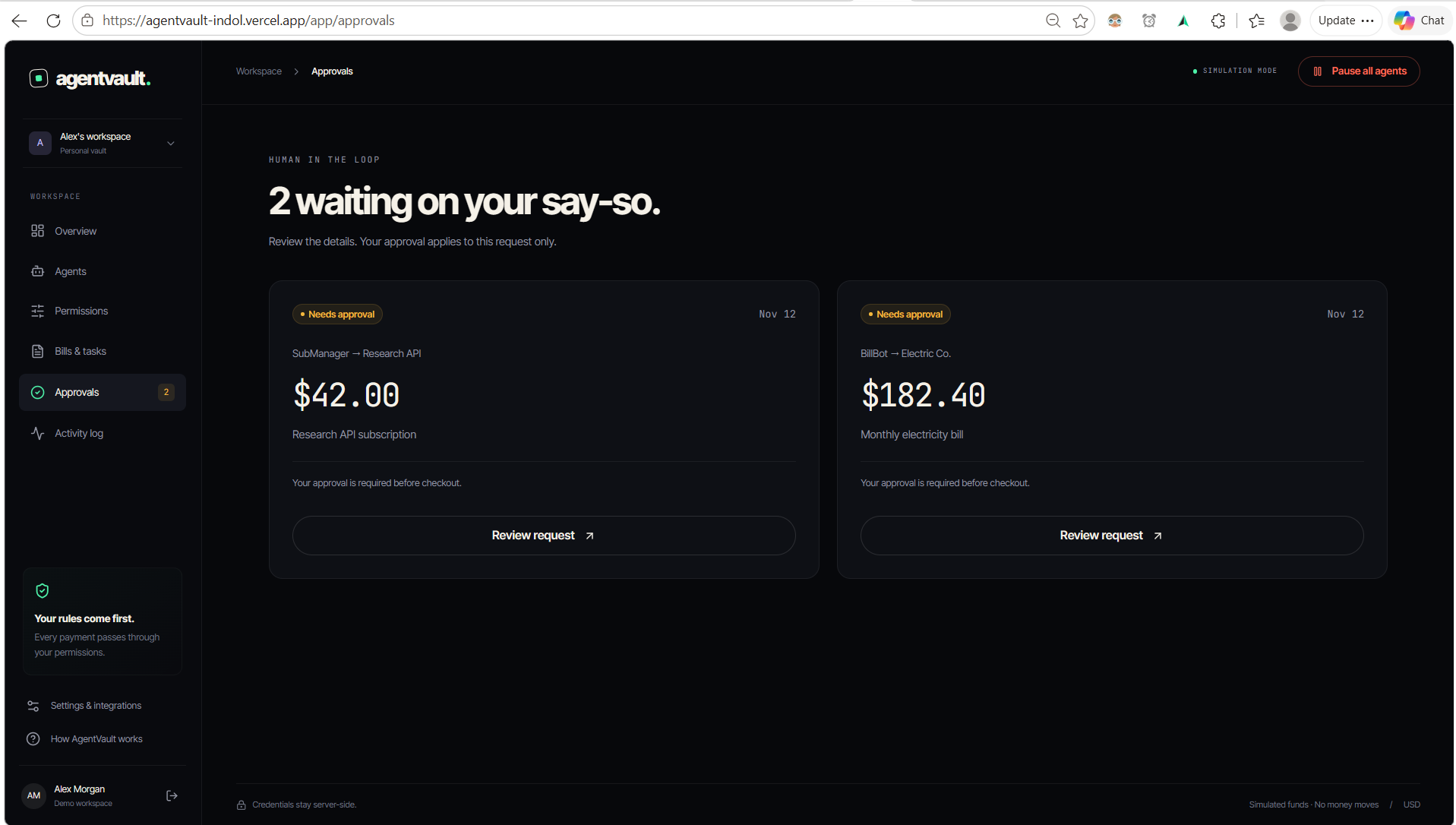
- Human-in-the-Loop Approvals
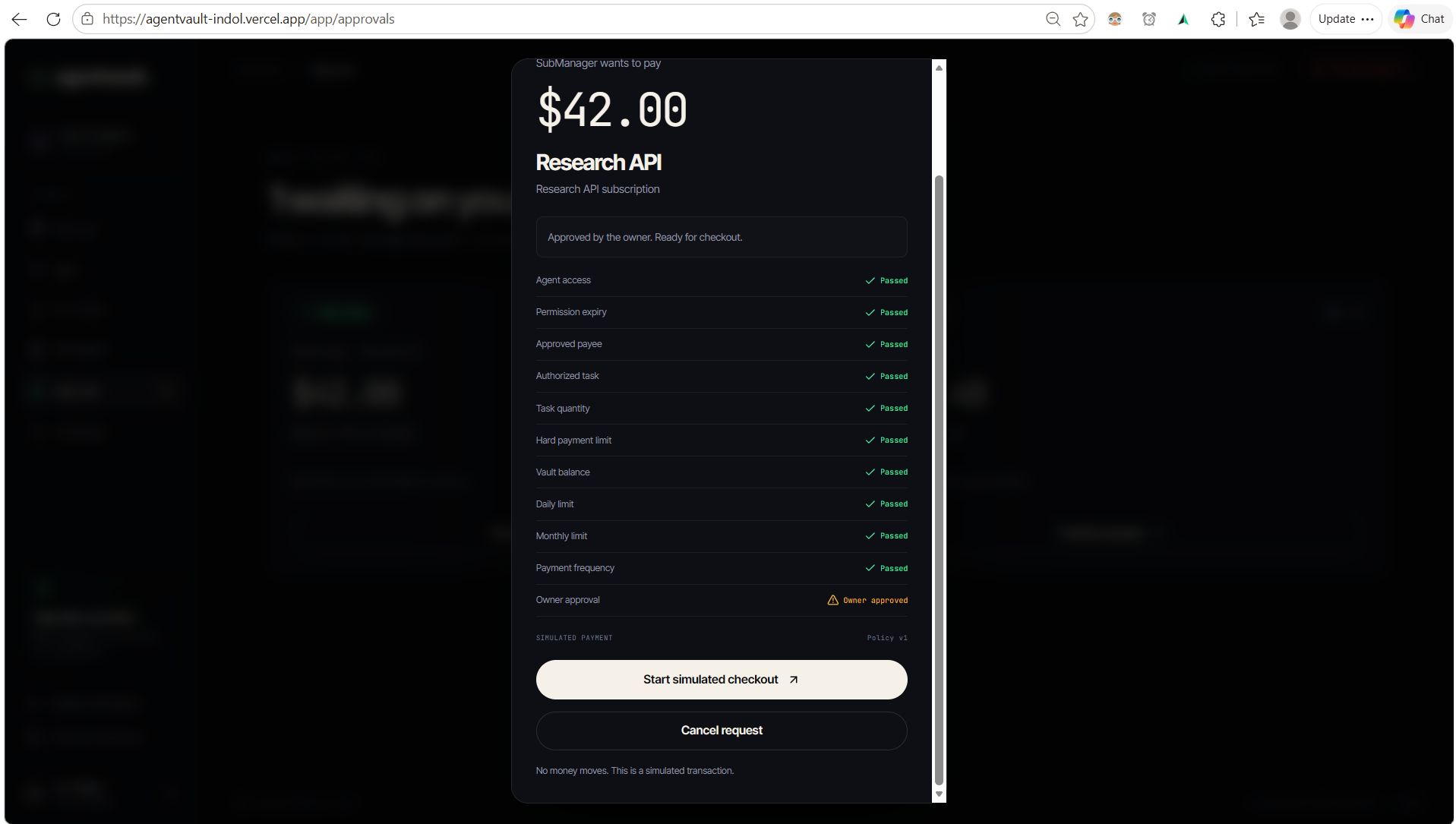
Transactions exceeding an agent's automatic approval threshold require explicit owner authorization.
Agents cannot approve their own payments or modify their spending limits.
- Task-Based Authorization
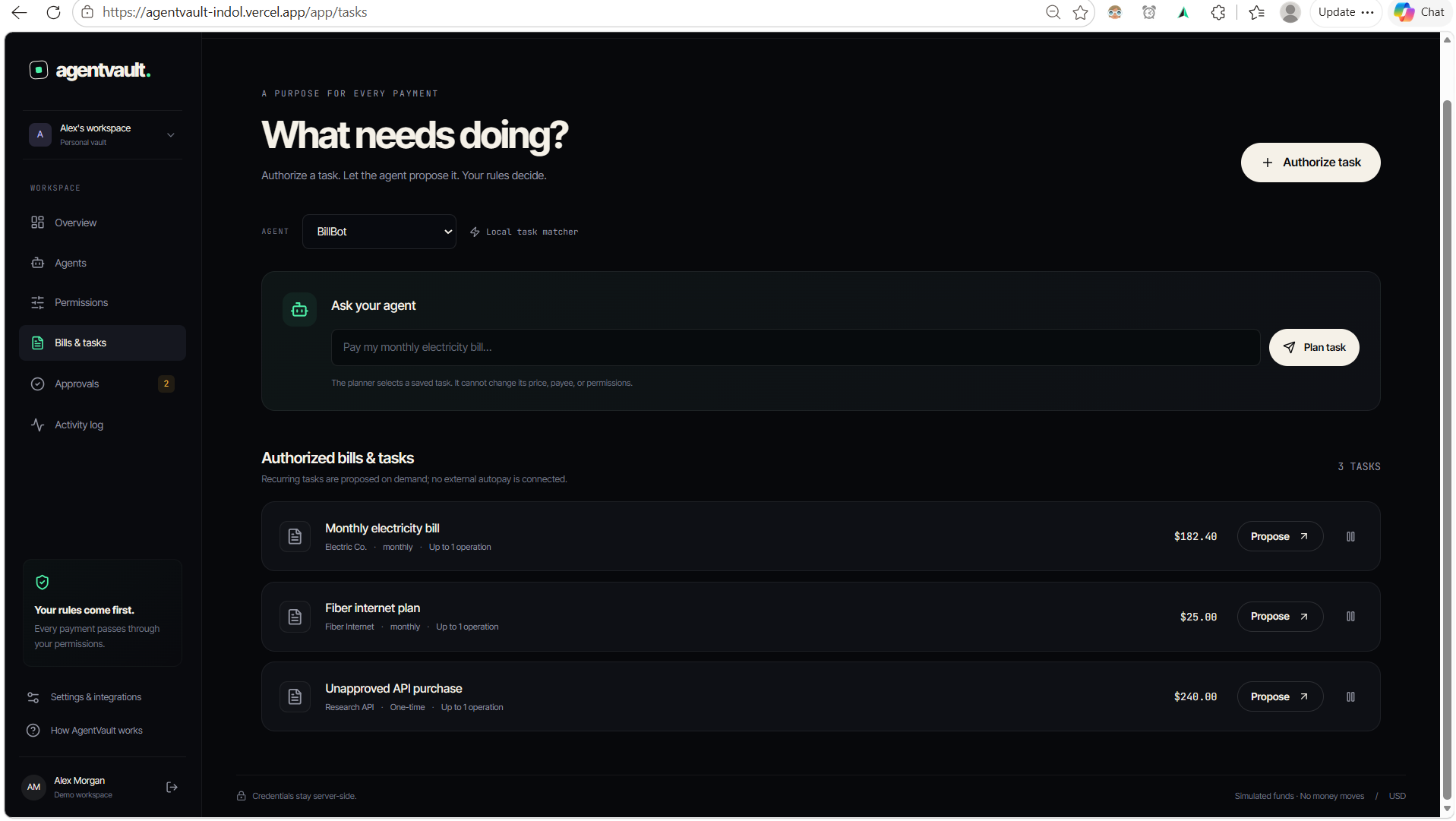
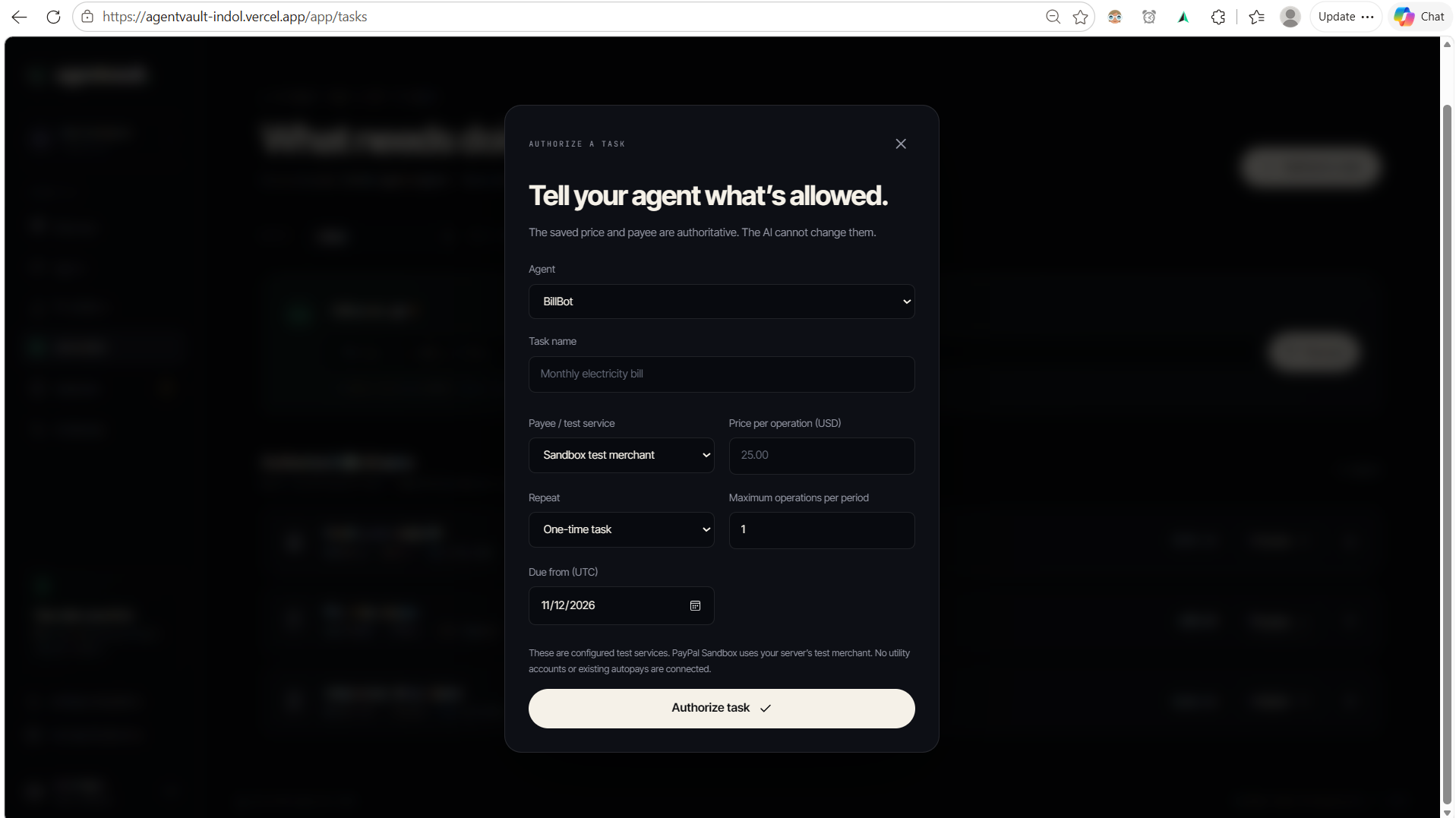
Users create predefined financial tasks with fixed prices, authorized merchants, recurrence settings, and operation limits.
Agents can propose existing tasks but cannot independently modify their authorized details.
- PayPal Sandbox Integration
AgentVault integrates PayPal Sandbox for test payment workflows, including checkout order creation, buyer authorization, and server-side payment verification.
Owner approval within AgentVault remains separate from PayPal buyer authorization.
- Backend Policy Enforcement
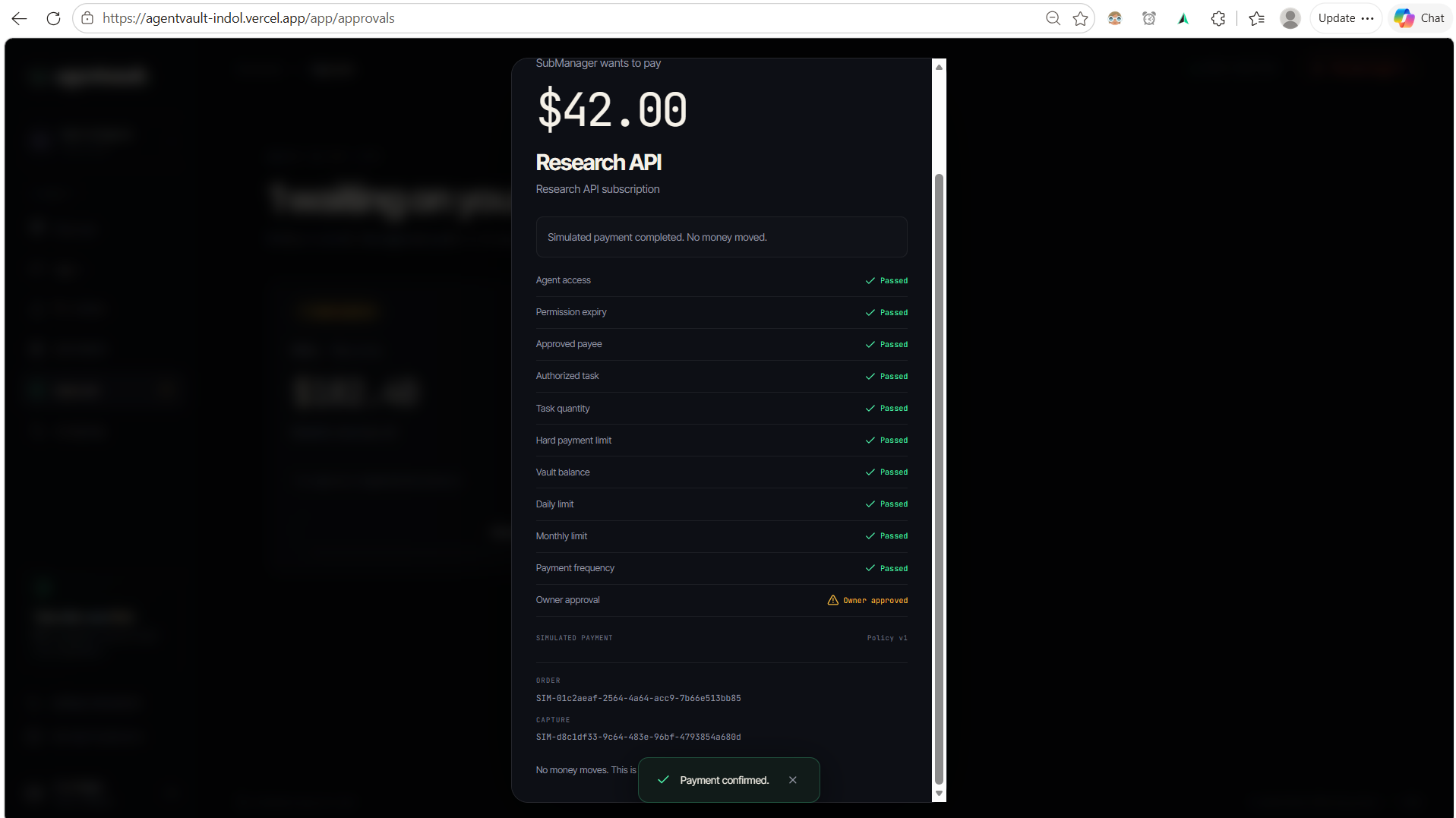
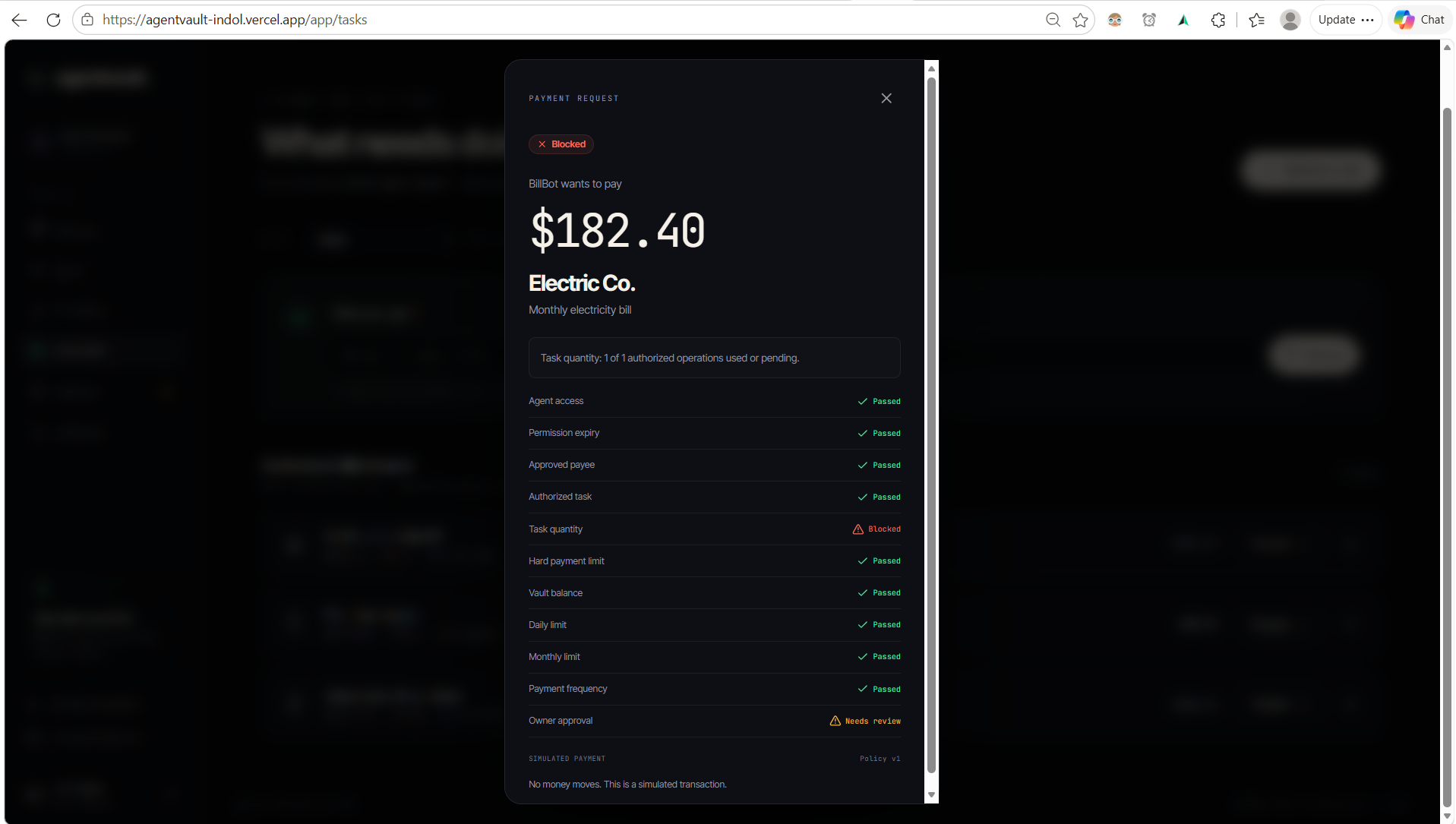
Payment requests are evaluated against backend-enforced permissions before payment execution.
The system is designed to enforce budget reservations, prevent duplicate operations, and handle uncertain payment outcomes without allowing agents to bypass limits.
- Transparent Audit Trails
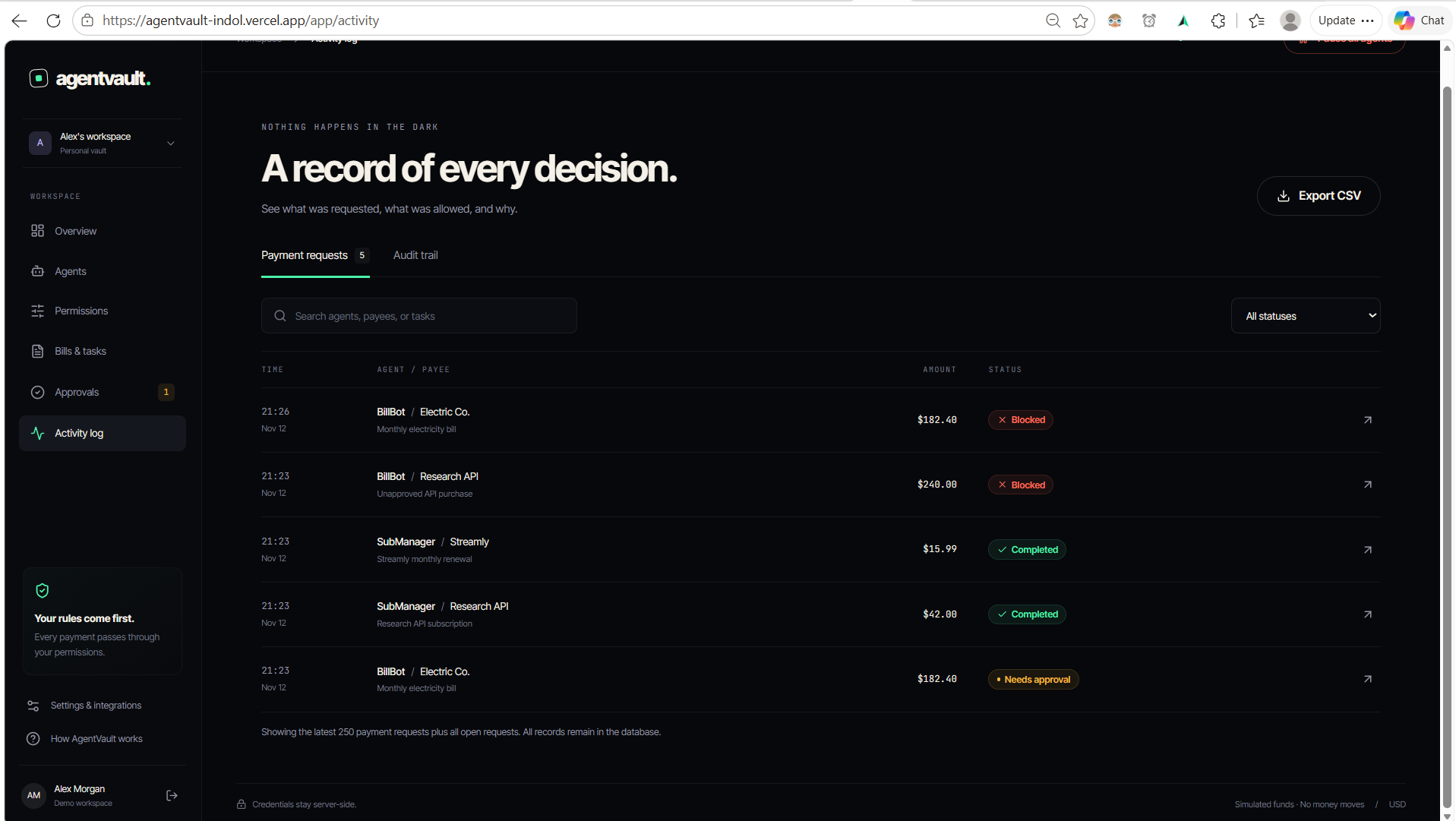
Every request is recorded with its status and authorization details.
Users can inspect permission checks, approvals, cancellations, and payment activity.
- Emergency Controls
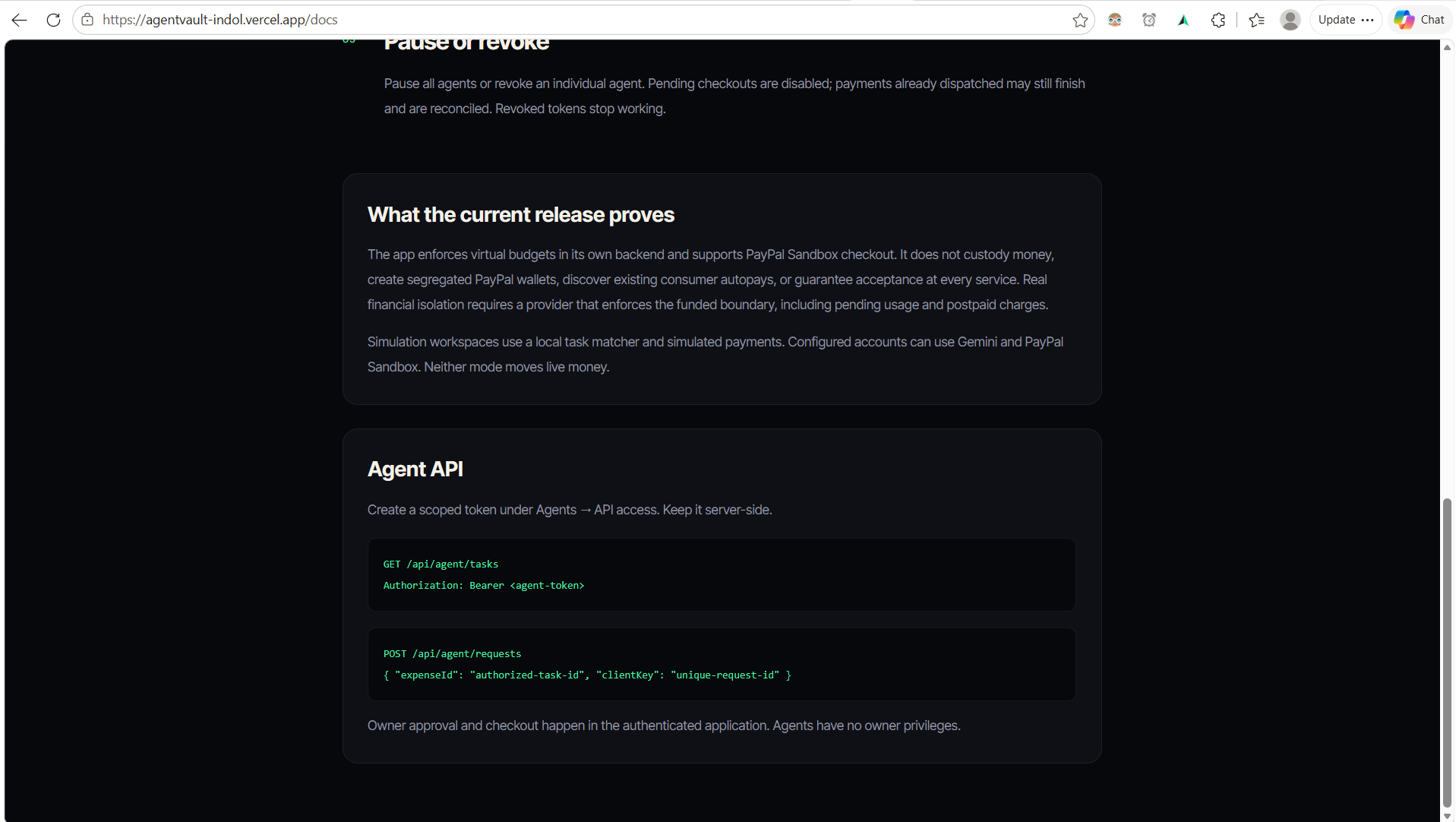
Users can pause agent activity or revoke individual agent credentials to prevent new unauthorized operations.
- Agent API
External agents can interact with authorized financial tasks using scoped API tokens without receiving owner-level permissions.
How We Built It
AgentVault combines a web-based application, server-side payment authorization logic, persistent transaction records, and PayPal Sandbox APIs.
Its architecture separates agent intelligence from financial authority.
Payment Workflow
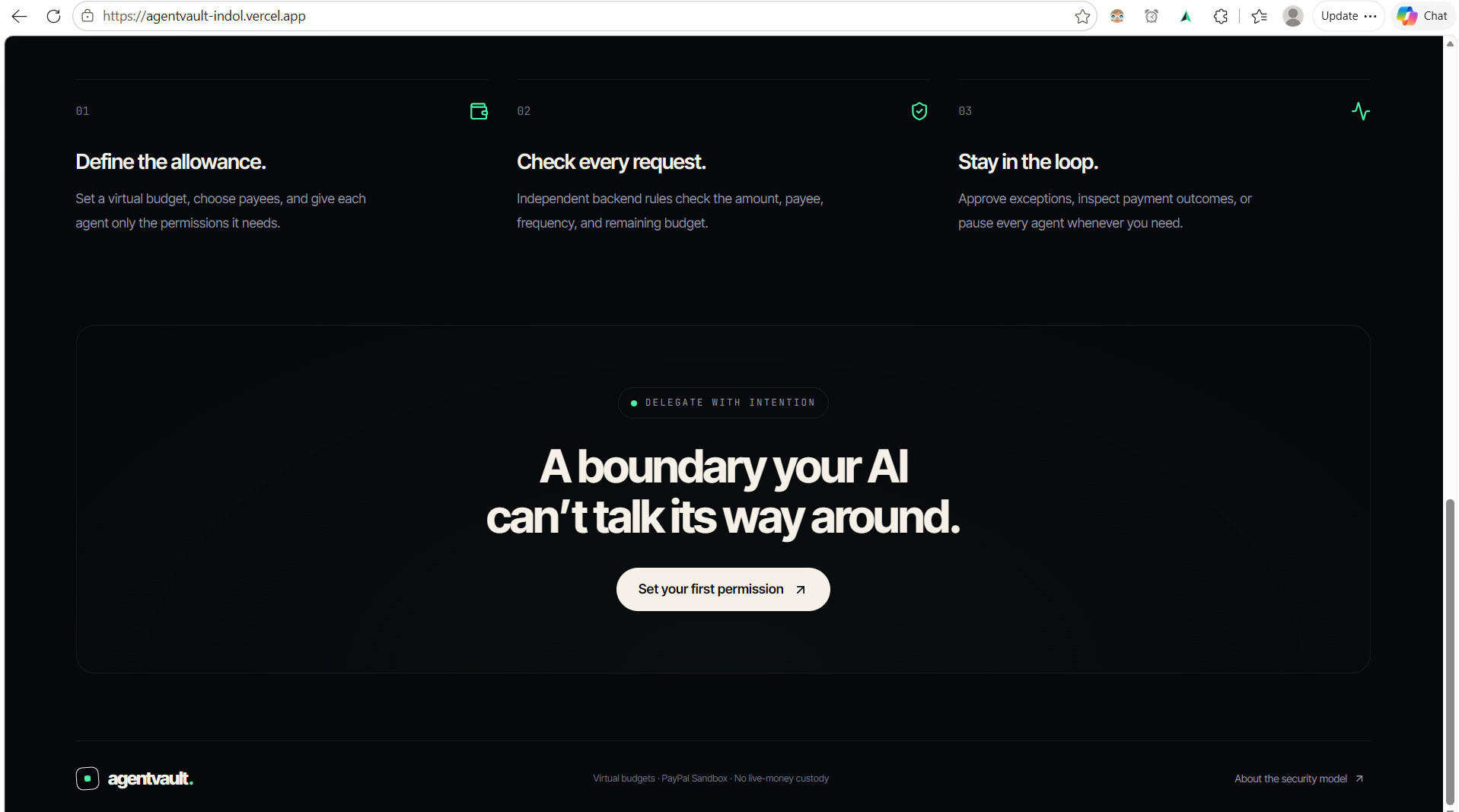
- Task authorization: The owner defines a permitted payment task.
- Agent request: An agent proposes an existing authorized task.
- Policy evaluation: The backend checks permissions, payee restrictions, available allocation, transaction limits, and payment frequency.
- Human approval: Requests above the automatic threshold require owner authorization.
- PayPal checkout: Eligible requests proceed through the PayPal Sandbox checkout workflow.
- Payment verification: The backend checks payment status and records the outcome.
- Audit logging: The transaction history retains a traceable record of the request and its decisions.
Agent Planning
The current application includes deterministic local task matching for selecting previously authorized tasks.
It also provides a configuration path for Gemini-based AI planning, allowing natural-language task interpretation while preserving backend-enforced financial permissions.
Crucially, the planner does not receive authority to bypass payment restrictions.
Financial Safety Design
AgentVault is designed around the principle of least privilege.
Provider credentials remain server-side, agent tokens have limited capabilities, and payment authorization is enforced independently of agent-generated instructions.
The application currently manages virtual spending allocations rather than holding or segregating real funds.
All demonstrated payment operations use PayPal Sandbox test money.
Challenges We Faced
Balancing Autonomy and Security
Our primary challenge was allowing agents to initiate meaningful financial actions without giving them unrestricted control.
We addressed this by separating task selection, payment authorization, owner approval, and execution into distinct operations.
Preventing Duplicate Payments
Retries and concurrent requests can create serious financial risks.
We designed the backend around persistent requests, idempotency, and reservation-based spending checks to help prevent duplicate operations and excessive spending.
Handling Payment Uncertainty
Payment workflows are not always instantaneous.
A checkout may be pending, canceled, or awaiting confirmation.
Our design accounts for these states instead of assuming every payment attempt succeeds immediately.
Making Financial Policies Understandable
Complex permission systems can be difficult for users to understand.
We designed the dashboard to translate technical financial restrictions into clear, readable rules.
Accomplishments We're Proud Of
- Developed a centralized dashboard for managing agent payment authority.
- Implemented configurable per-agent spending permissions.
- Created backend-enforced policy checks.
- Integrated PayPal Sandbox checkout order creation.
- Built an owner approval workflow.
- Added task-based payment authorization.
- Implemented agent access revocation and emergency pause controls.
- Created detailed payment activity records and permission explanations.
What We Learned
Building AgentVault taught us that agentic commerce is not simply about connecting an AI model to a payment API.
Reliable financial automation requires clear authority boundaries, secure execution, auditability, and human oversight.
We also learned that an agent's ability to propose an action should remain separate from its authority to execute that action.
What's Next?
We envision AgentVault evolving into a broader financial authorization infrastructure for autonomous software agents.
Future improvements include:
- Fully integrated natural-language AI financial planning
- Additional payment providers and merchant integrations
- Advanced recurring bill management
- Risk-based transaction monitoring
- More granular financial permissions
- Stronger provider-enforced spending isolation
- Multi-agent financial workflow coordination
Our long-term vision is to enable AI assistants to handle everyday financial tasks responsibly, without requiring users to surrender control over their finances.
Closing Thoughts
As AI agents become increasingly capable, financial trust will become one of the most important challenges in autonomous computing.
AgentVault explores how we can make autonomous payments more controlled, understandable, and accountable.
AgentVault — Useful Autonomy. Explicit Authority. Your rules come first.
Built With
- agentic-ai
- agentic-commerce
- ai-agents
- human-in-the-loop
- oauth-2.0
- payment-orchestration
- paypal
- paypal-rest-api
- paypal-sandbox
- policy-engine
- rest
- rest-api
- vercel
