-
-
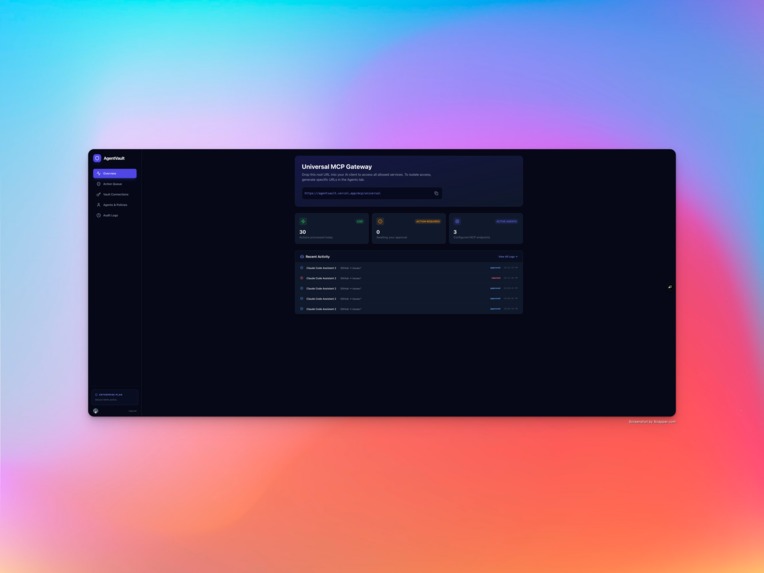
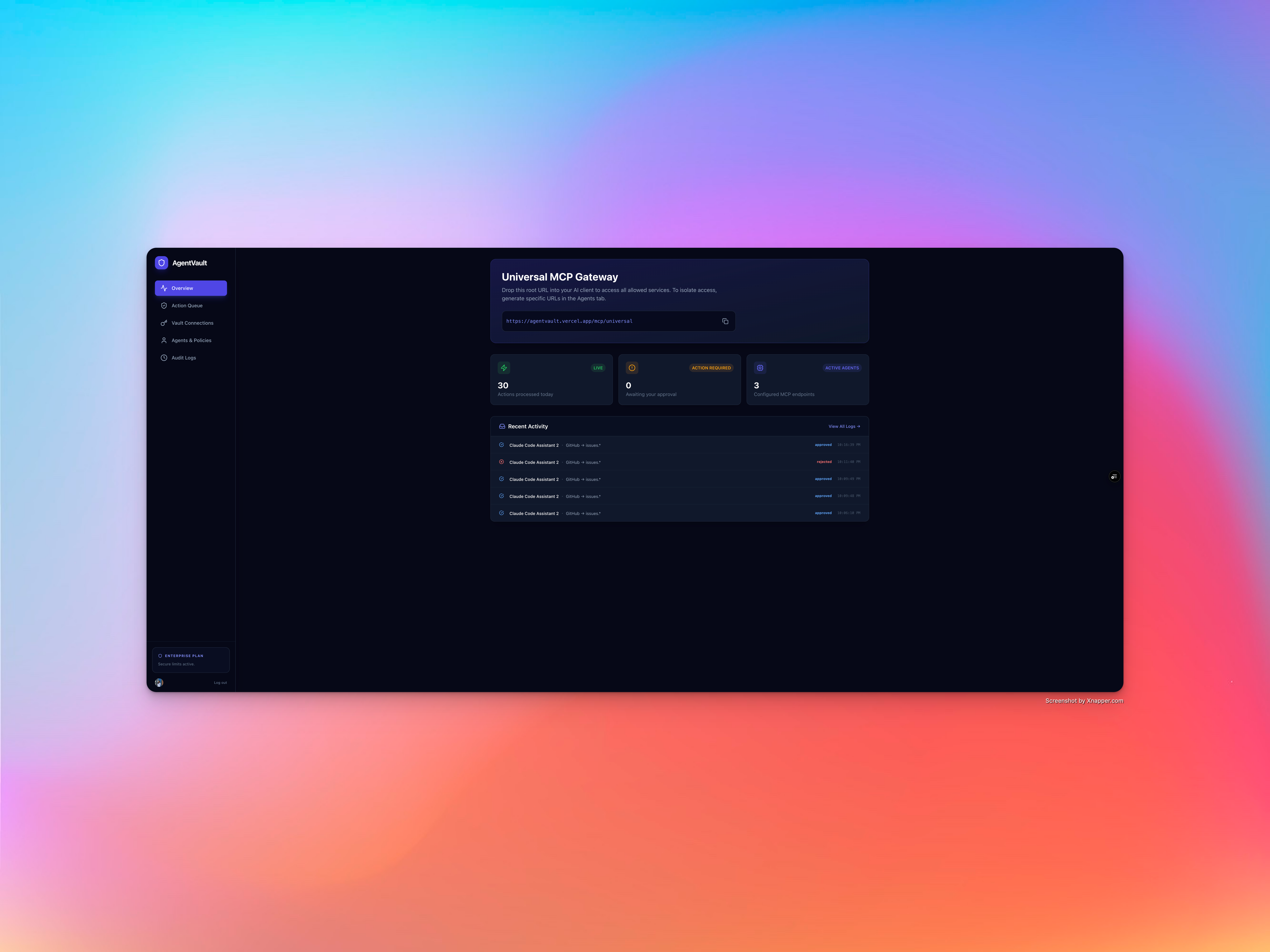
Dashboard view
-
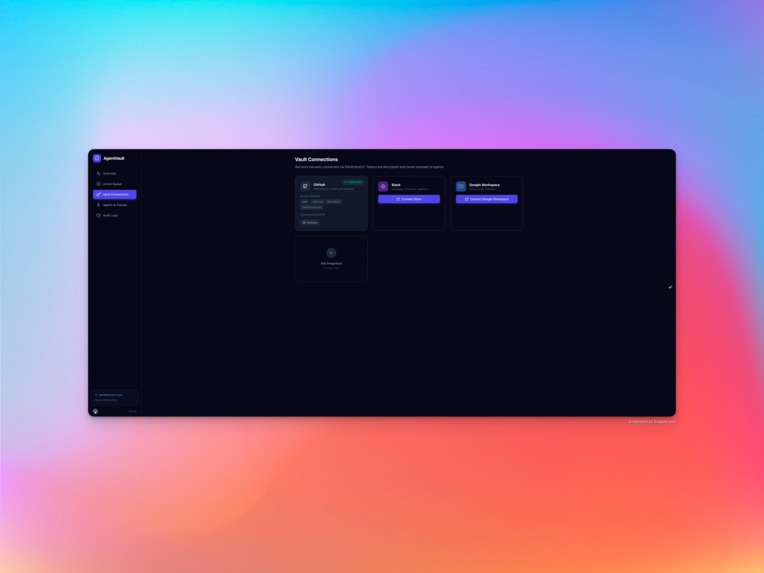
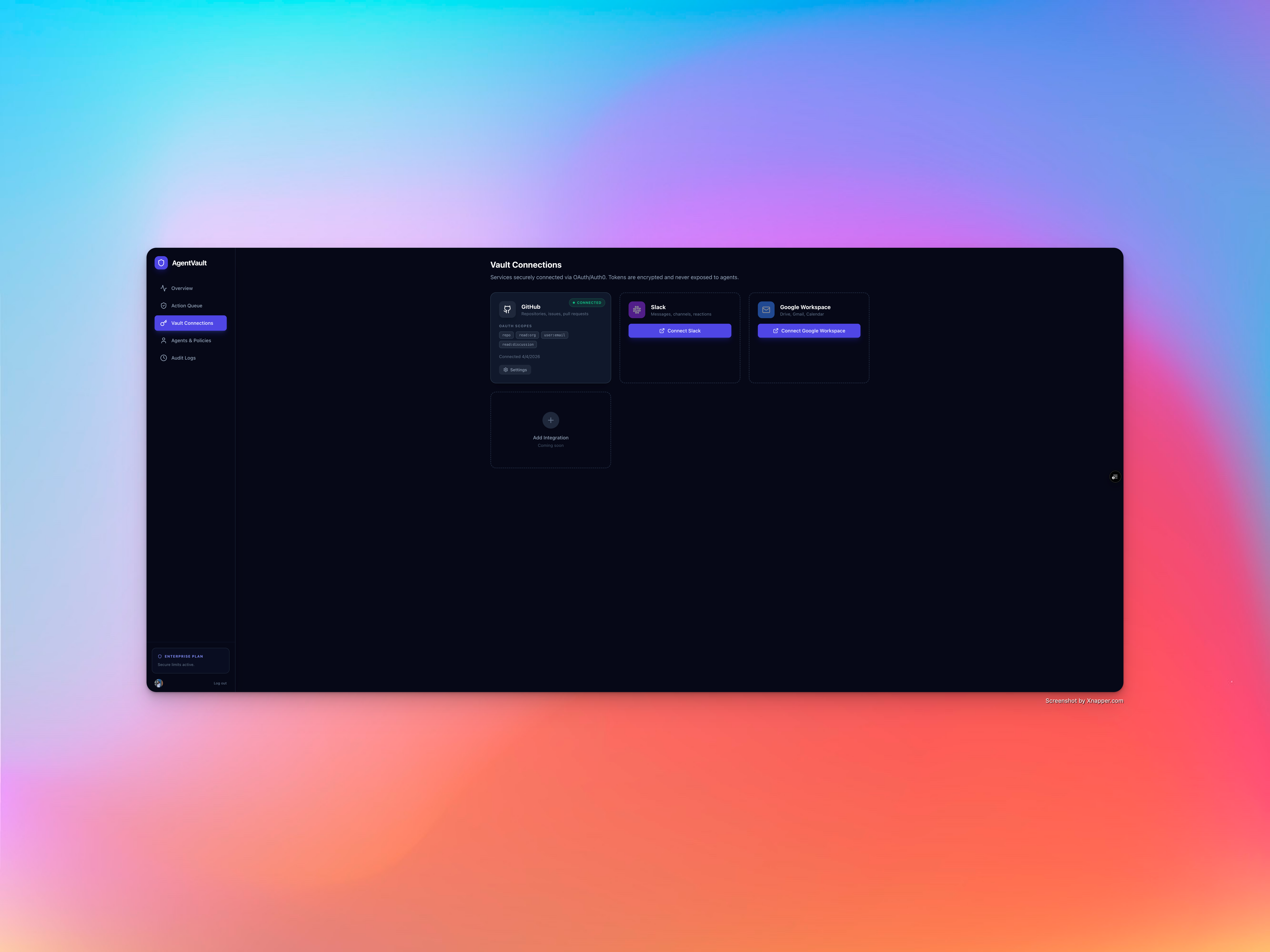
Vault Connector View
-
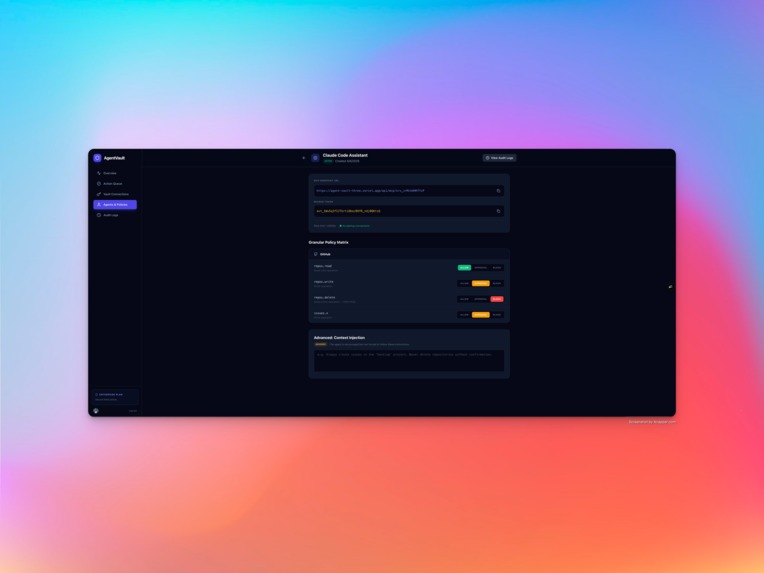
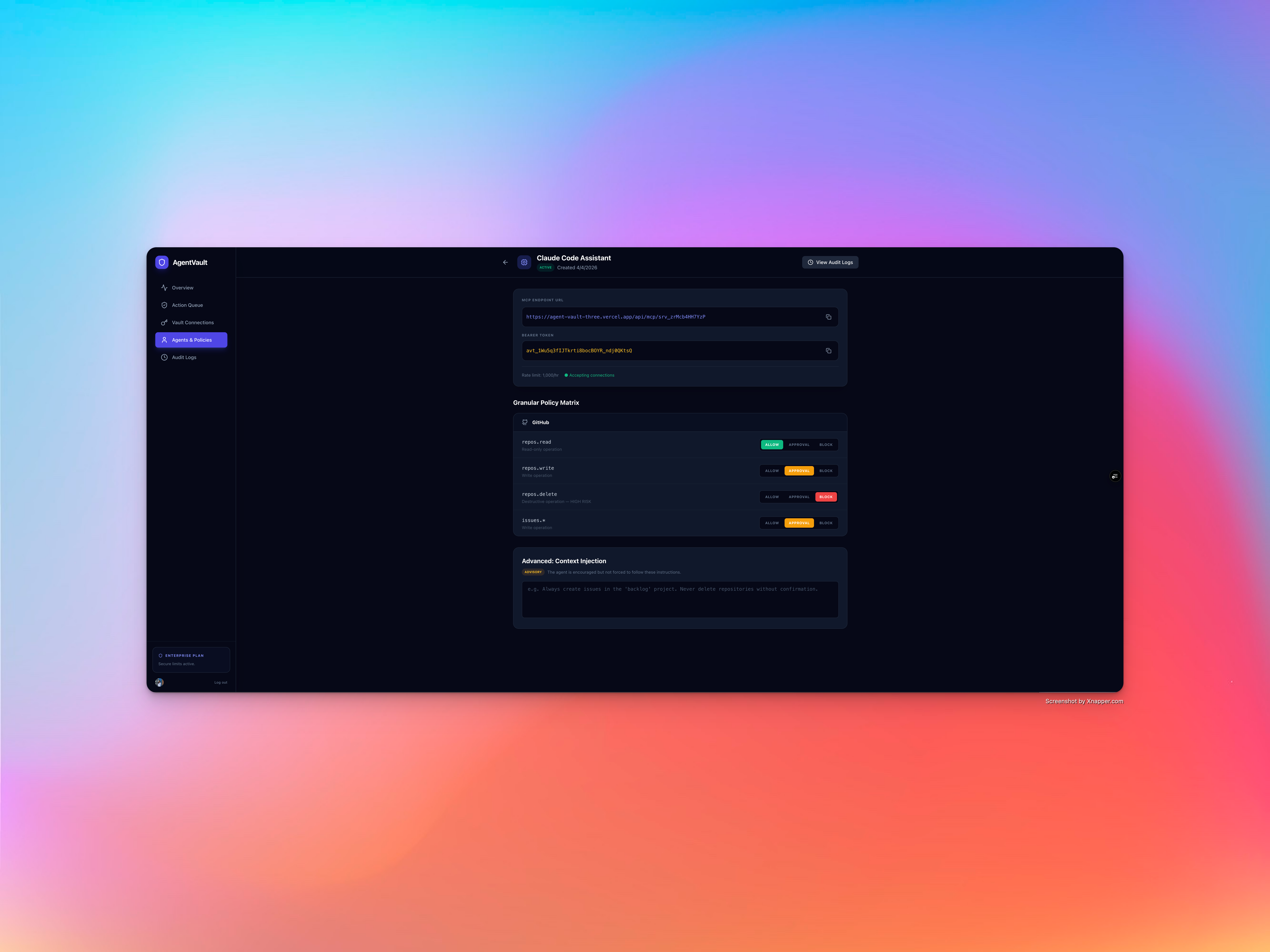
Policy Matrix View
-
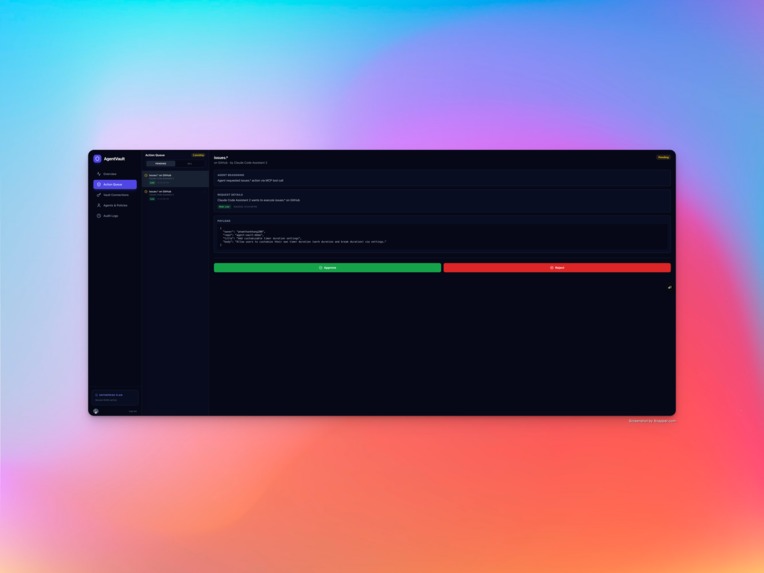
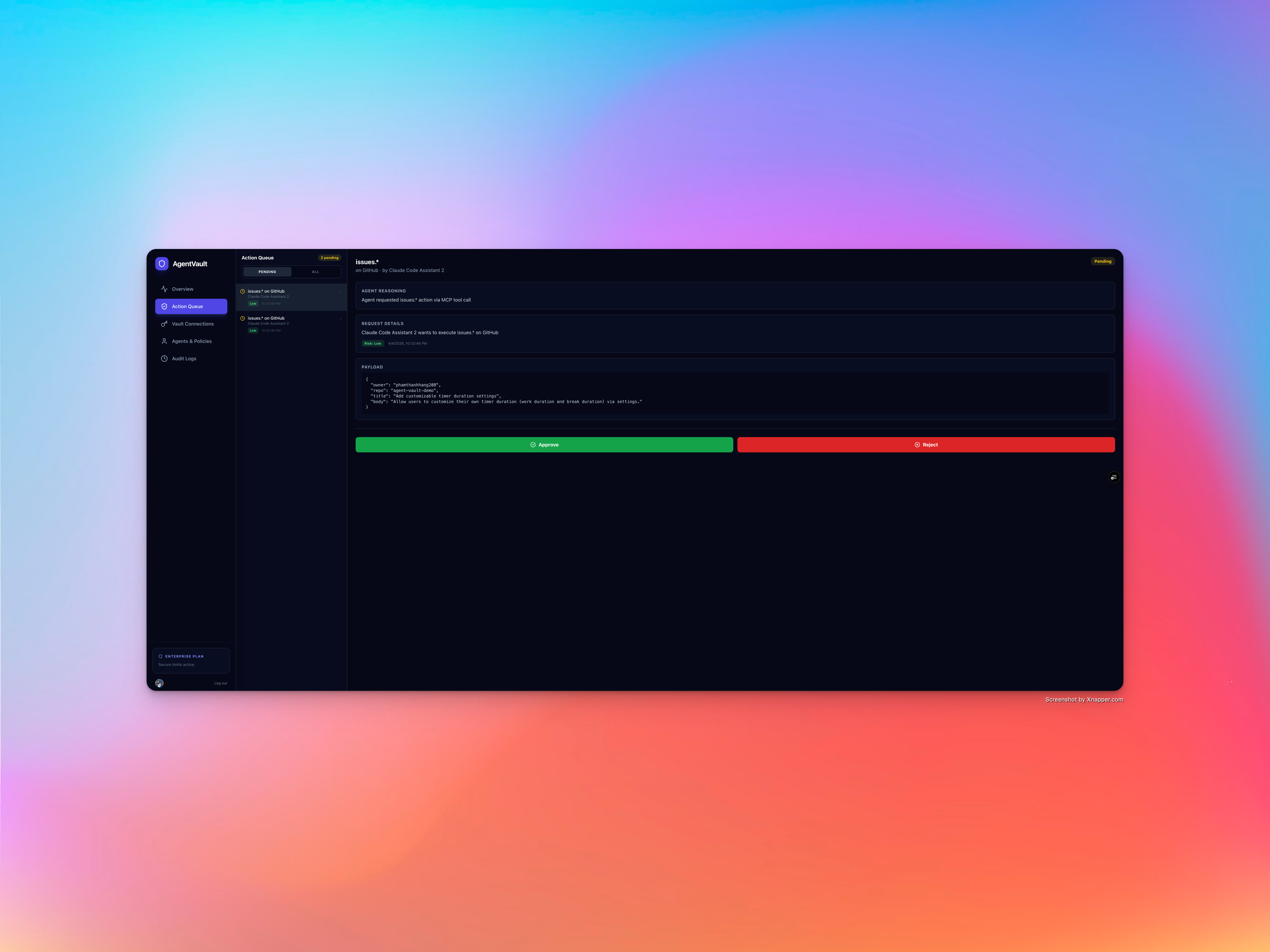
Approve / Reject a request
-
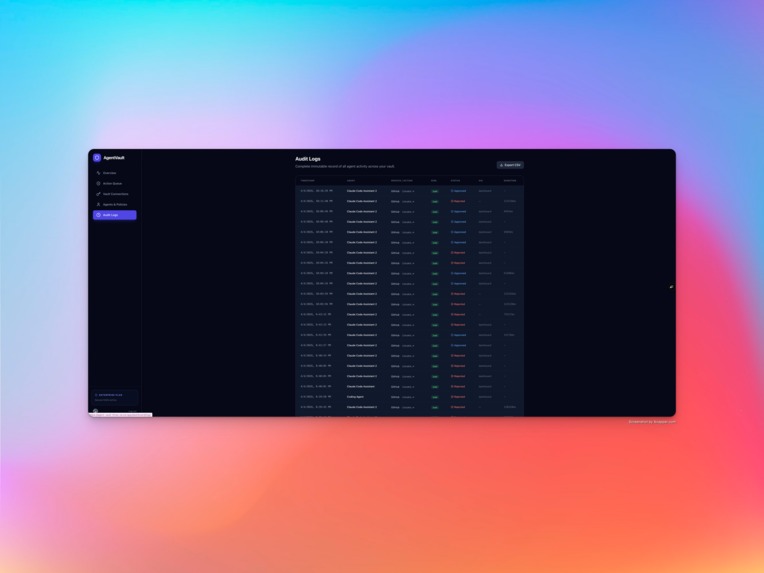
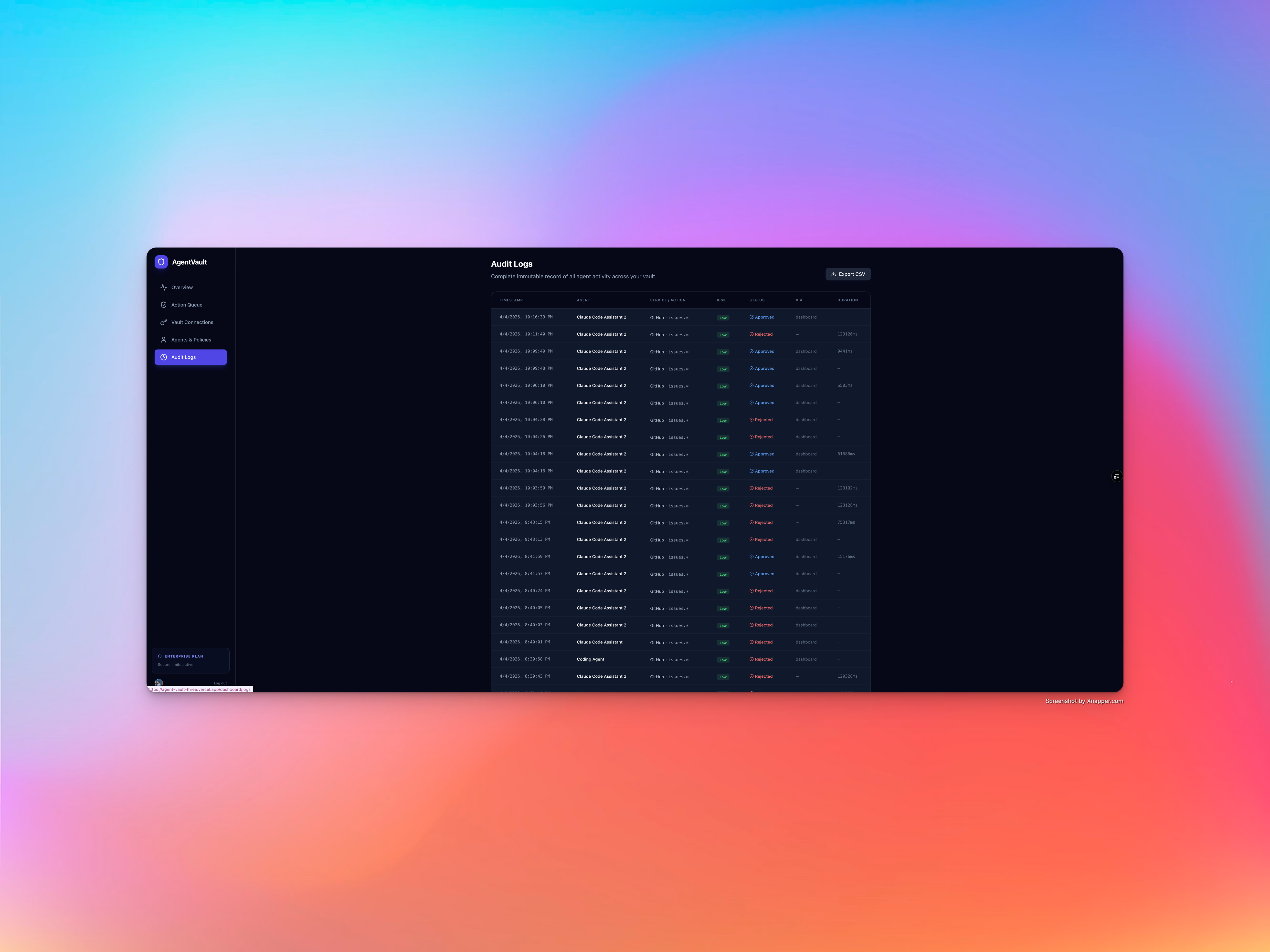
Audit log view
Inspiration
We kept running into the same problem: AI agents are getting real capabilities — reading emails, pushing code, sending messages — but there's no standard way to control what they're actually allowed to do. You either hand over a raw API token with full access, or you give the agent nothing.
The moment that crystallized the idea was watching Auth0's Token Vault documentation. It already solves the hard part — OAuth token management, encrypted storage, automatic refresh. But nobody was exposing it at the protocol level for AI agents. And then MCP (Model Context Protocol) clicked — it's the universal interface that every agent speaks. What if Token Vault + MCP could create a permission layer that works with any agent?
That's AgentVault: Auth0 handles the tokens, MCP handles the protocol, and we handle the permissions in between.
What it does
AgentVault lets you create permission-controlled "vaults" for your AI agents. Here's the flow:
Connect services — Link your GitHub, Google Workspace, Slack, or Jira through Auth0 Token Vault. One OAuth click per service. Auth0 stores and refreshes tokens — you never see raw credentials.
Create a vault — Each vault is a permission profile for one agent. Pick which services the agent can access, and for each action choose: Allow (auto-execute), Require Approval (CIBA push notification), or Block (tool is invisible to the agent).
Get an MCP URL — Each vault generates a unique MCP server URL + bearer token. Drop it into Claude Code, Cursor, OpenClaw, or any MCP-compatible agent.
Agent works within bounds — The agent discovers only the tools you permitted. Blocked tools don't appear at all — the agent can't even hallucinate using them. Write actions pause and wait for your approval via Auth0 Guardian push notification on your phone.
Full audit trail — Every tool call is logged: timestamp, agent, service, action, outcome (auto-executed, approved, denied, blocked).
The key concept is multi-vault: one user can have multiple agents with different permission sets. Your personal assistant gets broad access. Your work coding agent gets scoped access. A public bot gets read-only. Revoke one vault without affecting others.
How we built it
MCP Server — The core is a dynamic MCP server built with @modelcontextprotocol/sdk. Each request is stateless (serverless-compatible): bearer token → KV lookup → load agent config → register only permitted tools → handle the JSON-RPC call. We use WebStandardStreamableHTTPServerTransport for Next.js App Router compatibility, with a custom stream-piping solution to keep the transport alive until the response body is consumed.
Auth0 Integration — Three Auth0 features working together:
- Universal Login (
@auth0/nextjs-auth0v4) — user authentication for the dashboard - Token Vault — stores OAuth tokens for GitHub, Google, Slack. When an agent calls a tool, we exchange the user's Auth0 refresh token for a fresh provider access token, use it, then discard it
- CIBA (
@auth0/ai) — when a write action is detected, we send a backchannel auth request to Auth0, which delivers a push notification via Guardian. The MCP call blocks until the user approves or denies
Policy Engine — Maps agent policies to MCP tool visibility. "Allow" tools are registered normally. "Approval" tools are registered with a wrapper that triggers CIBA before execution. "Block" tools are simply not registered — invisible at the protocol level.
Dashboard — Next.js 15 App Router with Tailwind. Vault connections, agent creation wizard (3-step: identity → services → policy matrix), action queue with approve/deny, and audit log with export. All state in Vercel KV (Upstash Redis).
Tech stack: Next.js 15, TypeScript, @auth0/nextjs-auth0, @auth0/ai, @modelcontextprotocol/sdk, Vercel KV, Tailwind CSS, deployed on Vercel.
Challenges we ran into
MCP streaming in Next.js serverless — The biggest technical challenge. Our MCP server returned SSE (Server-Sent Events) responses, but the response body was empty. After hours of debugging, we found the root cause: our finally block was calling transport.close() before the response stream was consumed. The fix was piping the response through a TransformStream and only closing the transport after the stream finishes. Sounds simple in hindsight — took a full day to figure out.
Auth0 v4 migration — The @auth0/nextjs-auth0 v4 SDK changed the API significantly. initAuth0() became new Auth0Client(), routes moved from /api/auth/* to /auth/*, and middleware patterns changed entirely. Auth0's docs were helpful but we still hit edge cases — like the Initiate Login URI field requiring HTTPS even for localhost, and social connections needing both "Authentication" and "Token Vault" toggled on separately.
CIBA availability — CIBA requires an Auth0 Enterprise plan or add-on. We built a dual-path approval system: CIBA for push notifications when available, with a dashboard-only fallback that works on any plan. The approval request exists in both places simultaneously — whichever resolves first wins.
Token Vault scope mapping — Token Vault stores OAuth tokens with scopes, but there's no built-in way to map scopes to human-readable actions. "The repo scope means the agent can read files, create branches, push code, and delete repos" — we had to build that mapping layer ourselves.
Accomplishments that we're proud of
The blocked tool pattern. When a tool is blocked in the policy, it's not "access denied" — it doesn't exist in the MCP tool list at all. The agent can't hallucinate using a tool it doesn't know about. This is a fundamentally better security model than deny-after-the-fact.
Multi-vault architecture. One Auth0 identity, multiple permission profiles, each generating a unique MCP endpoint. This lets you give different agents different trust levels from the same set of service connections. We haven't seen this pattern anywhere else.
The streaming fix. Getting SSE responses to work in Next.js App Router serverless functions with the MCP SDK was non-trivial. The TransformStream pipe solution is clean and reusable — we think other teams building MCP servers on Next.js will hit the same issue.
Dual-path CIBA approval. The approval request lives in both Auth0 Guardian (push notification) and the dashboard (Action Queue) simultaneously. No double-resolution, no race conditions. Whichever the user responds to first resolves the request.
What we learned
Auth0 Token Vault + MCP is a natural combination. MCP tool calls are synchronous from the agent's perspective — call a tool, get a response. CIBA slots perfectly into this: the tool call just takes longer while the user approves. No agent-side changes needed. This pattern should be a documented recipe in Auth0's developer resources.
Permission management for agents is an unsolved space. RBAC exists for users. OAuth scopes exist for apps. But "what can this AI agent do on my behalf" doesn't have a standard solution yet. AgentVault is our take on it, but the industry needs a proper standard.
The gap between "demo" and "works with real OAuth" is significant. Mocking OAuth flows for development is easy. Actually configuring Google Cloud consent screens, Auth0 social connections with Token Vault enabled, and CIBA notification channels — each has a 5-step setup with subtle requirements (Offline Access must be checked, connections need both Authentication AND Token Vault toggled, authorized redirect URIs must match exactly).
What's next for AgentVault
More services — Auth0 Token Vault supports 25+ OAuth integrations. We've built GitHub, Google Workspace, and Slack. Adding Salesforce, Jira, Stripe, and Figma is straightforward — the architecture is service-agnostic.
Rate limiting enforcement — Currently display-only. Real per-vault rate limiting with sliding windows would prevent runaway agents from burning through API quotas.
Webhook-based approval — Instead of polling for CIBA results, use Auth0's webhook callback for instant resolution. Lower latency, fewer API calls.
Shareable vault templates — Export a vault's policy config as a shareable JSON template. "Here's my DevOps agent policy — import it and connect your own services."
SDK / npm package — npx agentvault init to scaffold a new vault, configure Auth0, and get an MCP URL in under 2 minutes.
Production deployment — Custom domains, encrypted vault tokens, SOC2-relevant audit log retention, and multi-tenant support for teams.
Bonus Blog Post
The Moment Token Vault Clicked — and the Bug That Almost Killed Our Demo
I'll be honest: when we started AgentVault, I thought Token Vault was just a fancy secrets manager. Store some OAuth tokens, fetch them later, done. I was wrong.
The real power hit me when I realized Token Vault doesn't just store tokens — it manages the entire lifecycle. Our agent never holds a token longer than a single API call. It asks Token Vault for a fresh access token via the refresh token exchange, makes the GitHub/Gmail/Slack call, and discards it. If the provider token expires mid-session, Token Vault silently refreshes it. If the user revokes access, the next exchange fails cleanly. We wrote zero token management code.
But the best moment was wiring CIBA into MCP tool calls. When an agent calls gmail_send, our MCP server triggers a CIBA request to Auth0. Auth0 sends a push notification to the user's phone via Guardian. The user taps "Approve." The MCP call — which has been blocking this entire time — finally returns. From the agent's perspective, it just called a tool that took a few extra seconds. It has no idea a human was consulted. That invisible human-in-the-loop pattern is something I'd never seen before, and it only works because Token Vault and CIBA share the same identity context.
Then came the bug that nearly ended us. Our MCP server returned 200 OK with an empty body. Every time. The WebStandardStreamableHTTPServerTransport was producing a valid SSE stream, but our finally block called transport.close() before Next.js could flush the response. The stream was being killed before a single byte was sent. The fix? Pipe the response body through a TransformStream and defer cleanup until the stream completes. Three lines of code, twelve hours of debugging.
Token Vault taught us that identity infrastructure for agents isn't about storing secrets — it's about controlling when and whether those secrets are used. That distinction changes everything.
Built With
- auth0
- nextjs
- tokenvault
- typescript
- vercel

Log in or sign up for Devpost to join the conversation.