-
-
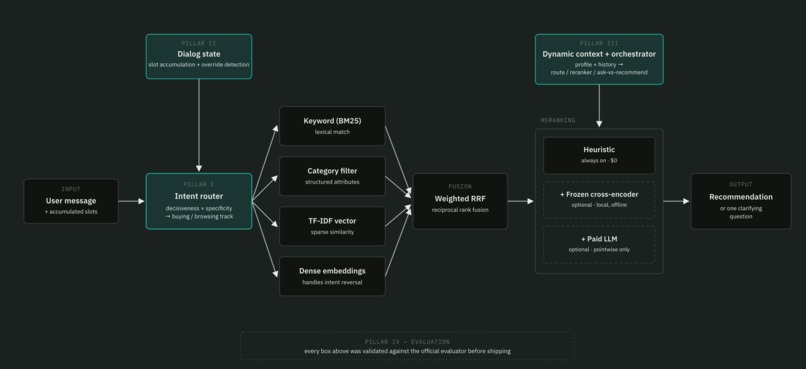
AgentShopper's Architecture
-
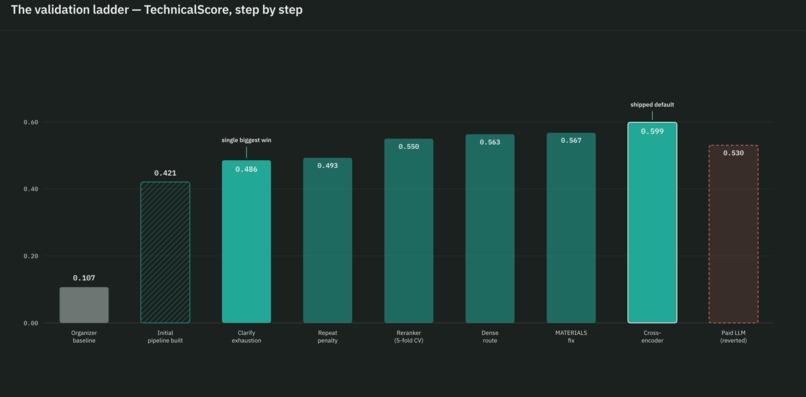
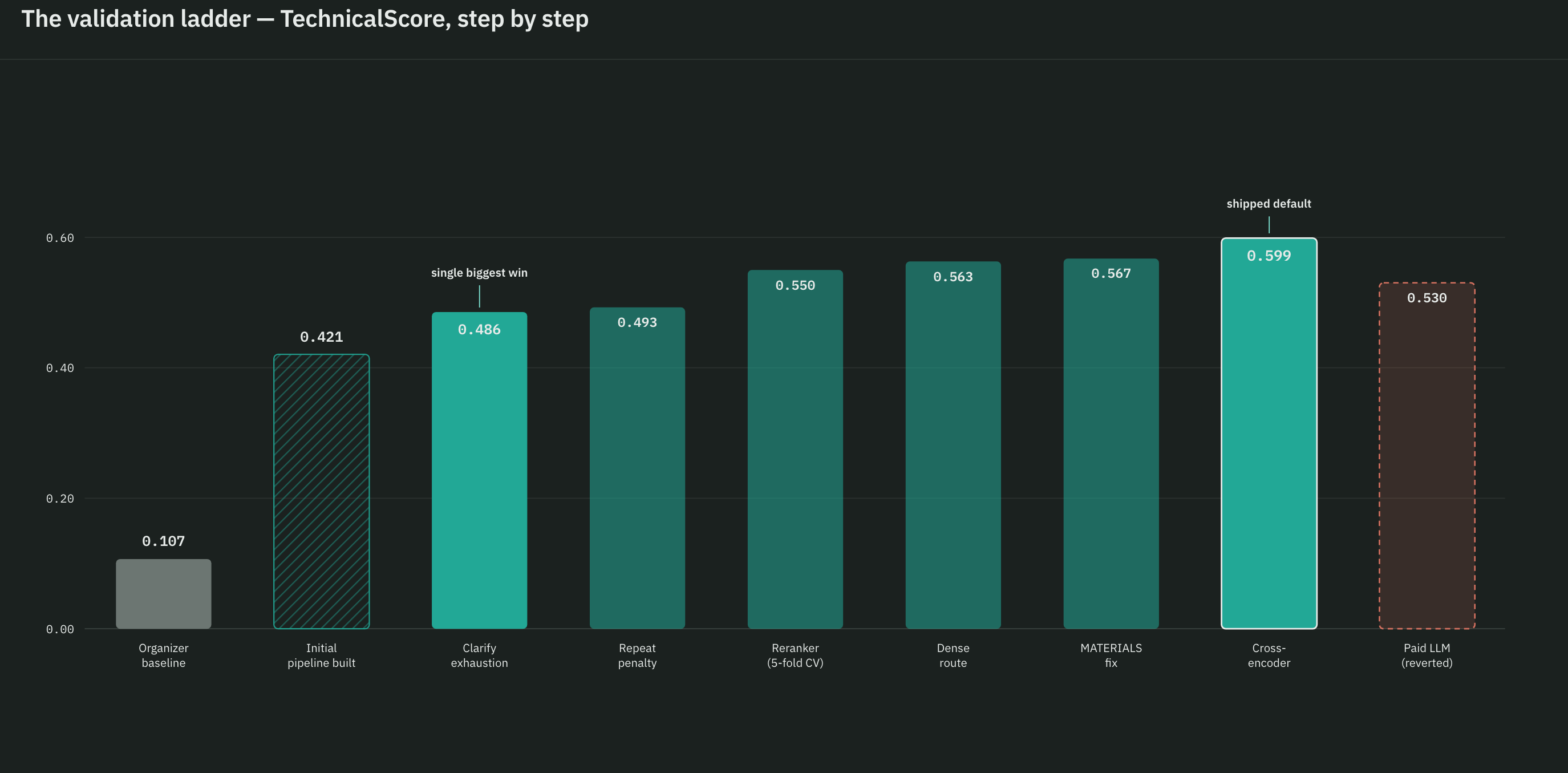
AgentShopper's Technical Score Climb Overtime
-
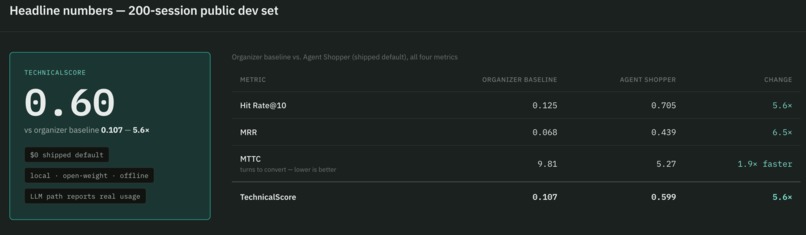
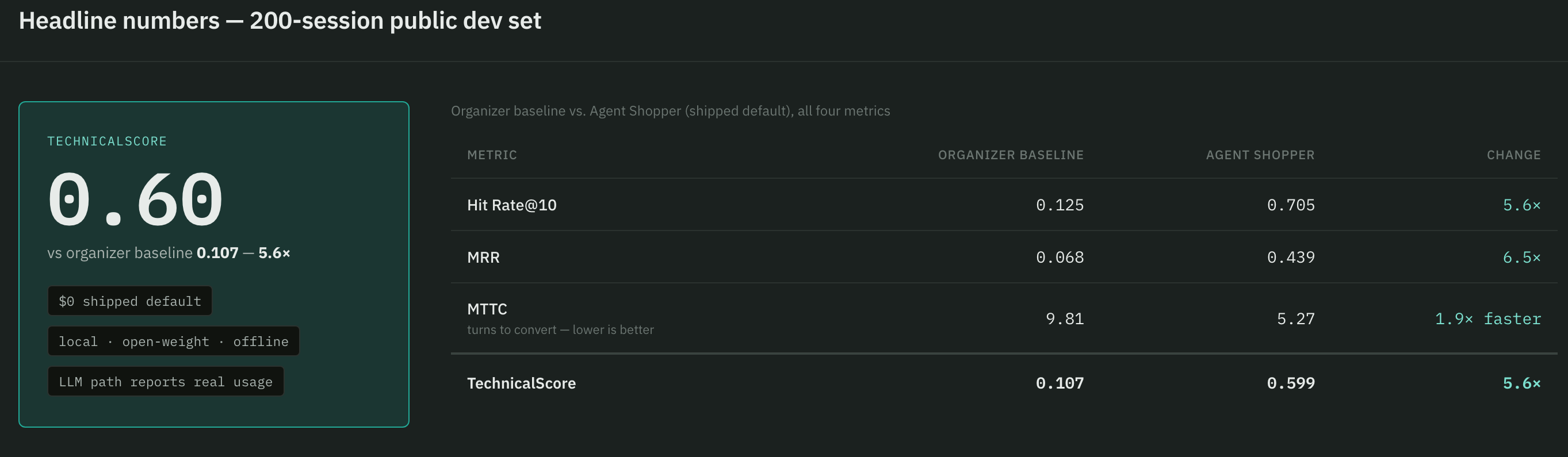
AgentShopper's Headline Metrics
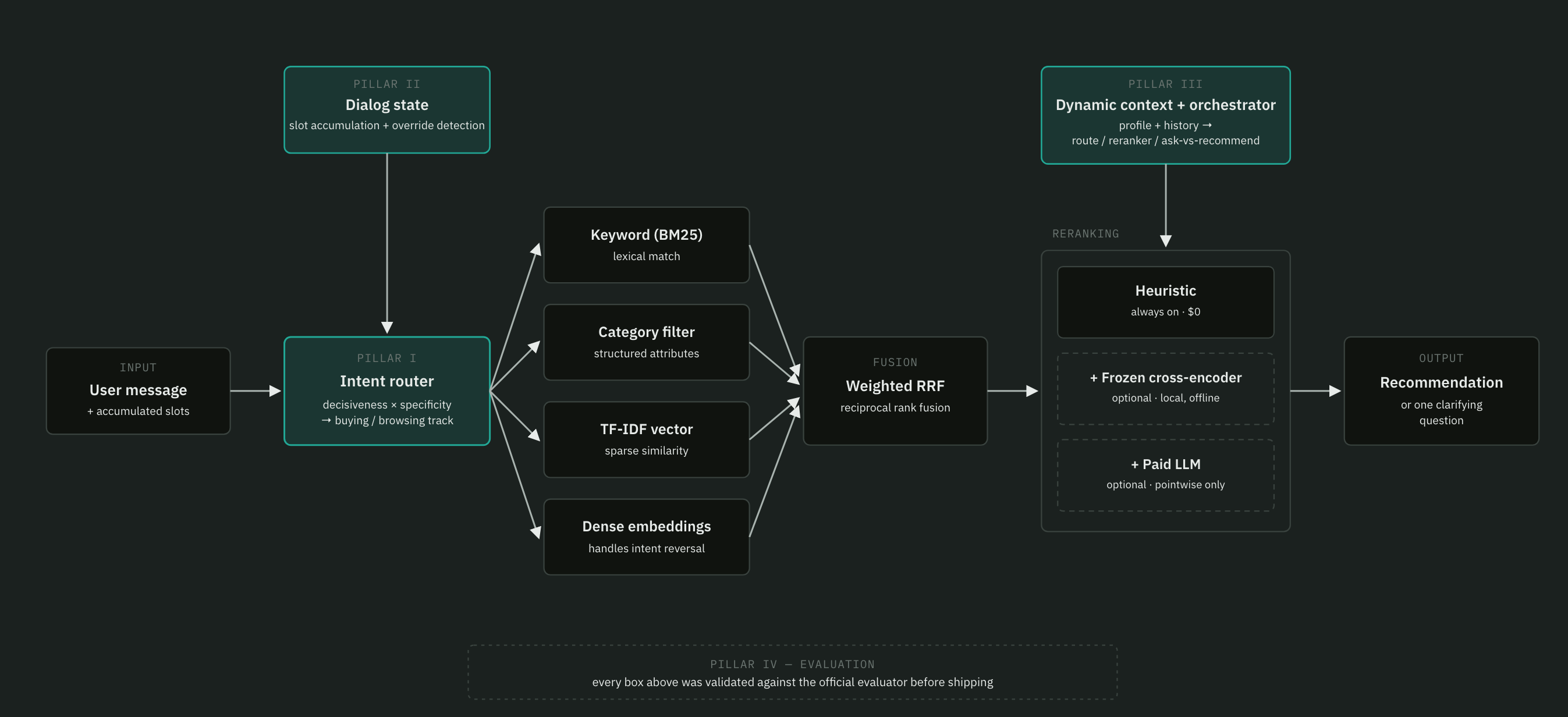
About the project
Inspiration
Most "smart search" demos assume the shopper says exactly what they want on turn one. Real shopping isn't like that — you say "something for a wedding," get shown options, realize you actually meant flats not heels, and maybe change your mind about color halfway through. The TechJam 2026 "Shopping Copilot" brief was explicit about this: intent routing, multi-turn evolution, context programming, and evaluation, scored end-to-end. That combination — a system that has to converge on one specific product across up to 10 turns, against a real 50,000-item catalog, with a hard metric at the end — was the appeal. Not a chatbot that sounds good, one that's graded on whether it actually finds the thing.
What it does
Agent Shopper is a conversational agent that narrows a 50k-item Amazon Clothing_Shoes_and_Jewelry catalog down to one target product through natural-language dialogue. It routes each turn along a buying/browsing axis, retrieves via three fused routes (BM25, TF-IDF/dense vectors, category filters), reranks candidates through a heuristic-or-cross-encoder stage, and tracks slots (category, material, color, size, budget, …) across turns — including detecting when a shopper reverses an earlier preference and rewriting state accordingly rather than blindly accumulating contradictory constraints.
Against the organizer's own evaluator on the 200-session public dev set:
| Hit Rate@10 | MRR | MTTC | |
|---|---|---|---|
| Baseline | 0.125 | 0.068 | 9.81 |
| Agent Shopper | 0.705 | 0.439 | 5.27 |
How we built it
The retrieval core fuses three independently-scored routes with weighted Reciprocal Rank Fusion:
$$ \text{RRF}(d) = \sum_{r \in \text{routes}} w_r \cdot \frac{1}{k + \text{rank}_r(d)} $$
On top of that sits a SessionState that accumulates slots turn by turn and distinguishes plain information-gathering from an intent override (explicit contradiction language, a conflicting category, a non-overlapping budget) — which clears and reopens only the affected slots rather than nuking the whole state. A lightweight orchestrator then decides, per turn, whether to retrieve, ask a clarifying question, or relax an over-constrained filter, based on turn budget and pool size.
The part we're most glad we did: nothing shipped as a default without an A/B run through the real evaluator first, and anything with enough free parameters to overfit 200 sessions (the reranker weights, the override-probability model) went through stratified k-fold cross-validation, not a single train/eval split. Of 21 tuning attempts logged, close to half regressed or came back neutral — and those were reverted completely, dead code and all, rather than shipped behind a disabled flag. The one exception worth calling out: adding a frozen local cross-encoder reranker, which went through offline replay, CV, a fault-injected circuit-breaker test, and a full re-evaluation against the extracted submission archive — not the working tree — before we trusted it as the default.
Challenges we faced
The one that cost the most time wasn't algorithmic, it was infrastructure: the cross-encoder checkpoint we originally intended to use (ms-marco-MiniLM-L-6-v2) reliably crashed the process with a SIGBUS during inference — an OS-level signal, not a catchable Python exception, so no amount of try/except could paper over it. Root-causing it meant bisecting across model sizes and architectures until we found a checkpoint (ms-marco-TinyBERT-L-6) that didn't crash, then building a subprocess-isolated smoke test so a native crash could never again take down a whole evaluation run silently.
A quieter but more dangerous bug: our submission-archive builder's file allowlist didn't include the dense retrieval model directory. DenseIndex degrades gracefully when its model is missing — meaning a judge's run would have silently lost an entire retrieval route with no error at all, just a quiet drop in Hit Rate@10 against every number in this README. We only caught it because we'd built the habit of extracting each submission archive into a fresh directory and re-running the full evaluation against that, never the working tree, before trusting anything as final.
And one honest, still-open gap: 26 of 200 public sessions never recall the target from any route at any depth, no matter what happens downstream. Diagnosing it (rather than guessing) meant writing a dedicated per-feature contribution script, which showed the bottleneck is upstream of reranking entirely — a rating-based candidate-injection step that never gives most of these targets a shot at being considered in the first place.
What we learned
The biggest lesson was procedural, not technical: a negative result you keep around as a disabled toggle is worse than no experiment at all — it's a landmine for a future version of yourself who assumes dead code is load-bearing. Reverting cleanly, every time, made the codebase trustworthy enough that we could keep iterating fast without re-litigating old decisions.
The second: for a system this stateful, the eval harness is the spec. A hand-picked weight or a plausible-sounding heuristic ("hard-filter on explicit requirement language") can look obviously correct and still measure worse than doing nothing — the turn-1 hard-constraint regex that accidentally matched the simulator's own scripted opening line, and quietly tanked buying-scenario Hit Rate@10 from 0.51 to 0.41, was a reminder that plausible and validated are different claims, and only one of them belongs in a shipped default.
Appendix: the full ablation log
Every one of these was measured with an A/B (or, where noted, a stratified k-fold CV) run of the official local evaluator on the 200-session public dev set — never eyeballed. "Shipped" means it's the current default in config.py; everything else, including a mechanically-confirmed-correct change, was reverted in full rather than kept as a disabled toggle.
Summary
| # | Experiment | TechnicalScore | Verdict |
|---|---|---|---|
| 1 | Per-attribute clarify exhaustion (stop clarifying only once no untried attribute is left) | 0.4207 → 0.4855 | Shipped |
| 2 | Reranker weights learned via 5-fold-CV logistic regression | 0.4927 → 0.5499 | Shipped |
| 3 | Soft repeat-penalty on already-shown, unconverted items | 0.4855 → 0.4927 | Shipped |
| 4 | Heuristic reranker applied to small pools too (not left in raw RRF order) | unchanged | Shipped (free, strictly more informed) |
| 5 | Per-department clarify-attribute relevance weighting | 0.4186 → 0.4207 | Shipped |
| 6 | Diagnostic (evidence-based) constraint relaxation | unchanged | Neutral — reverted |
| 7 | Rank-impact-aware clarify selection | 0.4927 → 0.4784 | Regressed — reverted |
| 8 | Negative/exclusion constraints ("no leather") | not measured — no track record | Prototyped, never shipped |
| 8b | Provisional (capped) recommendations on broad-pool clarify turns | 0.4207 → 0.3623 | Regressed — reverted |
| 9 | Stripping evaluator scaffolding text from BM25/TF-IDF queries | 0.5499 → 0.5371 | Regressed — reverted |
| 10 | Feature-richer reranker retrain (+category, +preference_tag) |
mean CV delta −0.0090 | Regressed — reverted |
| 11 | preference_tag retried alone (no category) |
mean CV delta −0.0042 | Regressed — reverted |
| 12 | Override-scoped boilerplate stripping (only on override turns) | MRR 0.2656 → 0.2308 | Regressed — reverted, off by default |
| 13 | Dense semantic retrieval (new dense route, MiniLM embeddings) |
0.5499 → 0.5634 | Shipped |
| 14 | Calibrated override-probability model (logistic regression, 5 features) | AUC/precision/recall 1.0 (5-fold CV) | Built, computed every turn, not yet consumed |
| 15 | LambdaMART reranker (14-feature LGBMRanker vs. 5-feature linear) |
mean CV delta −0.0188 | Regressed — reverted |
| 16 | Closing the intent_override slot-extraction gap (materials/features vocab) |
0.5634 → 0.5674 (2 of 4 words kept) | Partially shipped |
| 17 | Clearing stale point-constraint slots on an unattributed override | bit-identical | Neutral — reverted |
| 18 | LLM reranker (gpt-4o-mini, listwise) vs. heuristic |
0.5674 → 0.5301 (mean of 3 runs) | Regressed — kept optional, not default |
| 19 | Frozen pointwise cross-encoder reranking (ms-marco-TinyBERT-L-6, hybrid RRF fusion) |
0.5674 → 0.5989 | Shipped (submission default) |
| 20a | Category as an independent recall route on ungated turns | 0.5674 → 0.5650, 0/26 targets recovered | Regressed — reverted |
| 20b | Raise per-route search depth 200 → 500 | 0.5674 → 0.5589 | Regressed — reverted |
| 21 | Smaller capped structured-match injection (counterfactual-only, cap 5/10) | 0/26 recovered at either cap | Stopped before implementation |
For more details look at the GitHub's README.md and doc/experiments.md
Built With
- numpy
- pydantic
- python
- pytorch
- scikit-learn
- sentencetransformer


Log in or sign up for Devpost to join the conversation.