-
-
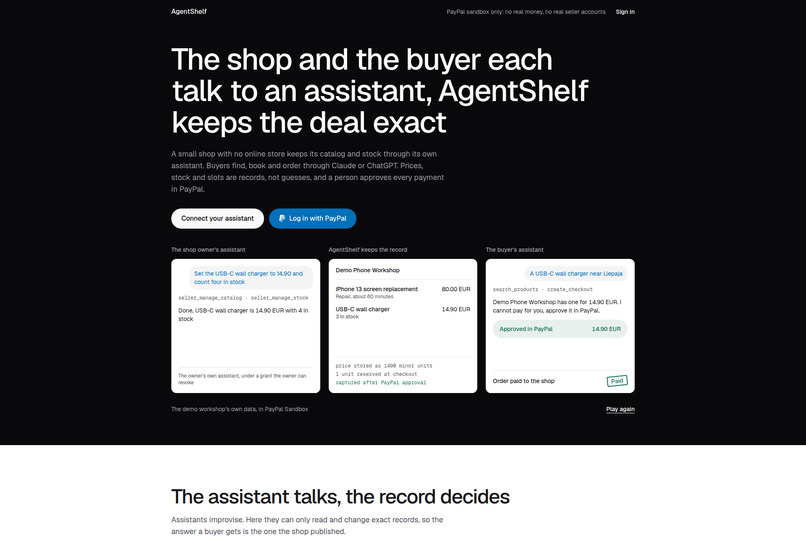
The shop and the buyer each use an assistant, with AgentShelf keeping the catalog, stock and payment records
-
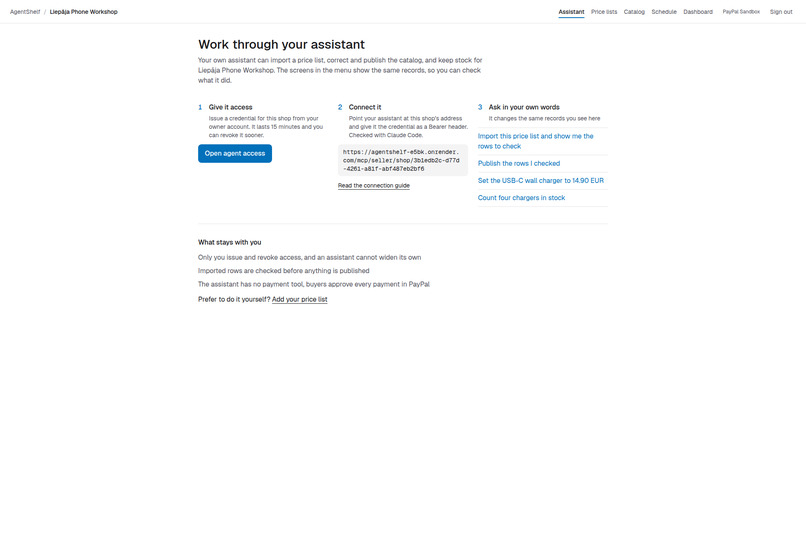
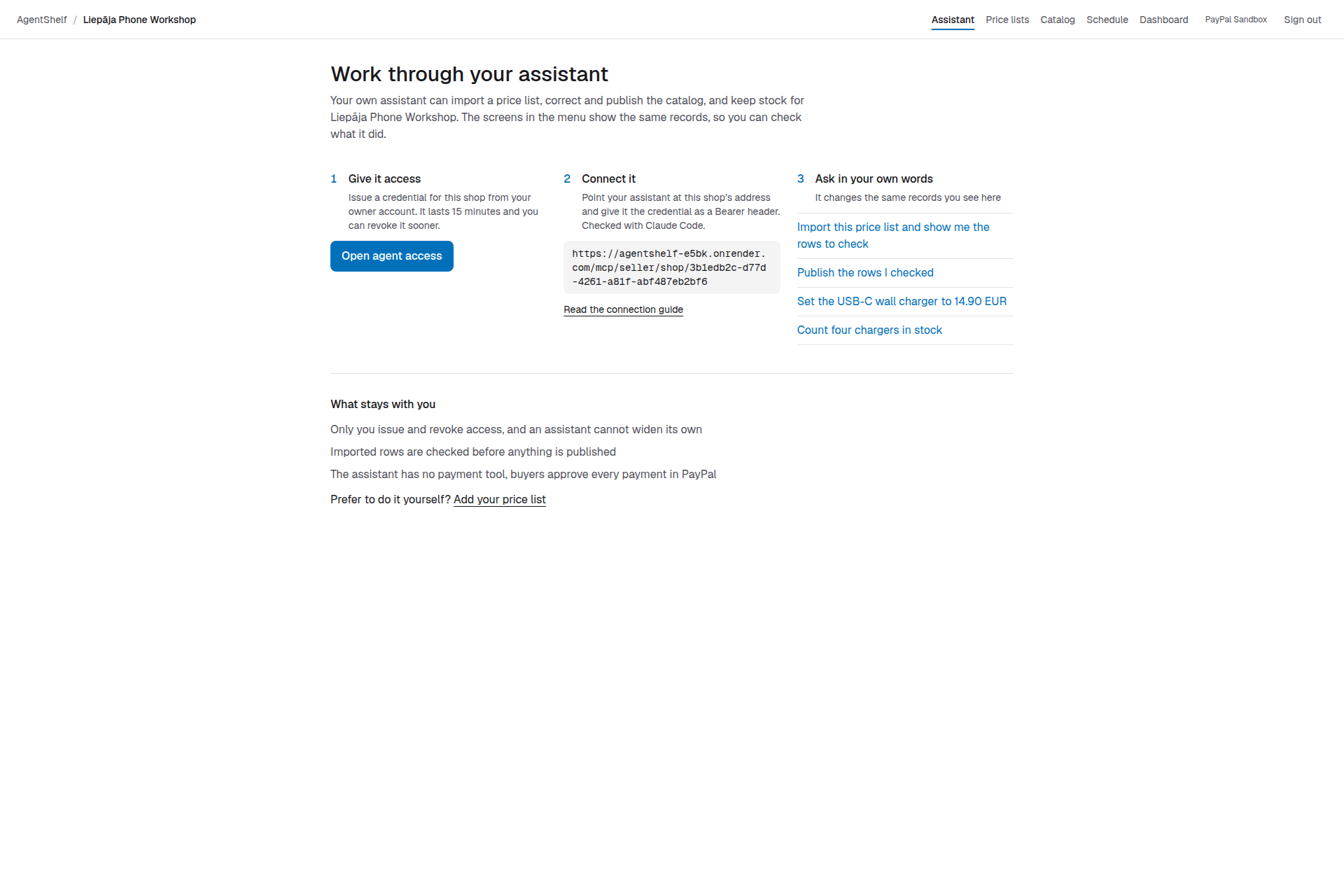
A shop owner connects an assistant with scoped, revocable access to the catalog and stock
-
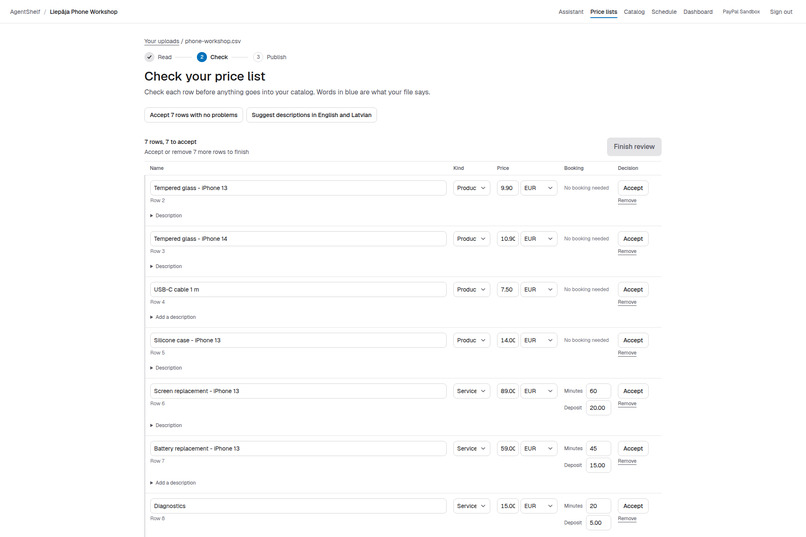
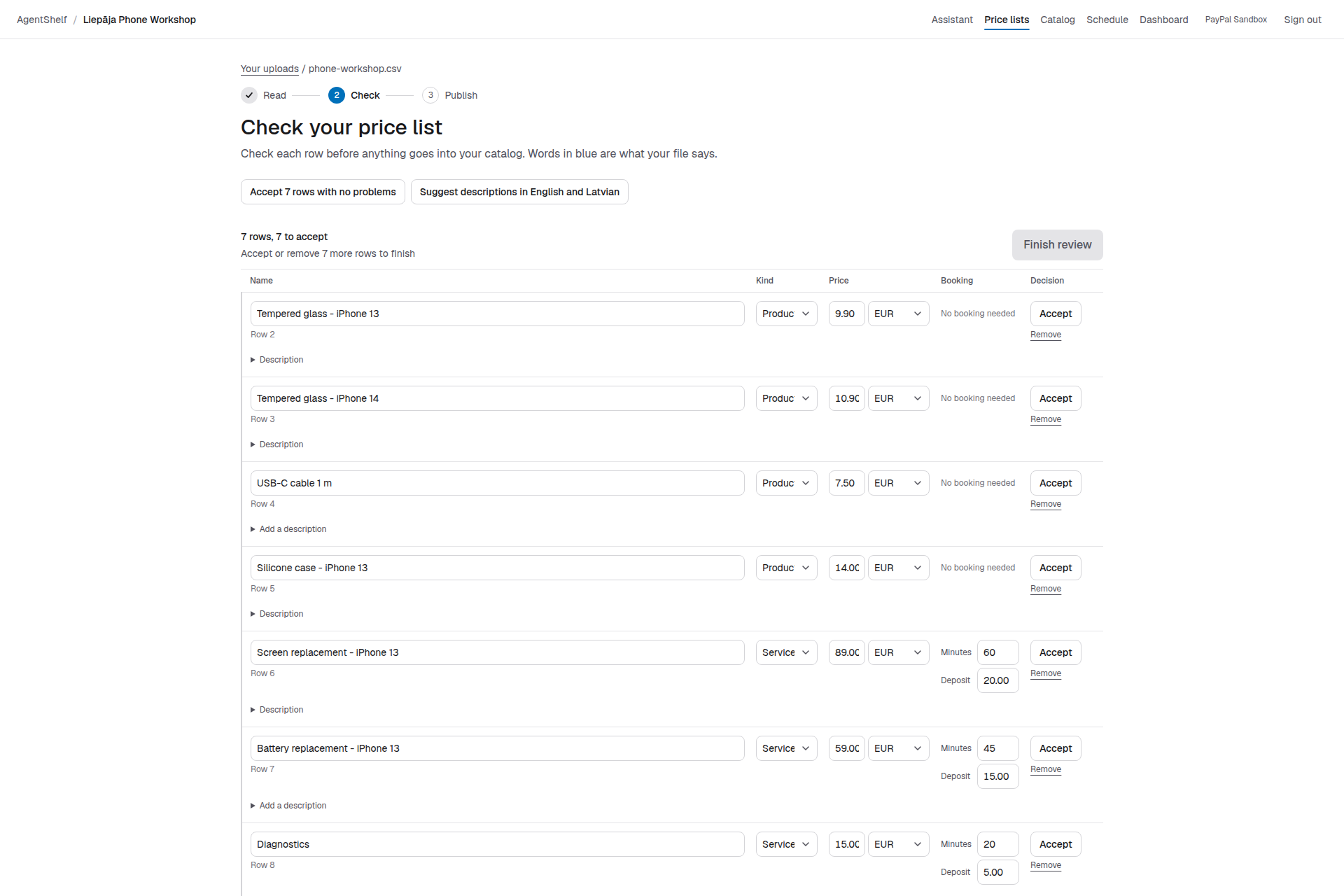
Review imported CSV products and services before publishing
-
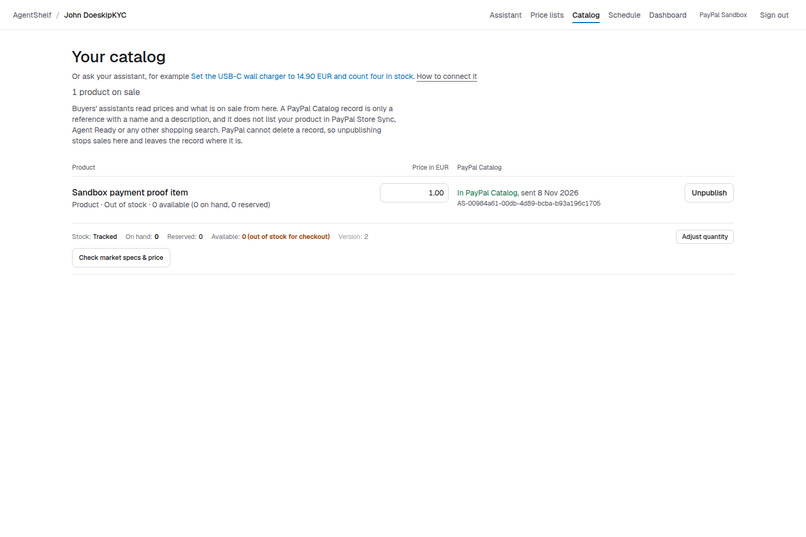
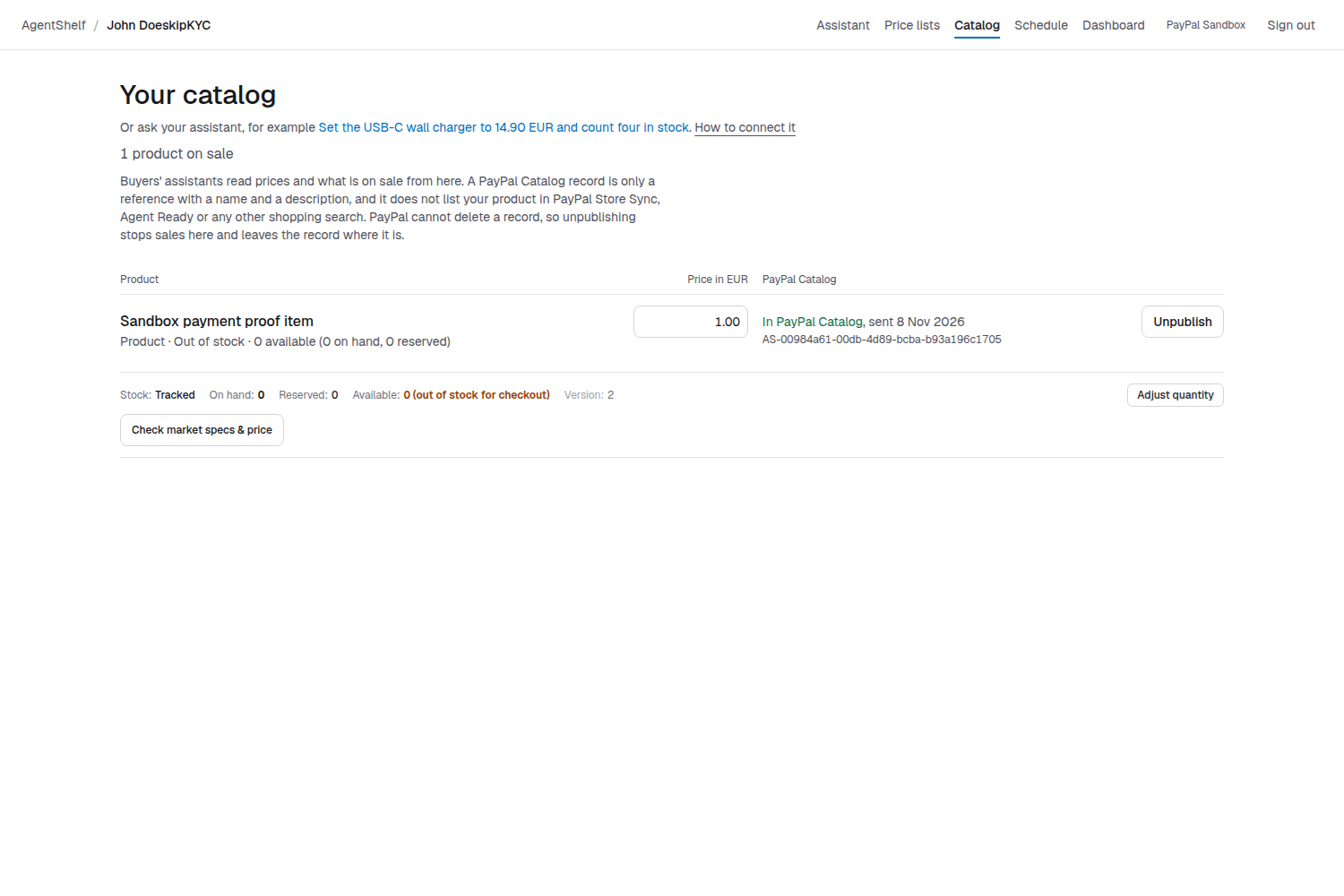
Tracked stock for a sold-out Sandbox item: 0 on hand, 0 reserved and 0 available for checkout
-
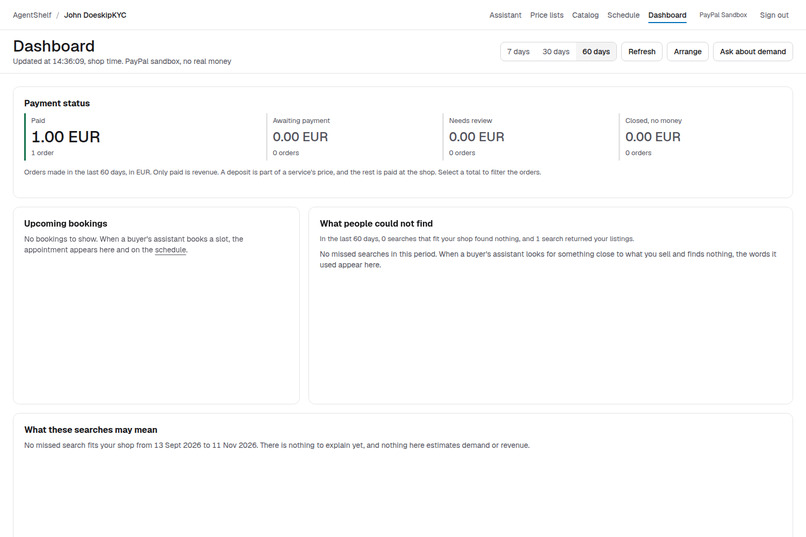
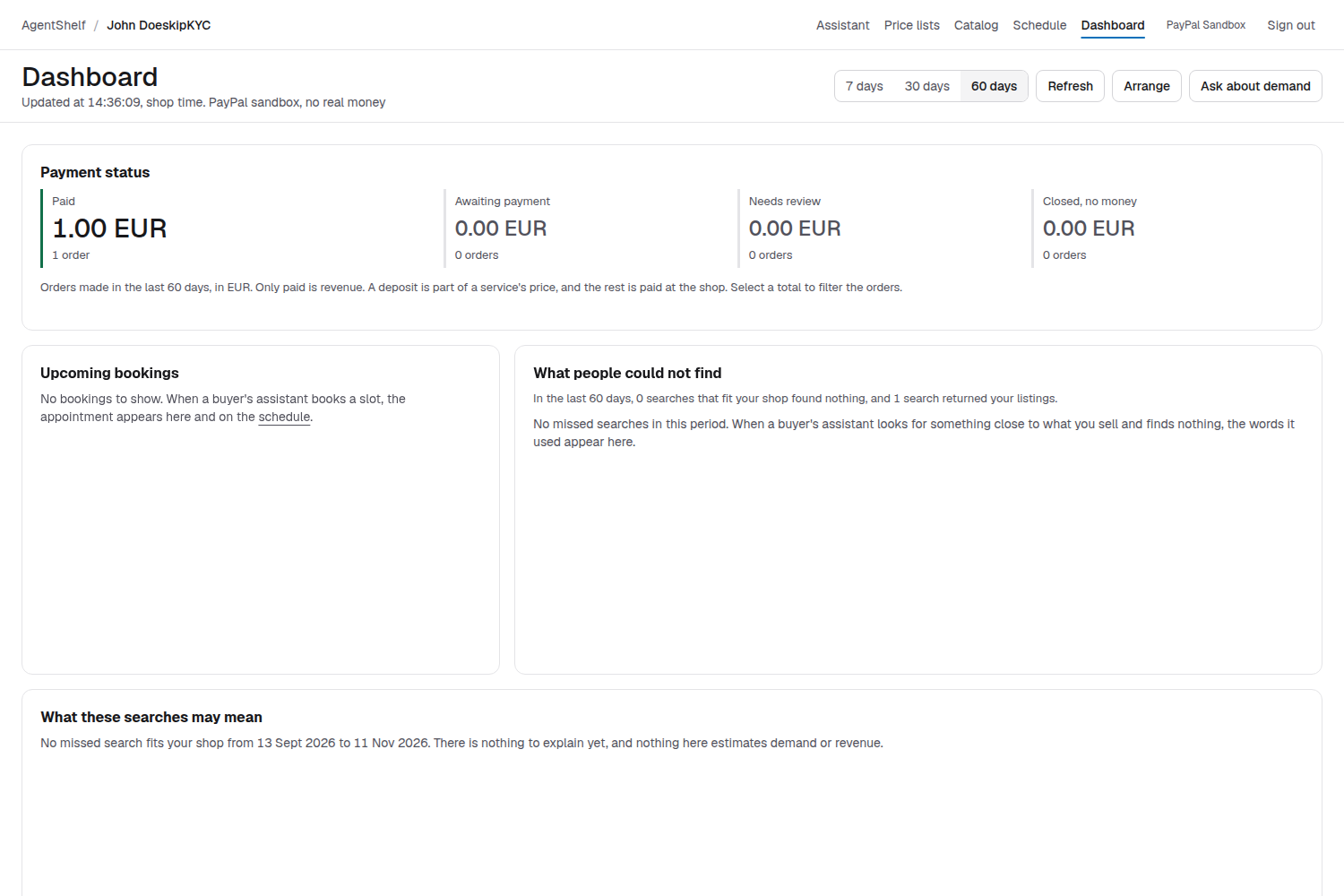
Seller dashboard, 60 days: 1.00 EUR paid from one PayPal Sandbox order, no bookings or missed searches
-
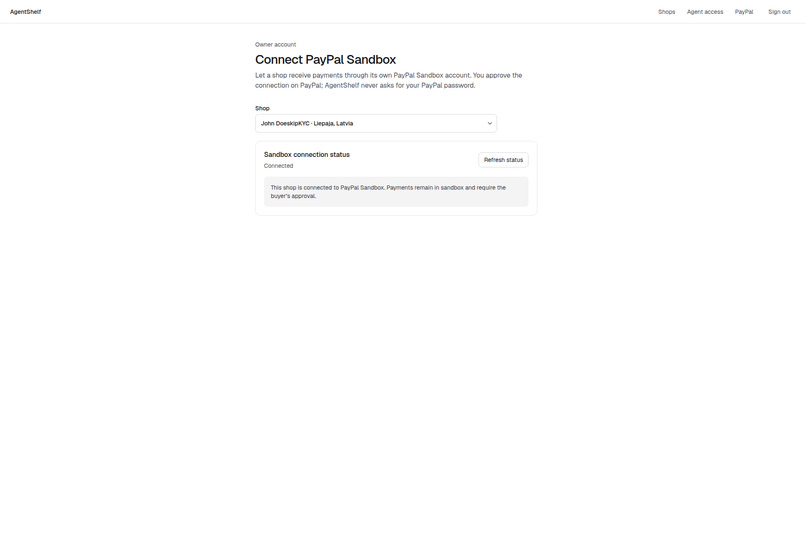
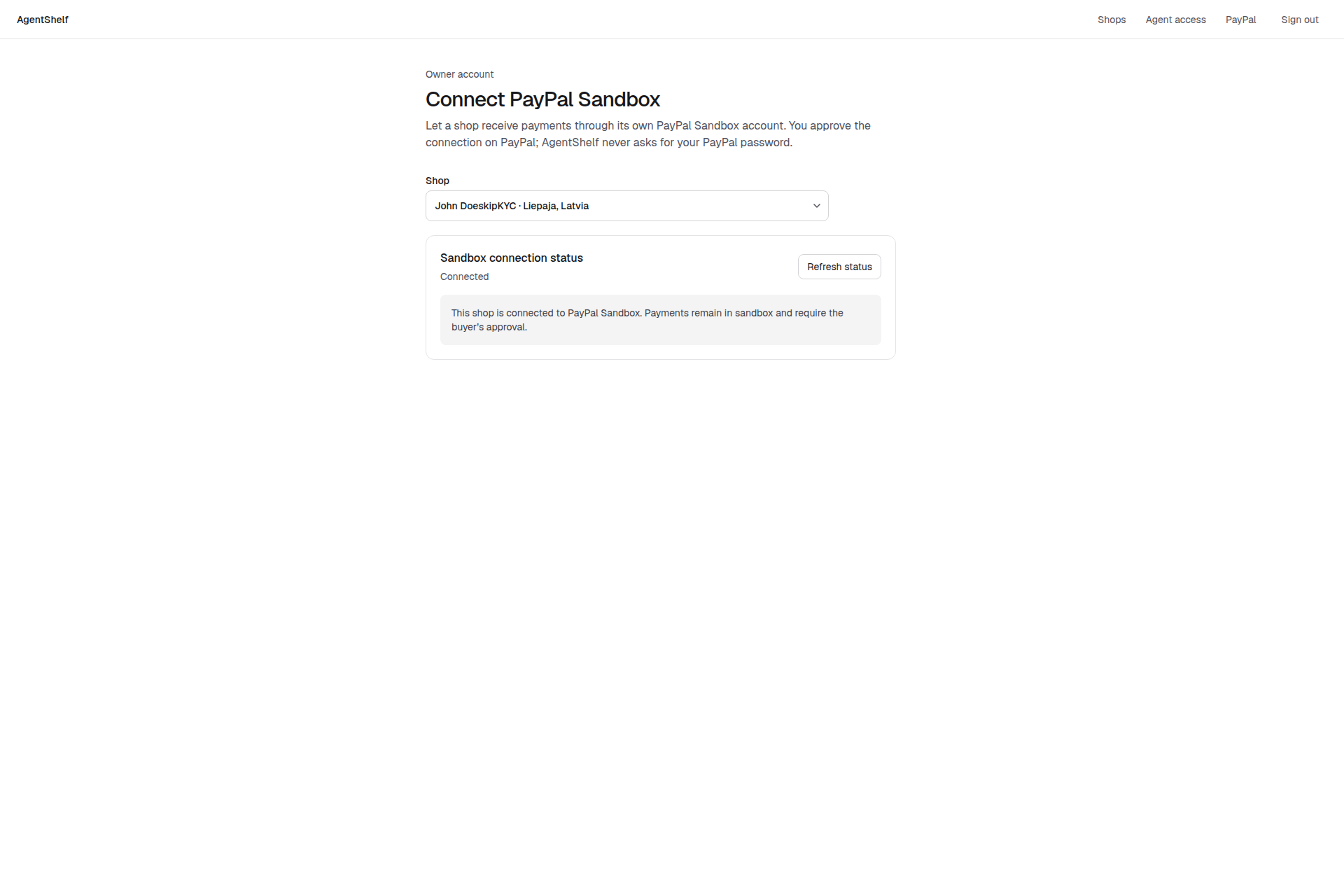
John DoeskipKYC is connected to PayPal Sandbox, payments require the buyer’s approval
-
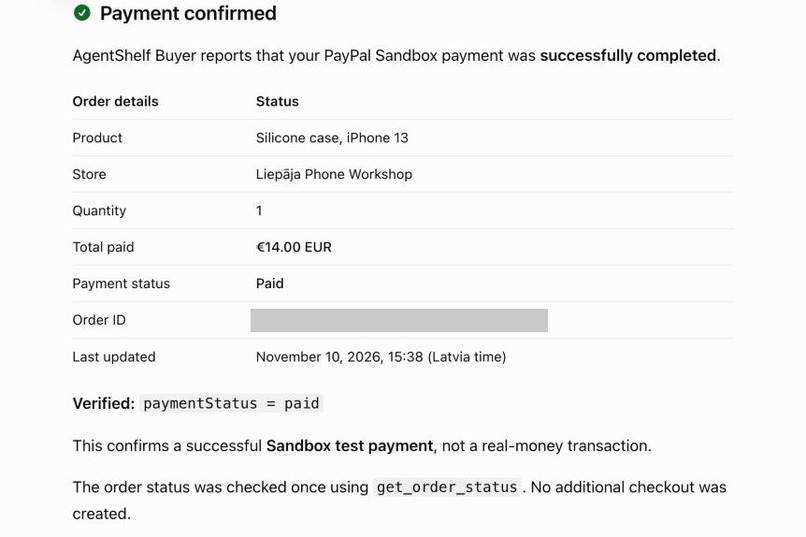
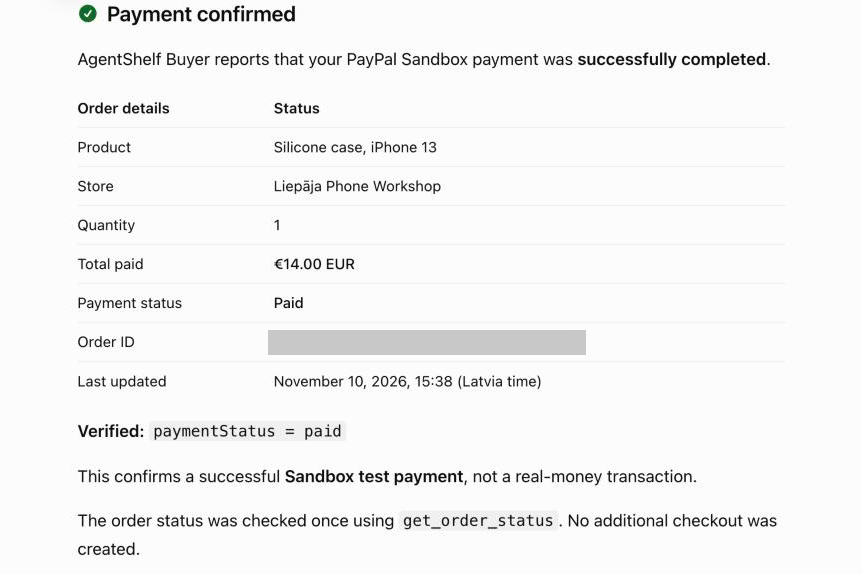
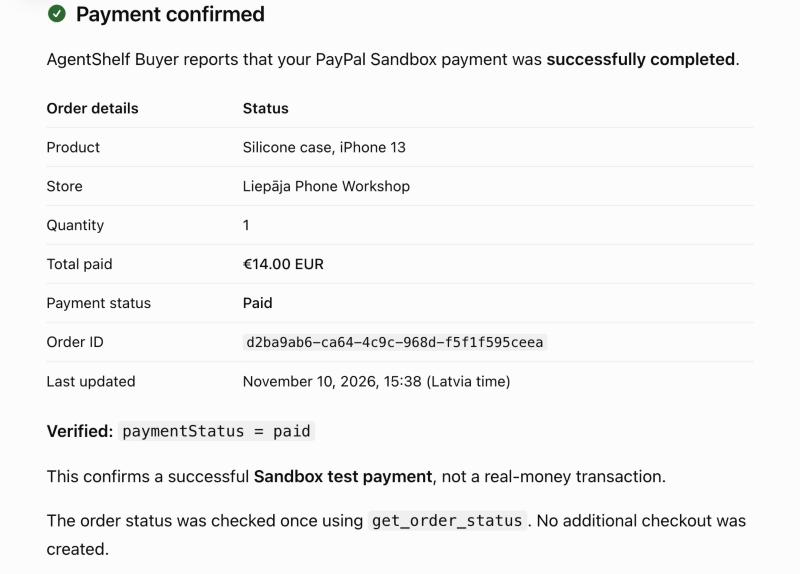
10 November 2026, PayPal Sandbox: ChatGPT with the AgentShelf connector reports a 14.00 EUR order as paid
-
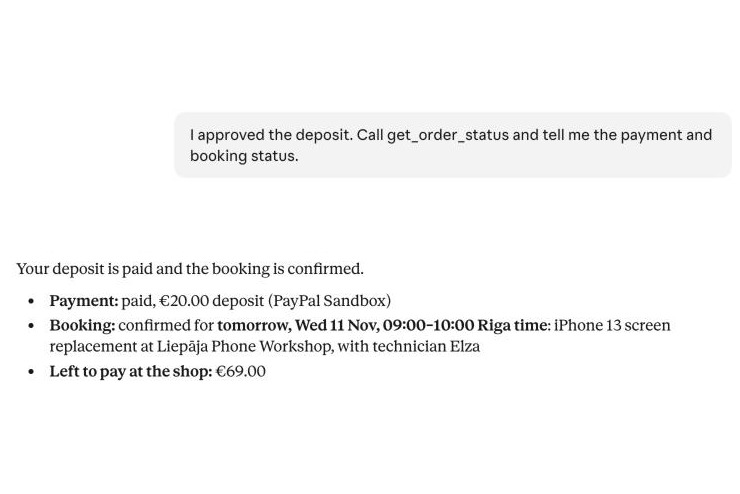
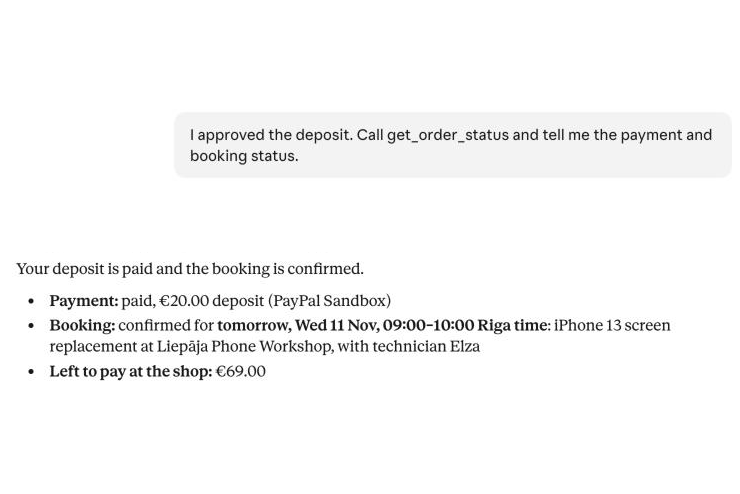
10 Nov 2026, PayPal Sandbox: Claude on claude.ai reports a paid 20 EUR deposit and a confirmed repair booking
-
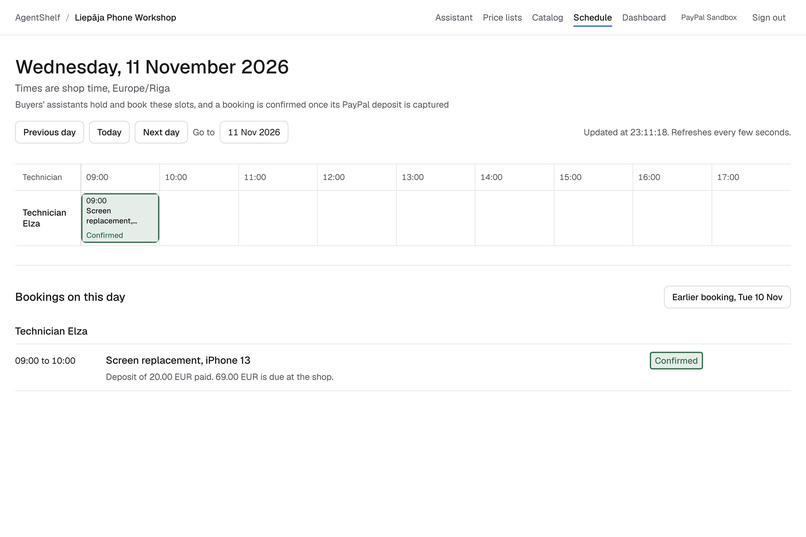
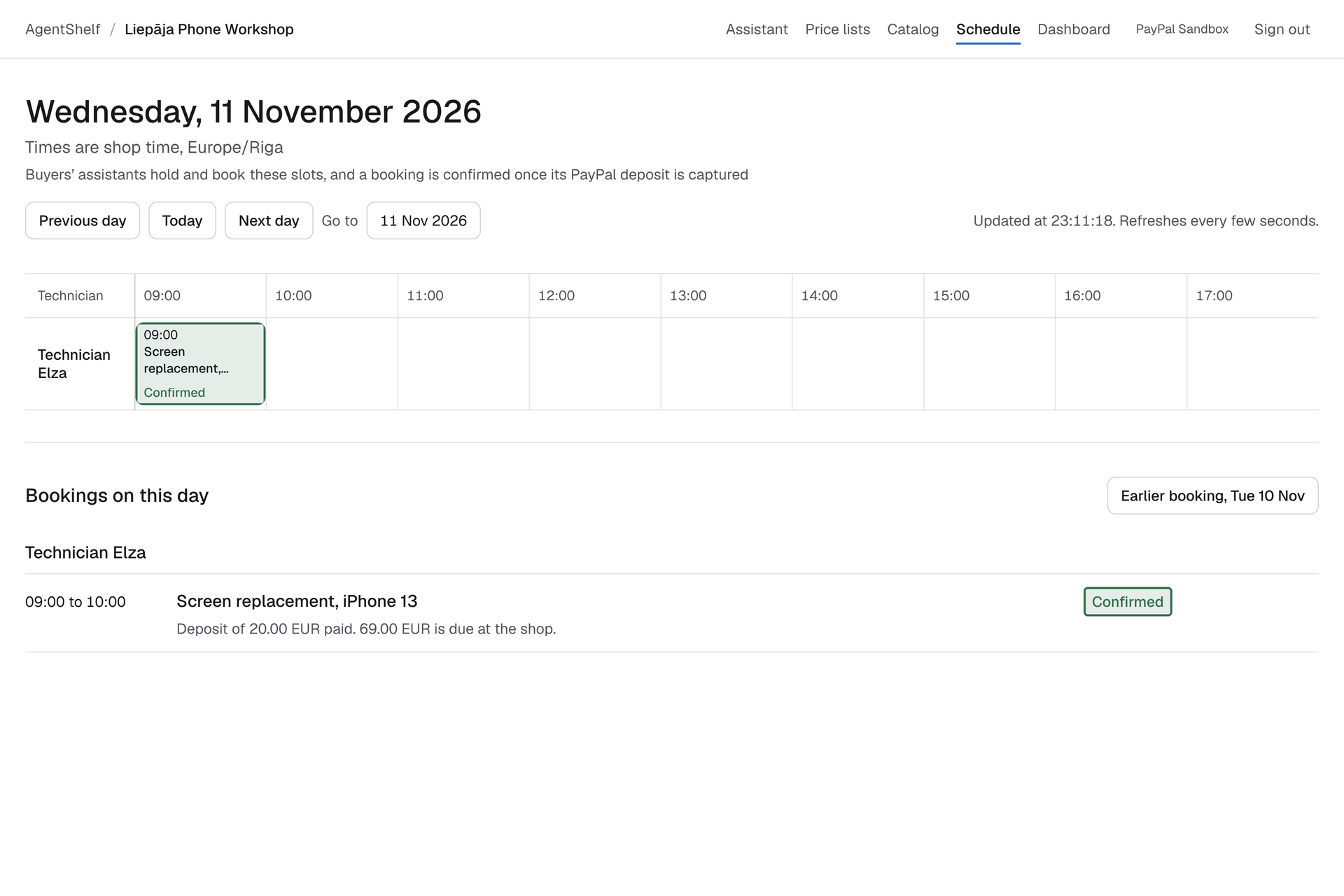
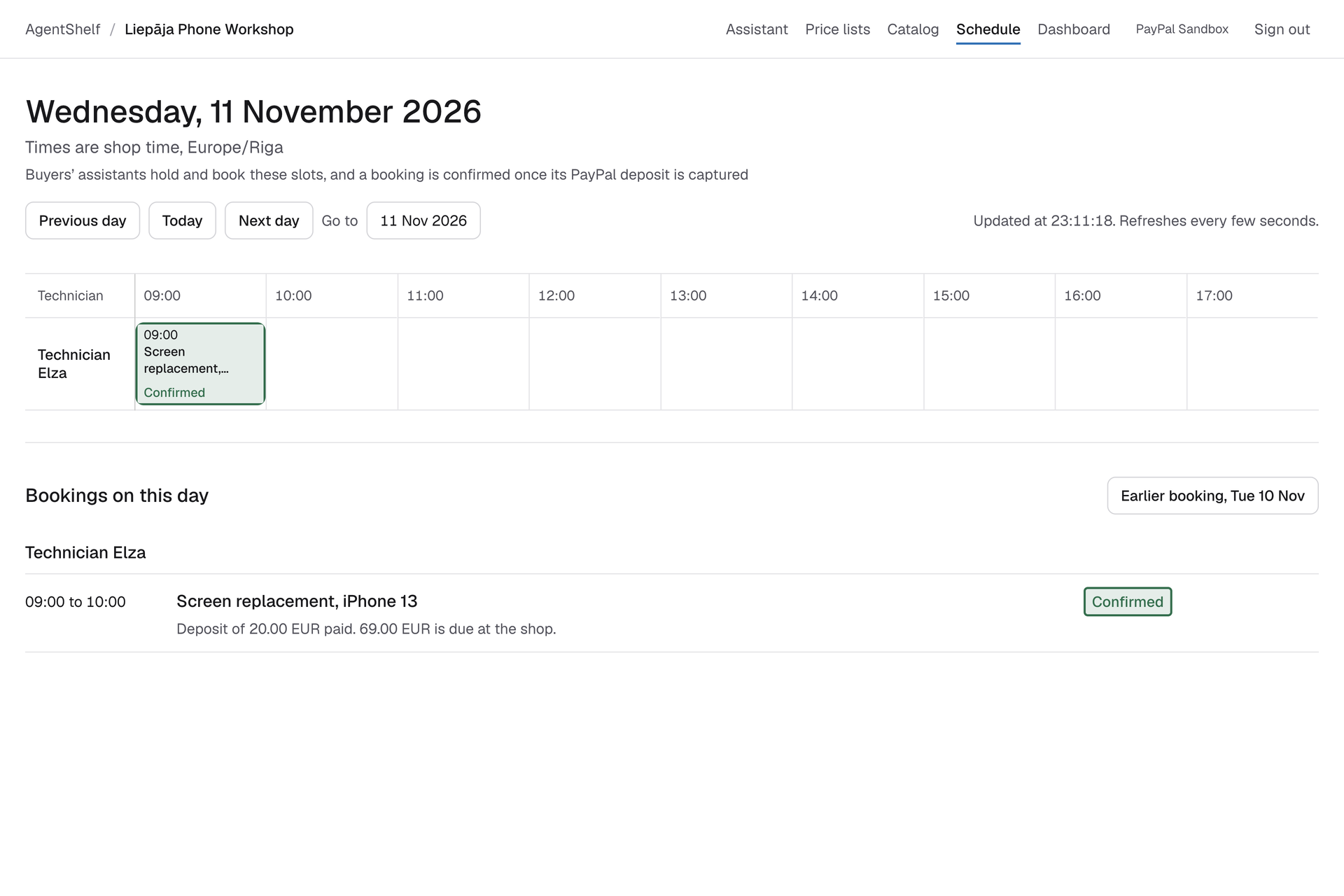
10 Nov 2026, PayPal Sandbox: the repair Claude booked on claude.ai shows as Confirmed in Bryntum Scheduler after the 20 EUR deposit
-
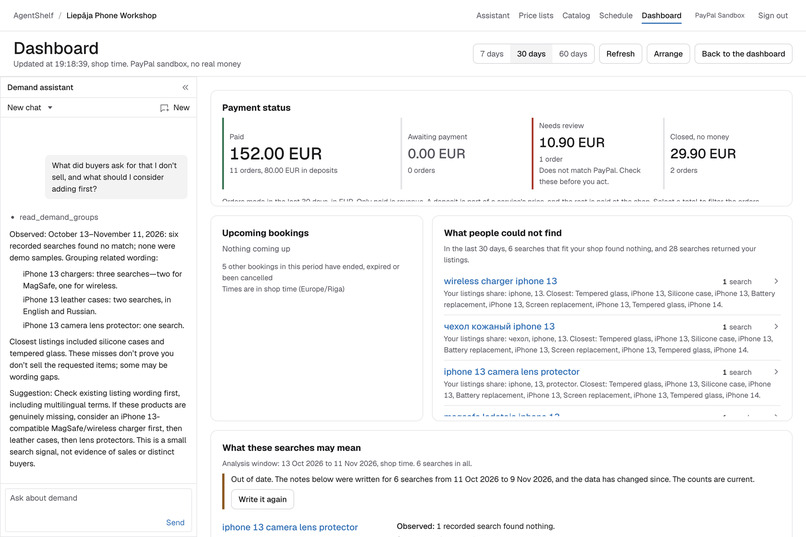
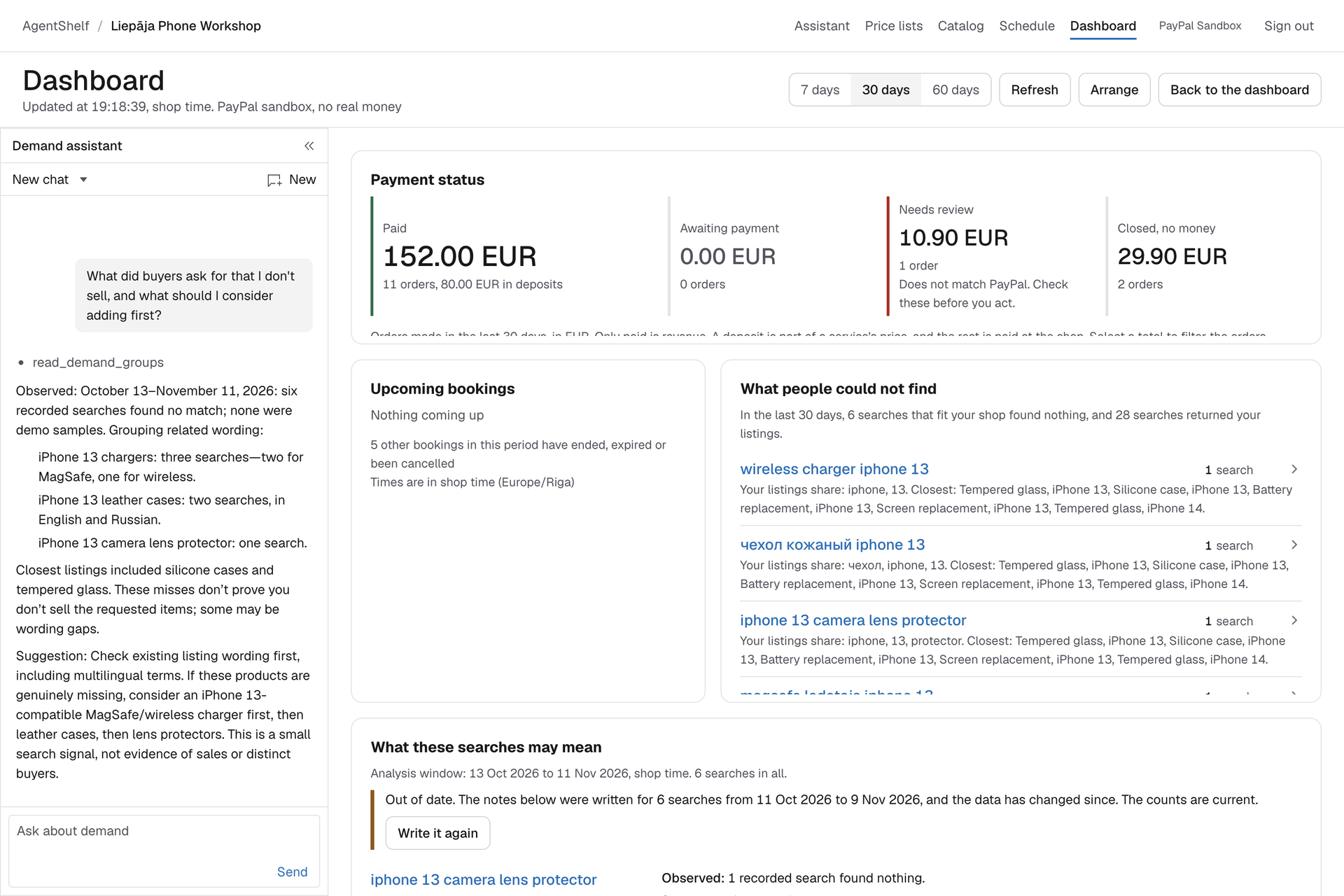
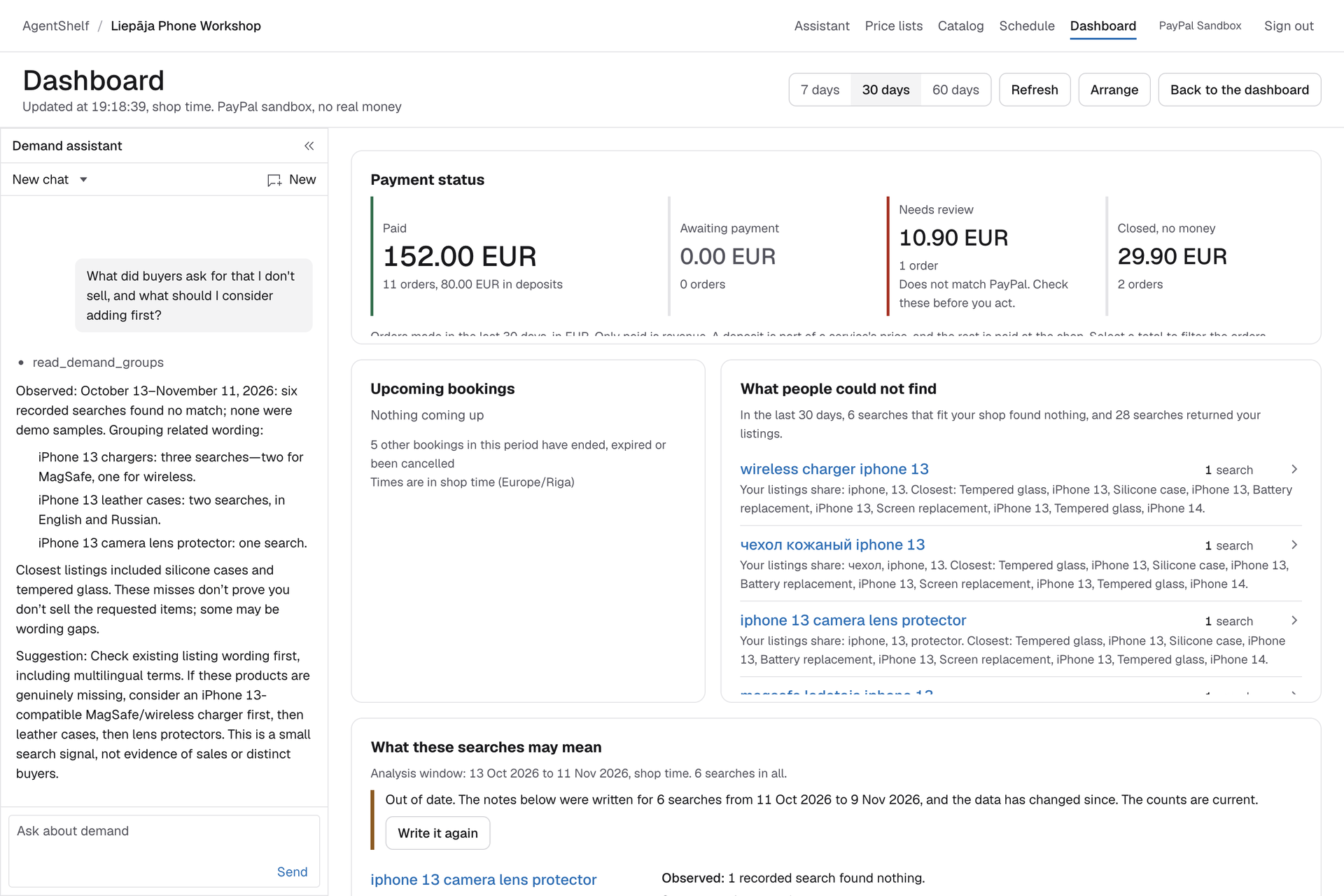
11 Nov 2026: the AG Studio Demand assistant groups six missed searches from team test runs and suggests an iPhone 13 MagSafe charger first
-
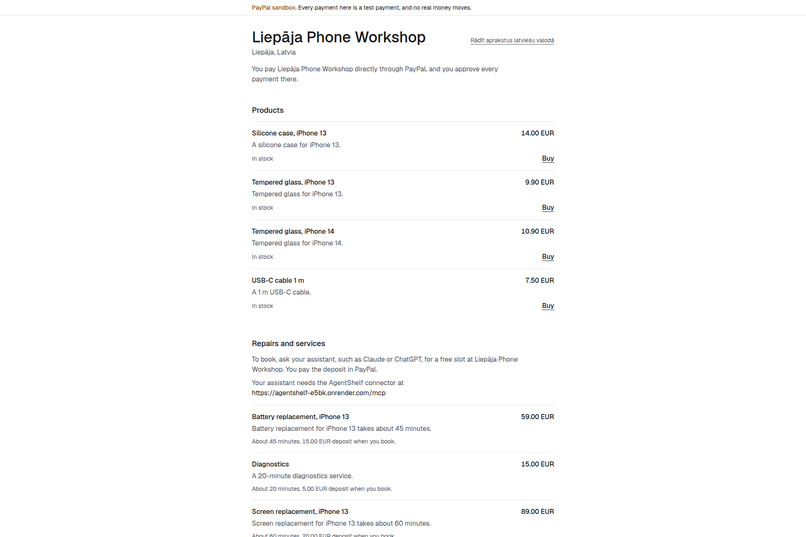
A public storefront shows available products and directs repair bookings to the buyer's assistant
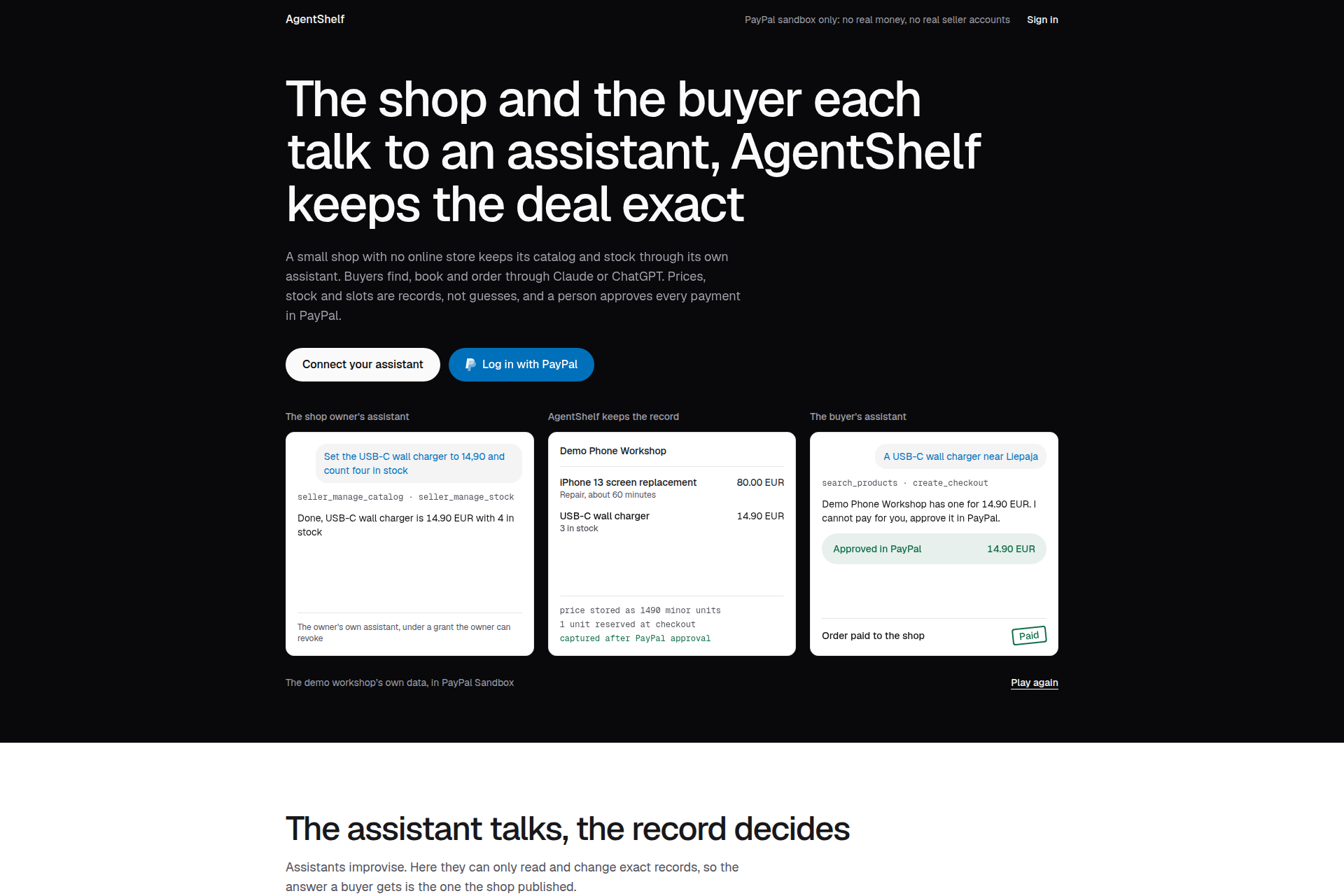
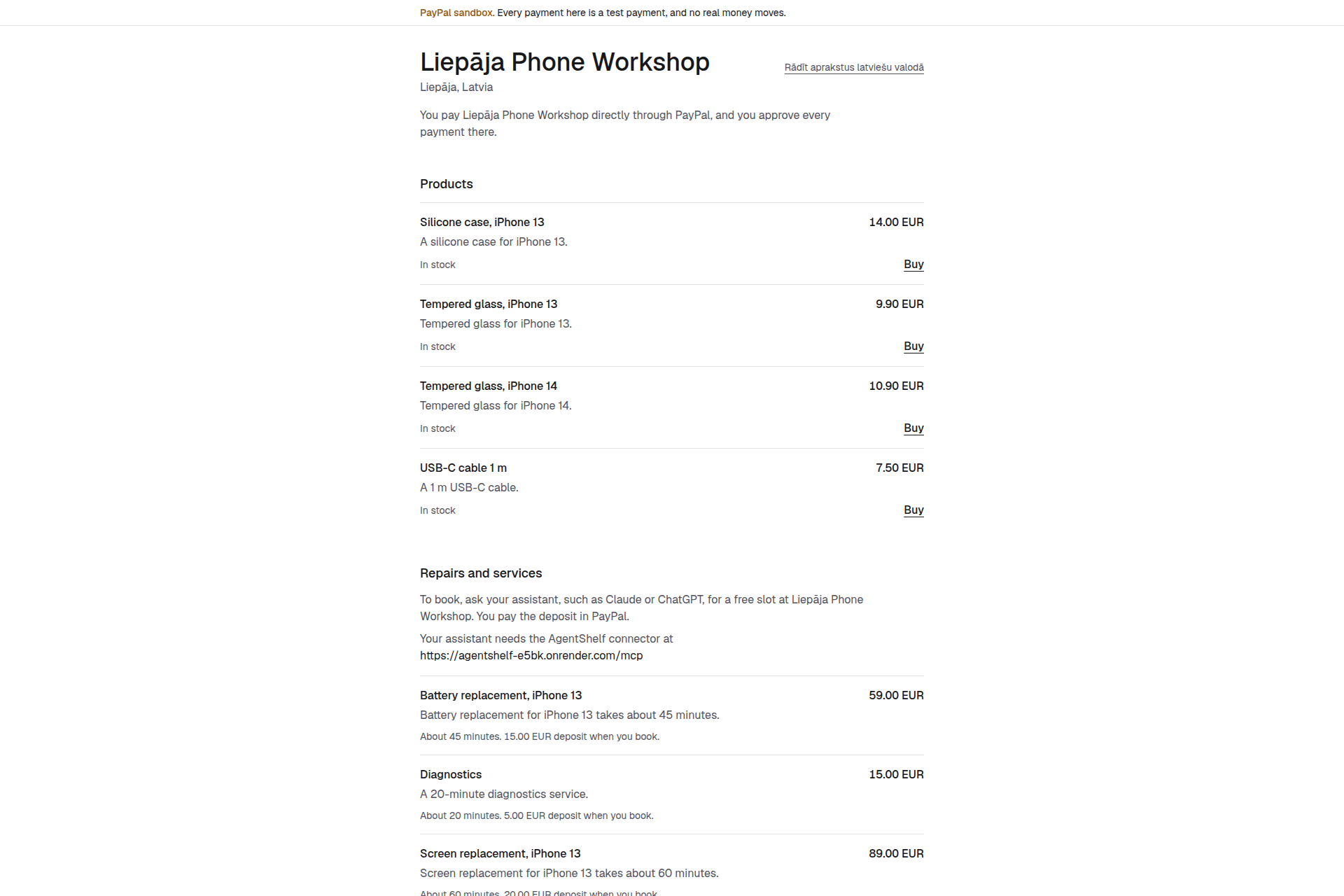
AgentShelf brings agentic commerce to shops that have no online store: the buyer's own assistant finds an item or holds a repair slot over MCP and prepares the PayPal order, a person approves the payment in PayPal, and the assistant never pays by itself
On the hosted service in PayPal Sandbox, Claude and ChatGPT each completed a paid product purchase, and Claude on claude.ai held a repair slot that was confirmed after the deposit was paid
Inspiration
A phone repair workshop has a paper price list on the wall and an Instagram page, it has no online store and no time to build one
When someone asks an assistant "who can replace an iPhone 13 screen tomorrow, and what does it cost?", that workshop does not exist for the assistant: it cannot be searched, its free slots cannot be read and an order cannot be started
Shopping is moving into assistants, and the shops with the least time for technology are the first to be left out, so we wanted the smallest possible step for them: a photo of the price list they already have
This is close to home for us: the father of one of our team members runs TipTop telefons, a phone shop in Liepāja, Latvia, the same kind of business as our demo workshop
Before submitting we described AgentShelf to him and to three other people who work for themselves: his business partner in Riga, a tiler in Germany who works alone as SKWildCat, and a key maker in Valga
All four called it a good idea, these were short conversations with family and acquaintances, not a survey
They are the people this is built for: they sell their time and small jobs as much as goods, and AgentShelf handles both products and bookable services
What it does
For the shop
- Photograph a price list or upload a CSV, AI reads the photo into rows, the seller corrects them in a table and publishes
- A price that is not one clear amount, such as "from 60 €" or "on request", stays empty and blocks that row from publishing until the seller enters it
- Connect a PayPal account once, every order names the shop as the payee, so the money goes directly to the seller
- See orders, repair bookings and stock in one dashboard, together with what assistants searched for and did not find
For the buyer
- One MCP connector covers every shop, the buyer's own assistant searches products and services, reads free technician slots, holds a slot and creates a checkout
- The assistant never pays: it returns a PayPal approval link, a person approves the payment in PayPal, and only then does the server capture it
Demonstrated on the hosted service in PayPal Sandbox
- In the Claude desktop app, Claude with AgentShelf added as a custom connector listed the tools, found a tempered glass for iPhone 14 and created one 10.90 EUR order, a person approved it in PayPal and the order status read
paid - ChatGPT with AgentShelf installed as a custom MCP server bought a 14.00 EUR silicone case with the same three prompts: tools listed, product found, one PayPal order created, approved by a person, status
paid - In the claude.ai web client, Claude with the same connector listed the next day's free repair slots, held 09:00 for an iPhone 13 screen replacement and returned a 20 EUR deposit link, after the person approved it the status read payment
paid, bookingconfirmed, and the workshop's Bryntum Scheduler shows that 09:00 booking as Confirmed with 69.00 EUR due at the shop (pictured below) - A person bought a 7.50 EUR cable with the PayPal button on the public shop page, without an assistant
- Three rehearsals on one deployed commit, with no reset between them, produced six captures, the price list was photographed, reviewed and published once, in the first rehearsal, and the second and third repeated the booking and the purchase on that catalog, tracked stock went from 4 to 3 after a paid order, and a paid booking appeared in the workshop's schedule as confirmed (rehearsal evidence)
Each run is recorded with its date, live commit and limits in the capability matrix
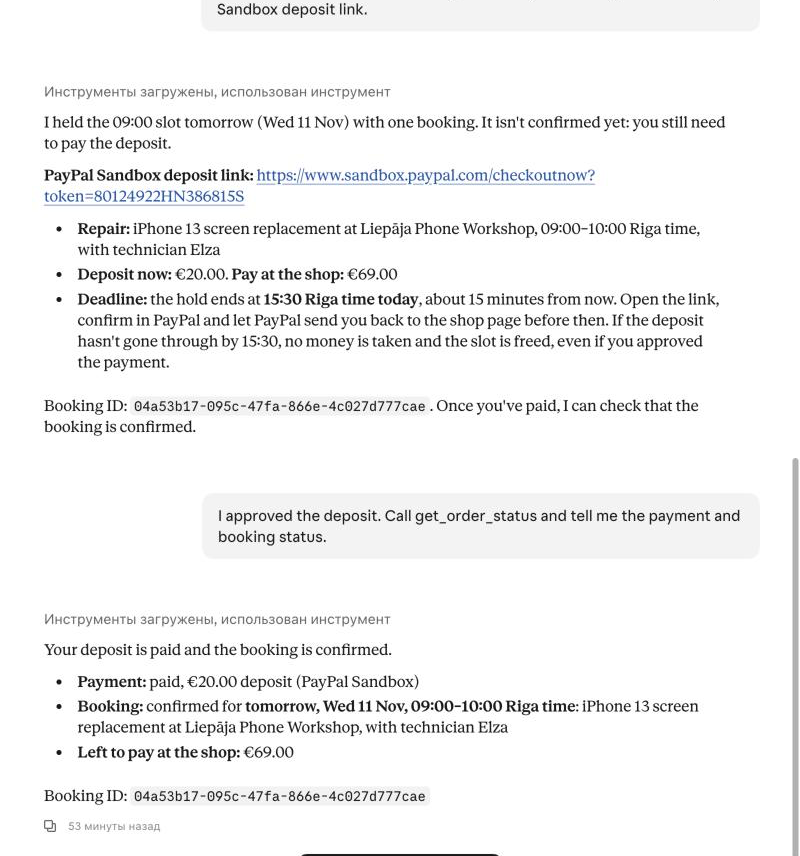
One booking, end to end: Claude held 09:00 on 11 November for an iPhone 13 screen replacement (89.00 EUR) with technician Elza, a person approved the 20.00 EUR deposit in PayPal Sandbox, and the same slot appears in the workshop's schedule as Confirmed with the remaining 69.00 EUR due at the shop
How we built it
Next.js 16, TypeScript and PostgreSQL on Render, CI runs lint, more than 1,900 tests and the production build, then deploys the exact commit
PayPal
- Orders v2 with the seller as
payee, the tools create the order and return the approval link, capture happens only after PayPal reports the buyer's approval - Partner Referrals for seller consent, with two separate Sandbox merchants connected
- Webhooks, signature-verified and reconciled with orders, slot holds and stock (PayPal Sandbox proof)
- Log in with PayPal for shop owners, and JS SDK v6 buttons on the public storefront
AI
gpt-6-astrareads price-list photos into rows and marks what it is unsure about, a note planted in a test photo asking it to change every price was ignored (AI acceptance)- When a listing is published, the model writes its description in English and Latvian and its search terms in English, Latvian and Russian
- Buyer search is PostgreSQL full-text search over those terms with no model call per query, not vector or semantic search, so it is fast and repeatable
- The model groups and explains unmet searches and answers the seller's questions about them in the dashboard
- CSV parsing is deterministic
MCP
One buyer endpoint over Streamable HTTP with five tools: search_products, get_slots, book_slot, create_checkout and get_order_status
A separate seller endpoint lets the owner's own agent manage the catalog and stock under a shop-scoped grant the owner can revoke
Partner tools
- AG Grid: the seller dashboard is built on AG Studio with a custom theme and custom widgets for payments, bookings and unmet demand, its Demand assistant runs on the Studio AI harness (
createAiHarnesswithdirectLlmRunner) with only its own tools, two read the shop's unmet searches and one switches the demand chart, so the seller can ask what buyers looked for and did not find, without access to payment data or unrestricted dashboard editing - Bryntum Scheduler Community 8.0: technicians are resources and bookings are events, a slot reserved by a buyer's assistant is temporarily Held and becomes Confirmed only after the PayPal deposit is captured
- APIMatic Context Plugin: its skills for
@paypal/paypal-server-sdkinformed the Orders v2 client, which has a 12-second request timeout, SDK retries switched off, a repeated checkout that sends the samePayPal-Request-Id, and errors classified by status,debug_idand issue name - Channel3: in the seller catalog, a lookup through the Channel3 search API shows suggested specs and retailer reference prices with a source link, matching is heuristic, so nothing changes until the seller applies a price explicitly, and the catalog keeps working when Channel3 is unavailable, rate-limited or not configured (Channel3 evidence)
- Render: Web Service and managed PostgreSQL, CI deploys the exact tested commit through a Deploy Hook and accepts it only after Render reports that commit live and the health and readiness checks pass, and on 11 November a Render Workflow task read one price-list photo on the hosted service into 7 draft rows, then dispatch was switched off again, because workflow runs have no spending cap and the app has no run quota yet (hosted run)
- Postman: a smoke collection run with Newman
Challenges we ran into
Stock, a slot hold and a PayPal order must agree: a slot is held for 15 minutes while the buyer approves, stock is reserved at checkout and decremented once after a verified capture
Tests cover the last unit bought twice and a cancel racing a capture
A price list is messy, so the model leaves unclear values empty, because a wrong published price is worse than a blank the seller fills in
Accomplishments that we're proud of
- The whole path works on a public URL: price list, catalog, assistant search, human-approved PayPal payment, capture, stock and schedule update, dashboard
- Services are sold as well as products: a technician slot with a PayPal deposit
- Sellers get a signal ordinary stores do not have: the demand that assistants could not satisfy
What we learned
Fail-closed defaults are easier to trust than silent fallbacks: a product with no stock decision cannot be bought, and a shop with no PayPal connection cannot take an order
One working MCP client does not prove another works, so we record which client ran which flow
What's next for AgentShelf
Turn the Render Workflow photo import back on with a run quota, sync published items to the PayPal catalog, then try AgentShelf with real workshops
Verified scope – updated 12 November 2026
PayPal Sandbox only, no real money
Purchases ran through Claude Code, through the Claude desktop app with a custom connector and through ChatGPT with a custom MCP server, and a repair booking with a paid deposit ran through the claude.ai web client (MCP status)
A repair booking from ChatGPT is not recorded
Added on 11 November: a hosted Render Workflow imported one photo and is switched off again, the demo database moved to a paid plan with no expiry through judging, the claude.ai booking shows as Confirmed in Bryntum Scheduler, and the AG Studio Demand assistant answered from team test searches (what was added)
Webhook receipts for the 9 and 10 November payments and platform-shop Catalog sync remain unconfirmed (capabilities)
PayPal Agent Toolkit and Shipment Tracking are not used
Built With
- ag-grid
- ag-studio
- apimatic
- bryntum
- channel3
- claude
- drizzle-orm
- gpt
- gpt-6
- mcp
- newman
- next.js
- openai
- paypal
- postgresql
- postman
- render
- typescript


