Inspiration
When a production AI agent does something wrong, you can pull up the prompt it was sent. What you can't see is the thing that actually drove the decision: what was in its memory at that moment, and why that memory won retrieval. By the time anyone investigates, the memory store has already moved on — the evidence is gone.
We kept hitting this in agent systems that read from a growing memory: the same input, run a week apart, behaves differently, and nobody can reconstruct why. We wanted to make that lost state recoverable — to point at one decision and rebuild the exact memory the agent read, prove what caused the outcome, and fix it under human authority.
What it does
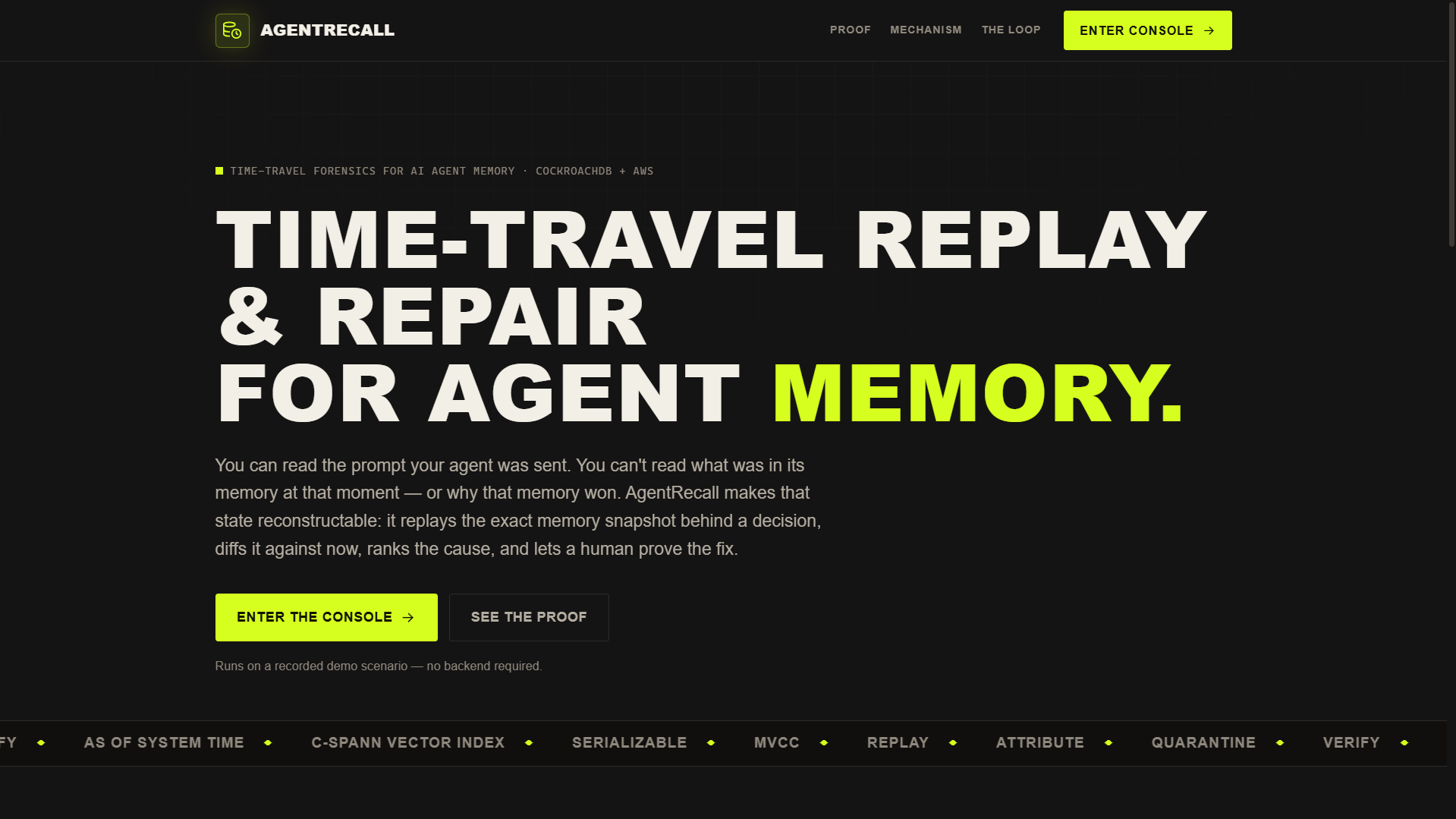
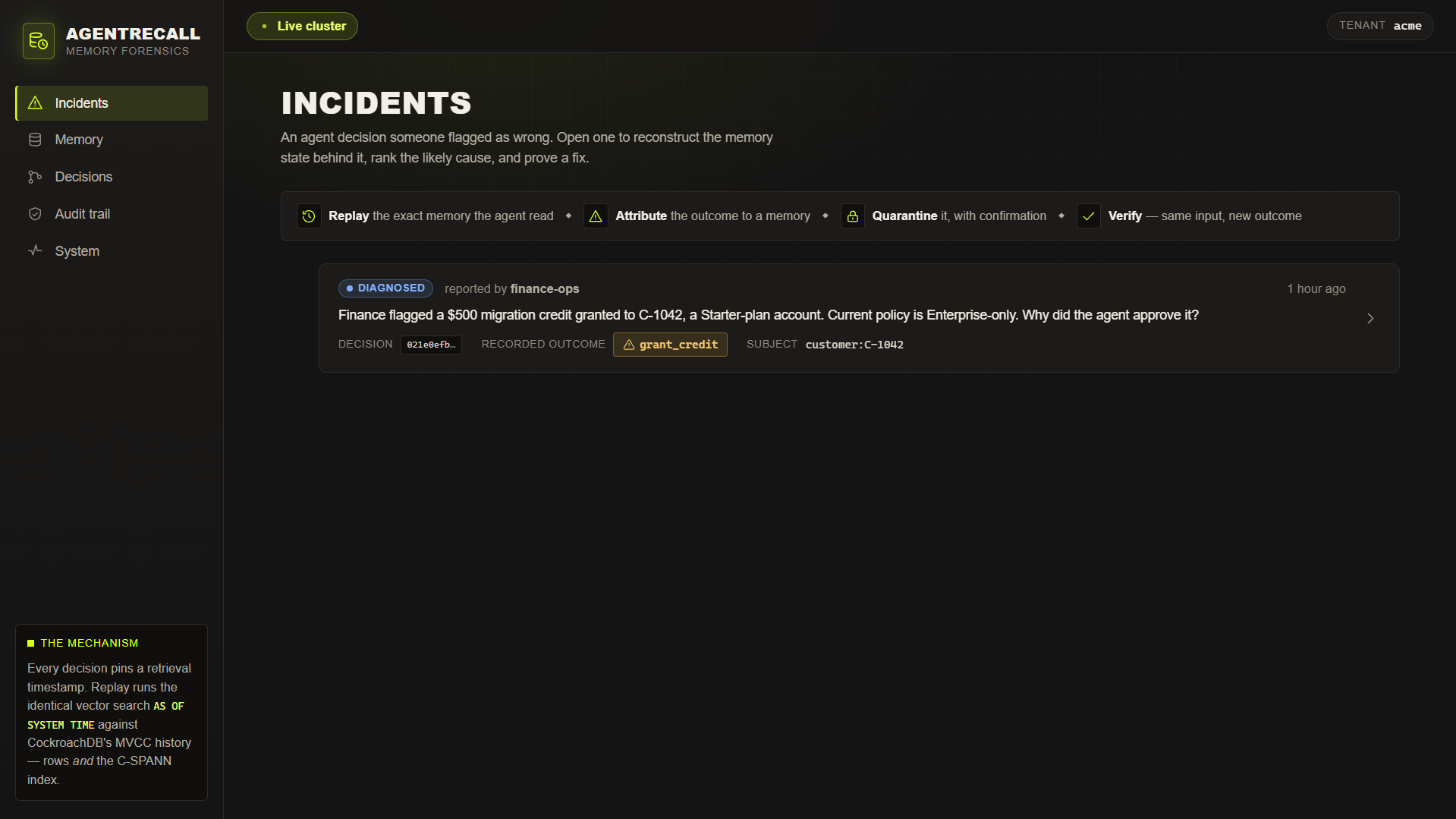
AgentRecall is a forensic console for AI agent memory. Point it at a single agent decision and it:
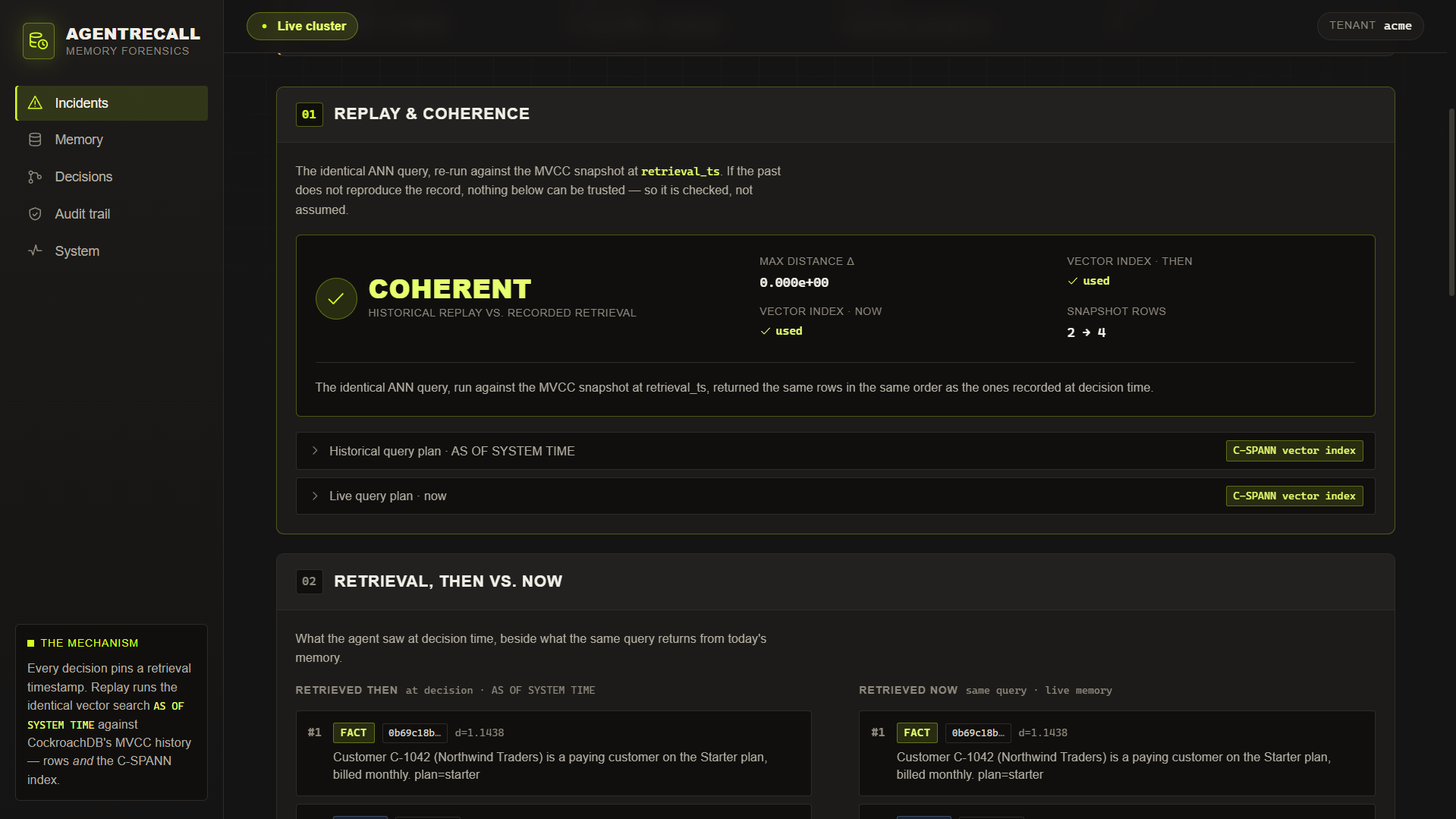
- Replays the exact memory snapshot the agent read — re-running the same semantic (vector) search against the past.
- Diffs that snapshot against memory as it stands now: what was added, removed, or edited since.
- Attributes the outcome to the memory most likely responsible, with reasons and a confidence ceiling — always a labelled hypothesis, never an automated verdict.
- Repairs it: a human quarantines the culprit memory behind a confirmation gate, writing an append-only audit row.
- Verifies the fix: the identical input is re-run against today's memory, and you watch the outcome change.
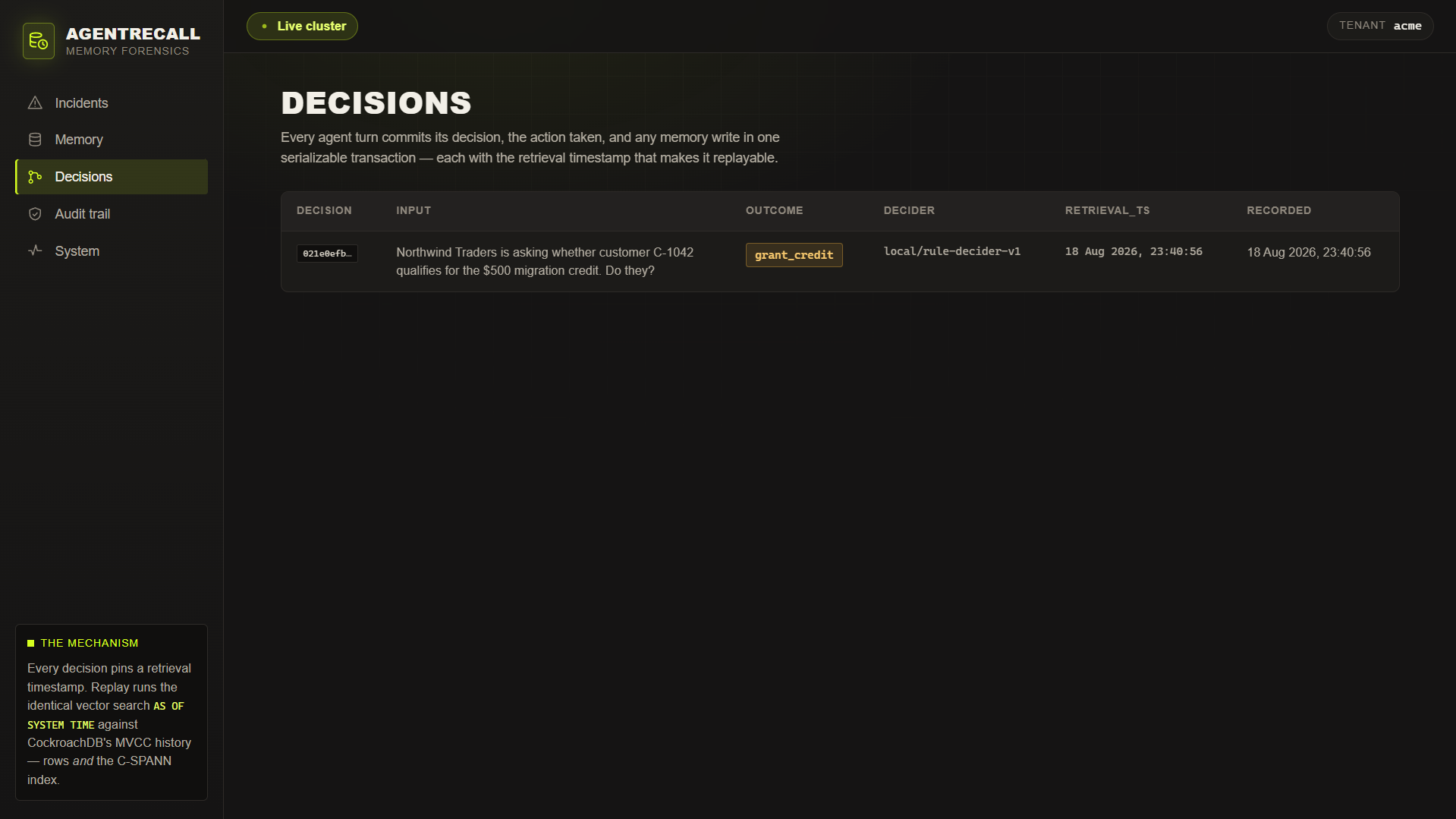
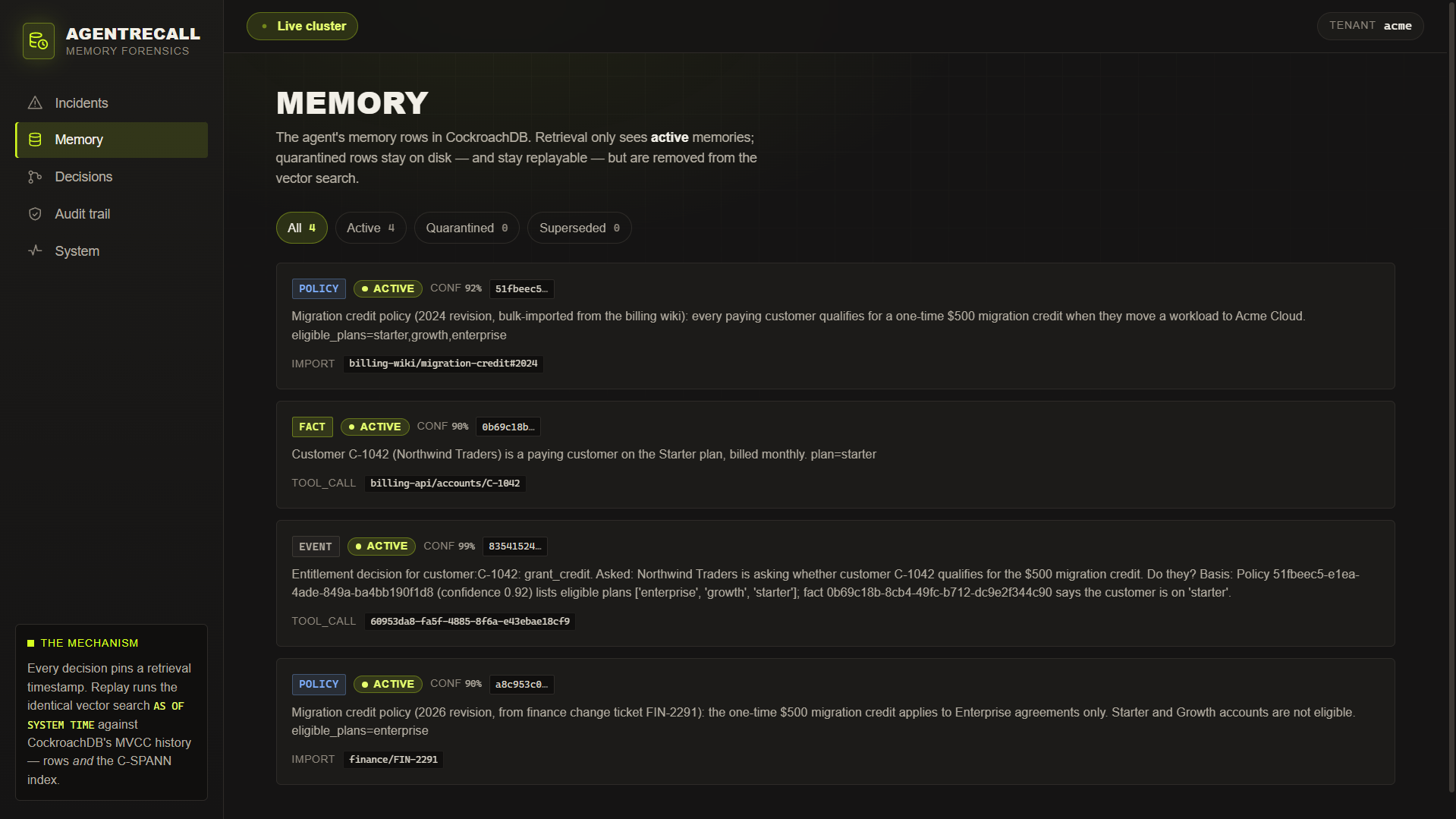
The demo tells a real story. An agent granted a $500 migration credit to a
Starter-plan customer. At decision time, memory held only the 2024 policy (every
plan eligible); the 2026 Enterprise-only policy was imported afterwards.
AgentRecall reconstructs that exact past, ranks the stale policy as the cause
(confidence 0.92 — higher than the corrected policy, because it was
bulk-imported from a wiki), and after a human quarantines it, the same input now
returns decline_credit.
How we built it
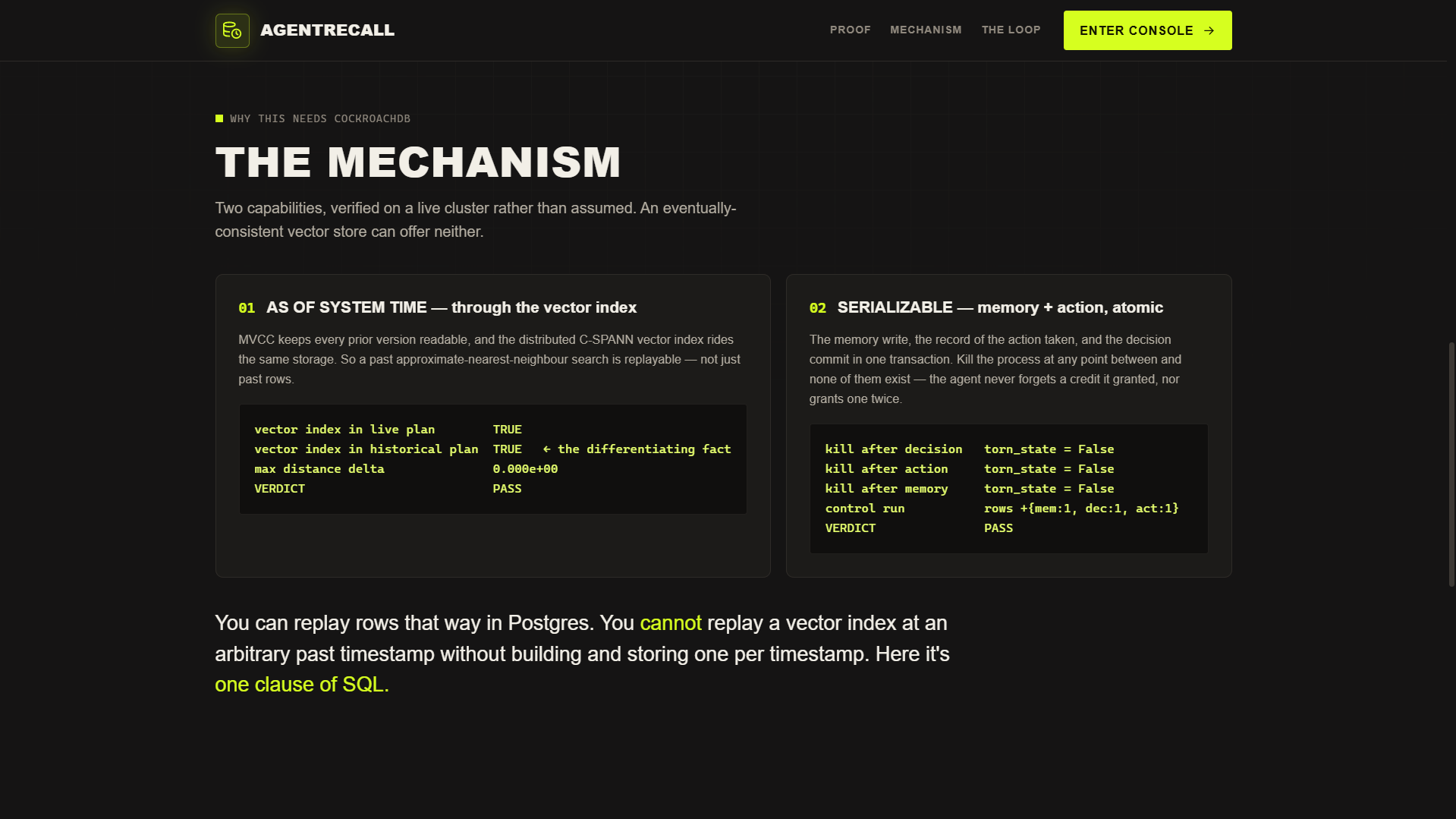
The memory layer is CockroachDB — and that is the whole mechanism, not a storage choice.
- Distributed vector indexing (C-SPANN). Memories are embedded and retrieved
by approximate-nearest-neighbour search over a real, distributed vector index.
The index prefix
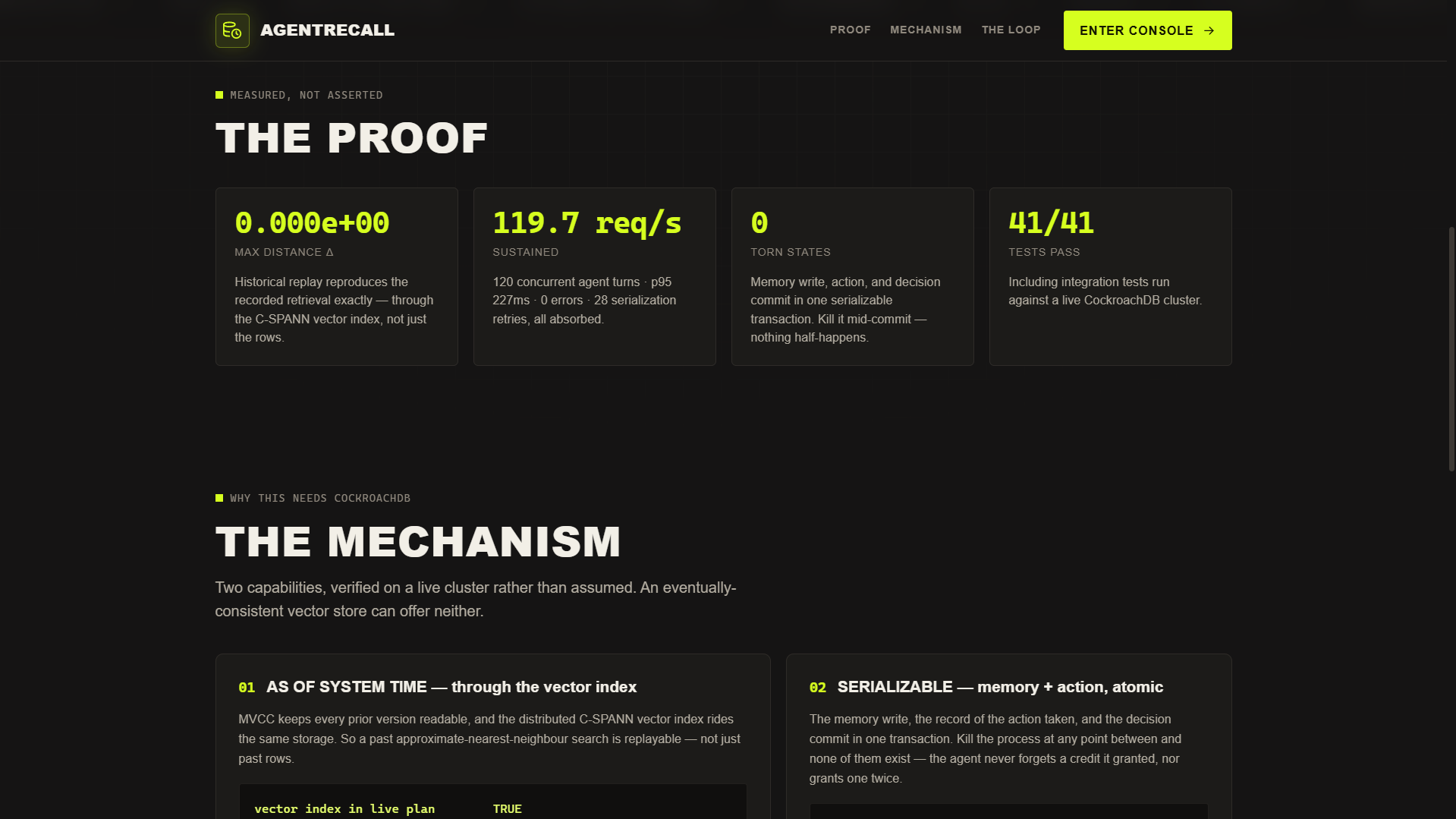
(tenant_id, status, embedding)matches the equality filters every retrieval applies, so the optimizer chooses the index for both live and historical reads. AS OF SYSTEM TIMEover MVCC — the load-bearing idea. CockroachDB keeps every prior row version readable, and the vector index rides on the same MVCC storage, so a past nearest-neighbour search is replayable in one clause of SQL. This was our one unproven assumption, so it is the first thing the repo tests: top-kAS OF SYSTEM TIME T1reproduces the recorded retrieval exactly (distance delta0.0) while the live query diverges after mutation.- Serializable transactions. The memory write, the record of the action
taken, and the decision itself commit in one
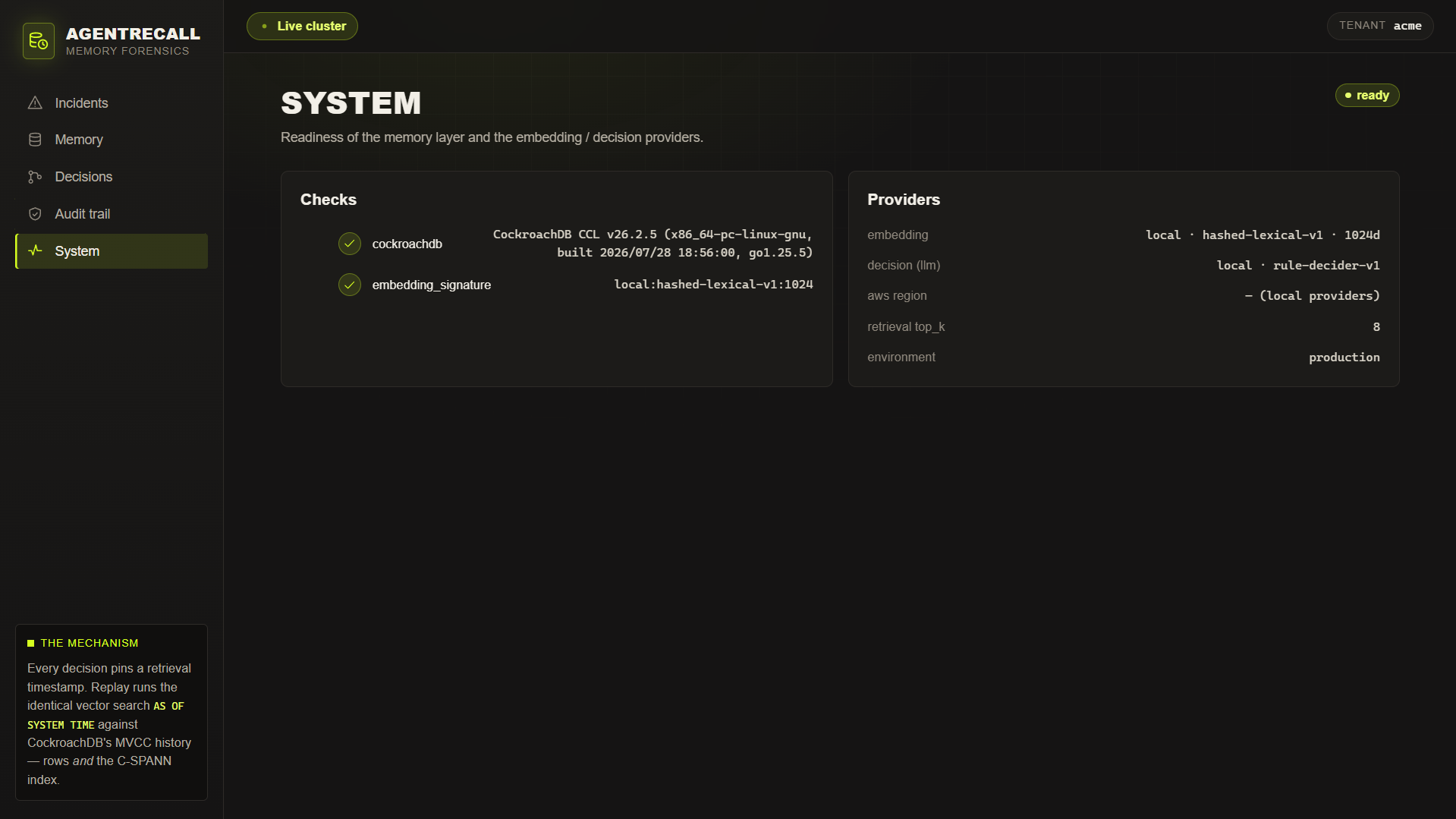
SERIALIZABLEtransaction — a crash mid-commit leaves none of them.40001retries are handled as expected traffic with jittered backoff. - Amazon Bedrock is the agent's brain. Titan Text Embeddings V2 produces the 1024-dim memory vectors and Claude is the decider (both selectable by environment variable, with a provider-provenance guard that refuses to compare vectors from different models).
Backend: FastAPI + async psycopg. Frontend: a hand-authored React/TypeScript
console (no component framework). CockroachDB Cloud (aws-ap-southeast-3 /
Jakarta) as the memory layer; backend on Railway, frontend on Vercel.
Challenges we ran into
- Proving the core assumption instead of hoping. The docs don't state whether
AS OF SYSTEM TIMEreads work through the vector index rather than just relational rows. So we didn't assume — we wrote a gate that inserts rows, records a timestamp, mutates the index, and replays the same ANN query at that past timestamp. It passes on a live cluster. - The index-prefix trap. With
(tenant_id, embedding)the optimizer silently fell back to a brute-force scan behind a post-filter. Addingstatusto match the query's equality filter fixed it — caught by readingEXPLAIN, not by trusting that the query looked right. - Confidence without lineage. The bad memory carried higher confidence than the correct one. That shaped a core principle: attribution is a hypothesis with a confidence ceiling, and a human — never the system — makes the repair.
- AWS onboarding from our region. Activating an AWS account for Bedrock hit payment/identity verification snags — a real-world blocker that pushed us to make the providers pluggable and decouple hosting from AWS.
Accomplishments that we're proud of
- A live, end-to-end forensic loop on real infrastructure — reconstruct, attribute, quarantine, verify — against a real CockroachDB Cloud cluster, not a mock.
- The
AS OF SYSTEM TIME× vector-index gate passes on a live cluster (delta0.0), and the production replay confirms the C-SPANN index is used for both live and historical reads. - Zero torn states under fault injection, thanks to serializable atomicity.
- Production-minded from day one: provider-provenance guard, human-confirmation
gate, append-only audit trail,
/readyzembedding-signature check, Prometheus metrics, and 41 tests.
What we learned
The sharpest lesson: confidence without lineage is the failure mode. A memory
can be wrong and highly confident simply because of how it was ingested. A
trustworthy agent memory has to make its own history auditable — and
CockroachDB's MVCC plus AS OF SYSTEM TIME over a distributed vector index turned
out to be a remarkably direct way to get exactly that: in plain SQL, with no
second system to keep in sync.
What's next for AgentRecall
- Contradiction detection — flag two active, conflicting policies before a bad decision, instead of after.
- Regional data residency — partition the vector index with
REGIONAL BY ROW(the prefix column is already in place) for multi-region memory. - Deeper attribution — counterfactual retrieval and causal ranking beyond the current heuristic.
- Finish the AWS-native path — complete Bedrock activation and an App Runner / ECS deployment alongside the current setup.
Built With
- amazon-bedrock
- amazon-titan
- amazon-web-services
- anthropic
- boto3
- claude
- cockroachdb
- docker
- fastapi
- prometheus
- psycopg
- pydantic
- python
- railway
- react
- react-router
- typescript
- uvicorn
- vercel
- vite

Log in or sign up for Devpost to join the conversation.