-
-
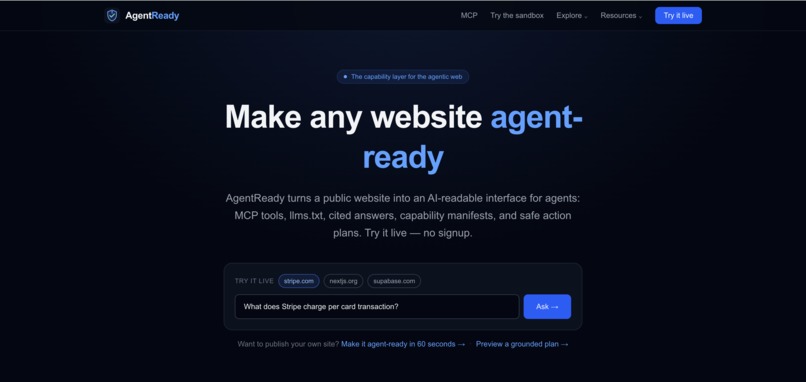
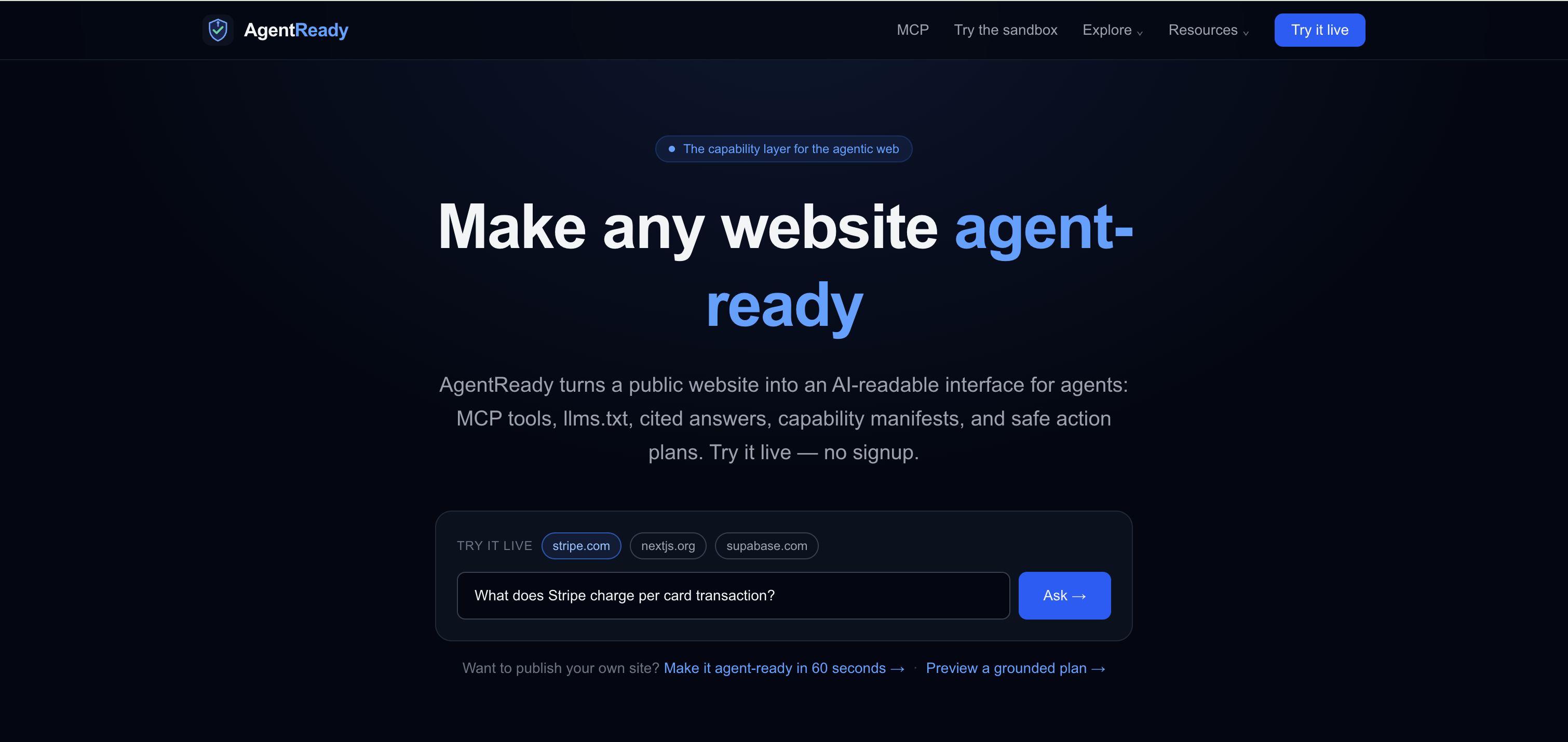
Homepage for AgentReady
-
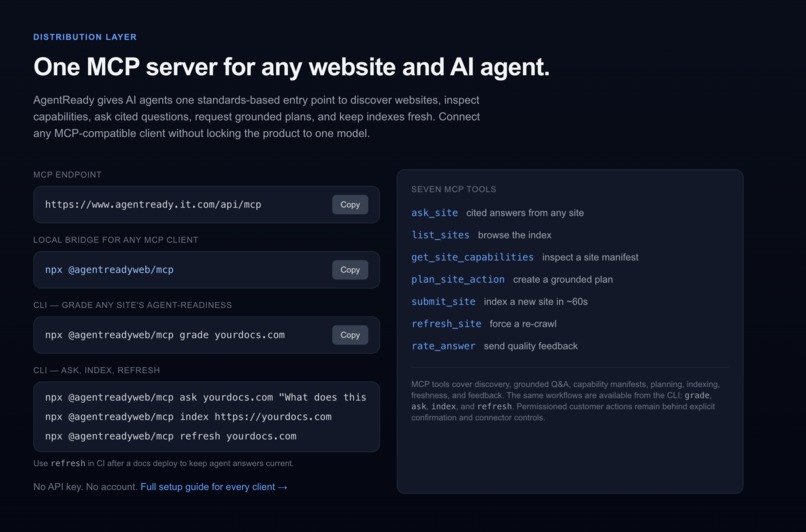
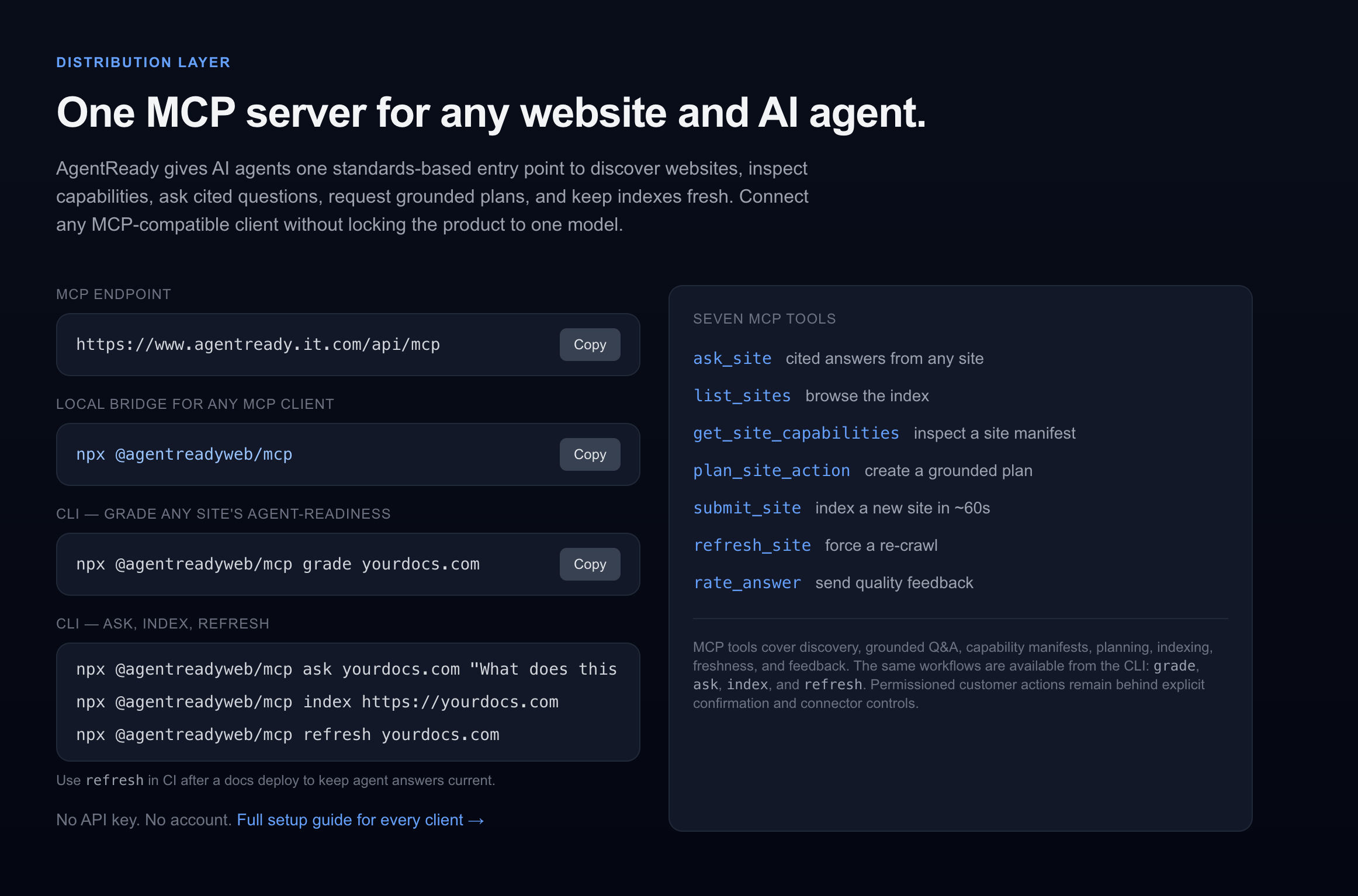
MCP for AgentReady
-
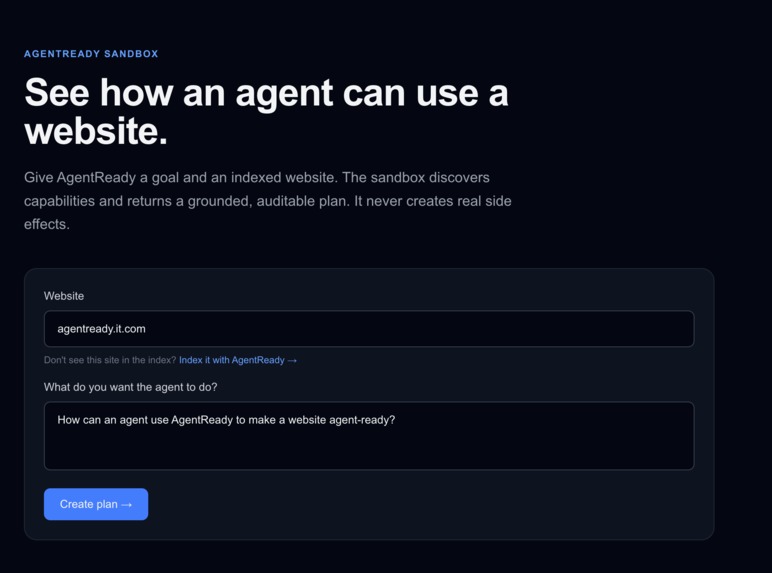
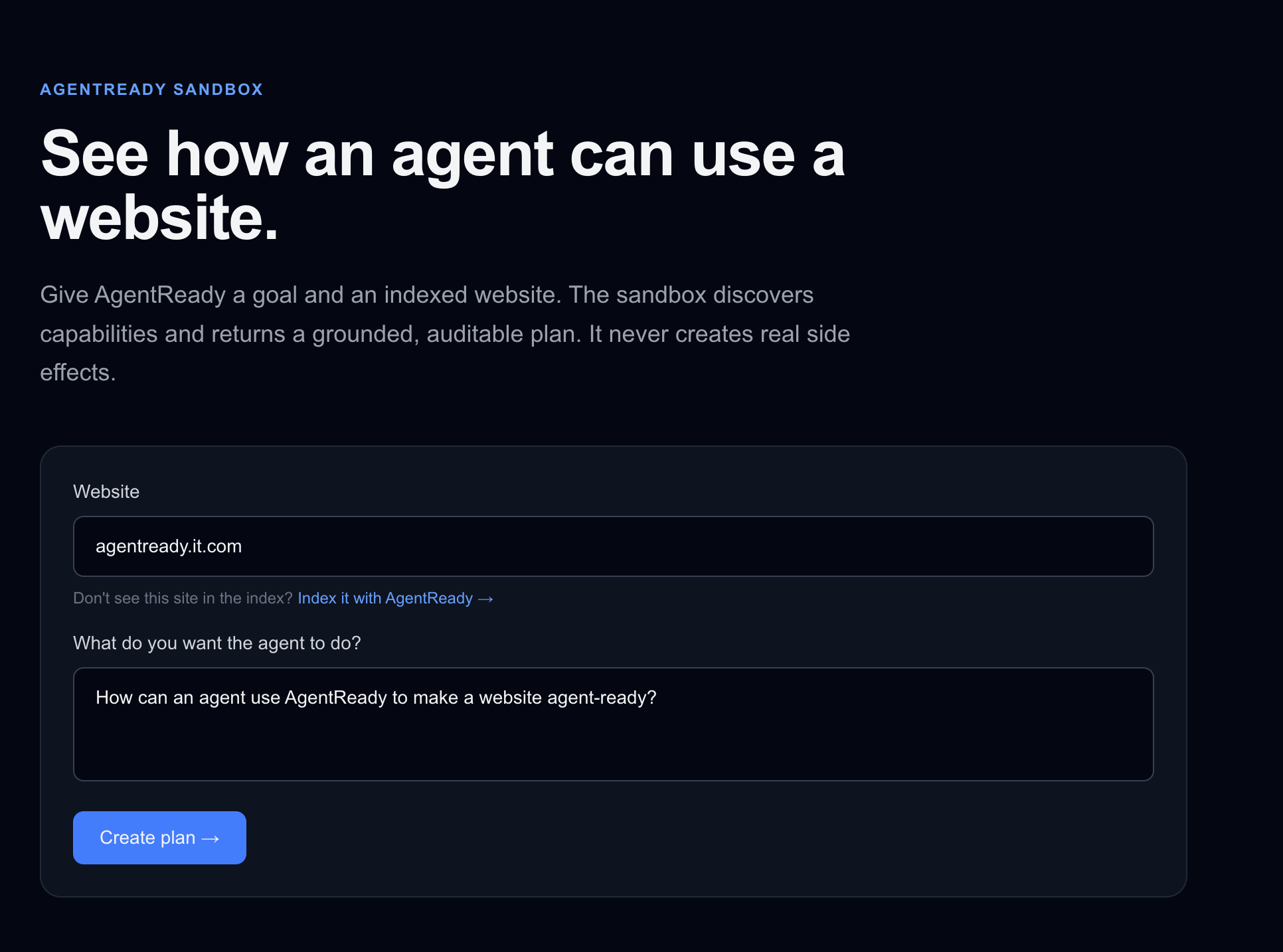
Capabilities a site can expose for an Agent
-
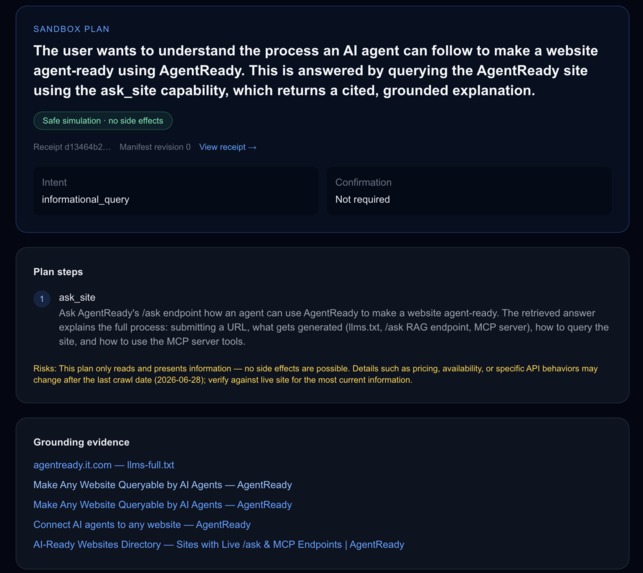
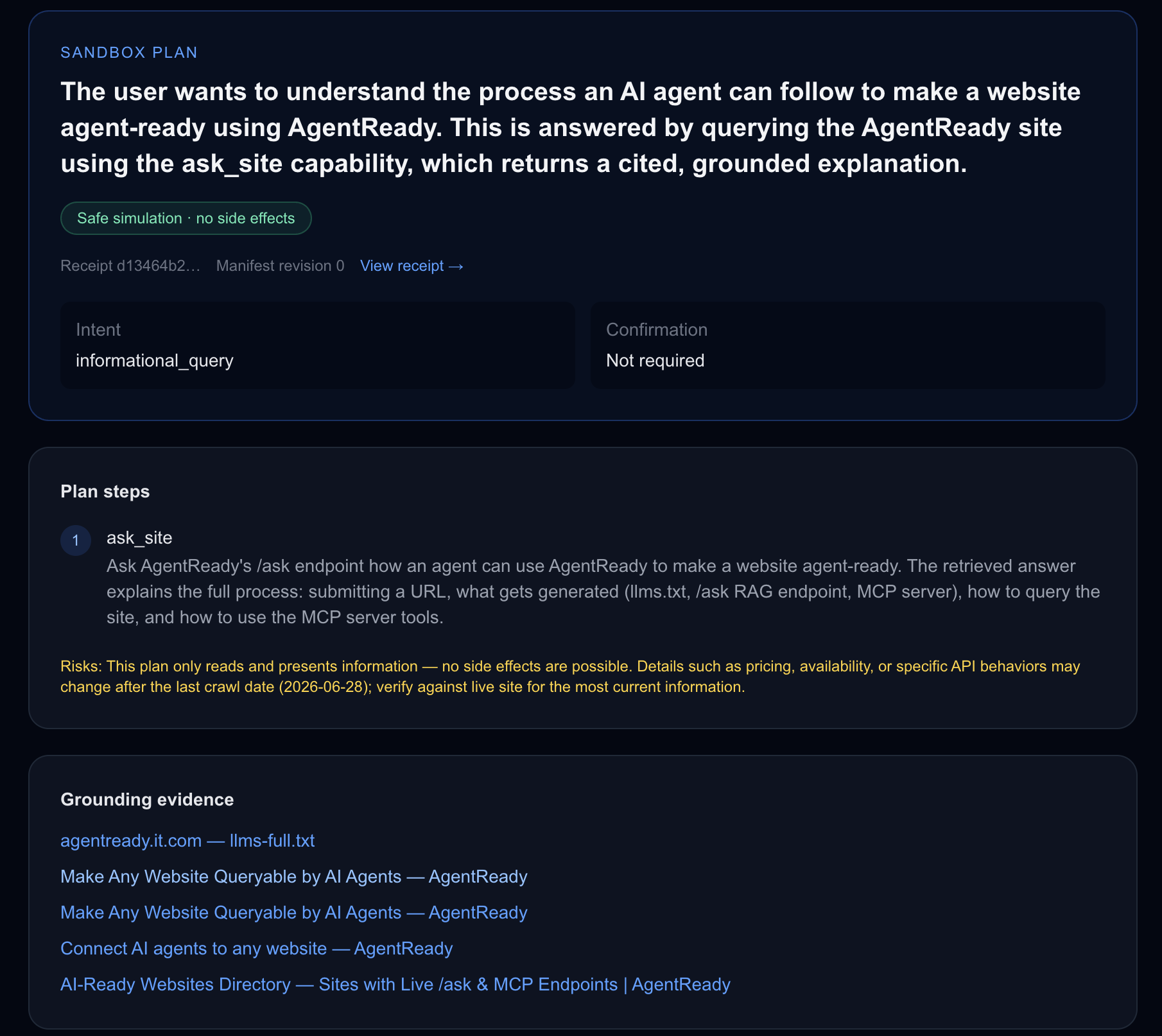
Live cited answer from AgentReady
Inspiration
The web was built for people, but more and more of it will be used by software agents. Today, an agent visiting a website often has to guess where the useful information is, fetch pages one at a time, and deal with JavaScript-rendered content or inconsistent navigation.
That creates a basic problem: websites may be readable to humans but still difficult for agents to understand and use reliably.
I wanted to build the missing layer between websites and agents. Instead of asking every agent to build its own crawler, search system, and integration for every website, AgentReady gives sites a standard way to expose their content and capabilities.
What it does
AgentReady turns any public website into an agent-ready interface.
A user can submit a URL and AgentReady crawls the site, extracts the useful content, generates llms.txt, and creates a hosted MCP and /ask interface. Agents can then:
- Discover indexed sites
- Ask questions and receive cited answers
- Inspect a site's capabilities and freshness
- Create grounded, read-only action plans
- Submit new sites for indexing
- Refresh existing sites
- Provide feedback on answer quality
If an agent asks about a site that has not been indexed yet, AgentReady indexes it automatically and continues with the requested workflow. This removes an unnecessary setup step.
The project also includes a safe sandbox for previewing agent actions. Any real side effect requires explicit confirmation and a connected action endpoint.
How I built it
AgentReady is built as a hosted web application with a Next.js frontend and API layer. Supabase stores sites, pages, chunks, manifests, action plans, receipts, and telemetry.
The indexing pipeline supports normal HTML sites, documentation sites, JavaScript-rendered applications, and sites that already publish llms.txt. Content is cleaned, split into chunks, embedded, and stored for retrieval.
The answer layer uses retrieval over the indexed content and returns the source pages used for each answer. The MCP server is available over HTTP, with a local npm bridge and CLI for terminal workflows.
I also built capability manifests so an agent can understand what a website exposes before planning an interaction. Plans contain the intended steps, evidence, risks, confirmation requirements, and a durable receipt.
Codex (GPT-5.6) was used throughout development as an engineering partner. It helped explore the product direction, design the architecture, implement the indexing and MCP workflows, debug production issues, write migrations and documentation, review the user experience, and validate changes before deployment. The final product decisions, testing, and deployment were reviewed and directed by me.
The application is deployed on Vercel and is available at agentready.it.com.
Challenges I ran into
The hardest part was making the system work across very different websites. Some sites have clean server-rendered documentation, while others are JavaScript-heavy or expose very little useful text in their initial HTML.
Freshness was another challenge. An answer can be correct when a site is indexed and stale a week later, so I added explicit refresh workflows and freshness metadata.
I also had to be careful with the word action. It is easy to make a demo that appears to execute something, but real agent actions need confirmation, validation, idempotency, audit trails, and a way to prove what happened. I designed the action layer around plans, receipts, and signed connectors rather than unrestricted execution.
Finally, I had to avoid treating every request as proof of agent traffic. I added better event tracking so I can distinguish indexing, querying, planning, refreshing, and feedback.
Accomplishments that we're proud of
I built and deployed a working product rather than just a prototype screen.
AgentReady now has:
- A live indexing and retrieval pipeline
- A global MCP server with seven tools
- HTTP and local MCP connection options
- A CLI for grading, asking, indexing, and refreshing sites
- Automatic indexing when a workflow needs a site
- Cited answers grounded in multiple pages
- Capability manifests for websites
- Read-only plans with durable receipts
- WebMCP support for browser-based agents
- A safe action sandbox with confirmation and connector controls
- Public documentation, plugins, and a live directory
AgentReady also indexes itself, so the product can be discovered and queried through its own infrastructure.
What I learned
Making a website available to agents is not just a matter of adding an API endpoint. Agents need discovery, structure, freshness information, clear schemas, and reliable evidence.
I also learned that trust matters as much as capability. Cited answers, explicit plans, confirmation steps, and receipts make the system easier to inspect and safer to use.
The MCP server became an important part of the product because it gives agents a simple distribution point. Instead of integrating with every website separately, an agent can connect once and work across many sites.
What's next for AgentReady
The next step is to make the action layer more useful while keeping it safe. We are starting with first-party sandbox actions, then expanding to customer-owned connectors that agents can call only after explicit approval.
We also want to add background indexing, better freshness signals, richer capability schemas, and analytics that show how agents actually discover and use websites.
The larger goal is to help create a web where websites are not only readable by people, but also understandable and usable by agents.
Built With
- ai-agents
- codex
- embeddings
- gpt-5.6
- javascript
- llms.txt
- mcp
- next.js
- node.js
- openai
- pgvector
- postgresql
- rag
- react
- supabase
- typescript
- vercel
- webmcp

Log in or sign up for Devpost to join the conversation.