
Inspiration
Selling on Amazon is a multidisciplinary challenge. To succeed, a seller needs to be a data analyst (to find gaps), a copywriter (to rank for keywords), and a professional photographer (to convert clicks).
For most independent creators and small businesses, hiring this team is too expensive, and doing it alone is overwhelming. We asked ourselves: What if we could package an entire creative agency into a single AI agent?
We were inspired by the potential of Agentic AI —not just chatbots that talk, but agents that do . We wanted to build a system that autonomously researches the market, crafts the perfect pitch, and "shoots" the product photos, all from a simple text prompt.
What it does
AgentR+ is an autonomous product listing generator that creates high-converting Amazon listings in minutes.
LangGraph.js orchestrator - Agent > Research competitors via TinyFish API or Yutori API Generate optimized content via : AWS Bedrock (Claude) Create product images via : Freepik API
Build complete Amazon-style listings with A+ content
LangGraph.js Orchestrator └─> Amazon Agent ├─> Research Agent │ └─> TinyFish API or Yutori API → competitor analysis, pricing gaps, keyword data │ ├─> Copywriter Agent │ └─> AWS Bedrock (Claude) → SEO-optimized titles, bullet points, descriptions │ └─> Image Generation Agent └─> Freepik API → product photography, lifestyle images, infographics
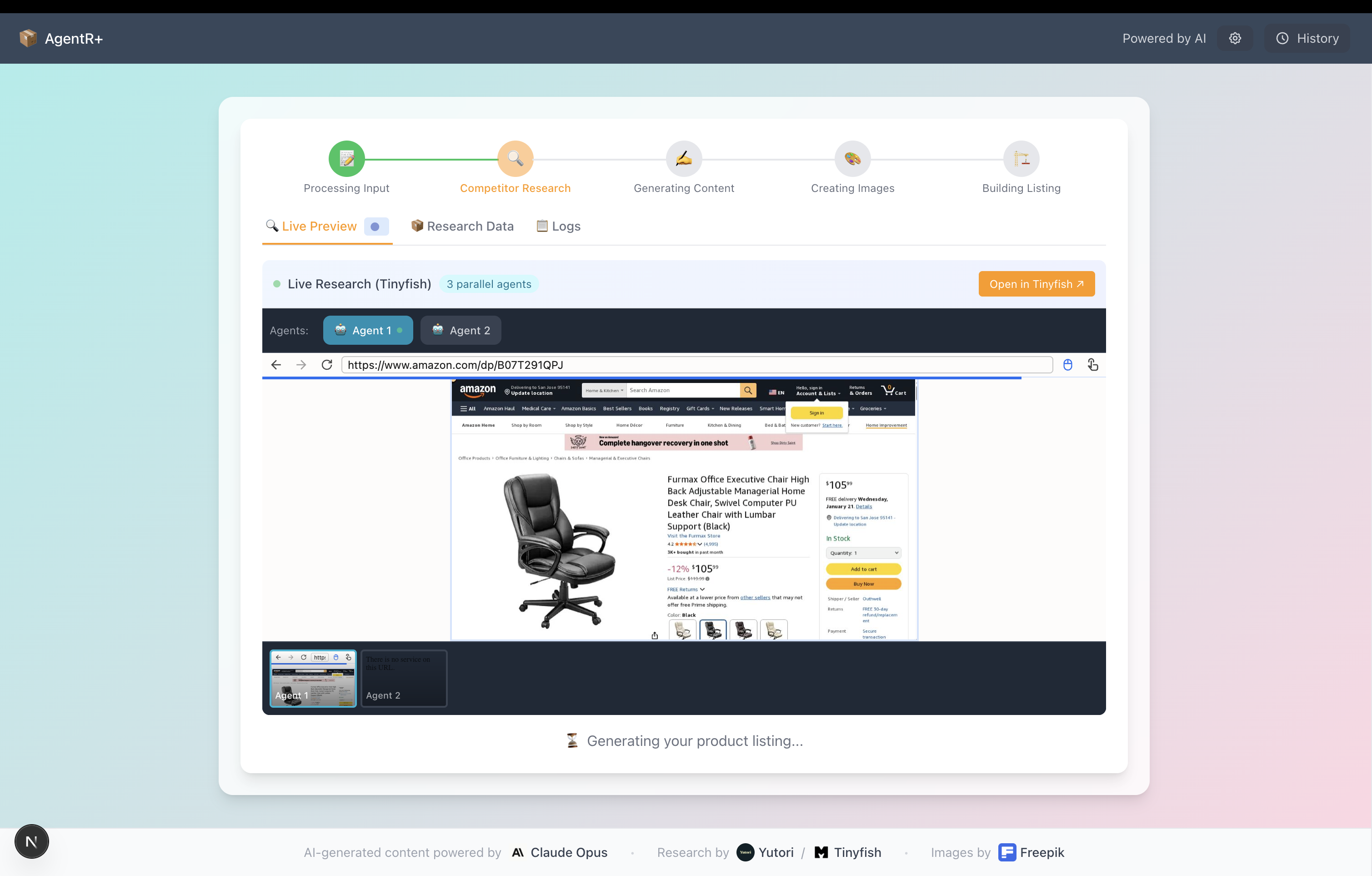
- Deep Market Research : It deploys browser agents (powered by Yutori and Tinyfish ) to scan live Amazon listings, analyzing competitor reviews, keywords, and gaps in the market.
- SEO-Optimized Copy : Using LangChain and Claude , it synthesizes this research to write compliant, keyword-rich titles, bullet points, and descriptions that are better than the competition.
- Studio-Quality Imagery : It integrates Freepik's Seedream v4.5 model to generate a complete visual kit:
- Main Image : White background, compliant with Amazon TOS.
- Gallery Images : Lifestyle shots and detailed angles.
- A+ Content : Vertical infographic-style banners.
- Edit Mode : Users can upload a reference image, and our implementation of the seedream-v4-5-edit endpoint ensures the generated images perfectly match the actual product's look. ## How we built it We built AgentR+ using a modern stack designed for real-time agentic workflows:
- Frontend : Built with Next.js 15 and React 19 , styled with Tailwind CSS . We used Server-Sent Events (SSE) to stream the agent's "thought process" to the user in real-time.
- AI Orchestration : We used LangGraph to manage the state of our agents. This allowed us to create a directed acyclic graph (DAG) where the output of the "Research Node" flows into the "Copywriting Node," which then informs the "Image Generation Node."
- Image Generation : We utilized the Freepik API , specifically the latest Seedream v4.5 model . We implemented a custom service layer that handles:
- Aspect ratio mapping (converting 1:1 to square_1_1 , 9:16 to social_story_9_16 ).
- Reference-guided generation : Mapping user uploads to the reference_images array for consistent character/product preservation.
- Data Layer : Prisma with SQLite for persisting listing history and generation results. ## Challenges we faced
- The "Consistency" Problem : Generative AI is great at making a yoga mat, but terrible at making your yoga mat five times in a row.
- Solution : We deeply integrated Freepik's Edit Mode . By passing the initial generated image (or user upload) as a reference to subsequent API calls, we achieved visual consistency across the main image, lifestyle shots, and infographics.
- Orchestrating Asynchronous Agents : Browser research takes time. Image generation takes time.
- Solution : We built a robust streaming architecture. Instead of a loading spinner, the user sees the agent's progress: "Analyzing top 5 competitors...", "Drafting bullet points...", "Rendering 3D visualization..." . This improves perceived performance and user trust.
- Complex API Types : Implementing the new Seedream v4.5 API required strict type safety for parameters like aspect_ratio and reference_images . We had to refactor our TypeScript interfaces to handle the specific requirements of the edit-mode endpoint versus the standard generation endpoint. ## Accomplishments that we're proud of
- Full End-to-End Automation : We went from a simple prompt to a ready-to-publish listing including 7+ professional images and SEO copy.
- Advanced Freepik Integration : We are one of the first to implement the full capabilities of Seedream v4.5 , including the advanced aspect ratios and reference image editing pipeline.
- Polished UX : The application feels like a mature SaaS product, with history management, real-time streaming, and a responsive design. ## What we learned
- Agentic workflows > RAG : Simply retrieving information isn't enough. Agents that can plan, execute, and critique their own work (e.g., "This image doesn't match the description, let me regenerate it") produce significantly better results.
- The power of specialized models : While general LLMs are okay at images, specialized models like Seedream v4.5 are non-negotiable for professional use cases where lighting, texture, and composition matter. ## What's next for AgentR+
- Direct Amazon Integration : Using the Selling Partner API (SP-API) to push listings directly to Seller Central.
- Video Generation : Utilizing image-to-video models to create 15-second product showcase clips for Amazon Video Shorts.
- Multi-Market Localization : Automatically translating and localizing listings for Amazon Japan, Germany, and UK.
Built With
- awsbedrock
- cline
- freepick
- langchain
- tinyfish
- yutori


Log in or sign up for Devpost to join the conversation.