AgentProof: The Trust Layer for Agentic Commerce
Inspiration
AI agents are becoming increasingly capable of researching products, understanding user requests, and helping people make purchasing decisions. As these agents become more autonomous, an important question emerges:
How do we give AI the ability to act on our behalf without giving it unchecked authority over our money?
An AI agent might understand what a user wants, find a suitable product, and recommend a purchase. But understanding an instruction is not the same as having permission to execute it.
Users need more than intelligent recommendations. They need enforceable spending boundaries, explicit authorization, visibility into financial actions, and reliable records explaining what happened.
That is the problem we set out to solve with AgentProof.
Our vision is to make agentic commerce more trustworthy by introducing an independent control and evidence layer between AI-assisted decision-making and financial execution.
What It Does
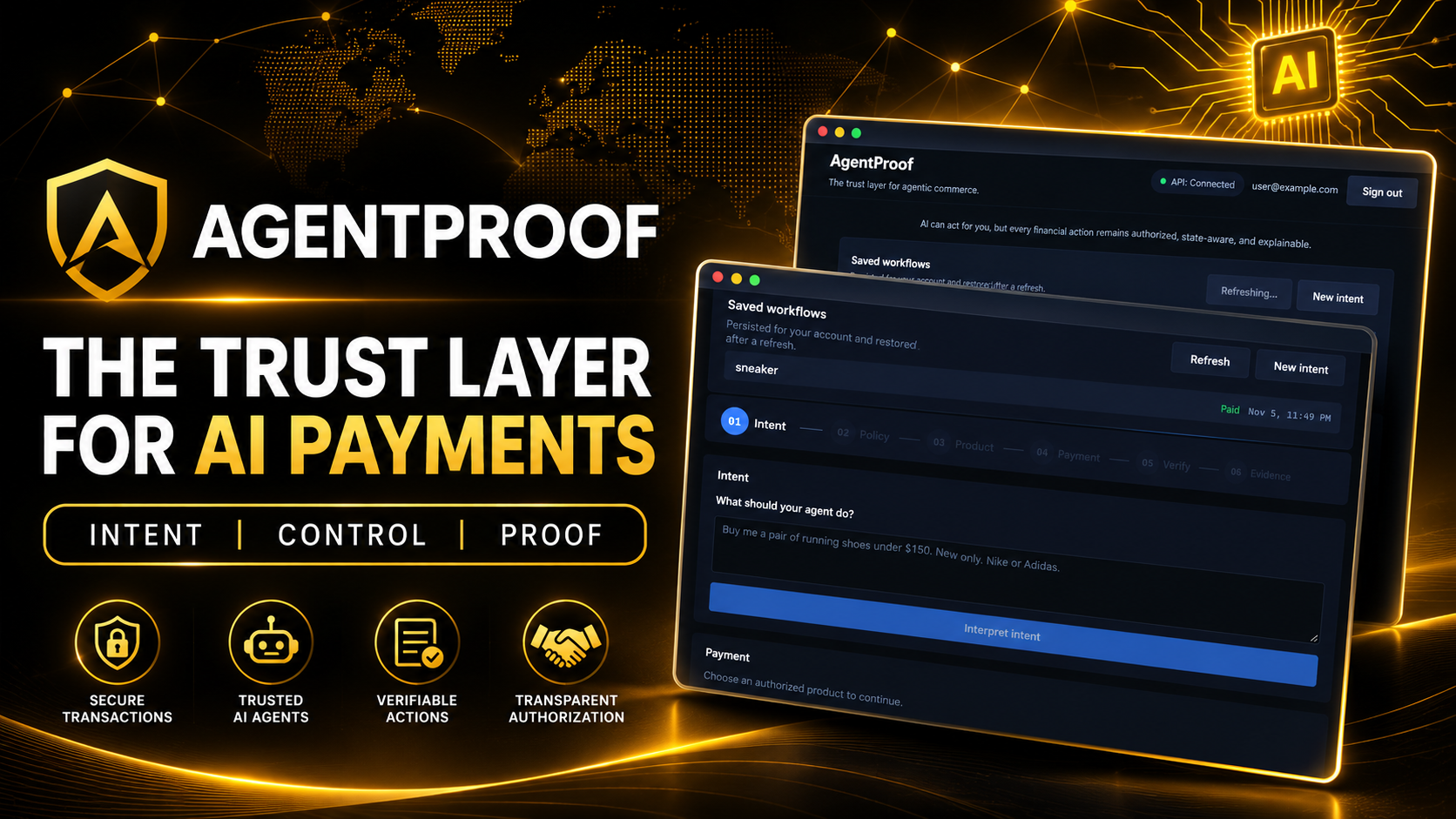
AgentProof is an audit and control layer for agentic commerce. It combines AI-assisted intent interpretation, real product discovery, deterministic policy enforcement, PayPal Sandbox payment workflows, and an auditable evidence history.
The platform is built around three connected pillars:
1. INTENT: What did the user authorize?
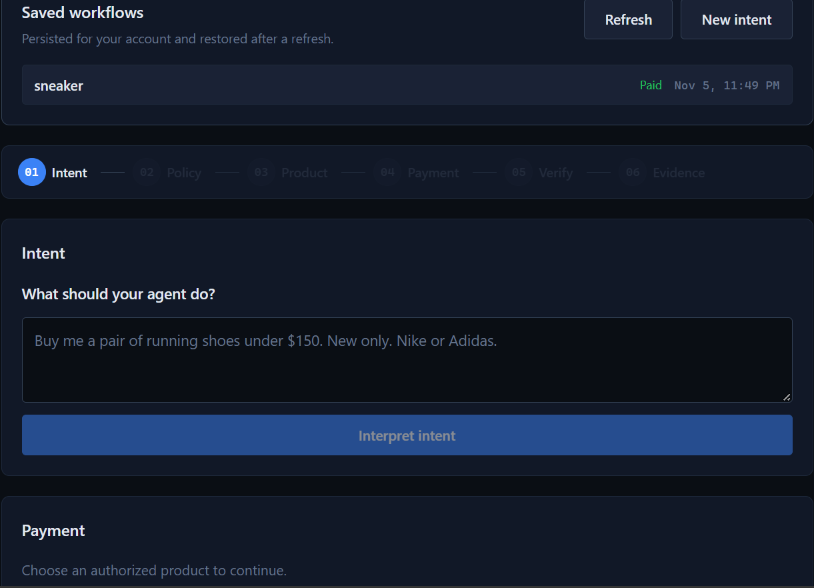
Users express purchasing instructions in natural language, such as:
"Buy me a pair of new Adidas running shoes under $150."
AgentProof uses OpenRouter to interpret the request and convert it into structured purchasing criteria.
These criteria establish the boundaries of the user's authorization, including relevant product requirements, brand preferences, condition, and spending limits.
2. CONTROL: What is the agent allowed to do?
AgentProof uses a deterministic Policy Engine to evaluate products against the user's structured intent and purchasing constraints.
This is a critical architectural decision: AI recommendations do not determine whether a purchase is authorized.
The Policy Engine independently evaluates candidates and rejects products that violate applicable restrictions. AI-assisted recommendations operate only on policy-allowed candidates, and the selected product is evaluated again before proceeding.
This keeps financial authorization separate from AI-generated suggestions.
3. PROOF: Can we explain what happened?
AgentProof maintains an evidence history of important workflow decisions and financial events.
This provides a traceable record of product discovery, policy evaluations, recommendations, and payment-related actions.
The objective is to make the workflow easier to inspect and understand, rather than treating an AI agent's final response as sufficient proof of what happened.
How It Works
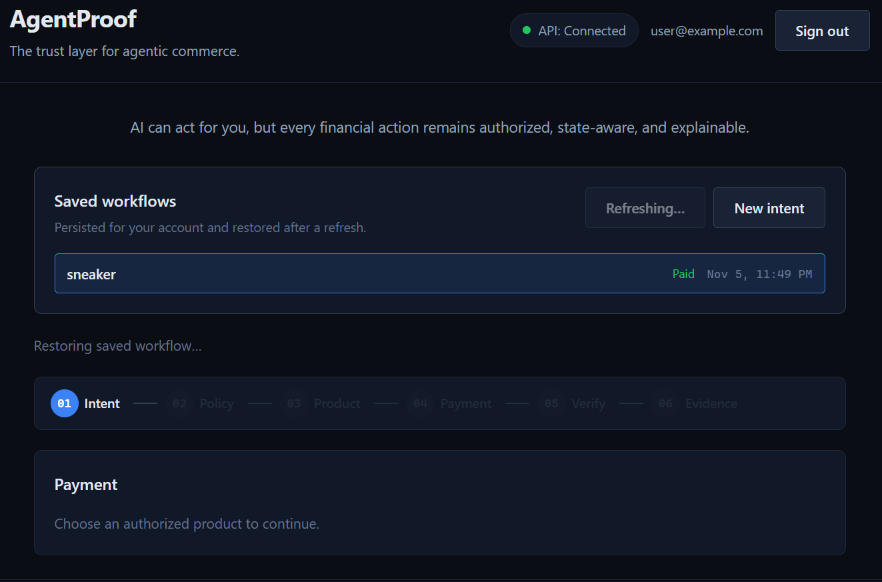
The AgentProof workflow connects these capabilities:
- User intent: The user describes the intended purchase in natural language.
- Intent interpretation: OpenRouter helps transform the instruction into structured purchasing criteria.
- Product discovery: Channel3 retrieves real product information and retailer offers from its product catalog.
- Policy enforcement: The deterministic Policy Engine evaluates products against the user's constraints.
- AI recommendation: OpenRouter helps recommend among candidates that have passed policy evaluation.
- Final policy check: The selected product is evaluated again before the workflow proceeds.
- Retailer handoff: AgentProof provides the relevant external retailer link. The retailer's checkout and fulfillment process remain separate.
- PayPal Sandbox: AgentProof supports PayPal order creation, approval, and capture within its payment workflow.
- Evidence history: Important decisions and payment-related events are recorded for traceability.
The distinction between product discovery, retailer checkout, and payment execution is intentional. A product listing or retailer link does not mean that a retailer purchase has been completed.
The central principle is simple: AI can assist with decisions, but it does not independently authorize financial actions.
How We Built It
AgentProof is a full-stack application built with a modular TypeScript architecture.
The frontend uses React and Vite, while the backend uses Node.js, Express, and TypeScript. Shared schemas and Zod validation help maintain consistent data structures and validation across application layers.
The platform integrates several technologies:
- OpenRouter: AI-assisted interpretation of natural-language purchasing instructions and product recommendations.
- Channel3: Real product discovery and retailer offer retrieval.
- PayPal Sandbox: Payment order creation, approval, and capture.
- MongoDB Atlas: Persistent application data and workflow evidence.
- React and Vite: Frontend application.
- Node.js and Express: Backend API and application services.
- TypeScript and Zod: Type safety, shared schemas, and structured validation.
A major architectural decision was keeping AI interpretation separate from deterministic authorization.
Rather than allowing an LLM response to decide whether a transaction is permitted, AgentProof uses an independent Policy Engine to enforce the user's purchasing constraints.
This separation makes authorization more predictable, testable, and auditable.
Challenges We Faced
One of our biggest challenges was designing a system where AI assistance and financial authorization could coexist without giving the AI unrestricted control.
Natural-language instructions are flexible, but financial permissions need to be precise. We had to establish a reliable boundary between interpreting what a user wants and determining what the system is actually allowed to do.
Another challenge was integrating real product discovery while preserving those authorization boundaries. Retrieved product information must be validated and evaluated rather than automatically trusted.
We also had to maintain a clear distinction between product discovery, external retailer checkout, and payment processing. These operations have different responsibilities, and the application must accurately communicate what has and has not happened.
Authentication, persistent sessions, and secure cookie configuration across development and production environments also required careful attention.
Finally, implementing the PayPal Sandbox workflow meant treating order creation, approval, and capture as distinct stages rather than assuming that initiating a payment is equivalent to completing one.
What We Learned
Building AgentProof reinforced an important lesson about agentic systems:
Intelligence without control is not enough, especially when money is involved.
An AI agent can interpret instructions and make useful recommendations, but trustworthy financial automation also requires explicit authorization, deterministic enforcement, reliable state management, and evidence of important actions.
We also learned that integrating multiple services does not automatically create a seamless transaction. Each integration must operate within its actual capabilities, and the system must preserve clear boundaries between them.
Most importantly, we learned to treat trust as something that must be built into the architecture, not simply promised in the interface.
What's Next
AgentProof is a foundation for more accountable agentic commerce.
Future development could explore persistent purchasing preferences, more granular spending permissions, price and availability monitoring, richer financial-state awareness, and expanded evidence capabilities.
Our long-term vision is to help people benefit from increasingly capable AI agents without surrendering control over their purchasing decisions.
We believe the future of agentic commerce should not be defined only by what AI can do, but also by what it is authorized to do and whether its actions can be explained.
AgentProof: AI can act for you. Trust should never be left to chance.
Built With
- ai
- express.js
- javascript
- mongodb
- node.js
- openrouter
- paypal
- react
- restapi
- sandbox
- typescript
- vite
- zod
