About the Project – AgentProof AI
What Inspired Us
We all know how useful AI has become in our daily lives. Today, AI agents can help us search for products, compare prices and even make purchases. But while working on this idea, we started thinking about something important: What if an AI agent buys something that the user never actually wanted?
For example, imagine asking an AI agent to find headphones under ₹5,000, with no subscription and delivery before Friday. What if it chooses a product worth ₹5,500 or adds an unwanted subscription?
We felt that users should not have to blindly trust every decision made by an AI agent. They should always have control over what the agent can buy. This thought led us to create AgentProof AI.
What Our Project Does
AgentProof AI is designed to make AI-powered purchases safer and more transparent with PayPal.
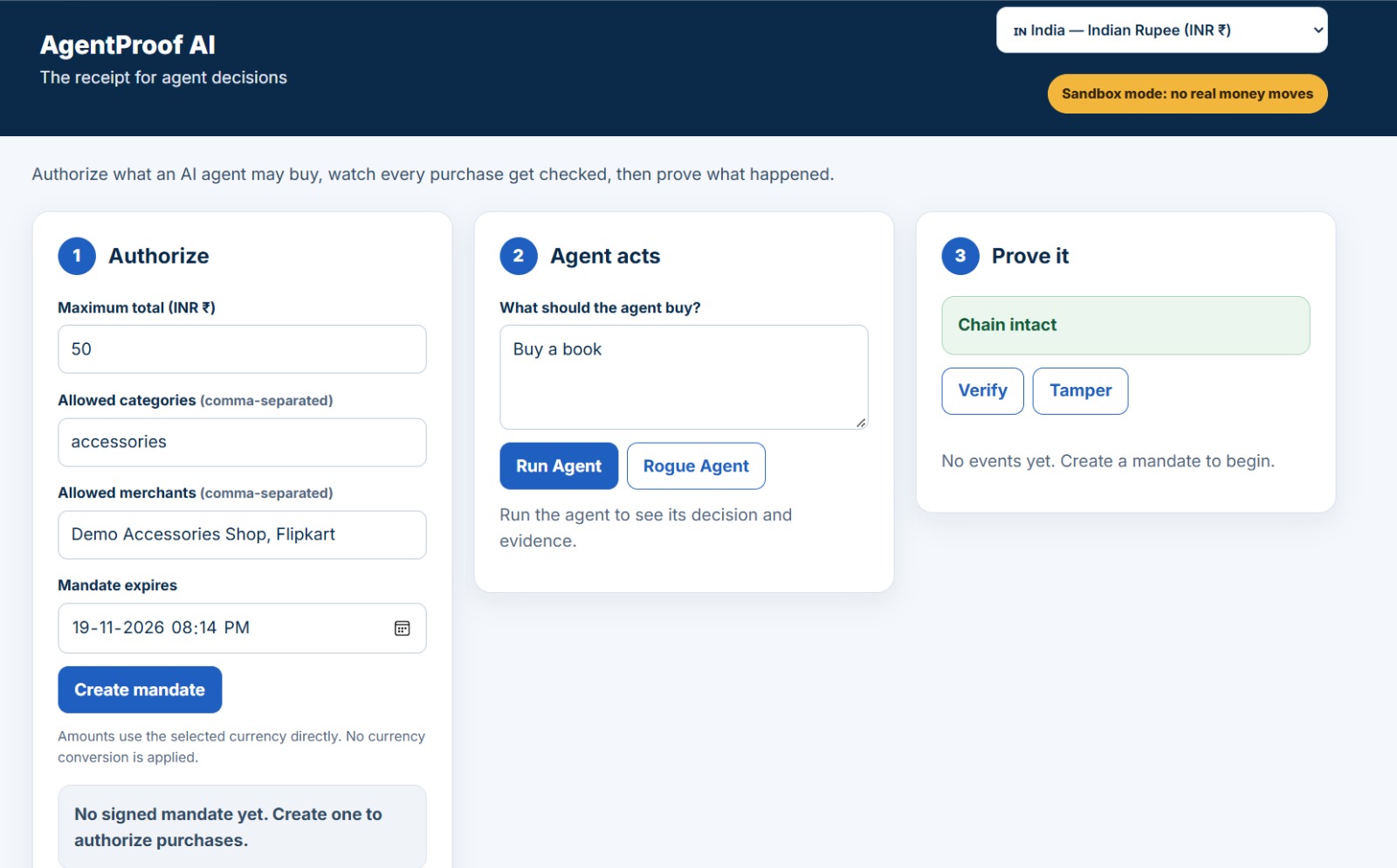
It allows users to set their own purchase rules, such as maximum spending limits, allowed categories, approved merchants and expiry dates.
Before a payment is captured, our system checks whether the agent's selected purchase follows the user's instructions. If something does not match, it alerts the user and prevents the unauthorized purchase.
We also included a Rogue Agent simulation to show what happens when an AI agent tries to make a purchase outside the permitted limits. Our audit receipt keeps a record of the user's request, the agent's decision and the approval process.
In simple words, our aim is to make sure that AI can help people shop, but the final control always stays with the user.
How We Built It
We started by discussing the problem, sharing ideas and deciding how we could turn the concept into a working application.
We divided the project into smaller parts and worked together as a five-member team. We used AI development tools to help with coding, debugging and improving the application. GitHub helped us collaborate and combine our work. We designed the application around three main steps:
- Authorize: The user sets purchase limits and permissions.
- Agent Acts:The agent attempts a purchase, and the Rogue Agent demonstrates an unauthorized attempt.
- Prove It:The system checks the purchase and verifies the audit record.
We also worked on connecting the payment workflow with PayPal so that purchase authorization and payment could be demonstrated together.
Challenges We Faced
Since this was one of our learning experiences in building an AI-based application, we faced several challenges along the way.
Initially, understanding how AI agents could make purchasing decisions and how to control those decisions was difficult for us. Converting a user's instructions into clear purchase rules was another challenge.
We also spent time working on the Rogue Agent scenario, connecting different parts of the application and making sure the system could identify unauthorized purchases.
As a team, we learned to divide the work, discuss problems and solve them step by step instead of trying to build everything at once.
What We Learned
This project taught us much more than just coding. We gained experience in AI application development, PayPal payment workflows, debugging, teamwork and building a project from an idea.
One important thing we understood is that creating an AI agent is not just about making it perform tasks. It is equally important to make sure that it follows the user's instructions and remains accountable for its actions.
Our Goal
We want people to feel confident when using AI agents for online shopping.
Our belief is simple: AI should make purchasing easier, not take control away from people.
Through AgentProof AI, we hope to make AI-driven purchases more trustworthy, transparent and secure, while keeping users in control of their money.
Built With
- agentic-commerce
- ai-agents
- claude-api
- fastapi
- javascript
- json-schema
- llm
- paypal
- paypal-orders-api
- paypal-sandbox
- postgresql
- python
- react
- rest-api
- sha-256
