-
-
-
-
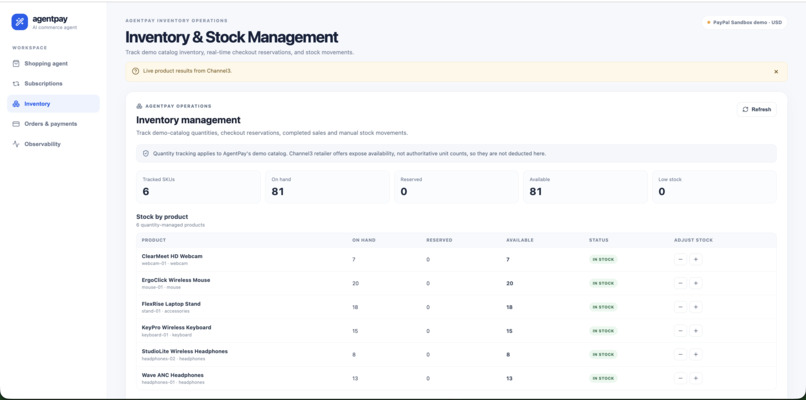
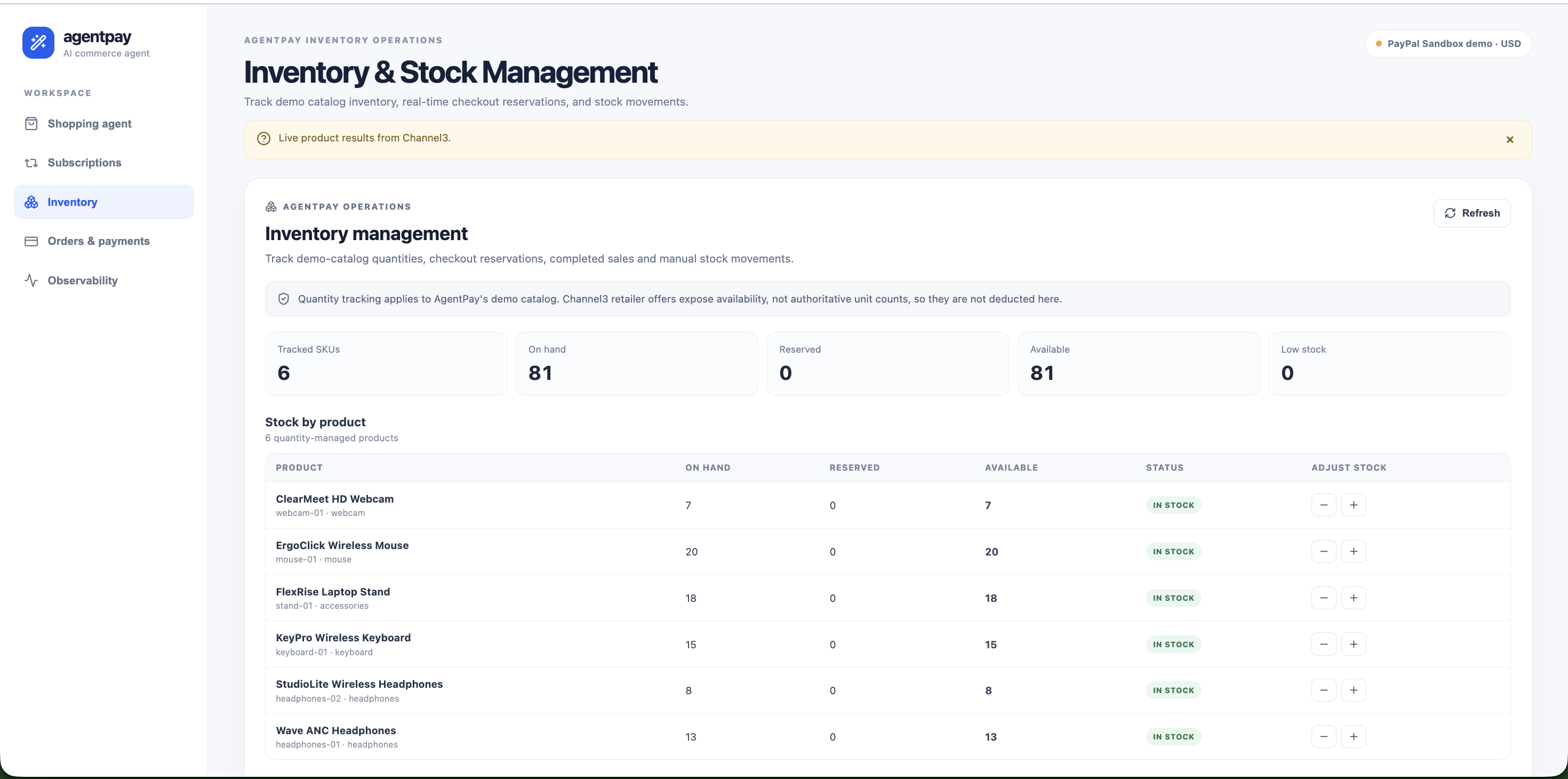
This demonstrates about the inventory
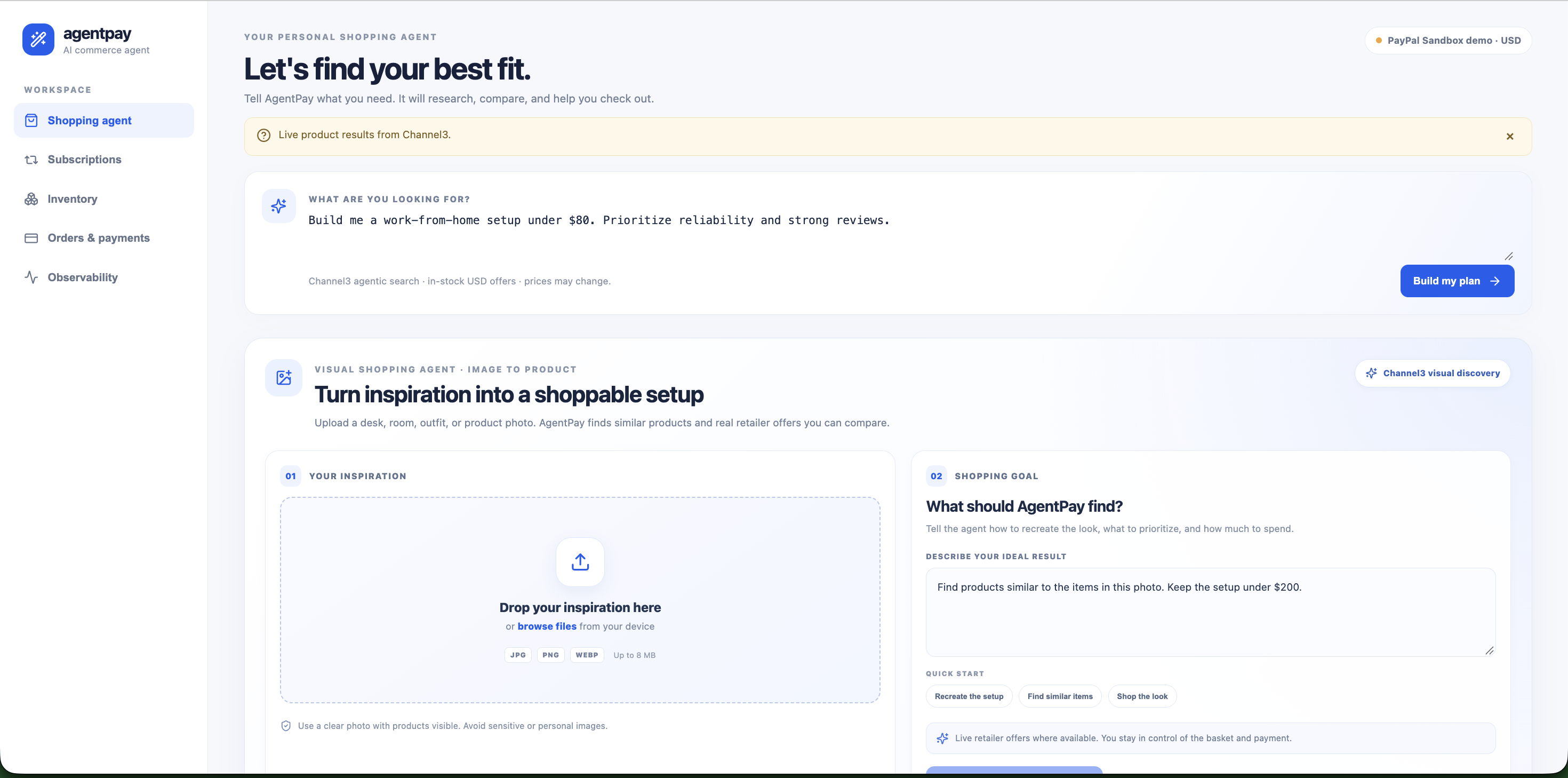
AgentPay – Your Personal AI Shopping Agent
Inspiration
Online shopping often involves jumping between multiple websites, comparing prices, checking product availability, reading reviews, and figuring out which option offers the best value. Even a seemingly simple purchase can turn into a time-consuming process.
We wanted to rethink this experience.
What if users could simply describe what they need, upload a picture of something they like, or ask for a recommendation, and an AI agent could handle the research, comparison, and checkout preparation?
That idea inspired AgentPay – an AI-powered personal shopping agent designed to make online shopping more intelligent, conversational, and seamless.
Our vision was to move beyond traditional product search and create an agent that understands shopping intent, researches available options, helps users make informed decisions, and connects the experience with secure payments.
What We Built
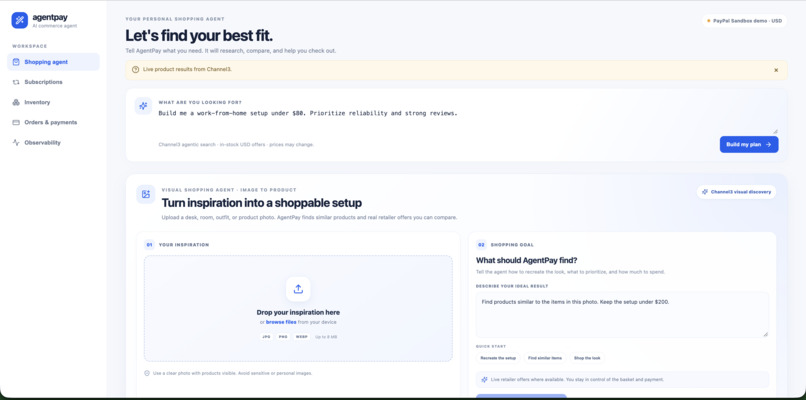
AgentPay brings multiple stages of the shopping journey into one intelligent workspace.
1. AI-Powered Conversational Shopping
Users can describe their requirements in natural language, including budgets, preferences, and priorities.
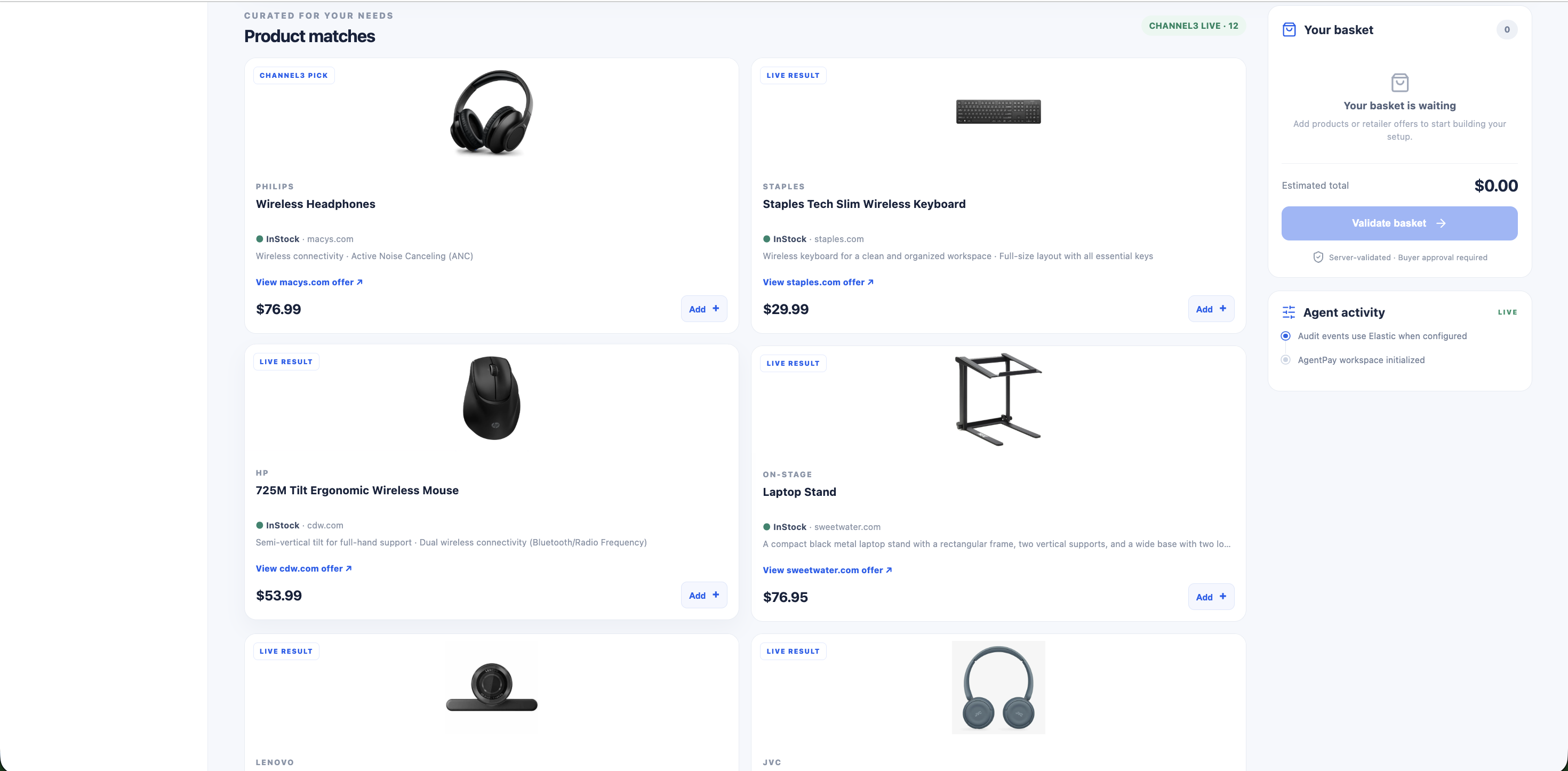
Using Channel3's agentic search capabilities, AgentPay discovers relevant products and retailer offers. Users can continue the conversation to request cheaper alternatives, explore different features, or refine their shopping preferences without starting over.
2. Visual Shopping Agent
We wanted shopping to work beyond text.
Users can upload an image of a desk setup, room, outfit, or product. AgentPay uses visual product discovery to identify similar products and find corresponding retailer offers.
This makes it possible to turn inspiration into a practical shopping list.
3. Intelligent Product Comparison
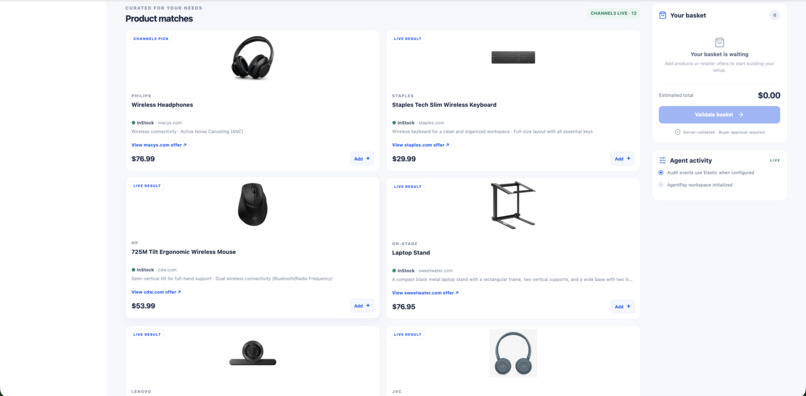
AgentPay presents discovered products and retailer offers in an interactive AG Grid interface.
Users can compare prices, merchants, availability, and product information, apply sorting and filtering, and add specific offers to their basket.
4. PayPal-Powered Checkout
We integrated PayPal Sandbox to demonstrate a secure payment workflow.
AgentPay validates basket contents and prices on the backend before creating a PayPal order. Buyer approval and payment capture are handled through dedicated payment workflows.
We also developed a subscription management experience to explore recurring billing and merchant-side payment visibility.
Importantly, the hackathon prototype demonstrates the payment workflow; it does not place or fulfill orders directly with third-party retailers.
5. Inventory and Payment Lifecycle
We extended the experience with inventory management capabilities, including stock validation, reservations, payment-confirmed deductions, reservation expiry, and inventory movement tracking for the demo catalog.
This helped us explore how an AI shopping experience could connect product discovery with transactional safeguards.
6. Agent Toolkit and Observability
AgentPay includes a read-only PayPal MCP tool explorer, allowing operators to discover available Sandbox tools while keeping payment mutations behind explicit approval workflows.
We also integrated Elastic-based event monitoring and Zapier webhook support for post-purchase automation, making agent activity and payment workflows easier to inspect.
How We Built It
We developed AgentPay using a modular full-stack architecture:
- Frontend: React, TypeScript, and Vite for the interactive shopping workspace.
- Backend: Python and FastAPI for APIs, basket validation, payment orchestration, and business logic.
- Product Discovery: Channel3 for conversational, agentic, and visual product discovery.
- Product Comparison: AG Grid for interactive retailer-offer comparison.
- Payments: PayPal REST APIs and JavaScript SDK for Sandbox checkout and subscription workflows.
- Inventory: SQLite-backed inventory records, reservations, and movement history.
- MCP: PayPal Sandbox MCP integration for read-only tool discovery and execution.
- Observability: Elastic for event indexing and monitoring, with in-memory fallback.
- Automation: Zapier webhooks for post-purchase event delivery.
We designed the application around independent modules so that product discovery, payment processing, inventory, and observability could evolve without tightly coupling the entire system.
Challenges We Faced
Building an agentic commerce experience meant solving challenges beyond simply connecting an LLM to a product catalog.
1. Connecting multiple external services
Integrating Channel3, PayPal, Elastic, and Zapier required handling different API contracts, authentication mechanisms, response formats, and failure scenarios.
2. Making payments reliable
We needed to ensure that prices were validated server-side rather than blindly trusting frontend basket values. We also separated payment creation, buyer approval, capture, and refund operations into controlled workflows.
3. Managing inventory safely
A product being available at a retailer does not necessarily mean its exact stock quantity is known. We therefore distinguished between quantity-based inventory in our demo catalog and availability-only information from Channel3 retailer offers.
We also worked on reservation handling and idempotent inventory updates to reduce the risk of overselling.
4. Handling SDK and integration issues
PayPal's checkout and subscription integrations required careful configuration, particularly around Sandbox credentials, SDK initialization, and separate application configurations.
5. Maintaining observability without blocking the experience
External monitoring services can become unavailable. We designed the event system to retain events in memory when Elastic connectivity fails, allowing the shopping workflow to continue.
What We Learned
Building AgentPay taught us that an effective AI agent is not just about generating intelligent responses. It must also interact reliably with external systems, preserve context, validate information, handle failures, and respect user approval.
We learned how to combine agentic search, visual discovery, structured product comparison, payment orchestration, inventory management, MCP integrations, and observability into one cohesive application.
Most importantly, we learned that trust and control are essential in agentic commerce. Users should remain in control of what enters their basket and when a payment is approved.
What's Next?
We envision AgentPay evolving into a more autonomous commerce assistant with:
- Personalized shopping profiles and preference learning.
- Smarter price and product recommendations.
- Real retailer inventory integrations.
- More advanced multi-agent shopping workflows.
- Expanded payment and subscription management.
- Automated order tracking and post-purchase assistance.
Our goal is simple: make shopping less about searching across websites and more about telling an intelligent agent what you need.
AgentPay is our step toward a future where AI doesn't just recommend what to buy – it helps make the entire shopping journey smarter, simpler, and more transparent.
Built With
- ag-grid
- agentic-ai
- ai-agents
- api
- channel3
- conversational-ai
- e-commerce
- elastic
- elasticsearch
- fastapi
- generative-ai
- inventory-management
- model-context-protocol-(mcp)
- payment-automation
- paypal
- paypal-javascript-sdk
- paypal-rest-api
- paypal-sandbox
- python
- react
- sqlite
- typescript
- visual-search
- vite
- zapier
