⬢ Agent OS: The Autonomous Operations Control Plane for AI Fleets
💡 Inspiration
Most AI agent demos today follow a brittle pattern:
$$\text{Prompt} \longrightarrow \text{LLM} \longrightarrow \text{Tool Call} \longrightarrow \text{Output}$$
While this works in isolated demos, it collapses in enterprise production. The real operational question facing AI engineering is:
When dozens of autonomous agents execute long-running workflows across distributed systems at 3 AM, who manages identity, enforces security boundaries, persists state across crashes, and recovers the mission when an agent dies mid-execution?
Kubernetes solved lifecycle management, auto-healing, and declarative scheduling for microservice containers. We built Agent OS to provide that exact operational control plane for autonomous AI fleets.
🚀 What It Does
Agent OS turns autonomous agent fleets into resilient, self-healing infrastructure:
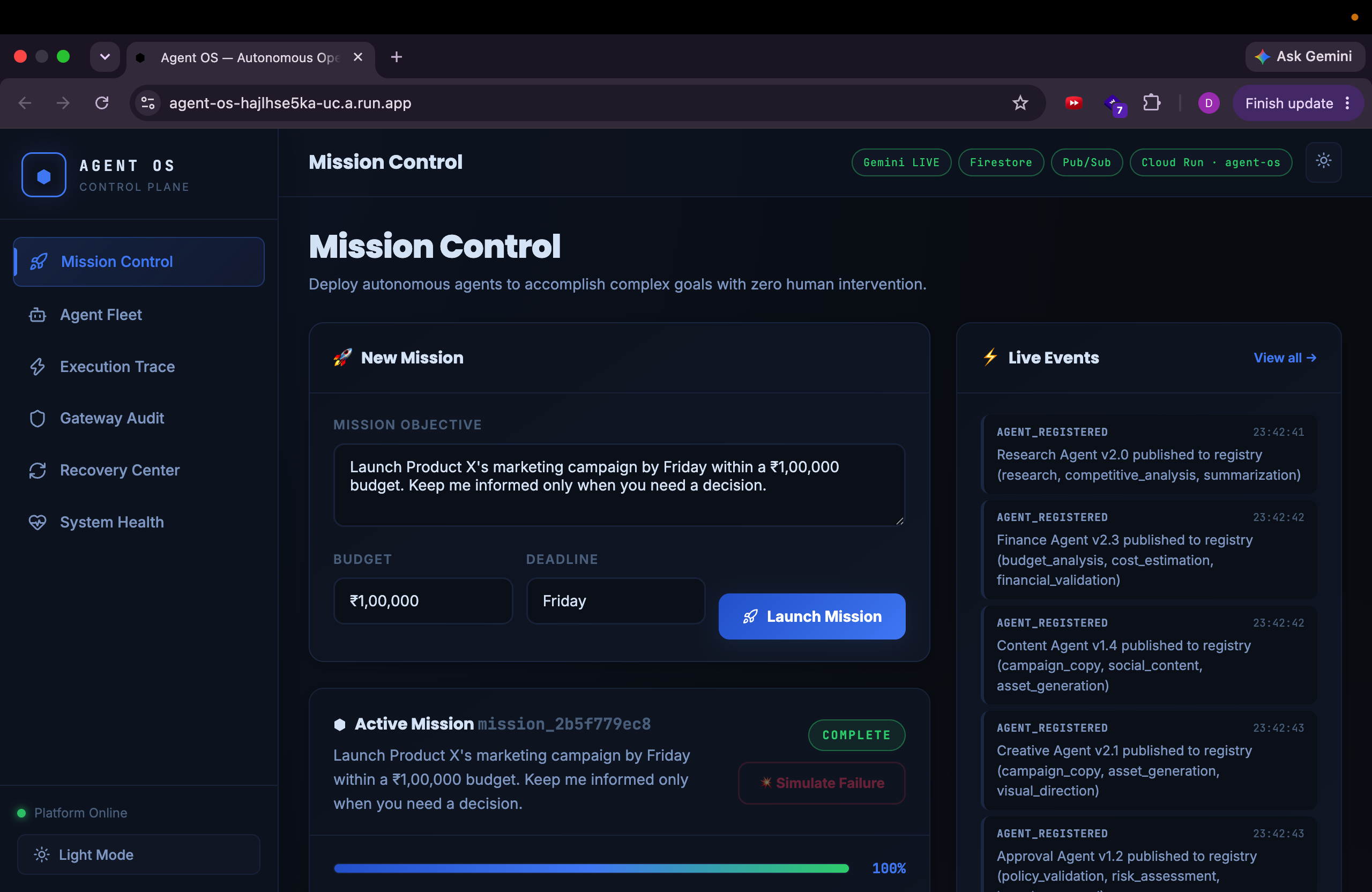
- Autonomous Mission Planning (Gemini 3.5 Flash): Decomposes natural language goals (e.g., "Launch Product X campaign by Friday within ₹1,00,000") into a validated, Directed Acyclic Graph (DAG) of interdependent tasks.
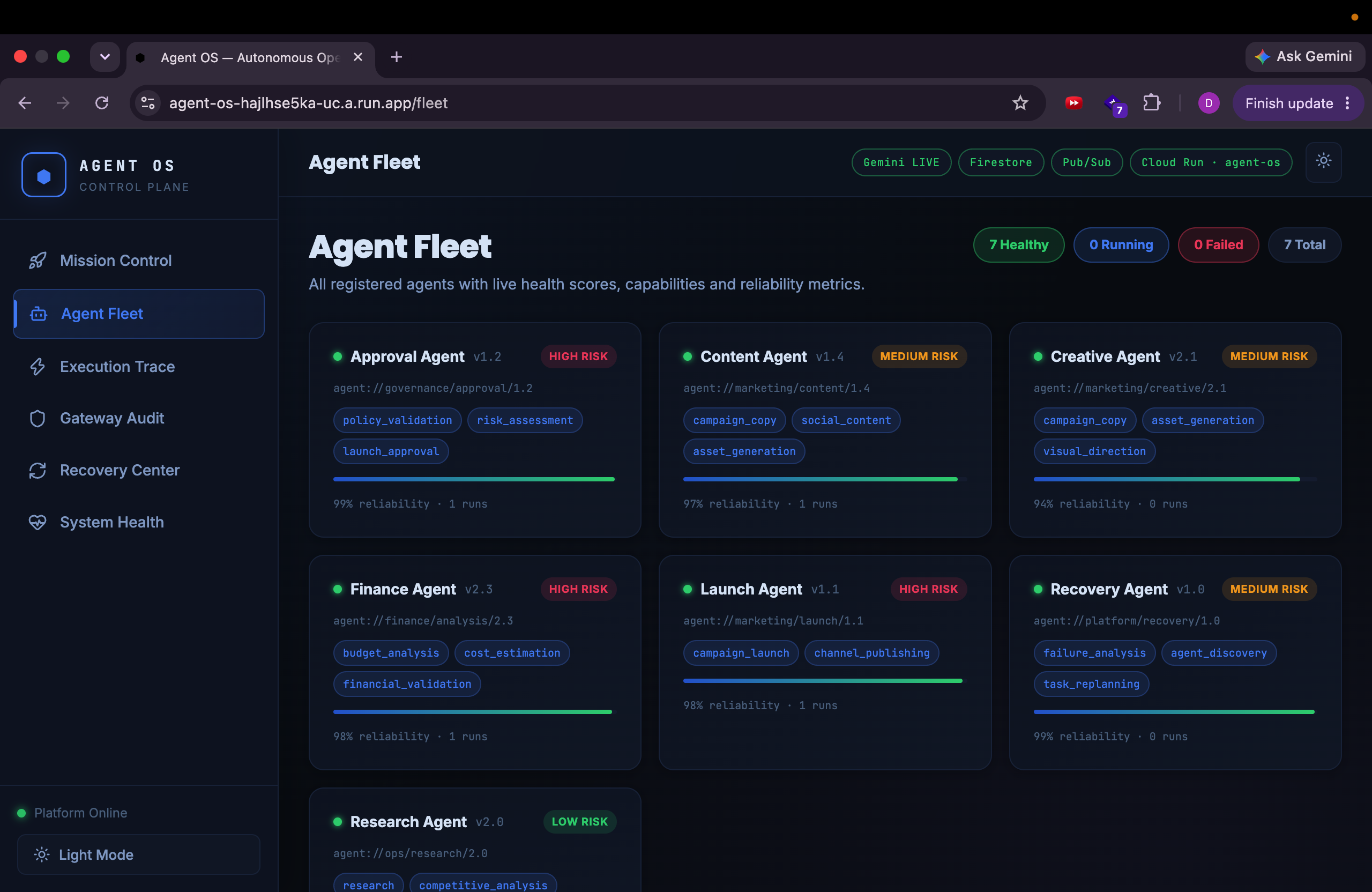
- Capability-Based Registry & Discovery: Agents publish declarative manifests with identity URIs, permissions, and live reliability scores. Tasks are matched dynamically via capability ranking: $$\text{Score}(A) = w_r \cdot R(A) - w_l \cdot L(A) - w_c \cdot C(A) - D(A)$$ (where $R$ is reliability, $L$ is latency, $C$ is cost, and $D$ is degradation penalty).
- Subtask Checkpointing & Persistent State: State is externalized to Google Cloud Firestore after every subtask completion. An agent crash loses only seconds of compute, never the entire mission.
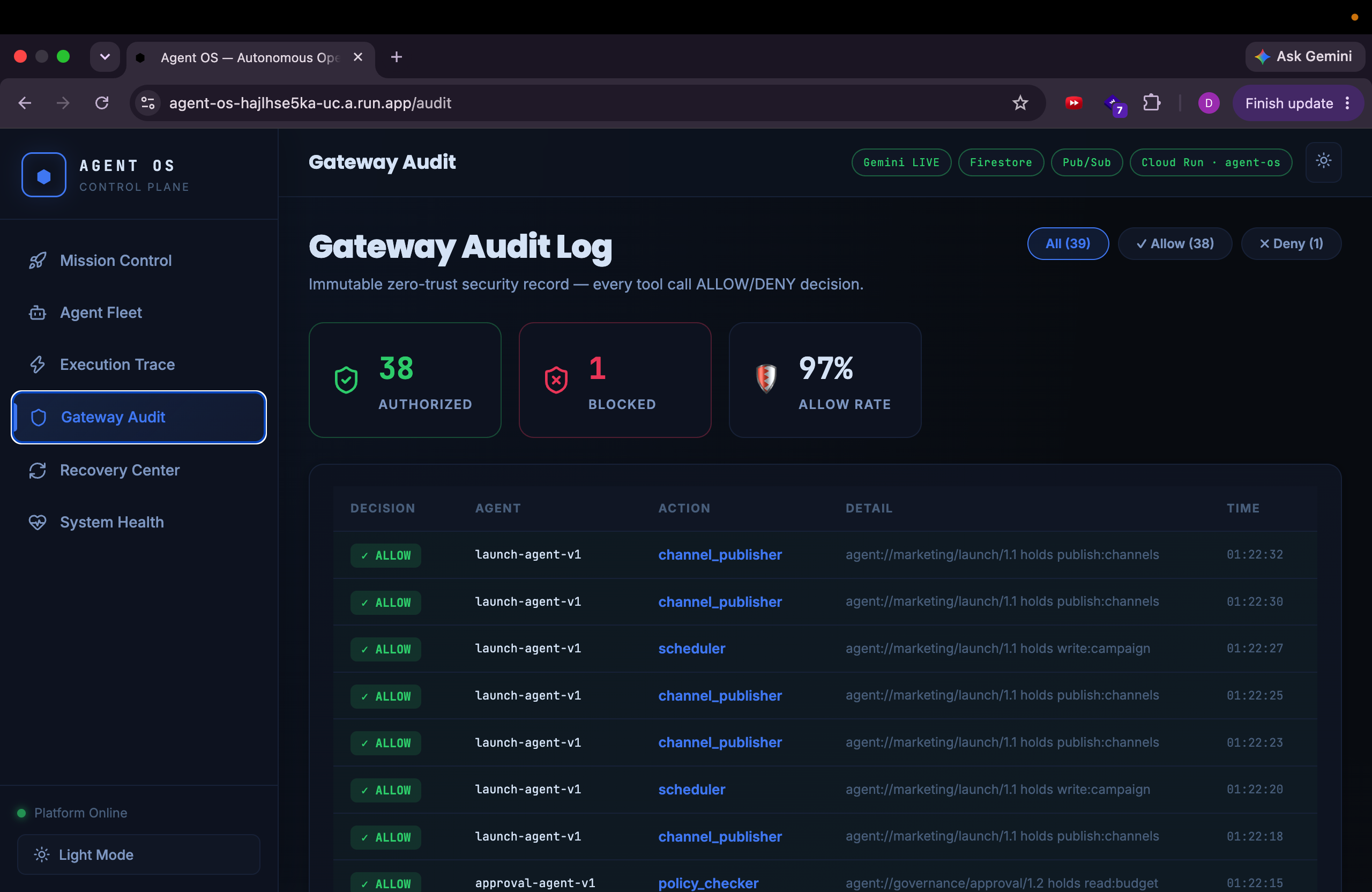
- Zero-Trust Security Gateway: Every tool invocation is intercepted and validated against manifest permissions before execution ($\text{Identity} \rightarrow \text{Permission} \rightarrow \text{Policy}$) with an immutable audit log. Unauthorized actions (e.g., Finance Agent probing payment execution) are blocked live.
- Self-Healing Recovery Engine: When an agent fails, the recovery engine triggers an autonomous escalation ladder: $$\text{Failure Detect} \longrightarrow \text{Restore Checkpoint} \longrightarrow \text{Gemini Diagnosis} \longrightarrow \text{Re-Discover Backup} \longrightarrow \text{Resume Task}$$ The mission finishes without human intervention, maintaining $0$ lost state.
- Mission Control Observability: A modern, interactive multi-page React/Vite dashboard providing live SVG DAG graph visualization, real-time Server-Sent Events (SSE) telemetry, gateway audit trails, and dark/light modes.
🛠️ How We Built It
- Gemini 3.5 Flash & Vertex AI (Google GenAI SDK): Used for schema-constrained task graph decomposition, per-step agent reasoning, and autonomous failure diagnostics.
- Google Agent Development Kit (ADK): Fleet agents are built as Google ADK agents with gateway-wrapped tool handlers, enforcing zero-trust constraints natively inside the execution framework.
- Google Cloud Run: Fully containerized serverless hosting for the unified FastAPI backend and React frontend with scale-to-zero efficiency.
- Google Cloud Firestore: Provides durable, acid-compliant storage for the agent registry, mission checkpoints, memory banks, and immutable audit logs.
- Google Cloud Pub/Sub: Serves as the asynchronous event backbone streaming 16 lifecycle events (
MISSION_PLANNED,AGENT_FAILED,AGENT_REPLACED,TASK_COMPLETED). - Frontend Architecture: Built with React, TypeScript, Vite, React Router, and Lucide icons with a glassmorphic design system and system-aware dark/light theming.
⚡ Challenges We Ran Into
- Making Recovery an Emergent Property, Not a Scripted Fallback:
We avoided hardcoded try/catch fallbacks. Recovery had to emerge naturally from the capability registry. We designed overlapping agent capabilities (e.g., Content Agent v1.4 and Creative Agent v2.1 both possesscampaign_copy), allowing the recovery engine to re-query the registry using the same ranking algorithm used for initial scheduling. - Deterministic Chaos Injection for Judging:
To prove self-healing capabilities on demand, we built failure simulation directly into the API (POST /api/missions/{id}/kill-agent). This terminates a running agent mid-task, exercising the exact exception path of a real-world infrastructure timeout. - Model Resilience & Fallback Parity:
To ensure the control plane never fails due to API rate limits or quota drops during evaluation, every Gemini prompt includes schema fallbacks with identical JSON contracts.
🏆 Accomplishments We're Proud Of
- The Autonomous Recovery Moment: Killing an agent while executing subtask $5/7$ and watching the system restore state to $71\%$, diagnose the failure, reassign the task to a healthy backup agent, and reach
MISSION_COMPLETEDwith 0 human interventions. - Inside-Out Zero-Trust Enforcement: Building tool execution wrappers within Google ADK that guarantee prompts cannot escalate permissions beyond an agent's registered manifest.
- 31/31 Automated Test Coverage: A complete test suite exercising end-to-end mission lifecycles, chaos recovery, and permission boundaries in CI/CD.
🧠 What We Learned
Autonomy is fundamentally a distributed systems and control plane problem, not just a prompt engineering challenge. Once state is externalized to persistent storage, permissions are bound to manifests, and state changes flow through an event bus, self-healing architectures and zero-trust security become natural properties of the fleet.
🔮 What's Next for Agent OS
- Multi-Cloud & Edge Agent Federation: Discovering and delegating tasks to remote agent nodes across disparate VPCs.
- Automated Canary Rollouts & Rollbacks: Automatically rolling back agent versions when real-time reliability $R(A)$ drops below threshold $\tau$.
- OpenTelemetry & Prometheus Native Export: Exporting agent execution traces directly into enterprise observability stacks like Datadog, Grafana, and Cloud Monitoring.
Built With
- fastapi
- firestore
- google-adk
- google-cloud
- google-cloud-pub/sub
- google-cloud-run
- google-gemini-3.5-flash
- python
- react
- typescript
- vite


Log in or sign up for Devpost to join the conversation.