

Inspiration
Navigating the developer's world has left me paralyzed most times than I can count, this is not because I don't know what to build, it's because of the hundreds of tools I'll need to stitch together. If one thing breaks, I have to go over them all, rinse them out, by the time I'm done, someone else must have stolen my idea by now, especially when I'm building in public. AgentOS was born to eliminate this, with AgentOS, building has never been more enjoyable.
What it does
With just one command, Super AgentOS can take up tasks, break into tiny executable steps, map out the necessary too and ensure work is completed end to end using any step necessary including extending to other external tools using the Universal MCP.
How we built it
How We Built AgentOS
AgentOS started with a simple observation: AI had become extremely intelligent, but using it still felt fragmented.
People were moving between chatbots, coding tools, automation platforms, applications, files, API dashboards, and disconnected agents just to complete one task. The intelligence existed, but there was no operating layer connecting everything together.
We built AgentOS to become that layer.
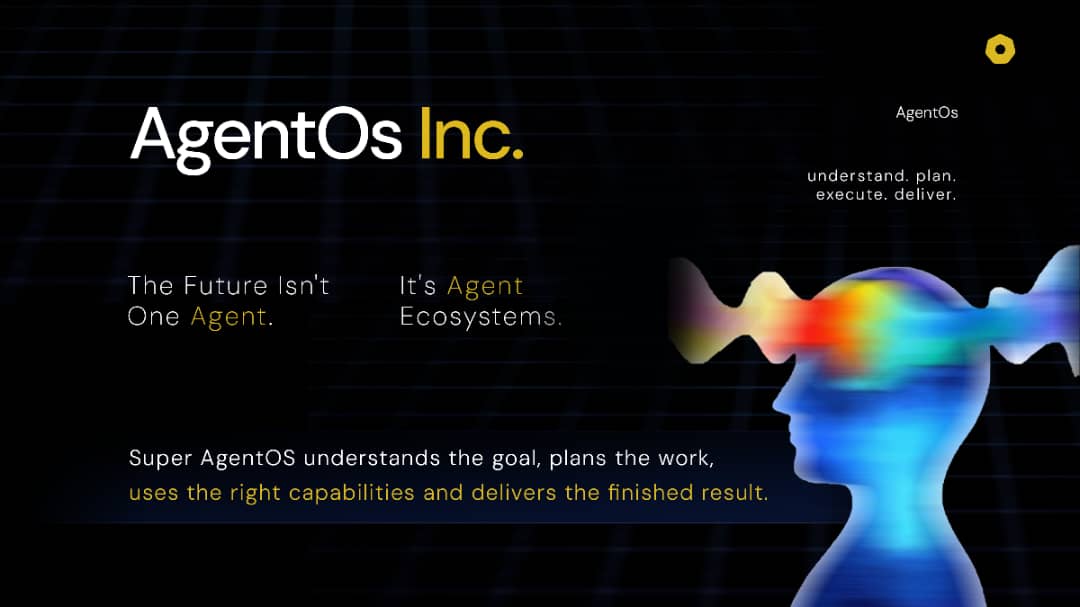
At the centre of the system is Super AgentOS, the primary intelligence and command interface. A user explains what they want in natural language, and Super AgentOS converts that intent into an executable plan, selects the required capabilities, coordinates the work, and returns the completed result.
The core idea is simple:
One command. Complete execution.
We did not want AgentOS to be another model wrapper or a platform that automatically routes every request through different AI providers. Super AgentOS is the native intelligence of the platform. External models, agents, and tools are optional capabilities that users can connect when they need additional intelligence or specialised functionality.
Around Super AgentOS, we built the operating environment required for persistent AI work.
The Context Engine maintains continuity across conversations, projects, files, decisions, preferences, and previous outputs. Projects act as persistent work environments instead of ordinary folders. The Library stores the user’s installed applications, skills, Prime Agents, Primeflows, files, and generated assets. Vault securely manages API keys and credentials, exposing them only when an authorised task requires them.
We then created the capability layer.
Prime Agents allow users to create specialised AI workers with their own instructions, memory, tools, permissions, and operating boundaries. Primeflows allow those agents, applications, skills, and external systems to be combined into repeatable or recurring execution pipelines.
The Appstore and Skill Store provide distribution. Developers can build capabilities inside or outside AgentOS, integrate the AgentOS SDK, and make their applications discoverable across the ecosystem. Universal MCP gives AgentOS a standard way to connect with external tools, data sources, services, and existing agent systems.
We also designed Furge Fabric Protocol, or FFP, as the native coordination and consensus fabric for AgentOS. Super AgentOS provides intelligence, while FFP is intended to support verifiable coordination between multiple independent agents, validators, applications, and execution environments.
We built AgentOS iteratively rather than treating it as a single chatbot interface. Each layer was developed around one question:
What would an AI need to operate like an actual operating system rather than a temporary conversation?
That question shaped the architecture: persistent context, secure secrets, reusable capabilities, execution logs, permissioned sharing, developer distribution, multi-agent coordination, and a workspace that survives beyond one chat session.
The result is an AI operating ecosystem where conversations become projects, instructions become execution, and capabilities can be installed, combined, reused, and distributed.
AgentOS is not another place to talk to AI.
It is the environment where AI gets work done.
Challenges we ran into
Real-Life Challenges We Faced
Building AgentOS was not only a technical challenge. It was also a test of persistence, resourcefulness, and the ability to keep moving when the conditions were far from ideal.
One of the biggest challenges was building an ambitious product with limited resources. AgentOS is not a small utility or a single AI feature. It combines intelligence, memory, execution, applications, skills, agents, workflows, developer tools, security, and an entire ecosystem. Building something at that scale without the resources of a major AI company meant we had to be extremely deliberate about every decision.
We also had to work through the reality of building from Nigeria, where access to funding, infrastructure, international networks, and specialised AI talent is not always as straightforward. Many tools, services, and opportunities are designed around founders in more established technology ecosystems. We had to find alternative paths, learn quickly, and continue building without waiting for perfect conditions.
Another challenge was turning a very large vision into something people could immediately understand. AgentOS made sense to us as an AI operating system, but most people were already familiar with chatbots, copilots, and automation tools. Explaining why AgentOS was different—and why it needed to exist—required us to constantly refine the product, language, interface, and positioning.
The scope itself was another real challenge. There was always more to build: Super AgentOS, Studio, memory, Prime Agents, Primeflows, the Appstore, the Skill Store, Vault, Universal MCP, developer infrastructure, and FFP. We had to resist the temptation to build everything at once and instead focus on creating a foundation strong enough to support the larger vision.
There were also moments when progress felt slower than the ambition. Features broke. Interfaces had to be redesigned. Ideas that appeared simple required deeper architectural changes. Some decisions had to be revisited several times before they matched the product we were actually trying to create.
Building visibility was another difficulty. A product can be technically strong and still remain unnoticed. We had to build the product while also explaining it publicly, creating demos, writing documentation, developing the brand, and finding early users and developers willing to understand the vision.
We also faced the challenge of protecting AgentOS’s identity. As the project became more visible, similar names, concepts, and implementations began to appear. That made it important for us to define our terminology, document our work, establish the AgentOS brand, and clearly communicate what we had built and when we built it.
Perhaps the hardest challenge was continuing to believe in the scale of the idea before there was external validation. Building a new category means there is no perfect roadmap. There are few direct comparisons, no guaranteed market response, and no certainty that people will immediately understand the product.
We kept building because the problem remained clear: AI was becoming more capable, but the experience around it was still fragmented. Someone needed to build the operating layer that connected intelligence, tools, applications, agents, memory, and execution.
That conviction became the foundation of AgentOS.
We did not build it under perfect conditions.
We built it because the problem was too important to ignore.
Accomplishments that we're proud of
Accomplishments
Our biggest accomplishment was turning AgentOS from a broad idea into a working AI operating system with a clear architecture, product identity, and execution model.
We built Super AgentOS as the central intelligence and command layer of the platform. Instead of forcing users to move between separate tools, applications, agents, and automation systems, AgentOS gives them one interface for expressing what they want and coordinating how the work gets done.
We created a persistent workspace around that intelligence. Conversations can develop into projects, generated outputs can remain available in the Library, credentials can be secured in Vault, and previous context can be reused instead of being lost after every session.
We also established the core building blocks of the AgentOS ecosystem:
- Prime Agents for specialised and reusable AI workers.
- Primeflows for repeatable and multi-step execution.
- Appstore for discovering and distributing complete applications.
- Skill Store for installing focused capabilities.
- Studio for natural-language work, workflow construction, and code-based development.
- Universal MCP for connecting external tools, services, and agent systems.
- AgentOS SDK for developers building products that can become discoverable within the ecosystem.
- FFP as the foundation for future verifiable multi-agent coordination.
Another major accomplishment was defining what AgentOS is and what it is not.
We deliberately avoided building a simple wrapper around existing AI models. Super AgentOS remains the native intelligence and operating layer, while external models and agents are optional capabilities that users can connect when needed. This gives the platform a clear identity and reduces dependency on any single provider.
We also developed a complete product and technical specification covering execution, context, memory, security, permissions, applications, developer infrastructure, monetisation, user experience, and future scaling. This gave us a structured roadmap for moving from prototype to production rather than treating AgentOS as a collection of disconnected features.
Beyond the platform itself, we began building an ecosystem around it. External products such as deZypher and Derek were designed for AgentOS SDK integration, demonstrating how independent applications can connect to AgentOS and become part of a broader distribution network.
We established AgentOS as more than a chatbot or automation tool. It now has its own terminology, architecture, developer model, marketplace structure, economic model, and long-term direction.
Most importantly, we proved that the idea could be built.
AgentOS moved from a concept into a functioning foundation for an operating system where intelligence, tools, applications, memory, agents, and execution can work together through one command.
What we learned
What's next for AgentOS (by PRIME)
- Completing console development and Welcoming Supet AgentOS and pen test.
- Collaboration with various universities and institutions in Nigeria and West Africa to use AgentOS
- Legal incorporation as a startup in Nigeria
- Mini hackathon "Build on AgentOS " usable apps, skills and workflow on AgentOS.

Log in or sign up for Devpost to join the conversation.