-
-
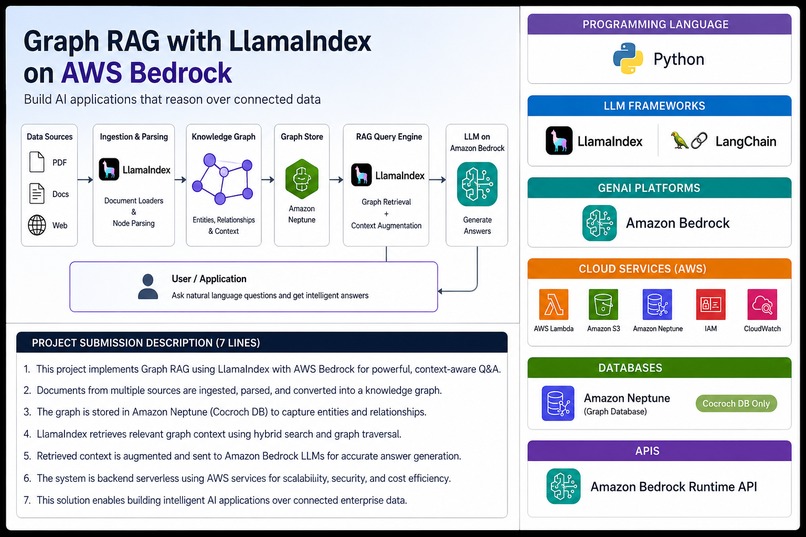
The repo explicitly uses Python, LlamaIndex, LangChain, AWS Bedrock, Bedrock Converse, Bedrock Embeddings, and Neo4j;
Inspiration
Recommended tech stack LLM: Amazon Bedrock (Claude, Llama, or Nova models) Persistent memory: CockroachDB Semantic memory: CockroachDB Distributed Vector Index Agent access: CockroachDB Managed MCP Server Execution: AWS Lambda or ECS Storage: Amazon S3 Framework: LangChain or LangGraph Frontend: Next.js + React
Instead of building a single chatbot, build an ecosystem of collaborating AI agents (Planner, Researcher, Coder, Analyst, Reviewer, Executor) that all share CockroachDB as a globally distributed memory layer. Each agent can retrieve relevant long-term memories through vector search, update shared knowledge, and continue tasks across failures or restarts. Use Amazon Bedrock for model inference, AWS Lambda for serverless execution, S3 for artifacts, and CockroachDB's Managed MCP Server plus Distributed Vector Indexing to satisfy the hackathon requirements.
What it does
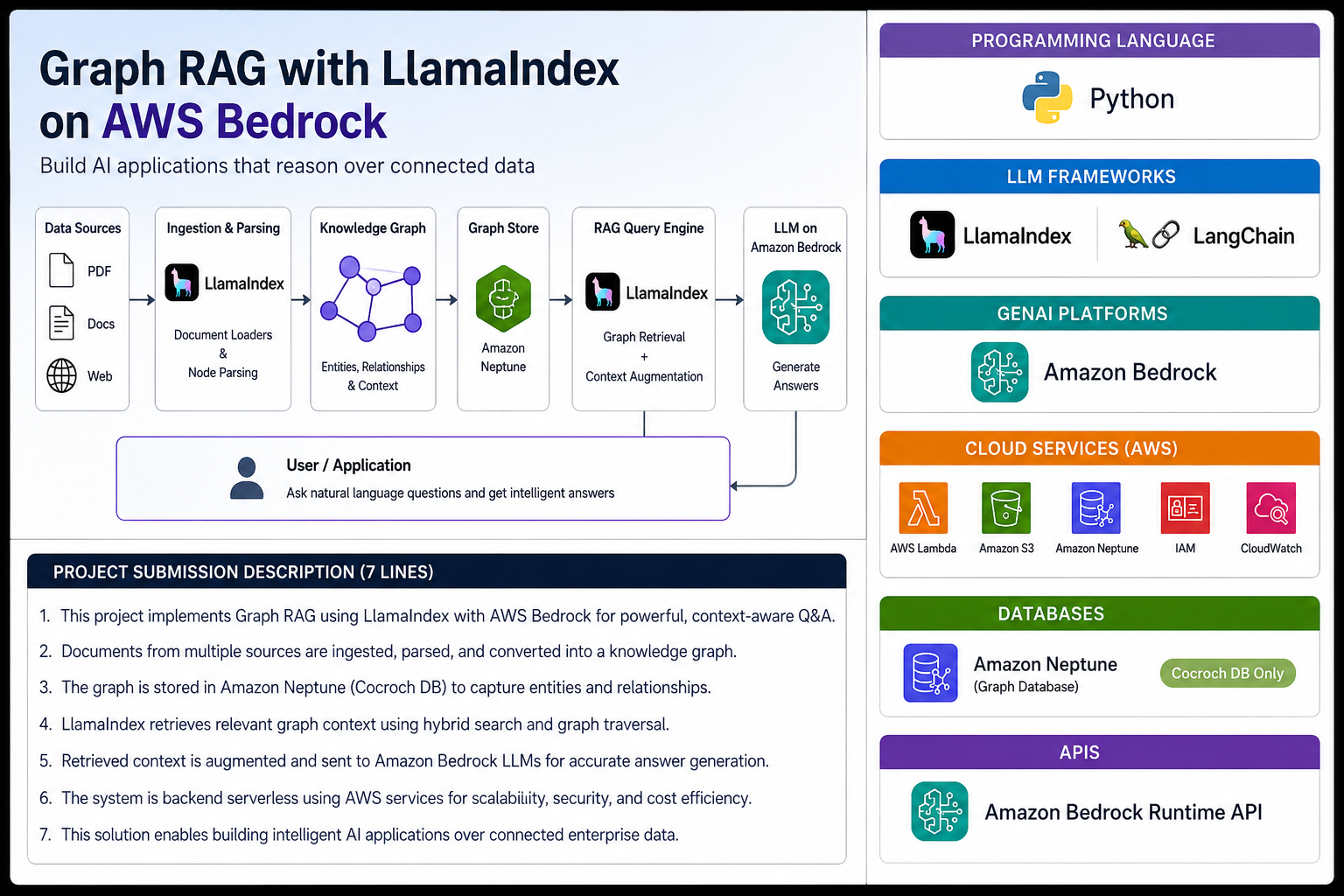
Builds a Graph RAG system that retrieves knowledge from connected data and generates context-aware answers using LlamaIndex and Amazon Bedrock.
How we built it
Built with Python, LlamaIndex, LangChain, Neo4j, and Amazon Bedrock using graph-based and semantic retrieval.
Challenges we ran into
Handling knowledge-graph construction, relationship retrieval, embeddings, and integration between LlamaIndex, Neo4j, and AWS Bedrock.
Accomplishments that we're proud of
Created a scalable Graph RAG pipeline capable of producing accurate and context-aware responses from connected information.
What we learned
Learned how knowledge graphs, vector embeddings, LLMs, and cloud-based GenAI services can work together to improve retrieval and question answering.
What's next for AgentOS – A Persistent Multi-Agent Operating System
Extend the Graph RAG architecture into a persistent multi-agent system where specialized AI agents can share knowledge, collaborate, and perform complex tasks autonomously.
Project Submission Description
- Developed a Graph RAG application using Python, LlamaIndex, LangChain, and Amazon Bedrock.
- Processed documents and transformed their information into a structured knowledge graph.
- Used Neo4j as the graph database to store entities, nodes, and relationships.
- Implemented graph-based and semantic retrieval to identify relevant context for user queries.
- Integrated Amazon Bedrock foundation models and embeddings to generate accurate contextual responses.
- Leveraged AWS cloud services and APIs to build a scalable and secure Generative AI solution.
- The project enables intelligent question answering, enterprise knowledge retrieval, and graph-enhanced AI applications.
Built With
- amazon-web-services
- architecture:
- aws-cloudwatch-database:-neo4j-graph-database-apis:-amazon-bedrock-api
- aws-iam
- aws-lambda
- bedrock-converse-api
- bedrock-embeddings-api
- boto3/aws
- graph
- hybrid
- knowledge
- langchain-genai-platform:-amazon-bedrock-cloud-services:-aws-bedrock
- llamaindex-api
- rag
- sdk


Log in or sign up for Devpost to join the conversation.