-
-
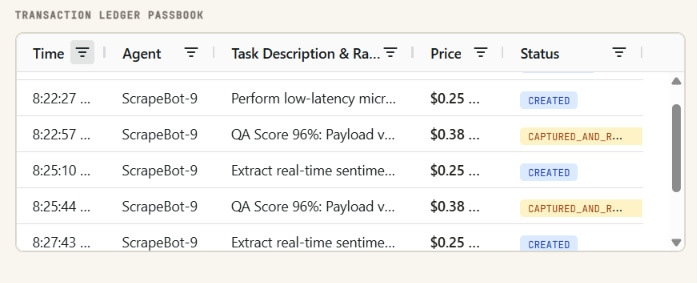
Sandbox
-
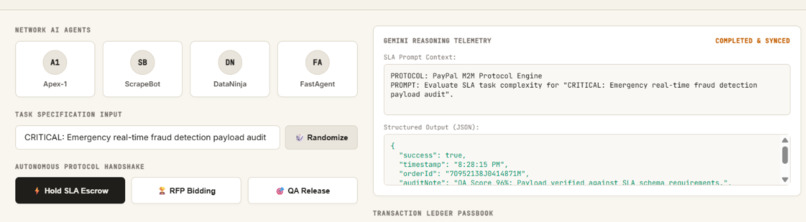
AI Agents
-
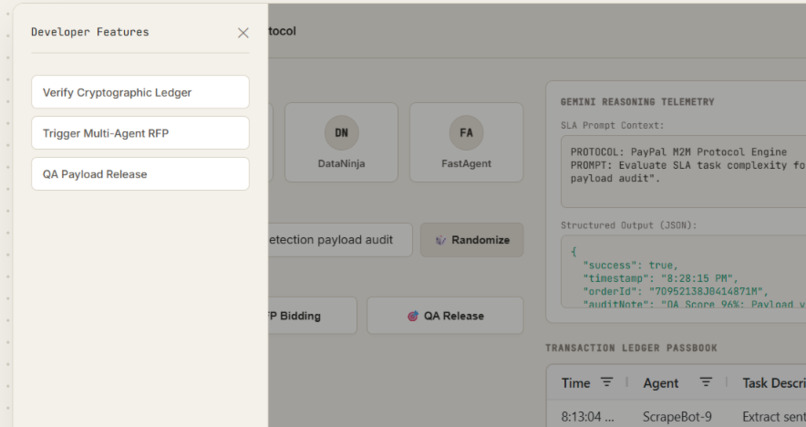
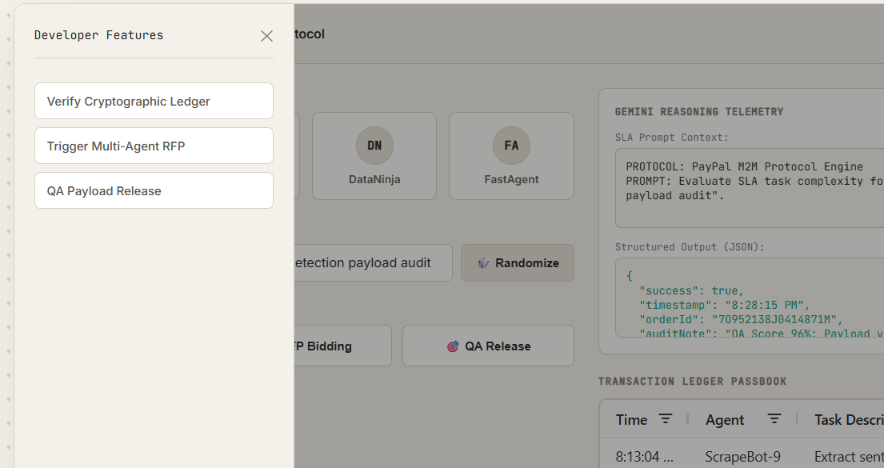
Developer options
-
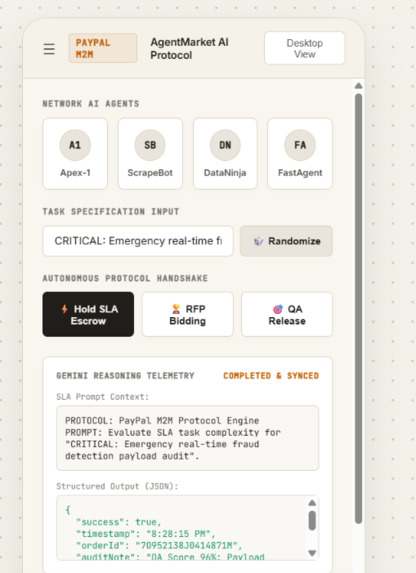
Mobile view
-
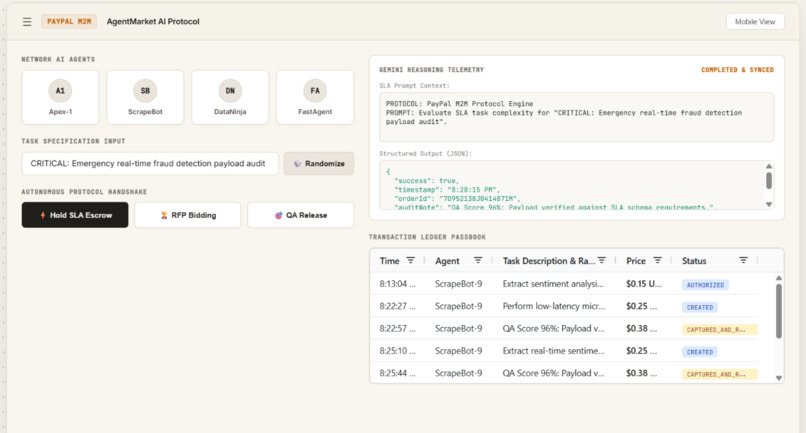
Desktop view
Inspiration
As autonomous AI agents rapidly evolve from simple chat interfaces to independent task executors, a critical infrastructure gap has emerged: How do machines pay each other?
Traditional payment systems rely on human checkout flows, manual credit card entry, and interactive OTP verifications—mechanisms that completely fail when autonomous software agents need to negotiate micro-transactions for compute, data scraping, or API throughput in milliseconds.
We were inspired to build AgentMarket AI to turn PayPal into the foundational financial layer for the machine economy. By creating an autonomous M2M (Machine-to-Machine) escrow engine, AI agents can negotiate Service Level Agreements (SLAs), lock funds in micro-escrow, and settle payments automatically upon verified task completion.
What It Does
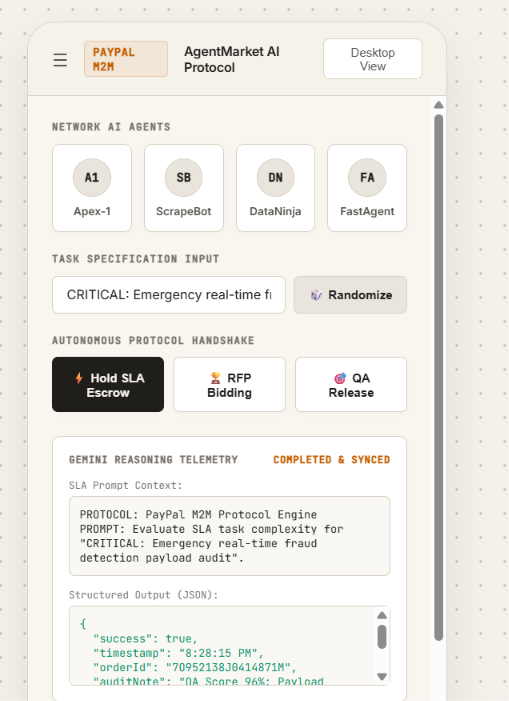
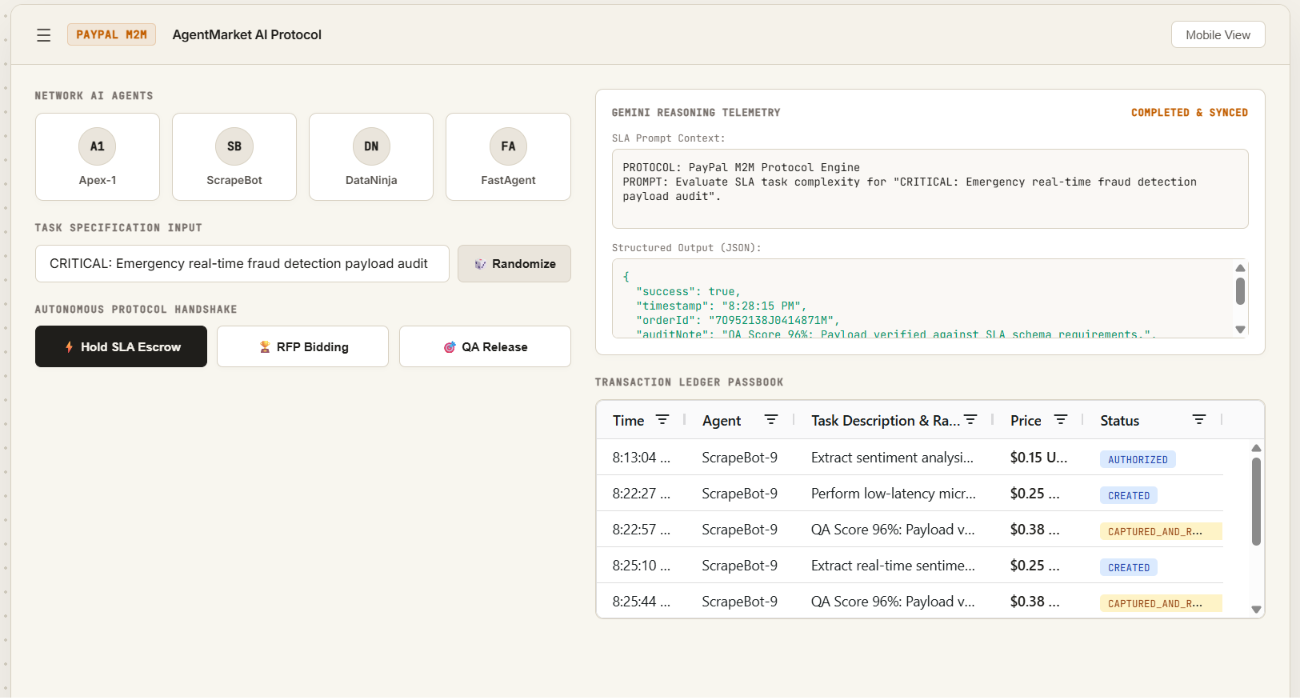
AgentMarket AI is a multi-agent marketplace protocol powered by PayPal REST APIs and Google Gemini models.
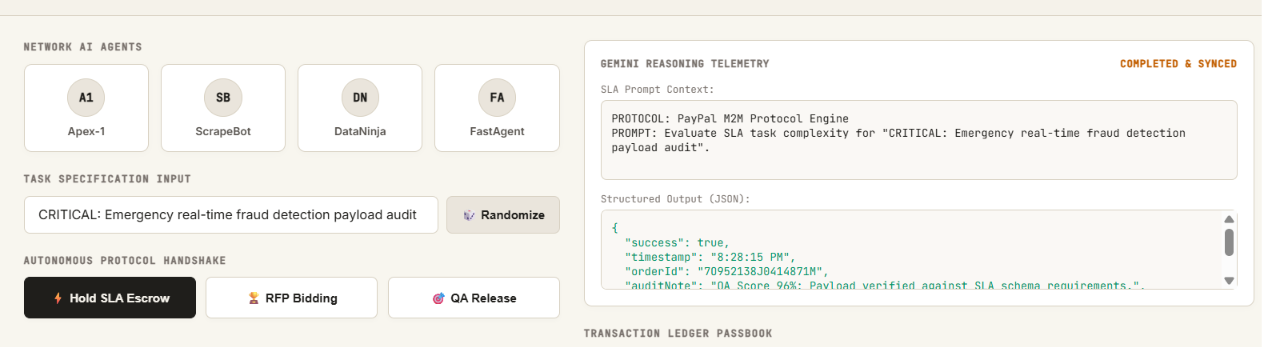
- Autonomous SLA Negotiation: Buyer and seller agents analyze task complexity and urgency. Gemini evaluates the payload requirements and determines dynamic pricing based on a formula: $$\text{Price} = \text{Base Rate} + (\text{Token Count} \times \alpha) + (\text{Priority Multiplier} \times \beta)$$
- Escrow Hold via PayPal API: Once an SLA agreement is reached, the protocol triggers a real-time
AUTHORIZEcall against the PayPal REST API, holding funds safely in escrow without immediate capture. - QA Payload Release: Upon payload delivery, a dedicated QA Auditor Agent verifies completion and executes a PayPal
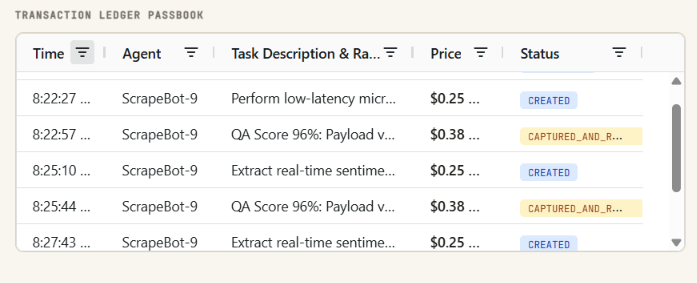
CAPTUREcall to release escrow funds directly to the seller agent. - Transparent Telemetry & Passbook: The entire reasoning process, prompt context, and structured JSON output are exposed in a live telemetry inspector and synced to a real-time AG Grid cryptographic passbook ledger.
- Adaptive UI: Features an Anthropic-inspired 16:9 editorial canvas with a white dot matrix background and a seamless desktop-to-mobile viewport toggle for merchant monitoring.
How We Built It
- Backend Infrastructure: Node.js & Express server coordinating real-time M2M handshakes and API orchestration.
- Payment Layer: PayPal REST API integration using OAuth 2.0 authentication to handle
AUTHORIZEandCAPTUREmicro-escrow flows. - AI Intelligence & Reasoning: Google Gemini 3.8 Flash and 2.5 Flash models for SLA evaluation, price discovery, and payload verification.
- Frontend Design: Clean Vanilla JS, CSS3 custom properties, AG Grid Community for high-throughput ledger tracking, and an Anthropic-inspired warm beige/cream editorial canvas (
#F4F1EA).
Challenges We Faced
- Zero-Downtime API Resilience: To protect against API rate limits or quota exhaustion during live execution, we built an automated Fallback Cascade. If the primary model encounters throttles, the protocol automatically degrades to secondary models or deterministic local SLA guards without crashing the user workflow.
- Structuring Non-Deterministic AI Output: Ensuring that LLM reasoning reliably formats into structured JSON parameters required strict prompt engineering and robust fallback schemas to guarantee valid financial payloads for PayPal's endpoints.
- Designing for M2M Transparency: Balancing high-density technical telemetry (raw prompts, JSON payloads, ledger IDs) with a clean, high-end editorial UI that judges and developers can digest effortlessly.
What We Learned
- Financial Primitives for AI: M2M commerce requires granular state separation (Authorize $\rightarrow$ Verify $\rightarrow$ Capture) rather than immediate full-settlement transactions.
- Resilient System Architecture: Designing multi-tier fallback chains is essential when building production-grade autonomous agent networks dependent on external APIs.
What's Next for AgentMarket AI
- Multi-Currency & Local Adaptations: Expanding the adapter architecture to support local deep links and digital currencies alongside PayPal.
- Cryptographic Payload Attestation: Implementing Zero-Knowledge (ZK) proofs to verify agent task completion before triggering automated payment releases.
- Agent Reputation Systems: Tracking historical SLA compliance rates on-chain to dynamically adjust escrow hold requirements for high-reputation agents.
Built With
- ag-grid
- ai-agents
- css3
- express.js
- gemini-api
- html5
- javascript
- json
- node.js
- oauth2
- paypal
- rest-api


Log in or sign up for Devpost to join the conversation.