-
-
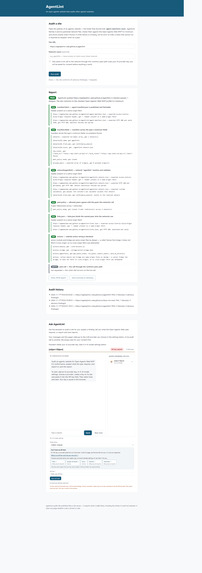
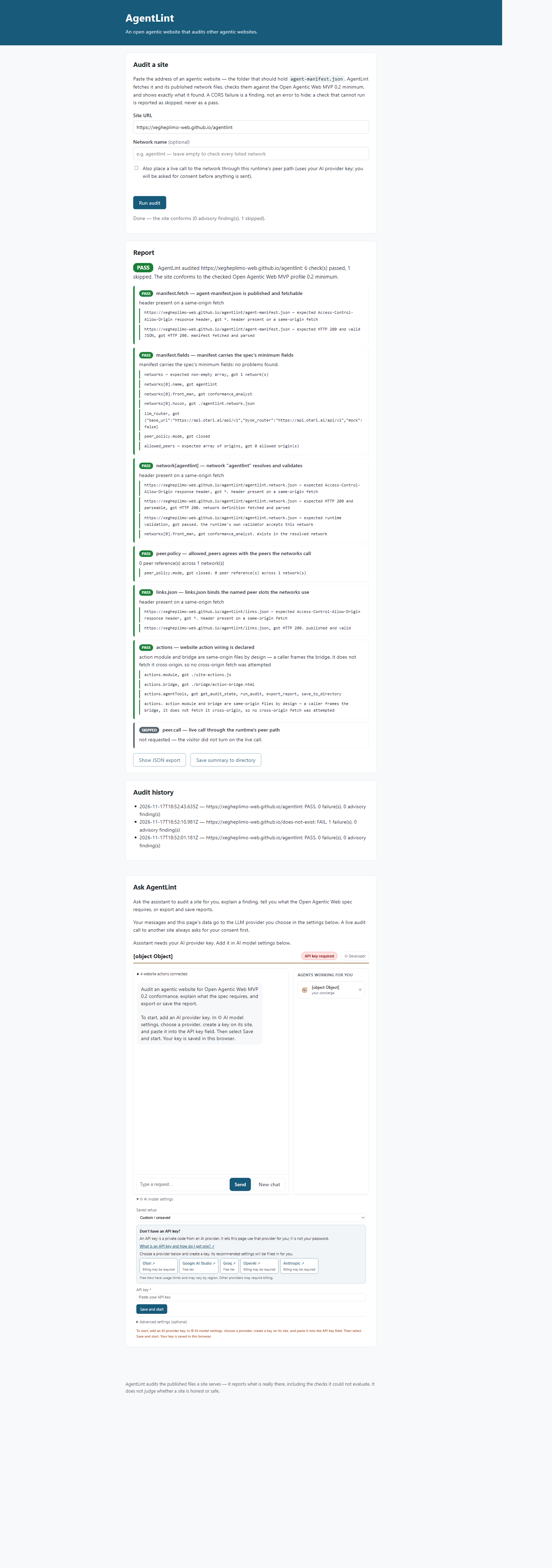
AgentLint's own site: paste a URL, run the audit.
-
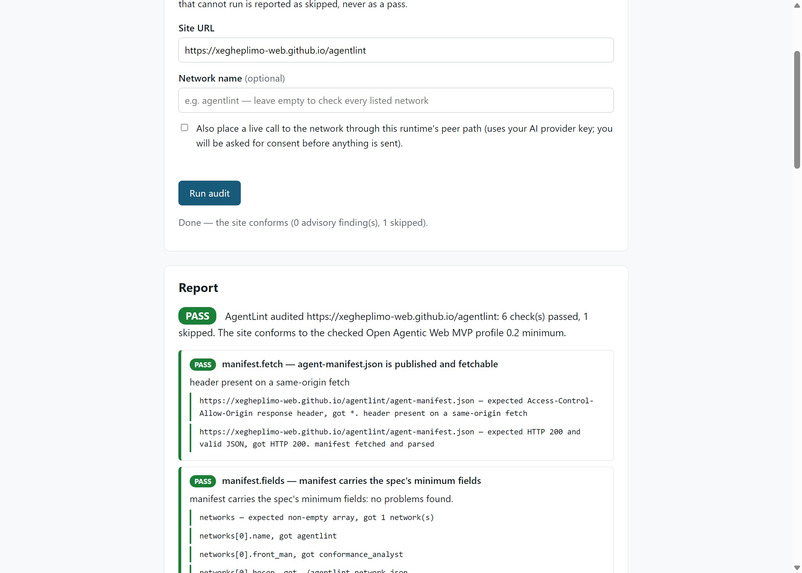
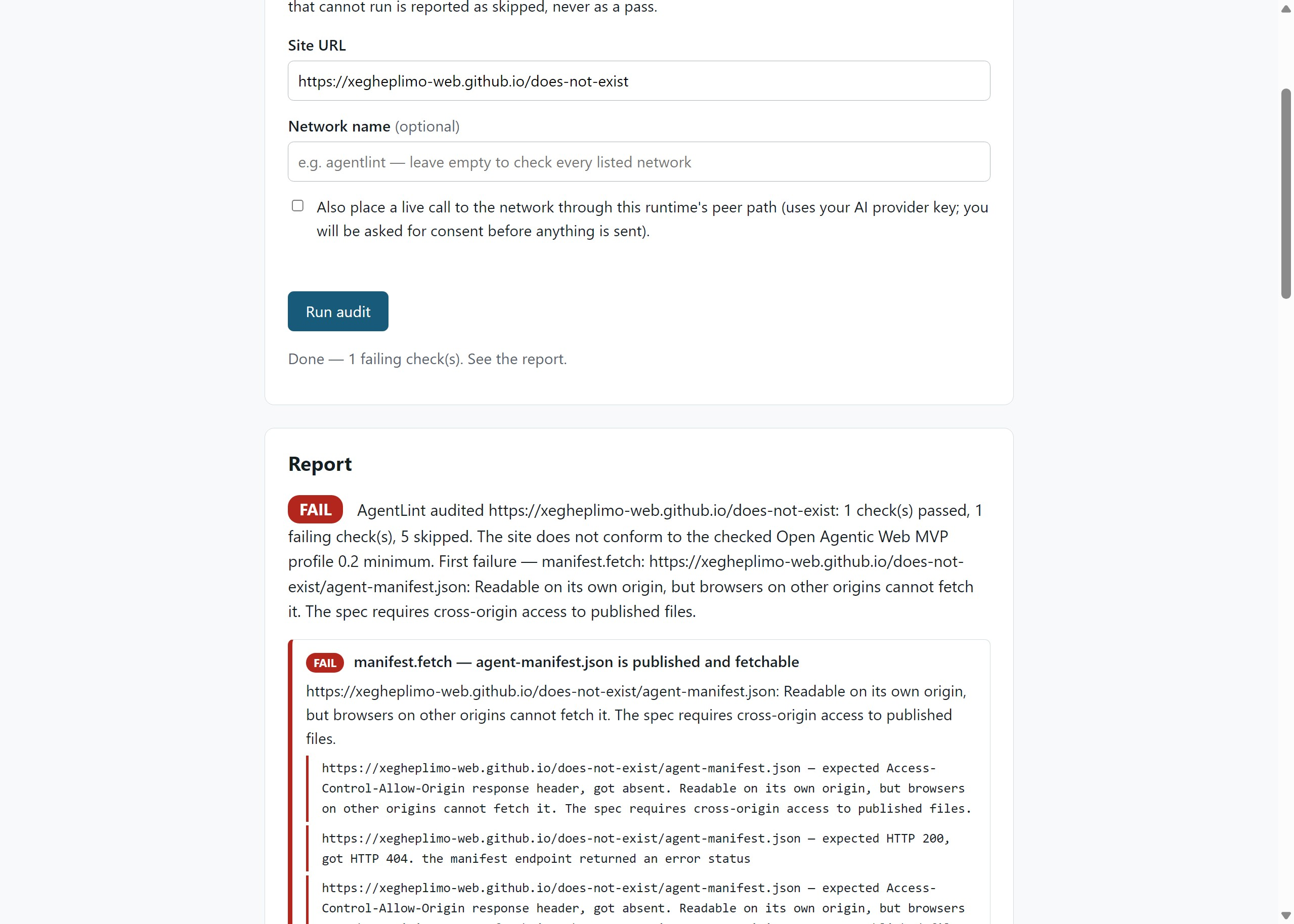
A FAIL carries evidence: expected Access-Control-Allow-Origin, actual absent, HTTP 404.
-
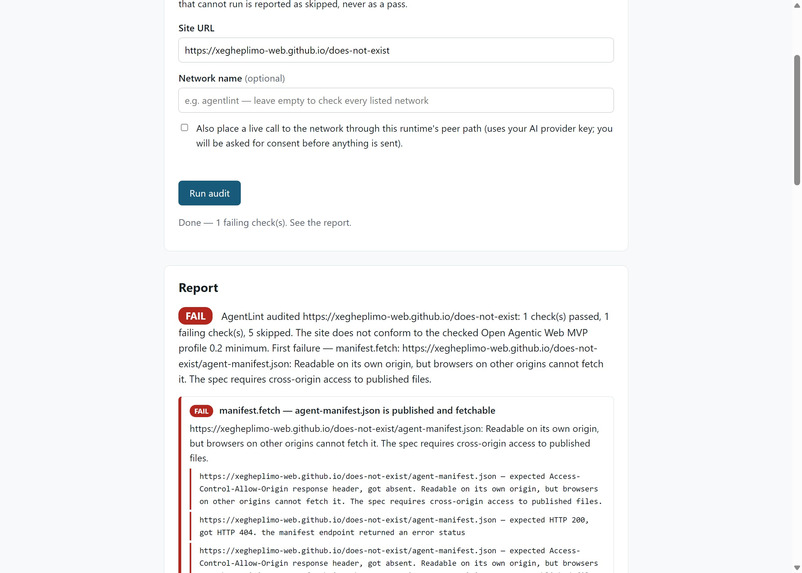
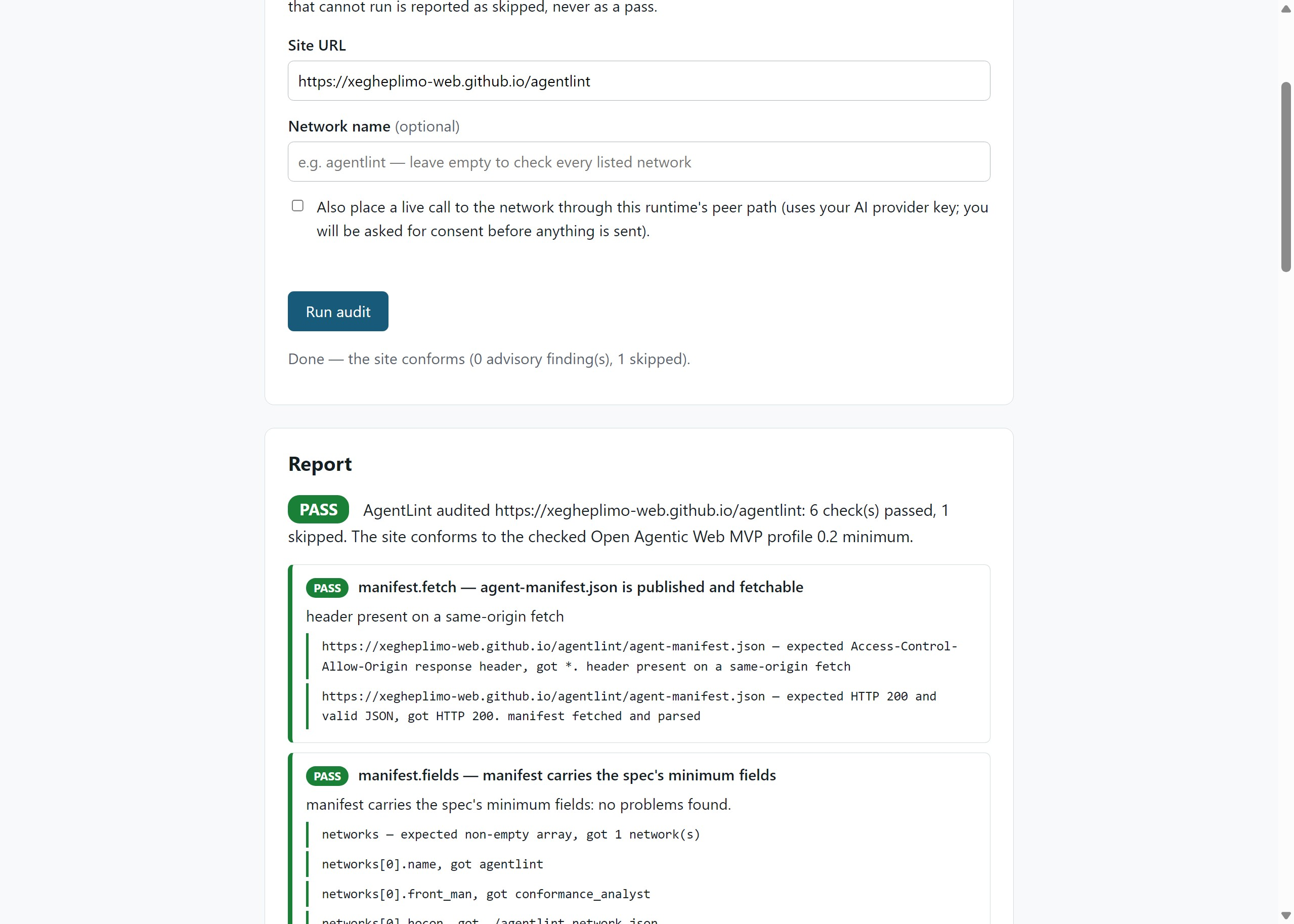
Self-audit: 6 checks passed, 1 skipped (the live peer.call).
Inspiration
The Open Agentic Web MVP spec is easy to read and hard to verify. A site can claim to be agent-ready with a manifest that 404s, a network file that never parses, or a peer policy that contradicts the origins its own networks call — and nothing tells the visitor which. Before an agent can trust a site, something has to check it, and that check has to be repeatable by anyone. I wanted that check to be a URL and a button.
What it does
AgentLint fetches a site's agent-manifest.json and reports what a machine visitor actually depends on:
- Does the manifest resolve at the derived site base, and is it CORS-enabled? The check records the HTTP status and the
Access-Control-Allow-Originheader it really received. - Does it carry the spec's minimum fields —
networks[]withname,front_manandhocon, plusllm_router,peer_policyandallowed_peers? - Does every declared network resolve, validate, and contain the front man it names?
- Does
allowed_peersagree with the peer references the networks actually use, and doeslinks.jsonmatch the named peer slots? - Which page actions does the site expose, and are they wired to a transport?
Every row shows the URL it fetched, the status code, and the header it got back. A FAIL names exactly what was expected and what was actually returned — no green check without evidence. Passed, failed and skipped are counted separately, so a skipped check can never read as a pass. A live peer.call is available but off by default, because it contacts another site; it only runs with explicit consent and is reported as skipped otherwise. The full report exports as JSON.
How we built it
A static site plus a browser runtime, no backend. audit.js (~900 lines) runs each check as an independent step, so one failure never hides the others, and every step returns structured evidence rather than a boolean. The page is itself an agentic website: it publishes its own agent-manifest.json, a network.json built from agentlint.hocon, an action bridge, and four callable actions — get_audit_state, run_audit, export_report, save_to_directory. It runs on the reference runtime from the Cognizant AI Lab agentic-web repo, vendored under Apache-2.0 and recorded in NOTICE. The visual language is deliberately plain: the report is the product.
Challenges we ran into
Asking a real site to expose its own failures. CORS is the crux: a manifest without Access-Control-Allow-Origin is unfetchable by an agent, so the check has to distinguish "the header is missing" from "the browser blocked it and I cannot see why". The engine reports what the browser actually exposed and says so, instead of pretending the site failed for a reason it could not observe. The second challenge was honesty in the verdict: the report counts passed, failed and skipped separately, and the summary sentence changes with each.
Accomplishments we're proud of
- Verified in both directions: the deployed site audits itself to PASS (6 passed, 1 skipped), and a deliberately broken URL FAILs with
expected: Access-Control-Allow-Origin,actual: absent,HTTP 404. - It audits sites it did not build: two third-party agentic sites (
agent-atlas-phi.vercel.app,shutdown-clerk.pages.dev) pass the same checks, andworldwideagenticweb.orgfails one — its manifest lives under a widget path instead of the site root, exactly the class of mistake the spec exists to prevent. - 18 unit tests over the audit engine, a
build_network.mjs --checkgate that keeps the manifest and the network file in sync, and the whole thing deployable as static files.
What we learned
Conformance tools live or die on evidence. A checker that returns "fail" without the URL, the status and the header it saw is just another opinion; the moment each row carries its own proof, disagreements become resolvable — and the tool can be pointed at its own authors.
What's next
- Persist run history across visits, so a site's conformance can be diffed over time.
- A machine-readable output alongside the JSON export, so a registry or another agent can consume the verdict without a human reading the page.
- Extend beyond the profile minimum into the spec's optional surfaces: MCP declarations, linking, and coded tools.
Built with
javascript, html, css, hocon, github-pages, github-actions, agentic-web, otari
Built With
- agent-manifest
- agentic-web
- cors
- css
- github
- github-actions
- hocon
- html
- javascript
- otari
