About the Project
Healthcare interoperability solved data exchange.
It did not solve intelligent coordination between systems, workflows, patients, providers, and now AI agents.
That is the problem AgentInterop was built to explore.
AgentInterop is an open interoperability framework for healthcare AI agents built on top of:
- HL7 FHIR
- MCP (Model Context Protocol)
- SMART-on-FHIR concepts
- Agent orchestration patterns
- Human approval workflows
- Provenance-aware healthcare interactions
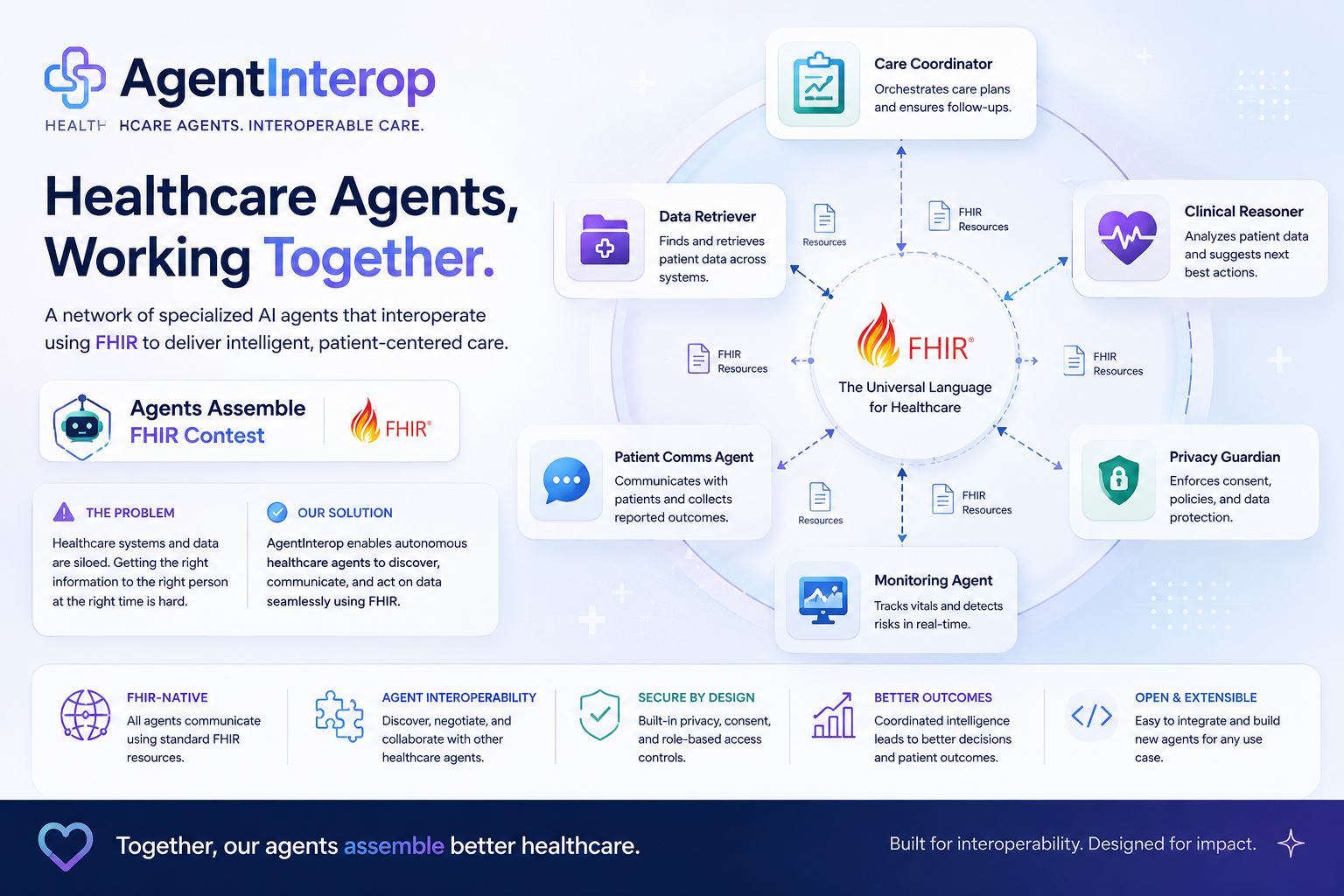
The project explores how healthcare agents can securely discover each other, exchange context, coordinate actions, and collaborate across fragmented healthcare ecosystems using open standards instead of proprietary silos.
The live prototype UI demonstrates a healthcare-native multi-agent environment designed around interoperability first. (Agents UI)
GitHub Repository: AgentInterOp GitHub Repository
Live Demo: AgentInterop UI Demo
The Why
AI agents are rapidly becoming capable of:
- reasoning over clinical information
- coordinating workflows
- summarizing records
- assisting with care management
- automating administrative operations
But healthcare systems remain fragmented.
FHIR standardized APIs, but healthcare still lacks a shared interoperability layer for autonomous systems.
Today:
- agents cannot safely collaborate across organizations
- context is isolated
- workflow orchestration is brittle
- trust and governance are inconsistent
- healthcare AI tooling is mostly disconnected point solutions
AgentInterop explores what happens when healthcare agents become interoperable by design.
The goal is not replacing clinicians.
The goal is reducing fragmentation and enabling intelligent coordination.
What AgentInterop Does
AgentInterop provides a framework where healthcare agents can:
- Discover capabilities dynamically
- Exchange structured requests
- Coordinate workflows
- Share healthcare context
- Route tasks intelligently
- Maintain provenance trails
- Enforce human approval checkpoints
- Operate against FHIR-native resources
The project introduces the concept of healthcare agents acting more like interoperable participants inside a shared ecosystem instead of isolated AI applications.
Example Healthcare Agents
The platform explores specialized agents such as:
Clinical Reasoner
Analyzes patient context and proposes evidence-based next actions.
Care Coordinator
Orchestrates follow-ups, transitions of care, and workflow handoffs.
Patient Communication Agent
Supports patient engagement and longitudinal communication.
Data Retrieval Agent
Aggregates patient information across FHIR endpoints.
Privacy Guardian
Applies consent enforcement, audit controls, and policy evaluation.
Monitoring Agent
Tracks longitudinal health events and detects changes over time.
Rather than building one monolithic AI system, AgentInterop explores distributed intelligence where agents collaborate through standardized healthcare interactions.
Core Architecture
AgentInterop is built around several major concepts:
FHIR-Native Communication
Agents communicate using healthcare-native data structures instead of generic JSON payloads.
This includes:
- Patient
- Observation
- Encounter
- CarePlan
- Condition
- MedicationRequest
- Task
- Provenance
- Communication
resources as shared context layers.
Agent Discovery + Routing
The system explores dynamic discovery of agent capabilities so workflows can route requests to the most appropriate healthcare agent.
Examples:
- care gap analysis
- summarization
- patient outreach
- utilization review
- quality measurement support
- longitudinal risk analysis
Human-in-the-Loop Safety
Healthcare AI cannot operate safely without oversight.
The platform incorporates:
- approval checkpoints
- audit logging
- provenance tracking
- explainable interactions
- permission-aware orchestration
- step-up authorization patterns
This concept was heavily influenced by the broader HealthClaw guardrail framework.
MCP + Interoperability
The project experiments heavily with MCP (Model Context Protocol) concepts for structured tool interoperability between healthcare agents and systems.
The broader AI ecosystem is rapidly moving toward open agent tooling standards and interoperable agent architectures. (Vercel)
AgentInterop applies those ideas specifically to healthcare.
Technical Stack
The project combines:
- Next.js
- React
- TypeScript
- Tailwind CSS
- Vercel deployment workflows
- MCP patterns
- FHIR APIs
- Agent orchestration concepts
- Healthcare authorization models
- Provenance-aware workflows
The architecture is intentionally modular and extensible to allow experimentation with evolving healthcare AI standards.
Inspiration
This project came from years of working in:
- healthcare interoperability
- FHIR analytics
- payer/provider exchange
- quality measurement
- healthcare data quality
- AI-assisted healthcare tooling
A recurring pattern became impossible to ignore:
Healthcare organizations still spend enormous effort moving information between disconnected systems while patients and clinicians deal with fragmented experiences.
At the same time, AI systems are becoming increasingly capable of coordinating complex workflows.
The missing layer is interoperability between intelligent systems.
FHIR standardized healthcare data.
AgentInterop explores standardizing healthcare agent collaboration.
Challenges
Some of the hardest challenges included:
- balancing autonomy with clinical safety
- handling inconsistent FHIR implementations
- creating explainable agent behavior
- designing interoperable workflows
- preserving healthcare privacy constraints
- modeling trust between agents
- maintaining human oversight
- preventing unsafe autonomous actions
Healthcare is one of the most difficult environments for agent systems because:
- trust matters
- provenance matters
- auditability matters
- explainability matters
- humans must remain in control
What I Learned
This project reinforced several major lessons:
- FHIR APIs alone are not enough.
- Healthcare needs interoperable intelligence layers.
- Agent ecosystems require governance and trust.
- Human oversight must remain central.
- Open healthcare ecosystems will likely outperform closed AI silos long term.
Most importantly:
Healthcare does not just need smarter AI.
It needs infrastructure that allows humans, systems, and intelligent agents to safely work together.


Log in or sign up for Devpost to join the conversation.