Agentic Chaos
What happens in a world where AI agents run companies, and their employees gossip, burn out and quit?
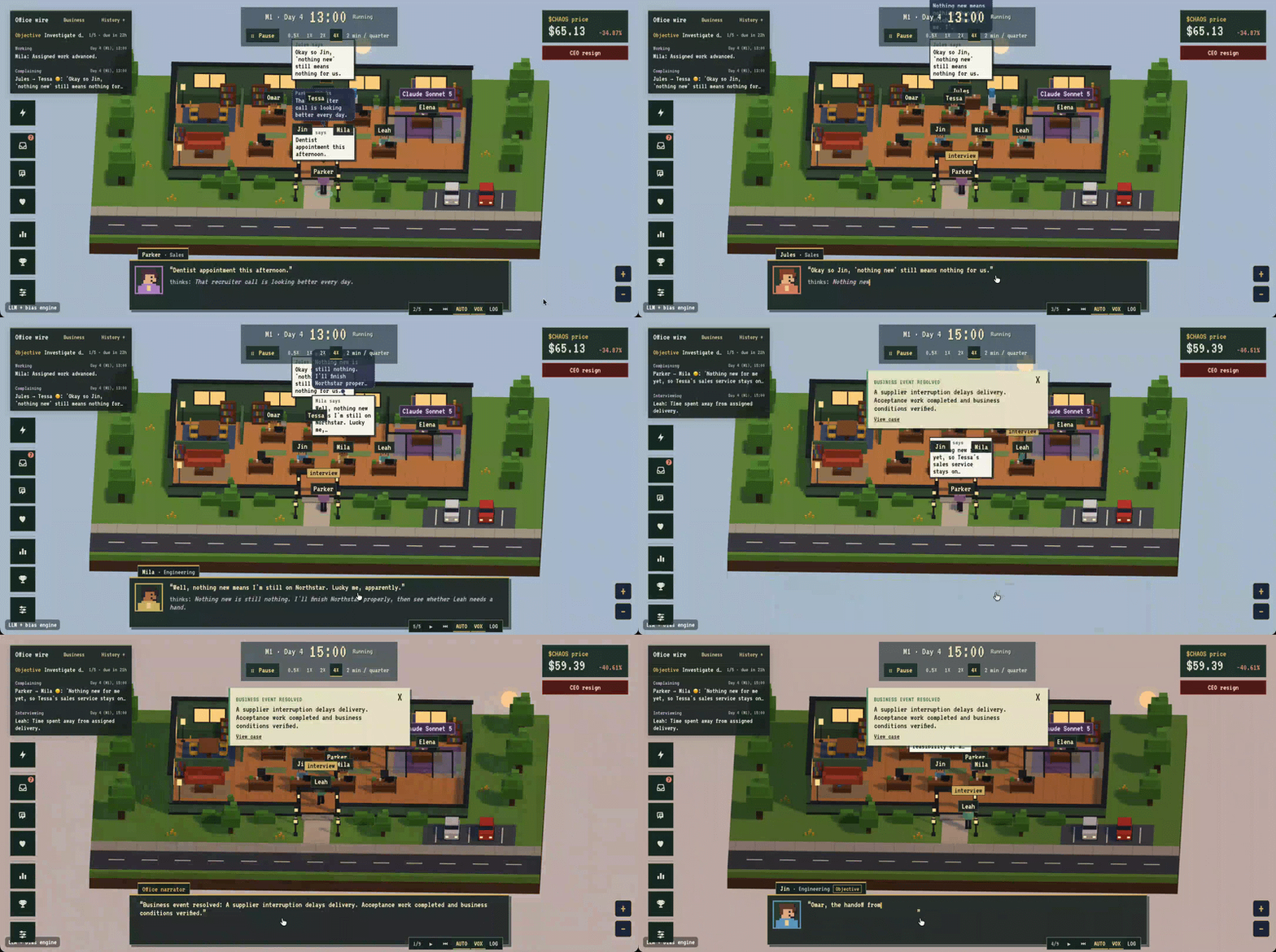
We built Agentic Chaos to step inside that world. You can start a rumour, watch the office react, and put different AI models in the CEO’s chair to explore how their decisions change the company’s share price.
Inspiration
People at work rarely have the full picture. Some hear an announcement directly, others hear it from a colleague, and some miss it altogether. Their reactions depend on what they know, who they trust and how they are feeling.
We built Agentic Chaos to explore how those differences affect a team. We wanted to see how a rumour could distract someone, delay a task or push an already stressed employee to leave.
What it does
Agentic Chaos is a 3D office with eight AI agents: a CEO, an operations manager and six employees. Each has a personality, along with changing levels of stress, burnout, loyalty and trust.
You can:
- Add news. Announce a bonus, change working hours, introduce a layoffs rumour or write your own headline. Employees decide what to believe based on what they hear and who tells them.
- Watch employees respond. They can work, help colleagues, gossip, check a claim, look for another job or resign. Their personality and stress affect what they choose.
- Set a business goal. The company breaks it into tasks. The CEO makes decisions, Ops assigns work, and employees share findings so others can continue.
- See what is happening. Follow an employee, read their dialogue and generated private thoughts, or check the inbox for task owners and reasons work has stopped.
- Check the results. View employee wellbeing, rumour spread, work output, cash, revenue, staff retention and a simulated share price. Saved reports summarise the run.
Employees move around the office, talk to colleagues, react to events and leave at the end of the day. If someone resigns, you can watch them walk out.
How we built it
Agent decisions
Claude suggests actions, and the simulation checks and applies them.
For each employee turn, Claude generates dialogue, beliefs and up to three possible actions. The engine removes actions the employee cannot take, adjusts the chances based on personality and stress, then selects one using seeded randomness.
An exhausted employee may be more likely to disengage. An ambitious employee may overwork. Trust affects whether someone checks a rumour or passes it on. Angry or frustrated reactions also need a cause in the simulation.
The CEO and Ops have their own rules. Their decisions must fit the available budget, skills and staff capacity.
Tech stack
- Frontend: React, TypeScript and Vite.
- 3D office: Higgsfield and Three.js.
- Backend: Node.js and Fastify, with shared TypeScript types.
- AI: Claude through the Anthropic SDK, OpenAI Codex with Zod to validate responses.
- Live updates: Server-Sent Events, with playback timing that keeps dialogue, movement and charts in sync.
- Audio: animalese-tts and Web Audio for character voices.
Tracking results
We use the simulated stock price as our primary measure of CEO performance. The engine calculates the price from work output, company performance, public news, and seeded noise.
The engine logs decisions and outcomes so we can review what happened alongside changes in the stock price. Those records persist across restarts and supply the figures in our reports. The inbox shows assignments and flags blockers.
Challenges we ran into
- Getting personality to affect actions. An agent could say it was exhausted and still work normally. We had to make stress affect the probability of each action.
- Tracking who knows what. The engine knows whether a claim is true, but employees should only act on information they have received.
- Keeping dialogue honest. An employee saying a task is finished cannot count as completing it. Progress and handoffs have to be checked against the task state.
- Keeping playback readable. The server could run faster than someone could read the dialogue. We added shared timing so the office and charts show the same moment.
- Handling failed AI calls. Invalid replies, timeouts and resets during a request all needed a way to recover.
Accomplishments that we're proud of
- Getting news, beliefs, employee decisions and task progress to affect one another in a working simulation.
- Building a CEO and Ops workflow alongside employee collaboration and user-defined goals.
- Showing what agents are doing through the office, employee views and inbox.
- Basing reports and metrics on recorded results.
- Writing around 300 automated checks across the engine, API, business logic, prompts and client models.
What we learned
We learned that personality prompts alone were not enough because agents needed rules that made stress, trust and ambition affect their choices.
We also learned to record the reasons behind decisions as they happened. That made it much easier to explain why someone stopped working, missed a deadline or resigned.
Playback mattered more than we expected because if a chart changed before the relevant conversation appeared, it was hard to follow what was going on.
What's next for Agentic Chaos
- Compare scenarios. Run the same office with different announcements, management policies and model settings.
- Make causes easier to follow. Show how a piece of news affected an employee's decision and the team's work.
- Improve the inbox. Add AI-written explanations based on recorded events, building on the current template-based messages.
- Test different CEO models. Use our existing “Best Boss” runner to compare models while keeping employee and Ops policies fixed. We still need to publish measured results; the current leaderboard uses labelled fictional examples.
We want to keep developing Agentic Chaos as a way to experiment with team communication and agent behaviour, and as a game where you can see what happens when you put an office under pressure.
This is an experimental simulation. It has not been calibrated to predict real employee behaviour or market returns.
Built With
- anthopicsdk
- drei
- fastify
- react
- recharts
- sse
- three.js
- typescript
- vite
- zod

