-
-
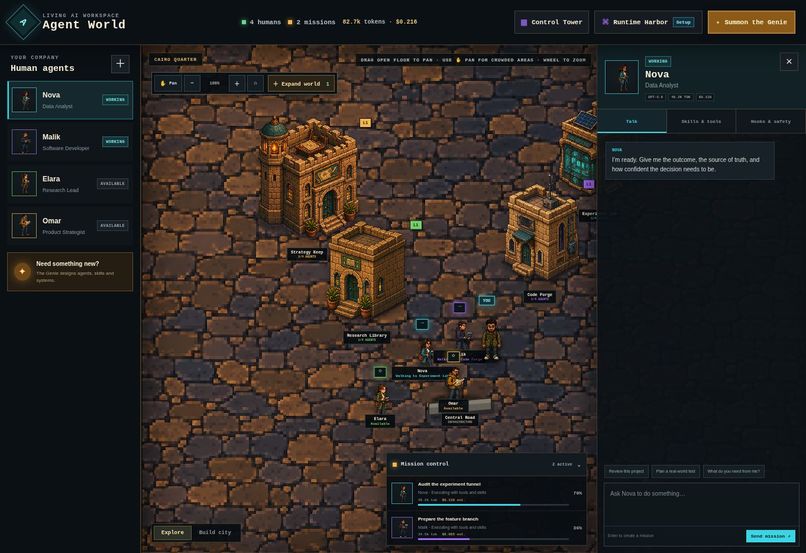
agent-world-first-view
Inspiration
AI agents usually live inside chat windows, logs, and hidden automations. That makes it difficult to understand who is working, what they are allowed to do, where they are working, and how much each task costs.
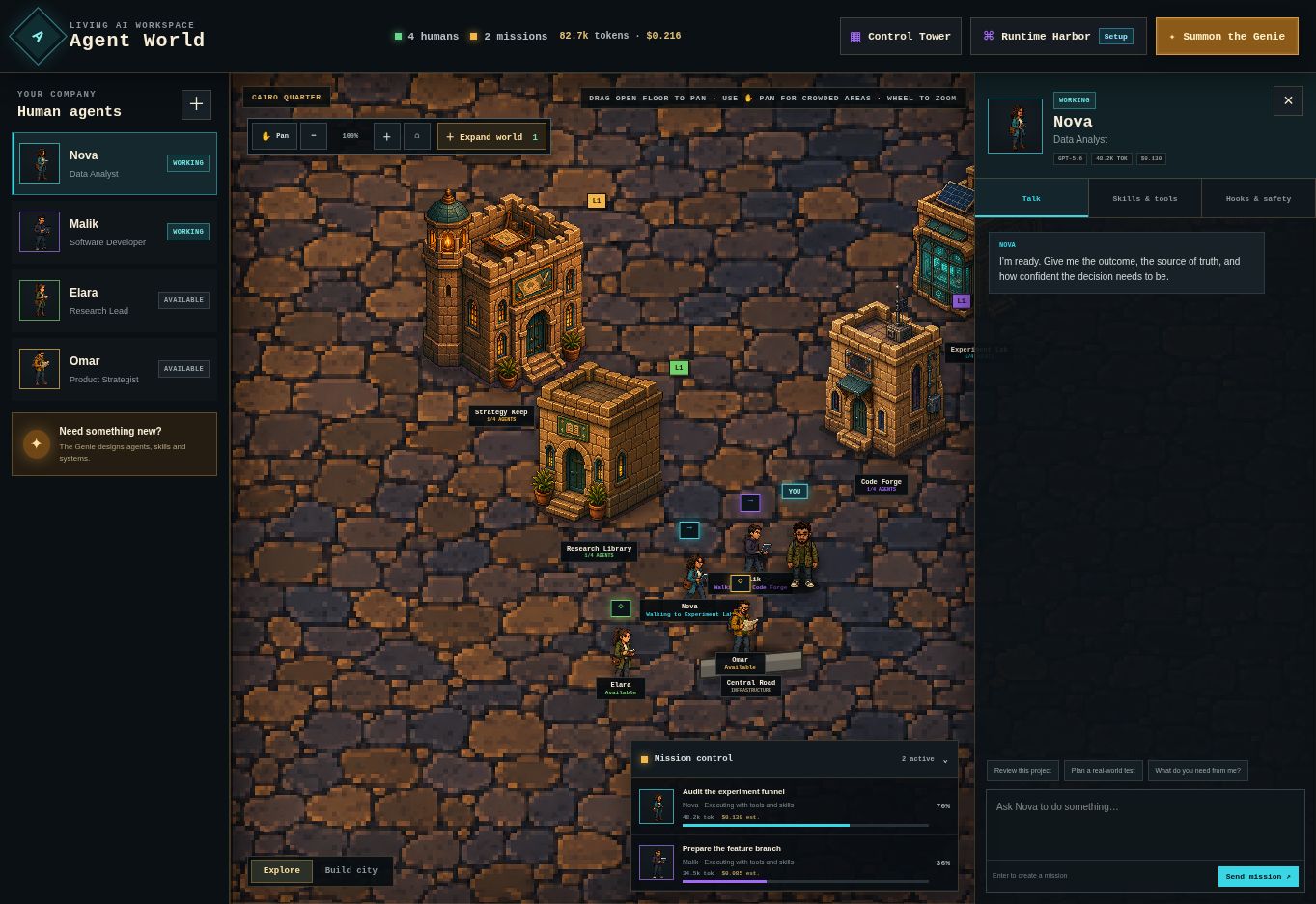
I wanted to make AI work visible and understandable through a pixel-art world. Agentic World turns a company into a living city where human-like agents have workplaces, skills, tools, permissions, missions, and measurable results.
What it does
Agentic World allows users to build and expand a pixel-based company world.
Users can:
Create human-like AI agents with specific roles and personalities Give agents skills, tools, lifecycle hooks, permissions, and budgets Build, move, rotate, duplicate, upgrade, and expand workplaces Use the Genie to create agents, skills, connectors, guardrails, missions, and buildings Upload reusable SKILL.md playbooks Assign missions and watch agents walk to the appropriate workplace Connect real GPT-5.6 missions through the OpenAI Responses API Connect repository work through Claude Code and Amazon Bedrock Track mission results, evidence, token usage, and estimated or reported costs
Simulation mode lets people explore the product without an API key. Real external actions require the appropriate connector, permission, approval, and execution boundary.
How we built it
Agentic World was built with React, TypeScript, Next-compatible Vinext tooling, and a custom pixel-world interface.
The frontend manages the city, buildings, agents, missions, Genie flows, skills, permissions, and local persistence. The OpenAI runtime uses a server-side Responses API route so API credentials never enter browser storage.
GPT-5.6 is used for real agent reasoning, skills, authorized web research, and measured mission usage. Codex supported the development process by helping design the product architecture, iterate on the visual system, implement interactions, build safety boundaries, debug issues, and create verification tests.
For repository work, we built an optional local Claude Code bridge with workspace allowlists, origin checks, bearer-token authentication, budget limits, turn limits, permission modes, and Anthropic or Amazon Bedrock routing.
Challenges we ran into
The biggest challenge was combining the feeling of a strategy game with the requirements of a real agent platform.
The city needed to feel visually coherent while supporting zooming, panning, expansion, building placement, rotation, movement, and human-like character navigation. At the same time, real AI execution required careful handling of credentials, permissions, connectors, evidence, costs, and external side effects.
Another challenge was separating simulation from real execution. A character walking through a city should not falsely imply that Jira, GitHub, or a repository was changed. We therefore made simulation visibly labeled and required real connectors and permissions before claiming that an external action occurred.
Accomplishments that we're proud of We created a complete pixel-city interface instead of another chat-only agent dashboard. Buildings are functional, movable workspaces rather than decorative cards. Agents visibly walk through the city toward their assigned workplace. The Genie can create people and system components through guided clarification. Agents support reusable Markdown skills, tools, hooks, permissions, and budgets. GPT-5.6 missions can return results, citations, and measured token usage. Claude Code and Amazon Bedrock can operate through a protected local bridge. The Control Tower makes usage, cost, status, and evidence visible. The project includes a no-key simulation mode so judges can test it immediately. The project has reproducible setup instructions, automated tests, a public repository, and an MIT license. What we learned
We learned that spatial interfaces can make complex agent systems easier to understand, but only if the visual world reflects the real system state.
A building should represent an actual capability. An agent should have visible authority. A mission should have an outcome and evidence. A cost should be measurable. A simulation should never pretend to be a completed external action.
We also learned that safety becomes more useful when it is visible and configurable instead of hidden inside implementation details.
What's next for Agentic World
The next step is to connect Agentic World to more real workplace systems, including Jira, GitHub, Slack, email, calendars, CRM platforms, and internal company tools.
We also want to add:
Shared accounts and persistent company worlds Multiplayer collaboration Richer building interiors Agent-to-agent delegation Replayable mission timelines Real OAuth-based connectors Marketplace support for verified skills, buildings, and workflows Analytics for team productivity, cost, reliability, and agent performance
The long-term vision is to create a pixel twin of a real organization: understandable like a strategy game, but connected to accountable real-world work.
Built With
- chatgpt

Log in or sign up for Devpost to join the conversation.