-
-
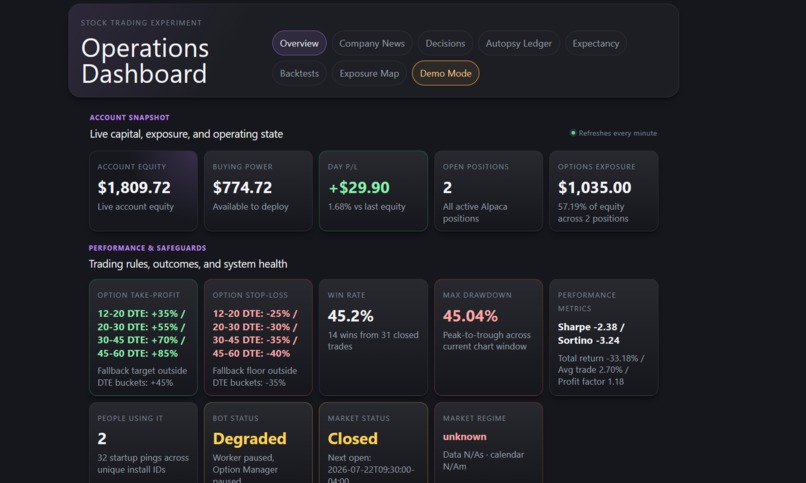
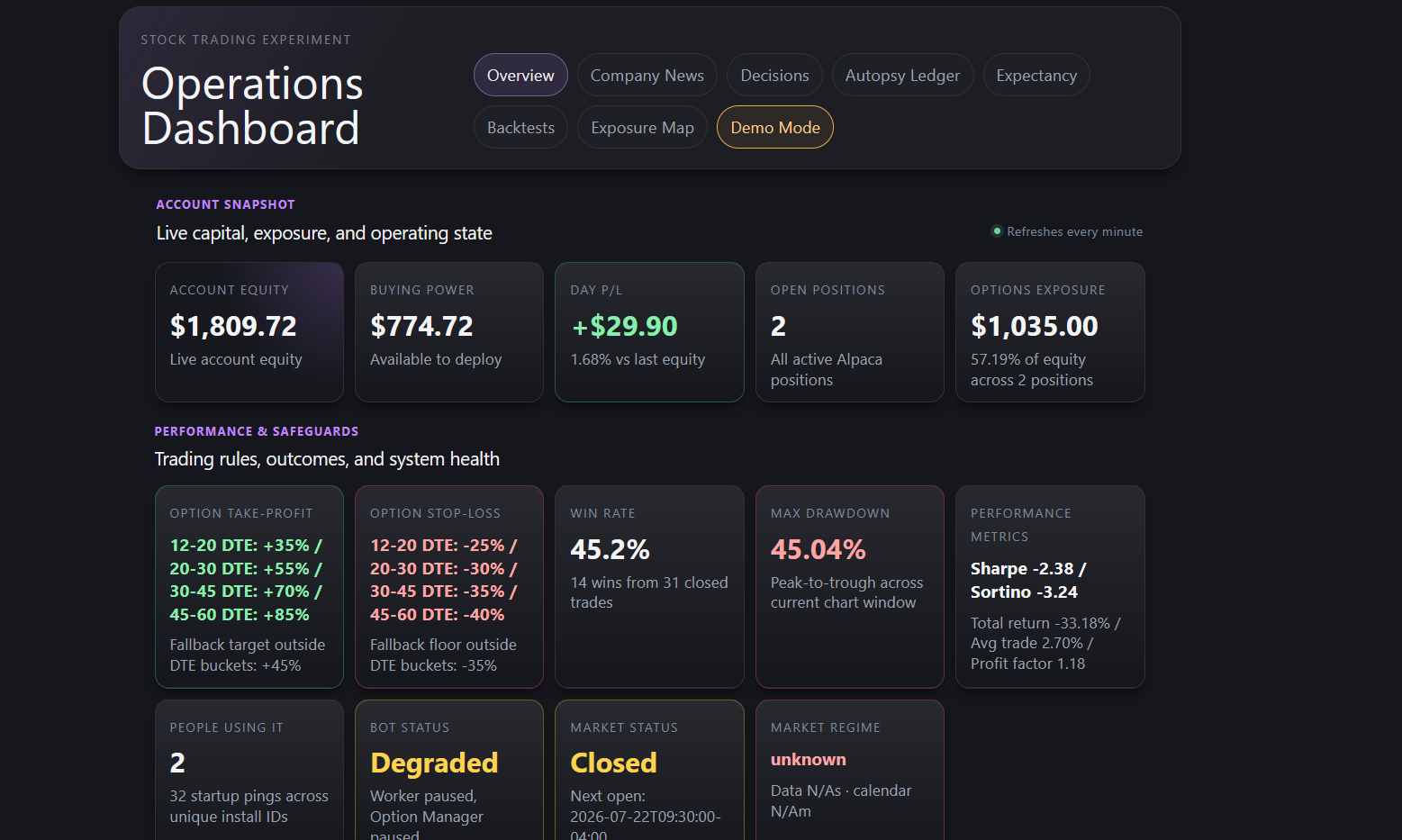
Overview Dashboard
Inspiration
Retail investors can access more market data than ever, but it is still difficult for the regular person to make a decision, get all evidence evidence for a trade, and actually learn why that decision was wrong. I wanted to build a system that connects market news, research, risk controls, and trade outcomes into one transparent workflow instead of treating trading as a black box, difficult for regular people to understand.
What it does
Agentic-Trading Manager is an evidence-first options-trading platform. It collects and analyzes market news, identifies sector, industry, and company relationships, and uses agent-driven research to form trading theses.
The dashboard makes each decision reviewable. Its Exposure Map connects a news article to affected sectors, companies, and current option positions, while the Decision Autopsy Ledger records the evidence, constraints, recommendation, execution outcome, and post-trade review.
The platform can place configured Alpaca option orders, but it applies deterministic controls before entry: evidence-confirmed trend continuation, market-regime gating, option-liquidity checks, portfolio exposure limits, sector concentration limits, and daily-loss limits. It also includes historical option-quote backtesting so strategies can be evaluated against stored bid/ask data instead of assumed fills.
How we built it
We built Agentic Trading with Python, Flask, SQLite, React, TypeScript, Docker, Alpaca, and a market-news collection pipeline.
Agentic Trading supports multiple model providers, including OpenAI, Vertex AI, and Ollama. The Exposure Map uses a provider abstraction: when configured with LLM_PROVIDER=openai, it defaults to GPT-5.6 Terra; otherwise, it uses the selected provider’s configured model.
Regardless of the model provider, Python validates referenced identifiers and calculates risk deterministically. This keeps model-generated analysis grounded in the supplied evidence and prevents the model from independently controlling trade execution or risk limits.
Codex helped us build and refine the Flask APIs, SQLite persistence, OpenAI provider configuration, React dashboard, Exposure Map, demo mode, backtesting workflow, automated tests, and audit controls.
Challenges we ran into
The hardest problem was making an agentic trading workflow explainable and testable. Market data can be incomplete, news can be weak or stale, and historical options data cannot be treated as a guaranteed trade fill.
We addressed this by failing closed when required evidence or market data is missing, preserving immutable decision snapshots, recording no-fill and coverage-gap outcomes, and separating AI-generated explanations from deterministic trade and risk controls.
Accomplishments that we're proud of
We are proud that Agentic Trading is more than a signal generator. It provides an evidence trail from news to market thesis, position risk, decision, execution, and outcome.
During Build Week, we added the Evidence Exposure Map, Decision Autopsy Ledger, Decision Expectancy dashboard, historical bid/ask backtesting, portfolio-level risk controls, an evidence-confirmed continuation gate, and a deterministic market-regime gate. We also created a seeded Demo Mode so the complete workflow can be reviewed reliably without live market data.
What we learned
We learned that risk management and observability are just as important as generating a trading idea. A model can help explain relationships in complex data, but it should not be the sole source of truth for execution or risk.
We also learned that evaluating trading decisions requires honest historical data, explicit assumptions, and clear records of what the system knew at the time of a decision.
What's next for Agentic Trading
Next, we want to improve historical data coverage, expand portfolio-level risk controls, add more strategy evaluation tools, and continue improving the system's ability to explain uncertainty before a trade is placed.


Log in or sign up for Devpost to join the conversation.