The Agentic Textbook
The textbook that builds itself around you.
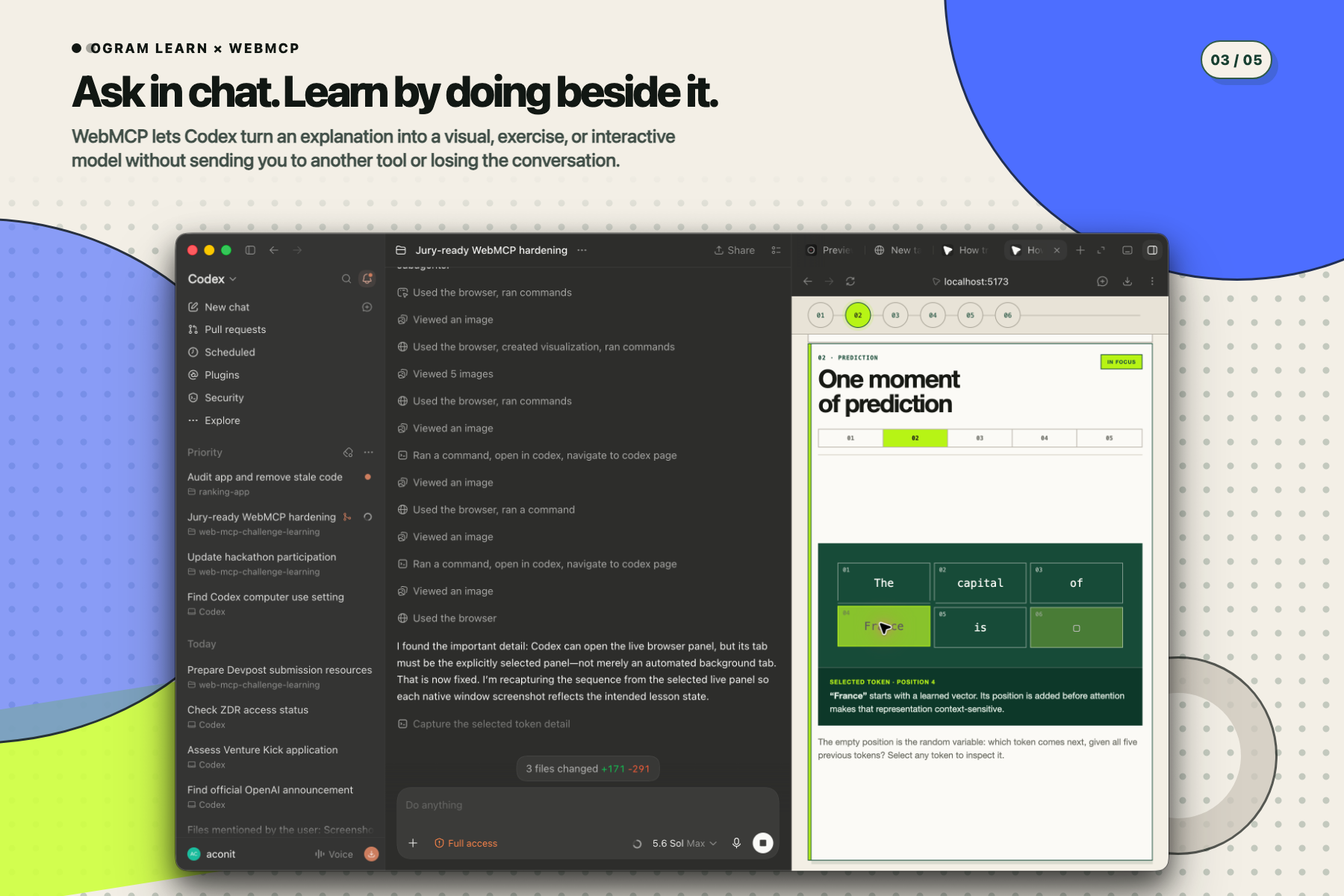
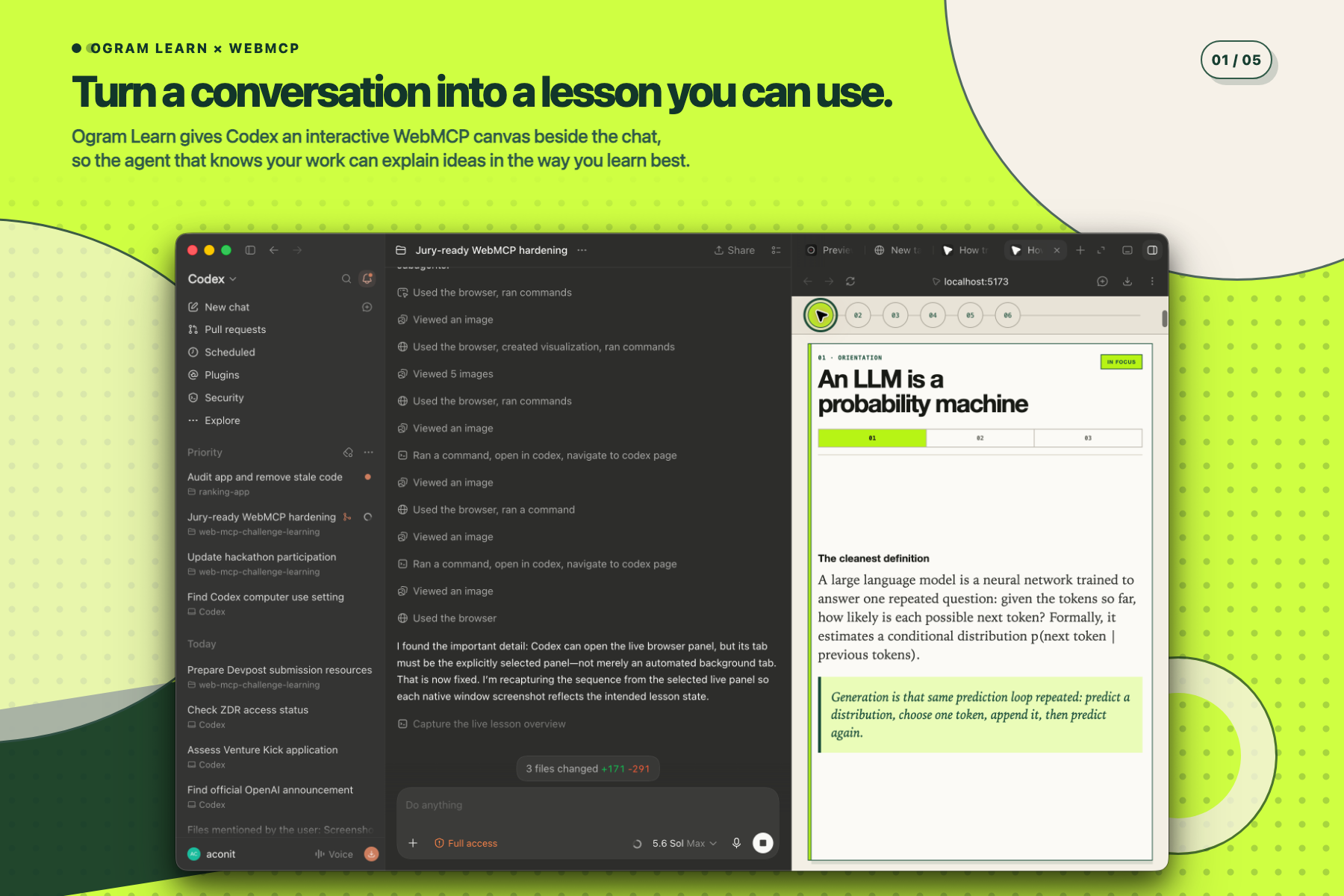
Learn any concept, with the help of the agent that already knows you Agentic Textbook turns the AI agent you already use into a live teaching partner, creating the exact explanations, visuals, exercises, and learning paths you need inside a shared WebMCP canvas.
Inspiration
Most training around tech products/concepts are outdated before they even goe live. We see this constantly while onboarding customers onto frontier AI tools—especially Codex. New capabilities appear almost every day, while users still need a simple place to understand what changed, why it matters, and how to use it well.
We needed a learning surface that could keep up. Not another static academy, but a place where every learner could generate the exact training they need, the moment they need it.
What it does
Agentic Textbook makes the textbook as dynamic as the technology it teaches. It also explores a bigger question: what should learning become when every learner has an AI agent?
The system has two deliberately separate parts:
The agent brings intelligence and context. It understands the learner’s goals, prior knowledge, interests, and current questions, and can generate explanations, diagrams, examples, code, or exercises on demand. The Agentic Textbook leverages coding agents capabilities to create new and exciting content.
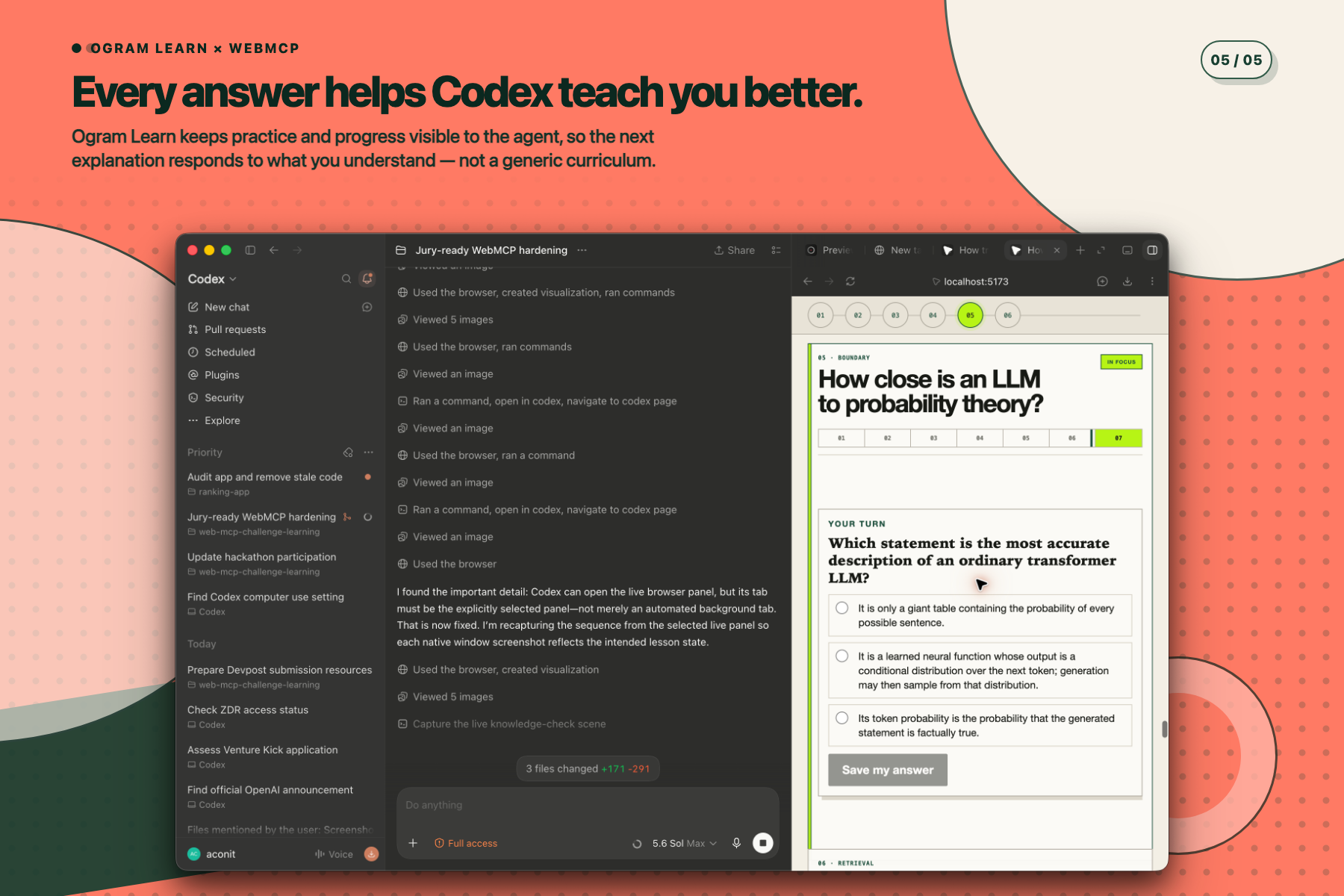
The textbook brings pedagogy and structure. It provides an open, editable canvas with lesson sequencing, remediation paths, learning-science-informed components, and clear learner controls. Think of it as the pedagogical authority, based on learning sciences, that harnesses the agent's infinite potential.
This creates a BYOA model: Bring Your Own Agent. Learners keep the agent they already trust, while WebMCP turns the browser into a shared workspace where human and agent can build the lesson together. And adapt it on-demand to the learner's needs.
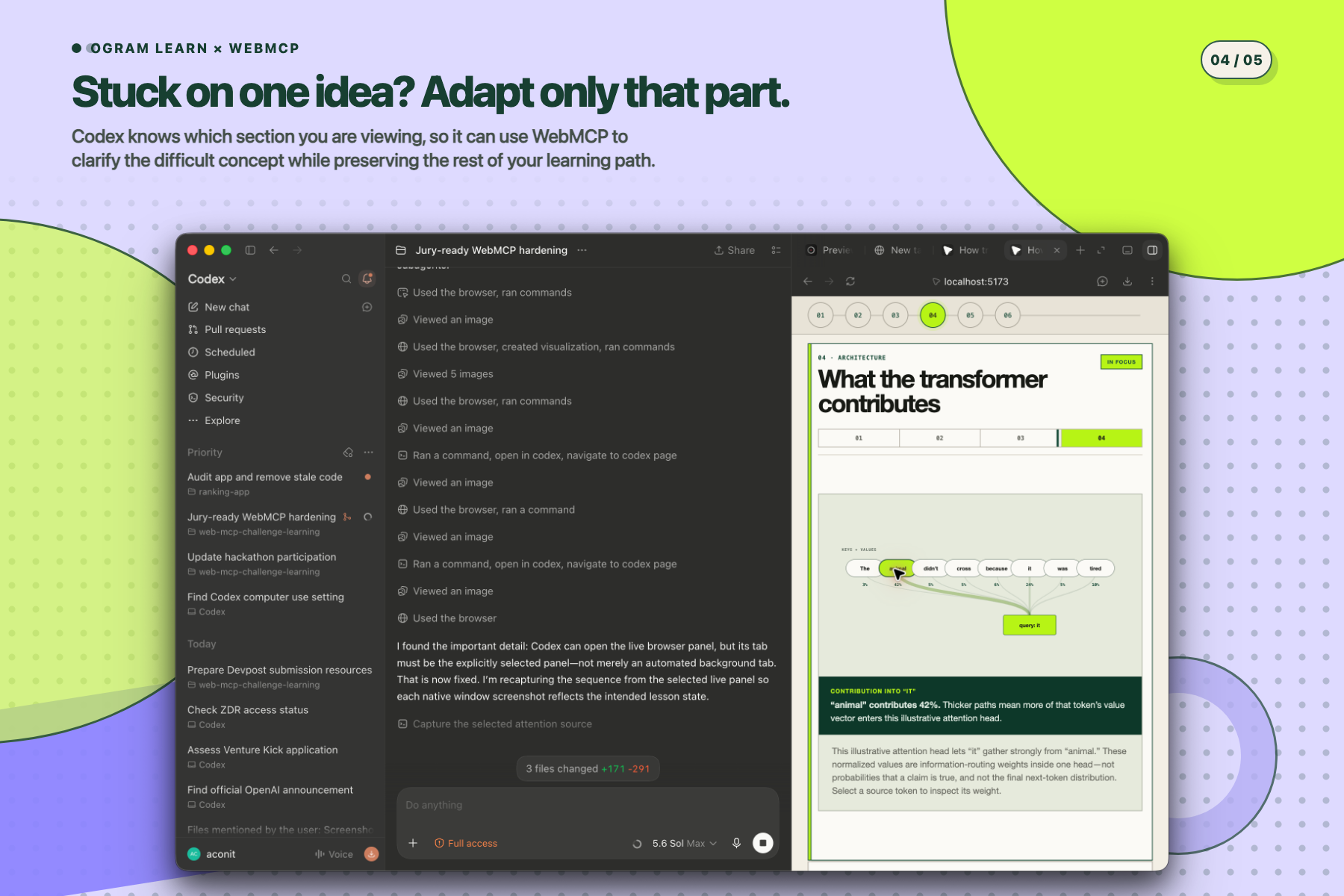
Ask for another explanation. Add a formula. Generate a diagram. Create a code exercise. Slow down, go deeper, or approach the concept from another angle. The agent can update one focused part of the textbook without rebuilding the entire experience.
How we built it
We wanted to understand what WebMCP makes possible at its core. The key primitive is surprisingly powerful: the browser becomes a shared place where humans and agents can read, act, and create together. We wanted to apply this concept to something that was both important for us in our day-to-day, and could also change the broader picture of web based learning experiences.
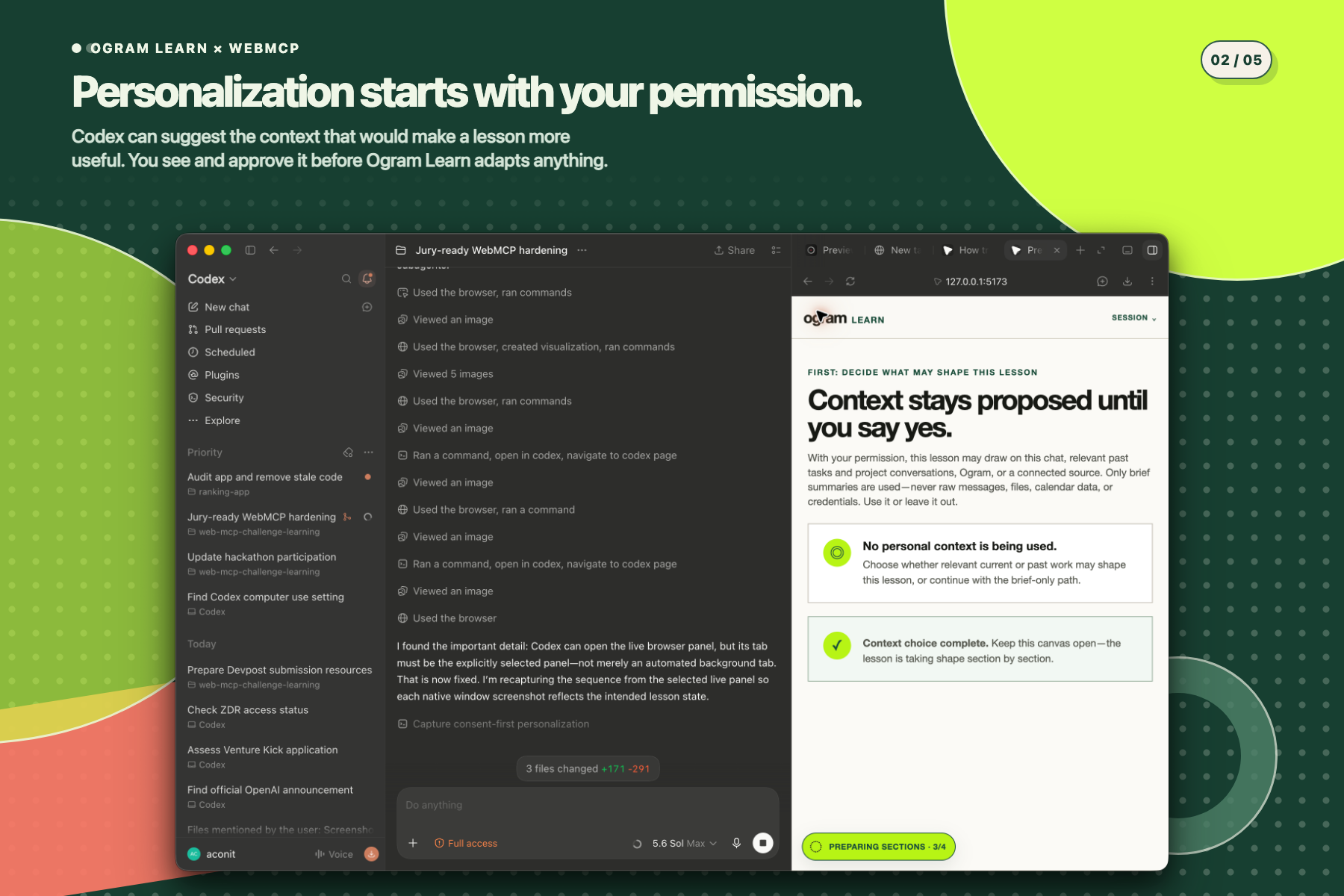
That insight shaped the entire product. The learner prepares a brief and reviews the context being used. The agent authors a structured lesson. The app validates and renders it. From there, the learner and agent can keep refining individual regions of the canvas together.
Once the interaction model clicked, Codex helped us turn it into a working product through tight iteration. Under the hood, topic-neutral lesson schemas can combine prose, formulas, diagrams, governed media, exercises, and executable code labs, without hard-coding a course for each new subject.
Challenges we ran into
The hardest part wasn’t implementation. It was making the idea legible to a coding agent.
First, we had to understand what WebMCP really changes compared with standard MCP, and how it relates to inline MCP apps inside products such as ChatGPT.
Then we had to steer Codex away from familiar patterns. Coding agents are excellent inside known territory. Asking them to help invent a genuinely new interaction model is much harder. We had to make the underlying idea extremely precise before the implementation became coherent. If you let a coding agent loose on an innovative concept, it tends to bring it back to known patterns, which destroy the originality of the idea.
Personalization introduced another tension: context is valuable, but privacy is non-negotiable. Codex was rightly cautious about exposing sensitive information. We designed a consent-scoped, local-first context lane where learners review minimized signals before they enter a lesson.
That became our biggest lesson: implementation is getting easier; steering agents toward reliable novelty is not.
The main bottleneck today is speed. At Cerebras-class inference speeds, the delay between asking for a change and watching the textbook transform could almost disappear. That’s when the experience becomes magical.
Accomplishments that we’re proud of
A small set of primitives created a surprisingly large design space. We’re proud that the product feels simple despite what is happening underneath: structured lesson generation, contextual adaptation, interactive exercises, targeted revisions, and learner-controlled publishing.
We’re especially proud of the UI and interaction model. The agent can do powerful work, but the learner always has a clear, understandable surface in front of them.
Our favorite technical detail is the JSON Render integration. Codex can author structured components while the textbook progressively renders them on the canvas. Pushed further, this could become one of the product’s defining capabilities.
What we learned
WebMCP isn’t simply MCP inside a browser. It’s a new interaction model.
The browser is no longer just the destination where an agent’s output appears. It becomes a shared, live workspace where humans and agents can think, create, inspect, and revise together.
We also learned how powerful a clear division of labor can be: the agent brings context and generative ability; the application brings pedagogical constraints, trust boundaries, and learner control.
What’s next for Agentic Textbook
AI education now has a shelf life measured in days. On September 2, while finishing this project, we discovered OpenAI’s new ChatGPT Training hub, with practical learning paths for ChatGPT Work and Codex. The timing felt almost comically perfect.
For teams like ours, keeping clients current with products such as Codex is already a daily challenge. We need a way to create tailor-made training capsules as quickly as the product itself evolves.
Next, we’re pushing in two directions. For businesses, we want organizations to bring their own curricula, terminology, policies, and role-specific knowledge into the same consent-scoped learning experience. For learners, we want to make the agent-to-canvas loop dramatically faster.
The long-term goal is simple: learning experiences that move as fast as the technology they teach.
Built With
- cloudflare-containers
- cloudflare-d1
- cloudflare-durable-objects
- cloudflare-r2
- cloudflare-workers
- docker
- javascript
- node.js
- openai-codex
- python
- react
- sqlite
- typescript
- vite
- webmcp


Log in or sign up for Devpost to join the conversation.