-
-
DevOps Pipeline Automated
Inspiration
The inspiration for Agentic SDLC came from recognizing that traditional software development is slow and expensive. We wanted to bridge the gap between having a great software idea and actually building it.
Key inspirations:
- Democratizing software development - Making professional-grade development accessible to everyone
- AI revolution in coding - Leveraging the power of large language models to automate complex processes
- Educational gap - Many developers and students struggle to understand the complete SDLC process
- Time-to-market pressure - Businesses need to validate ideas quickly without months of development
What it does
Agentic SDLC is an AI-powered Software Development Life Cycle simulator that transforms natural language requirements into complete software projects.
Core capabilities:
- Requirements Processing: Converts user ideas into structured requirements and user stories
- Design Generation: Automatically creates system architecture, database schemas, and API specifications
- Code Generation: Produces production-ready code with best practices and security considerations
- Testing Automation: Generates comprehensive test cases, security reviews, and QA processes
- Documentation: Creates professional project documentation, deployment guides, and maintenance plans
- Export System: Provides downloadable artifacts including source code, documentation, and complete project packages
Example workflow:
- User inputs: "I want a login system with SSO via Google"
- System generates: User stories, design docs, Python code, test cases, security reviews
- User receives: Complete project package ready for deployment
How we built it
Technology Stack:
- Frontend: Streamlit for the web interface
- AI Engine: LangChain + LangGraph for workflow orchestration
- LLM Integration: Groq, Google Gemini, and OpenAI APIs
- Workflow Management: LangGraph for complex process orchestration
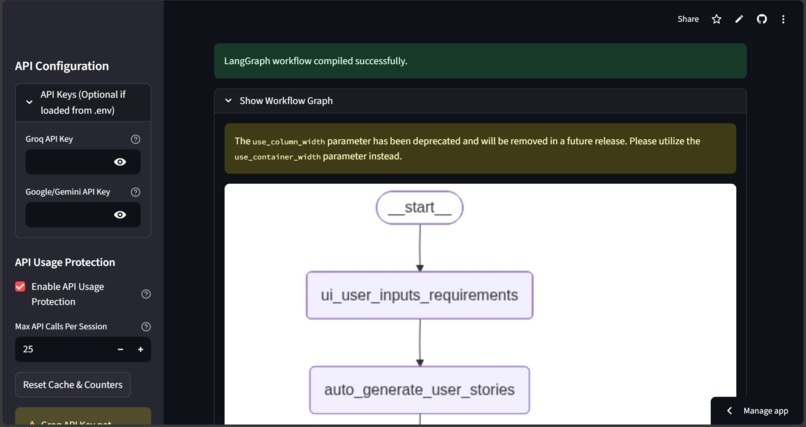
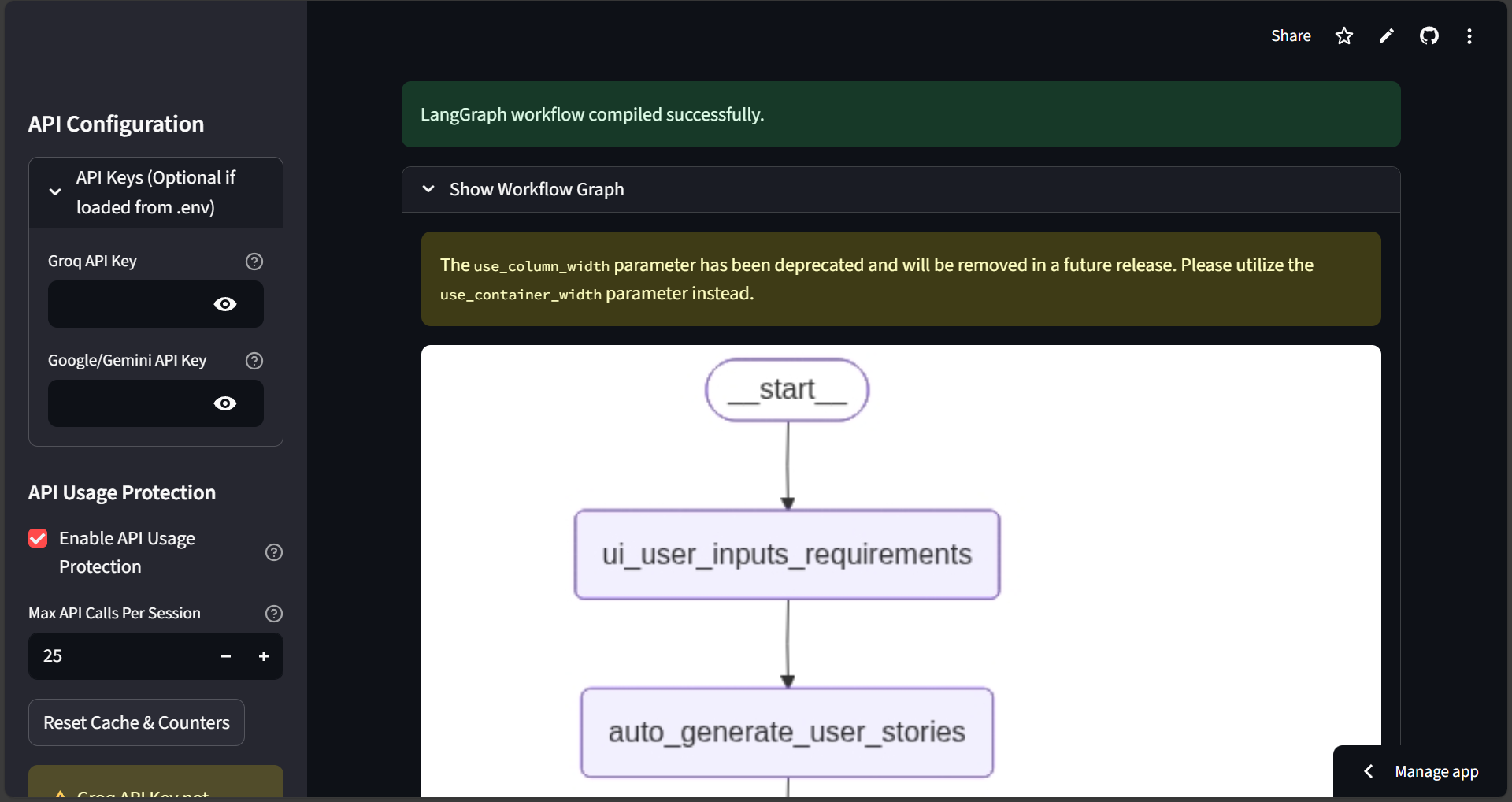
- Visualization: NetworkX + Matplotlib for workflow graphs
- Data Processing: Pandas for state management
Architecture - Key Components:
- Workflow Engine: Orchestrates the entire SDLC simulation
- LLM Manager: Handles multiple AI provider integrations
- State Management: Tracks progress through development phases
- Visualization: Shows real-time workflow progress
- Export System: Generates downloadable project packages
Challenges we ran into
Technical Challenges:
- Pydantic Compatibility: Major issues with LangChain packages and Pydantic v2 compatibility
- Dependency Management: Complex dependency conflicts between different LangChain versions
- Workflow Orchestration: Designing a robust workflow that handles all SDLC phases
- State Management: Maintaining consistent state across complex workflow transitions
- Error Handling: Graceful failure handling in AI-powered processes
AI Integration Challenges:
- API Rate Limits: Managing multiple LLM providers with different rate limits
- Response Consistency: Ensuring AI outputs follow consistent formats
- Quality Control: Maintaining code quality and best practices in generated output
- Context Management: Preserving context across multiple workflow steps
User Experience Challenges:
- Progress Visualization: Making complex workflows understandable to users
- Download Management: Creating intuitive file export systems
- Error Communication: Clearly explaining what went wrong and how to fix it
Accomplishments that we're proud of
Technical Achievements:
- Complete SDLC Simulation: Successfully automated the entire software development process
- Multi-LLM Support: Integrated three major AI providers with seamless switching
- Workflow Orchestration: Built a robust LangGraph-based workflow system
- Real-time Progress Tracking: Created intuitive visual progress indicators
- Comprehensive Export System: Built a complete file generation and download system
User Experience Achievements:
- Intuitive Interface: Created a Streamlit app that makes complex AI workflows accessible
- Professional Output: Generated artifacts that meet industry standards
- Educational Value: Built a tool that teaches users about professional development processes
- Time Savings: Reduced project development time from months to minutes
Innovation Achievements:
- AI-First Development: Pioneered AI-powered software development simulation
- Process Automation: Automated complex development workflows that traditionally require human expertise
- Accessibility: Made professional software development accessible to non-developers
What we learned
Technical Insights:
- AI Integration Complexity: Managing multiple LLM providers requires careful abstraction and error handling
- Workflow Design: LangGraph workflows need careful state management and error recovery
- Dependency Management: Modern Python packaging requires careful version compatibility planning
- Streamlit Limitations: While great for prototyping, Streamlit has limitations for complex applications
AI Development Insights:
- Prompt Engineering: The quality of AI outputs heavily depends on well-designed prompts
- Context Preservation: Maintaining context across multiple AI interactions is crucial
- Quality Assurance: AI-generated code needs careful validation and review processes
- User Feedback Loops: Continuous improvement requires user feedback on AI outputs
Process Insights:
- SDLC Complexity: Even with AI, software development involves many interconnected steps
- Documentation Importance: Good documentation is crucial for AI systems to work effectively
- User Experience: Complex AI systems need intuitive interfaces to be truly useful
- Iterative Development: AI-powered tools benefit from continuous refinement based on usage patterns
What's next for Agentic SDLC
Short-term Goals (3-6 months):
- Enhanced Code Quality: Implement better code review and validation systems
- More Languages: Support for JavaScript, Java, C#, and other popular languages
- Template Library: Pre-built templates for common application types
- User Authentication: Multi-user support with project history
- API Access: REST API for integration with other development tools
Medium-term Goals (6-12 months):
- Cloud Deployment: Hosted version with cloud-based processing
- Team Collaboration: Multi-user project collaboration features
- CI/CD Integration: Direct integration with GitHub, GitLab, and CI/CD pipelines
- Advanced AI Models: Integration with more specialized AI models for specific domains
- Mobile Support: Mobile-optimized interface for on-the-go development
Long-term Vision (1+ years):
- Enterprise Features: Role-based access control, audit trails, and compliance features
- Domain Specialization: Industry-specific SDLC workflows (healthcare, finance, etc.)
- AI Training: Custom AI models trained on specific development patterns
- Marketplace: Community-contributed templates and workflows
- Global Scale: Multi-language support and international deployment
Research Directions:
- Code Generation Quality: Research into improving AI-generated code quality
- Workflow Optimization: AI-powered workflow optimization and customization
- Security Integration: Advanced security analysis and vulnerability detection
- Performance Analysis: AI-powered performance optimization recommendations
The future of Agentic SDLC is about democratizing software development and making professional-grade development processes accessible to everyone, everywhere.


Log in or sign up for Devpost to join the conversation.