Inspiration
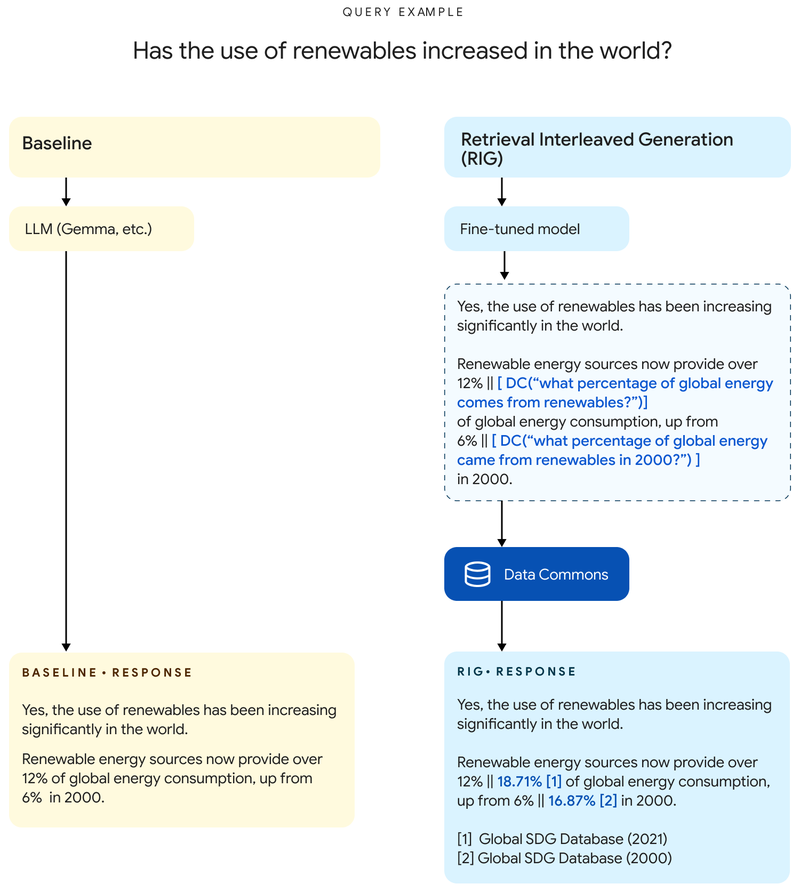
Our inspiration for Agentic Retrieval Interleaved Generation (RIG) stemmed from the need to enhance information retrieval in AI systems. Traditional approaches like RAG were efficient but often lacked the adaptability and contextual depth that modern applications require. We wanted to create a solution that not only retrieves information but also interleaves generation to provide more accurate and contextually relevant answers.
What it does
Agentic RIG improves upon traditional retrieval methods by combining the strength of Retrieval Augmented Generation (RAG) with a unique interleaving approach. The system utilizes both DataGemma and NVIDIA NIM models, offering flexible deployment options based on GPU availability or API usage. It is designed to leverage retrieved information, weave it into generated text, and provide comprehensive answers to complex queries.
How we built it
We built Agentic RIG using a combination of Hugging Face API, NVIDIA NIM microservices, and DataGemma models. The core of the system integrates a local deployment option utilizing GPUs and a cloud-based API fallback when GPU resources are unavailable. The framework is powered by LangChain and FastAPI, and we use Gradio to enable interaction. We focused on a modular, scalable design that allows easy switching between models and APIs based on hardware availability.
Challenges we ran into
One of the main challenges was optimizing the model switching mechanism between local deployment (GPU) and cloud APIs. Ensuring that the system would seamlessly switch without performance loss required extensive testing. We also had to manage token limits and prompt truncation issues, especially when using Hugging Face’s API, which required careful management of input and output token lengths.
Accomplishments that we're proud of
We’re proud of successfully implementing a flexible AI system that dynamically chooses between models based on available resources. This capability makes the system more robust and adaptable for users with varying levels of access to computational power. We also managed to integrate state-of-the-art models like DataGemma and NVIDIA NIM in a way that enhances the user’s ability to retrieve and generate meaningful insights.
What we learned
We learned the importance of modularity and flexibility when building AI-driven solutions. By integrating multiple models and ensuring that the system can handle varying computational environments, we were able to develop a tool that adapts to the user’s hardware and needs. We also gained deeper insights into prompt engineering and token management, particularly when dealing with large language models and APIs.
What's next for Agentic Retrieval Interleaved Generation
The next steps for Agentic RIG include refining the interleaving algorithm to further improve context retention and accuracy. We also plan to expand the model pool and improve the interface for a more user-friendly experience. Integrating advanced features like hallucination detection and fine-tuning model parameters based on real-time feedback is also on the roadmap.

Log in or sign up for Devpost to join the conversation.