
Inspiration
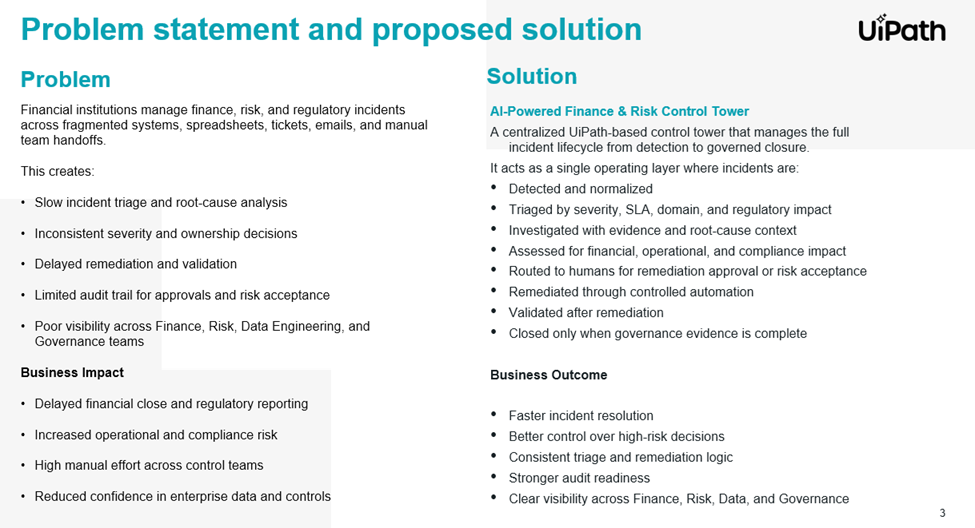
Finance, Risk, and Regulatory teams often manage critical control incidents across emails, spreadsheets, tickets, dashboards, and manual approvals. Even when organizations have strong data platforms and governance frameworks, incident handling can still be fragmented: teams spend too much time identifying severity, finding root cause, collecting evidence, approving remediation, validating fixes, and preparing audit-ready closure evidence.
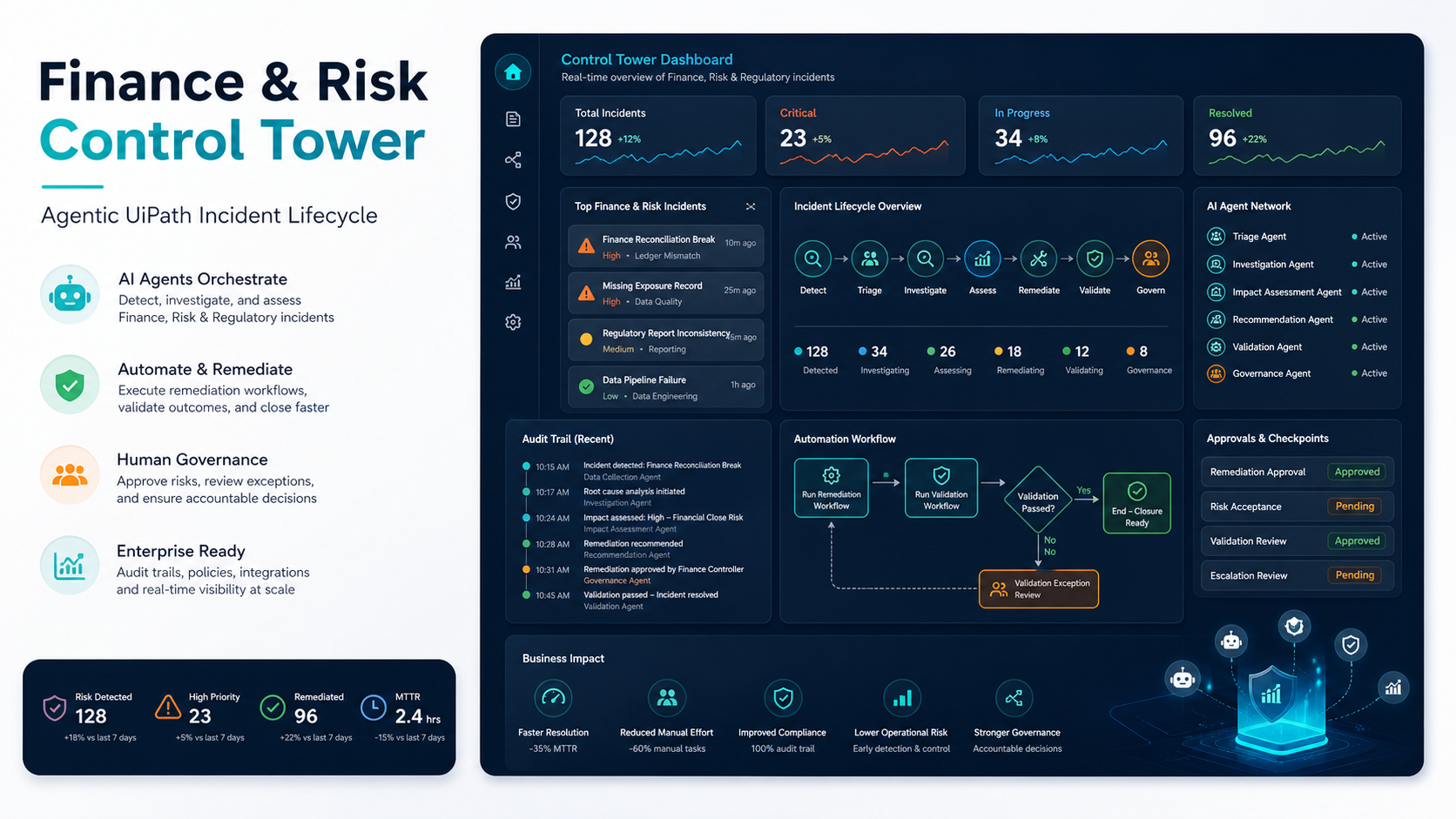
We built Agentic Minds - Finance & Risk Control Tower to show how UiPath can create one governed, agentic lifecycle for these incidents.
What it does
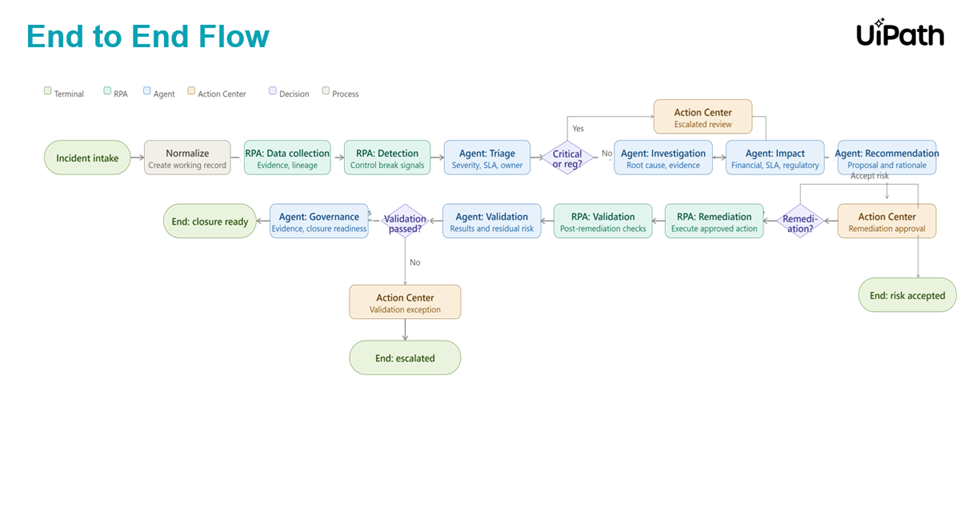
The solution manages a finance/risk incident from intake to governed closure.
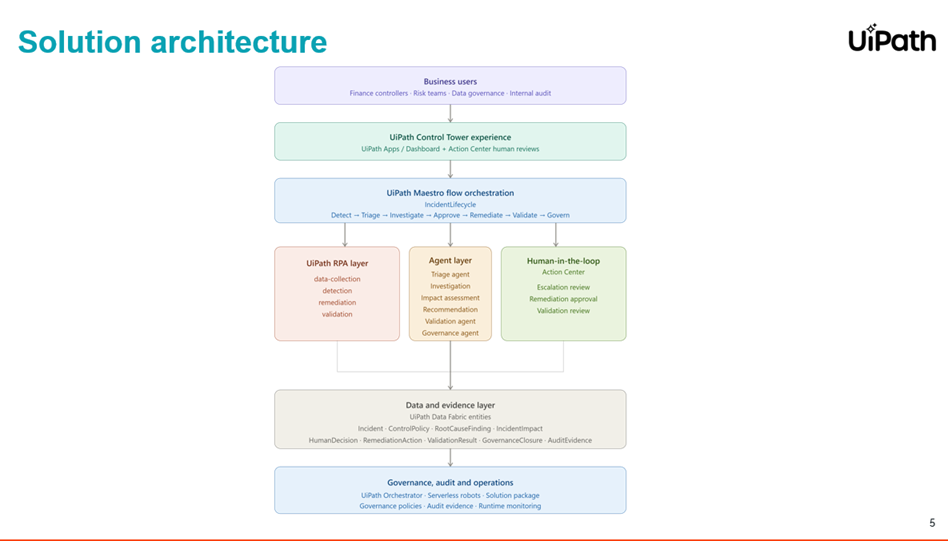
It uses a UiPath Maestro Flow called IncidentLifecycle to coordinate:
- RPA workflows for data collection, detection, remediation, and validation
- UiPath Agents for triage, investigation, impact assessment, recommendations, validation interpretation, and governance checks
- Action Center for human approvals, risk acceptance, and exception review
- Data Fabric design artifacts for incident, decision, remediation, validation, governance, and audit evidence records
- A Control Tower dashboard concept for operational visibility
The journey is:
Intake → Normalize → Collect Evidence → Detect → Triage → Investigate → Assess Impact → Recommend → Approve → Remediate → Validate → Govern → Close
How we built it
The project is built using UiPath technologies only.
Core components include:
- UiPath Maestro Flow for the end-to-end
IncidentLifecycleorchestration - 6 UiPath Agents:
- Triage Agent
- Investigation Agent
- Impact Assessment Agent
- Recommendation Agent
- Validation Agent
- Governance Agent
- 4 UiPath RPA processes:
data-collectiondetectionremediationvalidation
- UiPath Action Center for three human-in-the-loop checkpoints:
- Escalated Incident Review
- Remediation Approval
- Validation Exception Review
- UiPath Data Fabric model for audit-ready incident lifecycle records
- UiPath Apps / Coded App dashboard for the control tower experience
- UiPath Orchestrator and Cloud Robots - Serverless for deployment and execution
The RPA processes were made serverless-compatible using the Portable target framework, so the solution does not depend on an unattended machine setup.
What makes it useful
The solution keeps humans in control where risk decisions matter, while automating repetitive and evidence-heavy work.
Key benefits:
- Faster incident triage and resolution
- Consistent severity, SLA, ownership, and regulatory-impact classification
- Reduced manual evidence gathering and root-cause analysis effort
- Auditable remediation approval and risk acceptance decisions
- Automated remediation and validation workflows
- Governance-ready closure evidence
- Better visibility across Finance, Risk, Data, Operations, and Internal Audit teams
Challenges we faced
The biggest challenge was connecting multiple UiPath capabilities into one coherent lifecycle rather than building isolated automations. The Flow needed to coordinate agents, RPA processes, decision branches, and human tasks in a way that was understandable for both business users and technical reviewers.
We also worked through practical deployment considerations, including:
- Making RPA processes compatible with serverless execution
- Configuring Action Center human-in-the-loop tasks
- Designing clear approval values for Flow routing
- Keeping the Studio Web Flow, local solution package, and Orchestrator deployment aligned
- Building documentation and diagrams that explain the solution clearly to a business audience
What we learned
We learned that agentic automation is most valuable when it is not just “AI answering questions,” but when it is embedded into a governed business process.
In this project:
- Agents reason over incidents and produce structured outputs
- RPA handles deterministic execution
- Action Center preserves human accountability
- Data Fabric provides the audit model
- Maestro Flow ties everything together into one lifecycle
This combination makes the solution practical for enterprise risk and control use cases.
What's next
Future enhancements could include:
- Event-based incident intake from production systems
- Role-based Action Center routing by severity, domain, or control owner
- Richer remediation action catalogs
- SLA timers and escalation notifications
- Full Data Fabric deployment automation
- Test Manager coverage for every process branch
- Production dashboard deployment
- Integration with enterprise incident, data quality, and regulatory reporting platforms
GitHub Repository
See the complete architecture, process flow, documentation, screenshots, and validation evidence in our GitHub repository.
Built With
- typescript
- uipath-action-center
- uipath-agents
- uipath-apps-/-coded-apps
- uipath-cloud-robots-serverless
- uipath-data-fabric
- uipath-governance
- uipath-maestro-flow
- uipath-orchestrator
- uipath-rpa
- uipath-studio


Log in or sign up for Devpost to join the conversation.