-
-
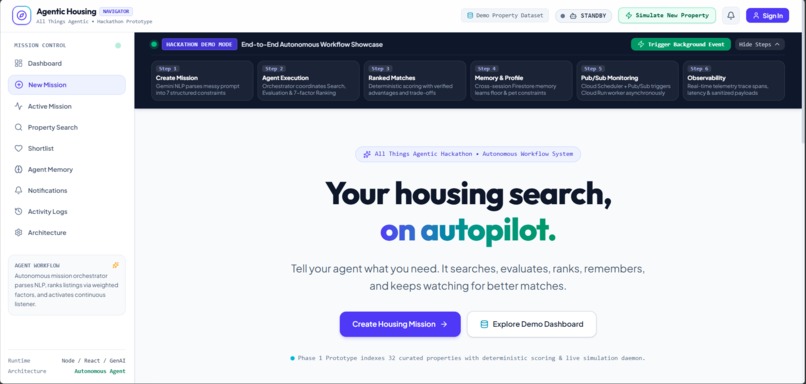
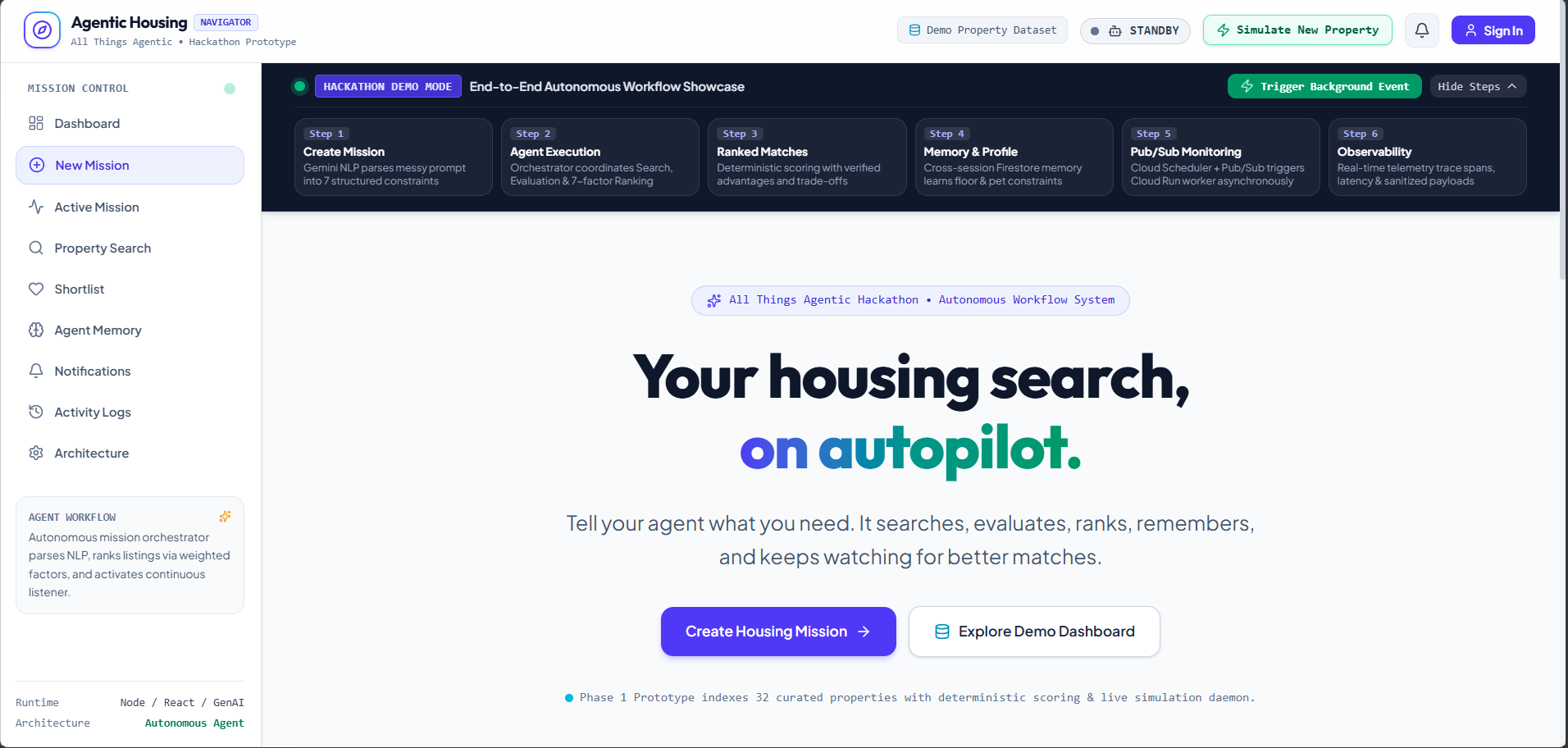
landing page
Inspiration
Finding a suitable home can be a time-consuming and fragmented process. People often have to search through multiple listings, compare prices, calculate affordability, check locations, evaluate amenities, and repeatedly look for new properties. We wanted to transform this manual process into an autonomous workflow where an AI agent does the heavy lifting instead of simply answering questions.
What it does
Agentic Housing Navigator understands a user's housing goal and autonomously:
- Converts natural-language requirements into structured preferences
- Searches and filters relevant properties
- Analyzes affordability and location
- Evaluates amenities, furnishing, layout, and other preferences
- Ranks properties using explainable matching criteria
- Remembers user preferences across sessions
- Monitors for new matching opportunities in the background
- Generates notifications when relevant opportunities appear
- Provides transparent agent activity and execution telemetry
- Uses human approval before sensitive actions
The result is a personalized housing-search workflow rather than a conventional chatbot.
How we built it
We built the platform around a multi-agent architecture with a central housing orchestrator coordinating specialized agents for requirements, property discovery, budget analysis, location, preferences, ranking, and monitoring.
The system uses Gemini for natural-language understanding and contextual reasoning, while deterministic logic handles important calculations such as affordability, distance, and property scoring.
For persistence and cloud infrastructure, we integrated Google Cloud services including Firestore, Cloud Run, Pub/Sub, and Cloud Scheduler, with event-driven background monitoring and persistent user state.
We also implemented authentication, user-specific data isolation, retry and fallback handling for transient AI failures, human-in-the-loop approvals, and observability for agent execution.
Challenges we ran into
One of the biggest challenges was making an AI-powered system reliable enough for real workflows. Gemini requests can occasionally experience temporary availability or rate-limit issues, so we implemented retry, exponential backoff, and model fallback mechanisms.
We also had to design a system where AI reasoning and deterministic calculations work together without making important decisions completely opaque. Another challenge was maintaining user-specific state and securely separating data while supporting background, asynchronous agent activity.
Accomplishments that we're proud of
We are proud of transforming a simple housing-search concept into a working autonomous multi-agent workflow.
Instead of stopping at recommendations, the system can understand a high-level goal, delegate work across specialized agents, evaluate results, maintain persistent context, and continue monitoring for new opportunities.
We are especially proud of combining AI reasoning, deterministic decision-making, persistent memory, asynchronous processing, human approval, and cloud infrastructure into one cohesive platform.
What we learned
This project taught us that building an effective AI agent is about much more than connecting an LLM to a chat interface.
We learned how to design multi-agent workflows, manage persistent state, combine LLM reasoning with deterministic logic, handle failures gracefully, secure user-specific data, and build asynchronous processes that can continue working beyond the initial interaction.
Most importantly, we learned to design AI around actions and outcomes rather than conversations.
What's next for Agentic Housing Navigator
We plan to evolve Agentic Housing Navigator into a broader autonomous housing assistant with:
- More real-time property sources
- Smarter market and price insights
- Improved location and commute intelligence
- More personalized long-term memory
- Advanced notification and monitoring workflows
- Deeper integrations with housing platforms and communication services
- Stronger security, governance, and production-scale agent infrastructure
Our long-term vision is to make finding the right home a continuous, intelligent, and largely autonomous experience rather than a repetitive manual task.
Built With
- aiagents
- artificialintelligence
- autonomousagents
- cloudfirestore
- cloudrun
- cloudscheduler
- express.js
- gemini
- generativeai
- google-cloud
- googleadk
- googleai
- googlecloudpubsub
- javascript
- machine-learning
- multiagentsystems
- node.js
- react
- typescript

Log in or sign up for Devpost to join the conversation.