-
-
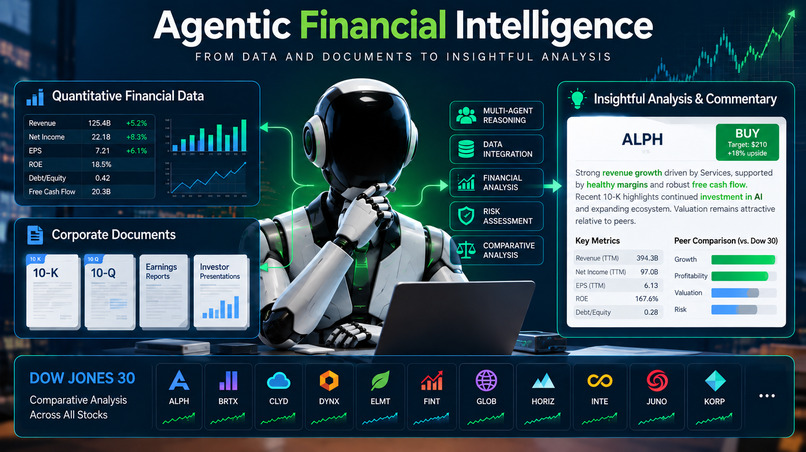
AI Financial Intelligence_ image
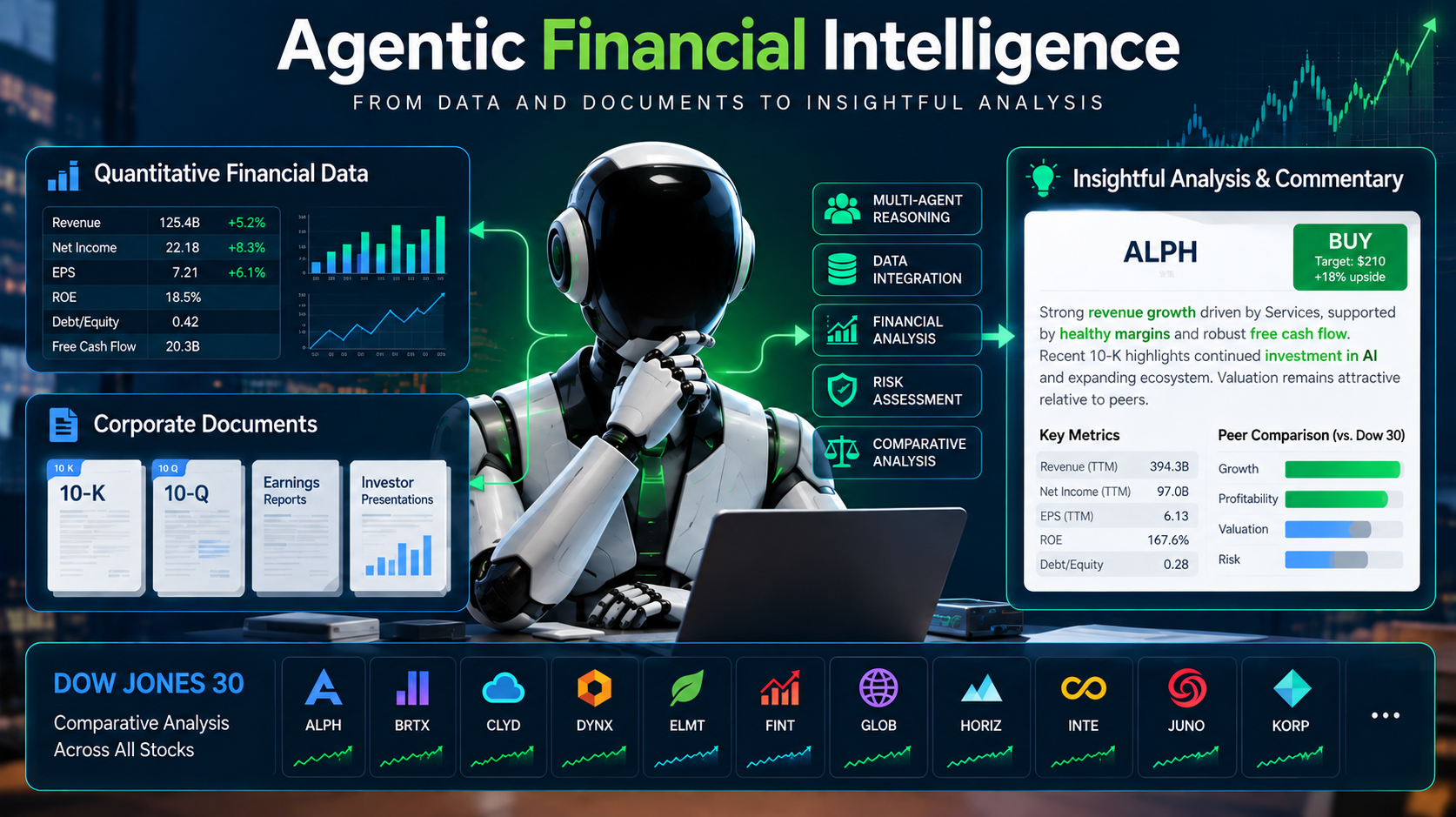
Inspiration and Objective Data analysis can go beyond calculating individual indicators. An in-depth financial assessment requires combining multiple analytical dimensions, including market performance, risk metrics, technical signals, and corporate disclosures. Fundamentally, the objective is to look beyond the numbers, understand the underlying context and heterogeneous factors, interpret their relationships, and identify the different drivers influencing financial performance. The Agentic Financial Intelligence project was developed to address this challenge through a multi-agent AI system focused on the historical price time series and corporate financial documents of the 30 constituent stocks of the Dow Jones Industrial Average (DJIA). How It Was Built The project was developed in Python using Google Colab and LangGraph, with NVIDIA Nemotron 3 Ultra 550B, accessed through Nebius Token Factory. The project supports two distinct analytical workflows: deterministic quantitative calculations and semantic analysis of corporate financial documents. These components are architecturally separated, with calculations performed independently of the processing of qualitative financial disclosures. Quantitative Financial Analysis — Deterministic Calculation Tools The first workflow establishes a validated quantitative foundation for the Dow Jones stock universe. Specialized agents process financial market data through deterministic Python/Pandas calculations, organized into the following analytical areas, producing verified and certified results:
- Market & Risk Analytics: Annualized return (CAGR), annualized volatility, Sharpe Ratio, Return-to-Risk Ratio, Pearson correlation.
- Momentum & Market Analysis: Momentum, Dollar Volume, and comparative stock rankings based on momentum.
- Asset Pricing — CAPM: Beta, annualized Alpha, R-squared (R²), observed annualized return, CAPM expected annual return, and the difference between observed and expected returns. Integration of Corporate Financial Documentation Corporate financial documents are ingested into the workflow and transformed into a queryable information base containing financial results, performance drivers, business highlights, management guidance, strategic priorities, milestones, and management commentary. Information retrieval is supported by a structured catalog of financial metrics, synonyms, keywords, and information categories, combined with semantic interpretation of the user's request. When direct lexical matching is insufficient, a semantic fallback based on TF-IDF and cosine similarity helps identify relevant underlying information. This approach allows the system to retrieve and interpret corporate evidence even when companies operating in different industries use different terminology to describe comparable financial concepts. As a result, heterogeneous corporate documents become accessible through a unified analytical framework. Multi-Factor Financial Reasoning NVIDIA Nemotron plays a central role in orchestrating specialized agents and their quantitative and document-based tools, interpreting complex financial requests, supporting response validation, and generating insightful commentary based on multiple sources. A fundamental architectural principle is the separation between LLM-based reasoning and deterministic financial computation. The model neither performs nor modifies numerical calculations. Instead, it interprets calculated results, compares quantitative and documentary evidence, and develops integrated financial assessments, following an approach similar to that of a human financial analyst. Furthermore, a single question may involve several companies, different observation periods, multiple quantitative indicators, and information extracted from multiple sources. To manage this complexity, the system decomposes each request into atomic analytical requirements, identifying the relevant companies or tickers, observation periods, metrics, selection criteria (such as the highest-ranked stock or top five securities), and calculation tools. Each requirement is assigned to the appropriate analytical component, and the resulting evidence is subsequently integrated into a structured comparative response. For example, users can ask a quantitative question such as: “Compare Apple and Microsoft in terms of risk, momentum, and CAPM.” Or formulate a more complex question combining financial statements, stock performance, and management expectations, such as: “Can you compare IBM's 2025 earnings, its stock performance in 2025 and 2026, and assess whether this evidence is consistent with the growth guidance communicated by management for 2026?” Context Retrieval and Conversational Continuity Once the quantitative and documentary information has been acquired, the second workflow manages natural-language queries. The workflow accesses the results stored in final_state and verifies their compatibility with the requested information to determine whether each component can be retrieved from previous computations (REUSE) or requires a new execution (EXECUTE). This mechanism preserves analytical consistency across successive questions while improving computational efficiency and supporting a more natural, context-aware interaction. Research Reliability and Validation The project incorporates complementary validation mechanisms throughout the analytical workflow. Market data undergoes a dual-source certification process, using a primary provider and an independent cross-validation source. Quantitative calculations are performed through deterministic Python/Pandas tools and subjected to consistency checks. The separation between numerical computation and LLM reasoning ensures that financial indicators remain traceable to their underlying calculations rather than being generated or modified by the language model. The architecture also includes a configurable fallback model, a three-stage critical response validation mechanism, and controlled revision procedures designed to identify inconsistencies, incomplete interpretations, and unsupported conclusions. Each calculation retains its analytical identity, allowing the system to associate results with their corresponding signatures, which contain information about sources, tools, securities, observation periods, and metrics. The broader objective is to establish a modular, transparent, and reliable architecture, in which each component performs a clearly defined responsibility and contributes to a certified, reusable, and queryable body of financial evidence. Development Challenges and Iterative Refinement A major challenge in developing Agentic Financial Intelligence was interpreting combined requests and producing complete analyses of complex financial questions. An important part of the development process involved cross-model benchmarking using Google Gemini 2.5 Flash as a comparative reference. Comparing Gemini's and Nemotron's responses to complex financial questions helped identify differences in analytical interpretation, completeness, and the quality of multi-factor comparative commentary. Rather than relying on the model's default behavior, these observations informed an iterative refinement process aimed at strengthening Nemotron's ability to interpret complex requests, retrieve relevant evidence, and identify differences across multiple analytical factors. What I Learned Developing Agentic Financial Intelligence reinforced my belief in the importance of treating financial data with methodological rigor, ensuring that information is properly acquired, cleaned, validated, and interpreted within a broader analytical framework rather than reduced to isolated numerical calculations. The project also demonstrated the importance of designing workflows around the specific capabilities and limitations of individual language models. Differences between models extend beyond the accuracy of individual responses. This work highlighted the need to continuously adapt the system to the model's behavior and capabilities, improving its ability to interpret complex requests and operate within an increasingly sophisticated, multidimensional analytical environment. Outcome The result is an integrated financial analysis system that transforms quantitative metrics and corporate disclosures into structured, evidence-based assessments, enabling users to look beyond the numbers and identify converging or diverging signals across multiple analytical dimensions. End-to-End User Workflow Users submit financial questions in natural language, ranging from individual metric requests to complex multi-company comparisons. The system interprets each question, identifies the required analytical components, retrieves compatible existing results or executes the necessary quantitative and document-based tools, and integrates the collected evidence. NVIDIA Nemotron then develops insightful financial commentary, performs multi-factor comparative assessments, critically interprets quantitative and qualitative evidence, and draws well-reasoned conclusions, acting as an AI analytical partner for financial analysts and professionals conducting in-depth financial research. Subsequent questions can reuse previous results, supporting conversational continuity and progressively deeper analysis.
Built With
- cosine-similarity
- google-colab
- google-gemini-2.5-flash
- langgraph
- nebius-token-factory
- numpy
- nvidia-nemotron-3-ultra-550b
- pandas
- python
- scikit-learn
- sec-edgar
- tf-idf
- twelve-data
- yahoo-finance

Log in or sign up for Devpost to join the conversation.