-
-
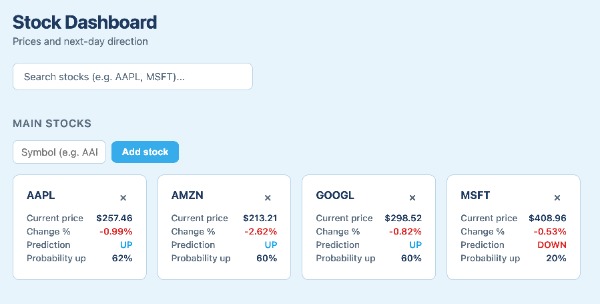
Front end
Inspiration
Being that our group has a shared interest in the stock market, we noticed the problem investors face when choosing which stocks to invest in, considering the huge mass of financial data that is confusing for them, In addition, we wanted to create a system that would use machine learning on historical data of stock prices to make predictions in order to help the investors make the right decision.
What it does
Using machine learning, our project predicts possible stock price fluctuations by analyzing stock market data. Daily stock key indicators such as opening and closing prices, previous day's high and low, are inputs to the model to predict future price movements. The system, therefore, recommends stocks to its users that are ideal for buying or selling based on its predictions. This makes it easier for investors to spot advantageous market opportunities.
How we built it
We constructed the project by aggregating stock data and utilizing it as feed data for a machine-learning model. The model examines price indicators on a daily basis, such as daily opening, highest, and lowest values, to detect patterns in stock prices. While the backend handles the data and produces the forecasts, the frontend provides the user with an intuitive interface that displays the data. Our process involved data preprocessing, the data pipeline to the model, the model training process, and finally the model output integrated into the user dashboard.
Challenges we ran into
One of the biggest challenges we faced was preparing and cleaning stock market data so it could be effectively used by the machine learning model. Financial data can be noisy and volatile, which made it difficult to produce consistent predictions. We also had to carefully select which features would provide meaningful signals for the model without overcomplicating the system.
Accomplishments that we're proud of
We are proud that we were able to successfully build a working machine learning pipeline that takes real stock data and generates predictions. Our team also managed to integrate the analysis into a user-facing system that makes the predictions easy to understand. Completing a full end-to-end project within the limited time of a hackathon was a major accomplishment.
What we learned
Throughout this project we learned more about financial data analysis, machine learning workflows, and how to work efficiently as a team under time pressure. We also gained experience in preprocessing datasets, training predictive models, and connecting backend analysis with a usable frontend interface.
What's next for ThinkInvest
In the future, we would like to improve the accuracy of the model by incorporating more features such as trading volume, market sentiment, and financial news. We also plan to expand the system to support real-time predictions and provide more advanced analytics to help investors better understand market trends.

Log in or sign up for Devpost to join the conversation.