-
-
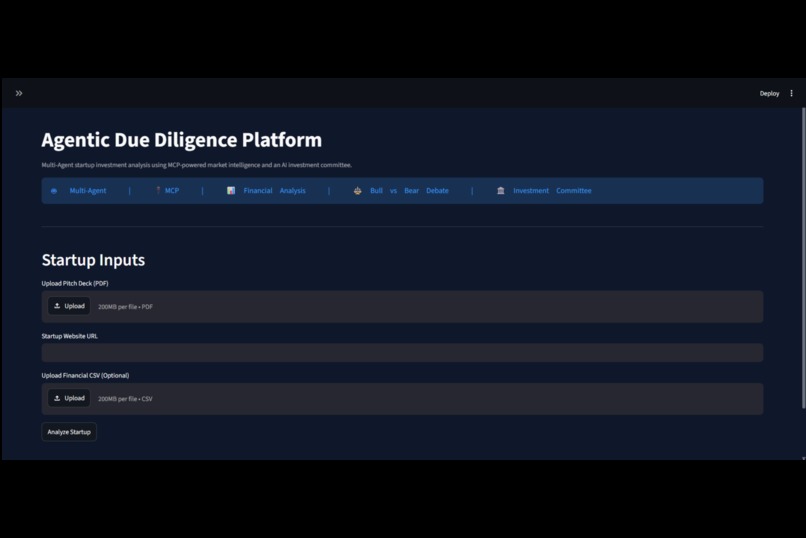
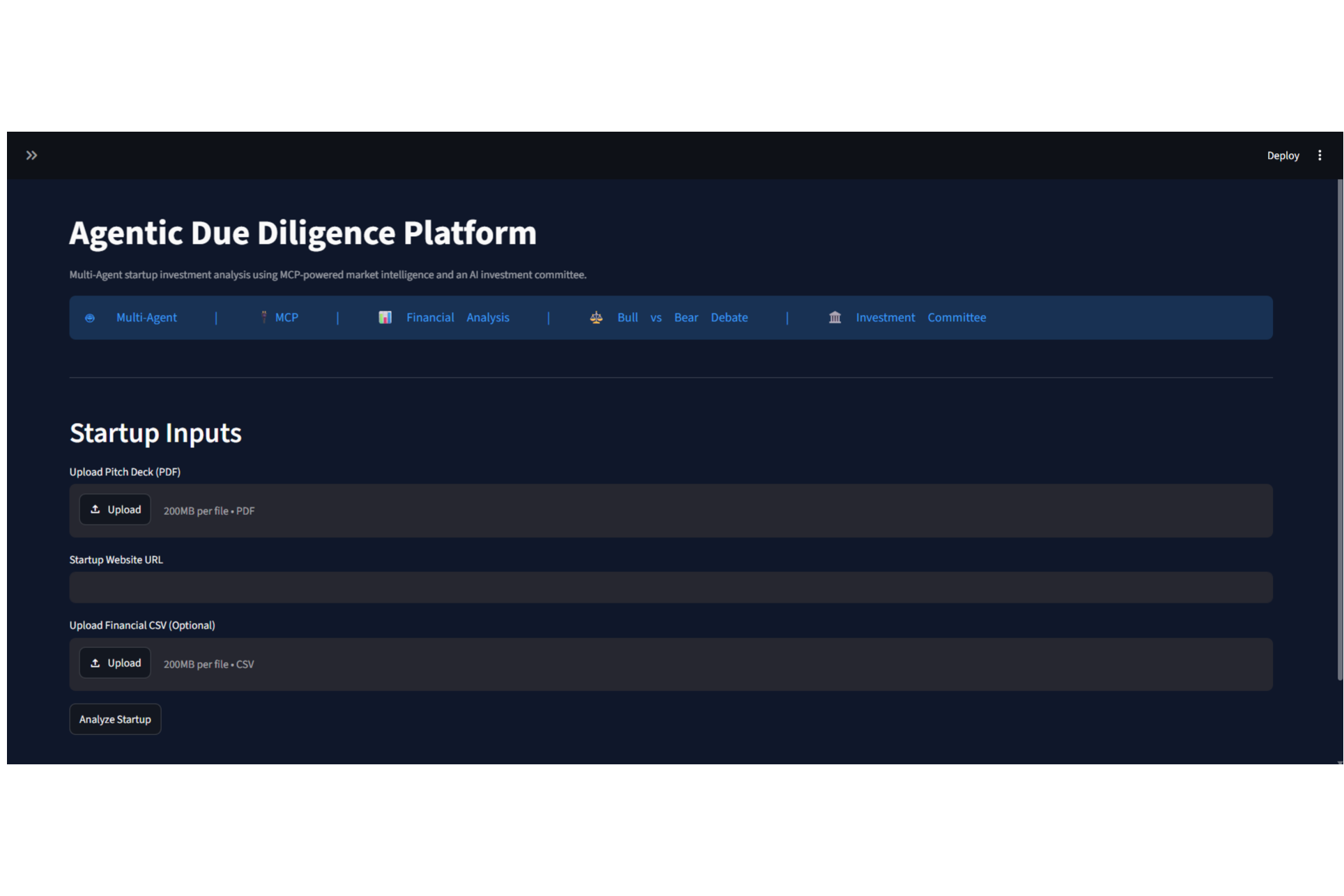
landing-page
-
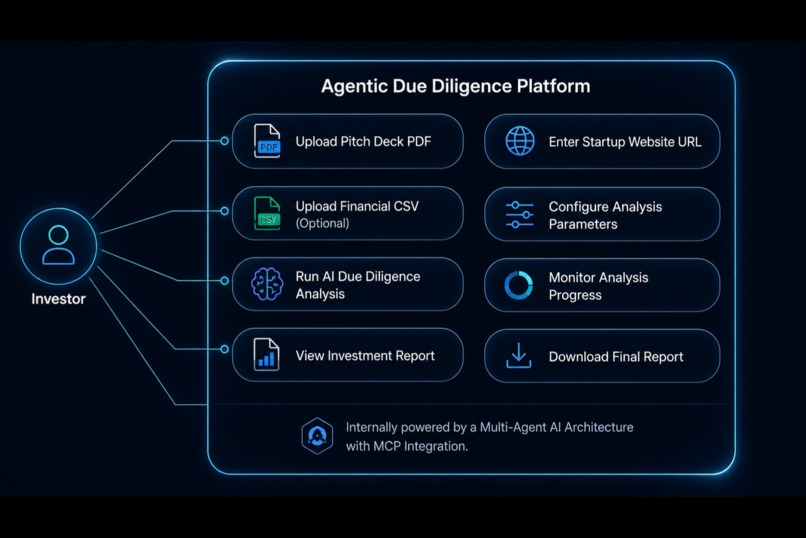
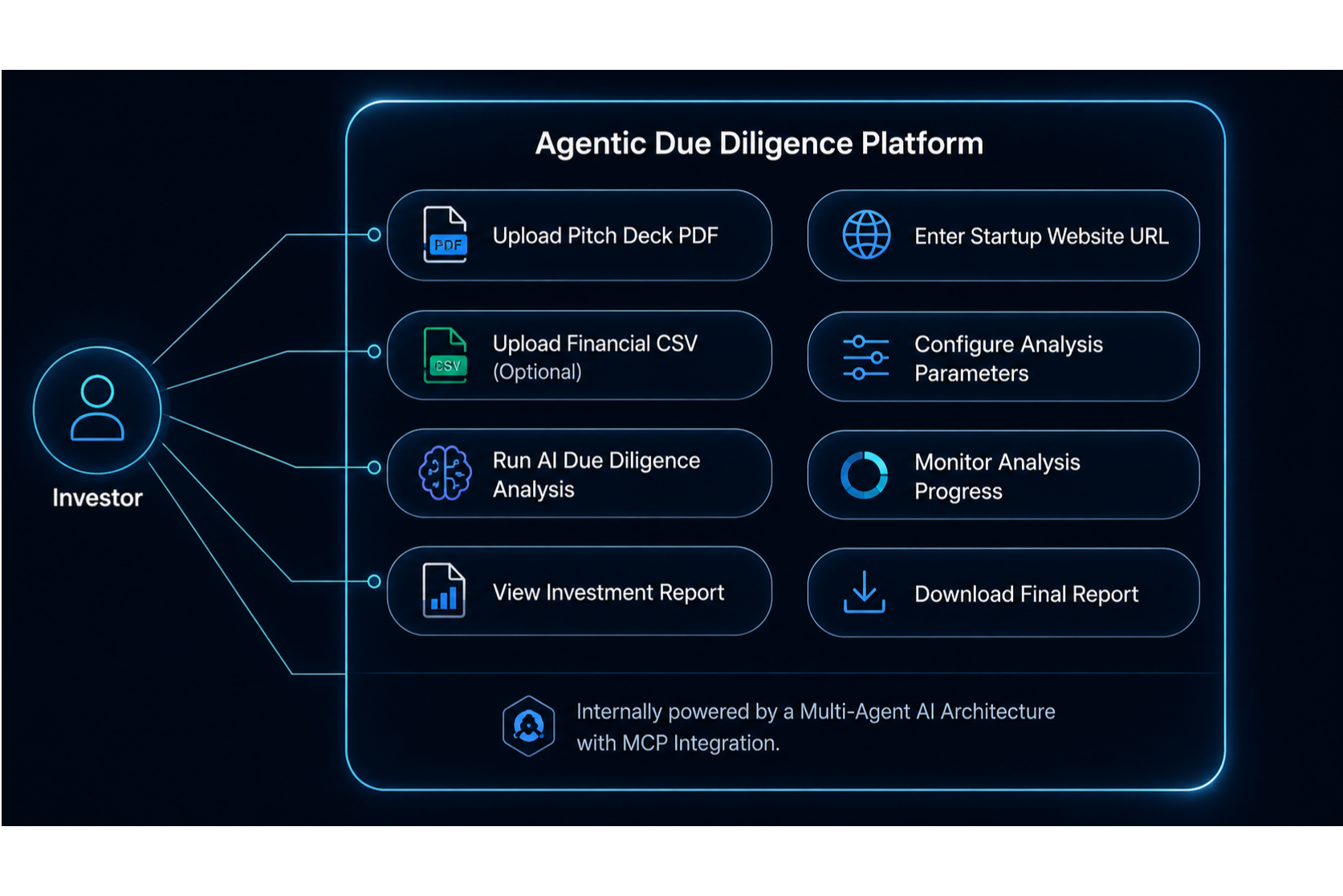
usecase
-
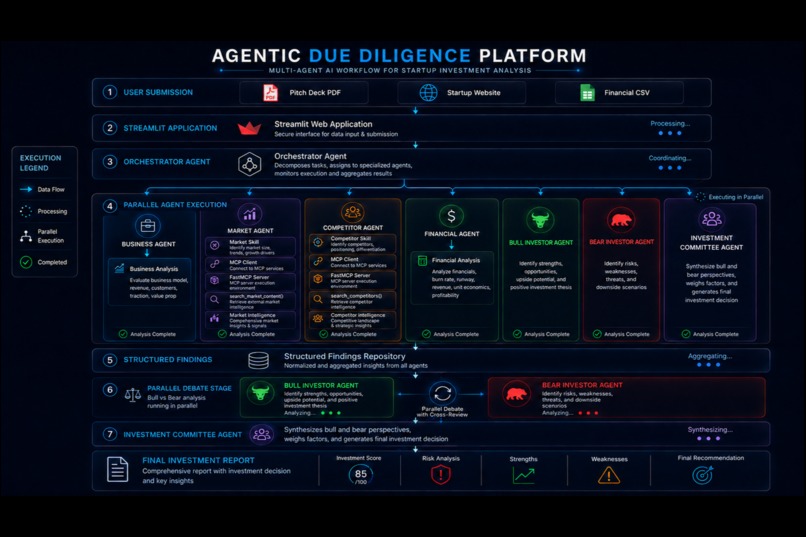
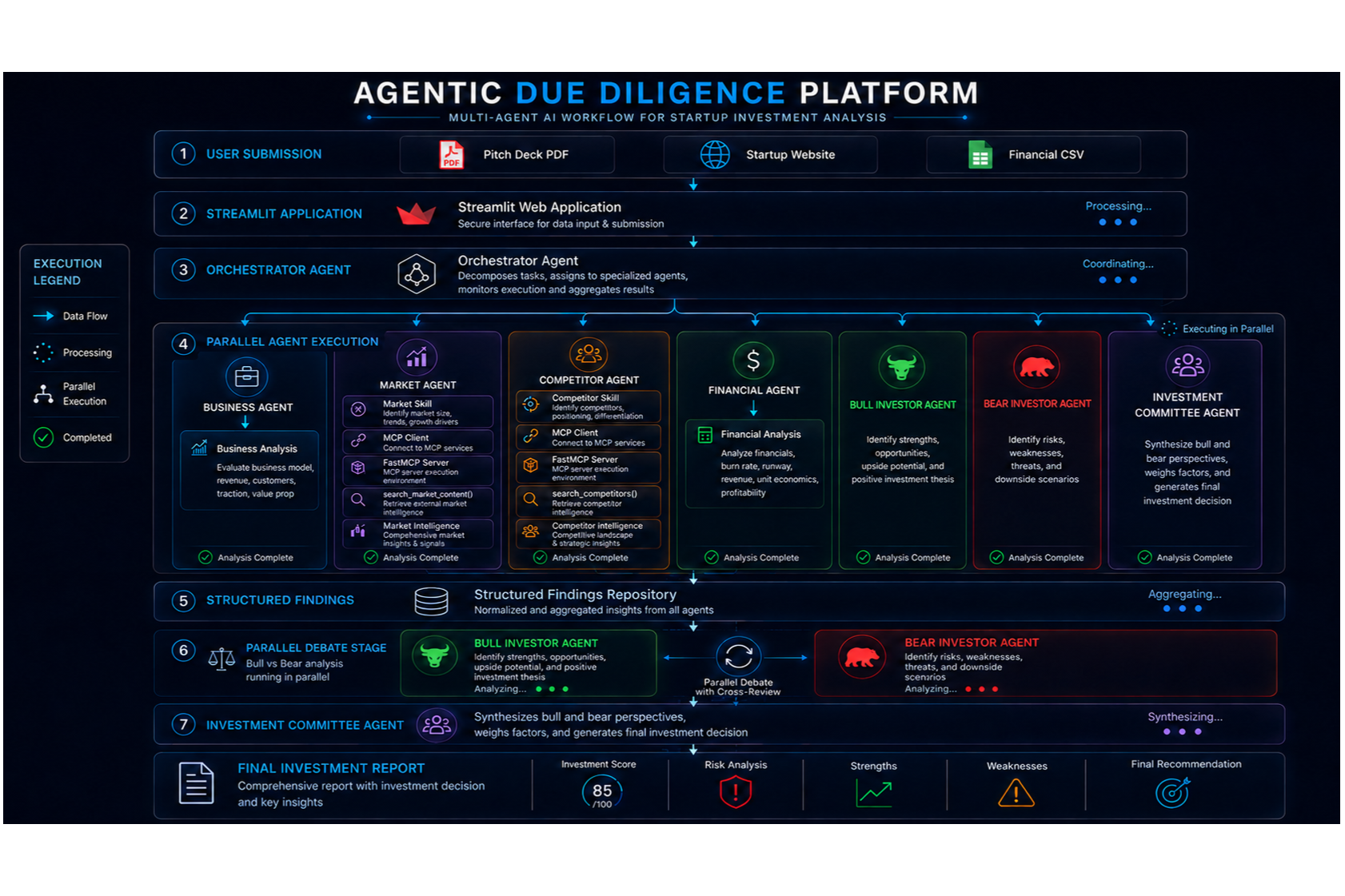
workflow
-
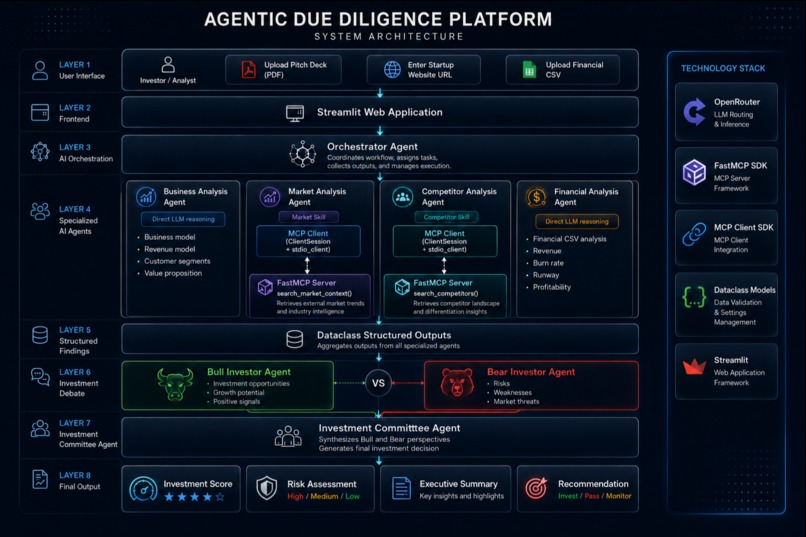
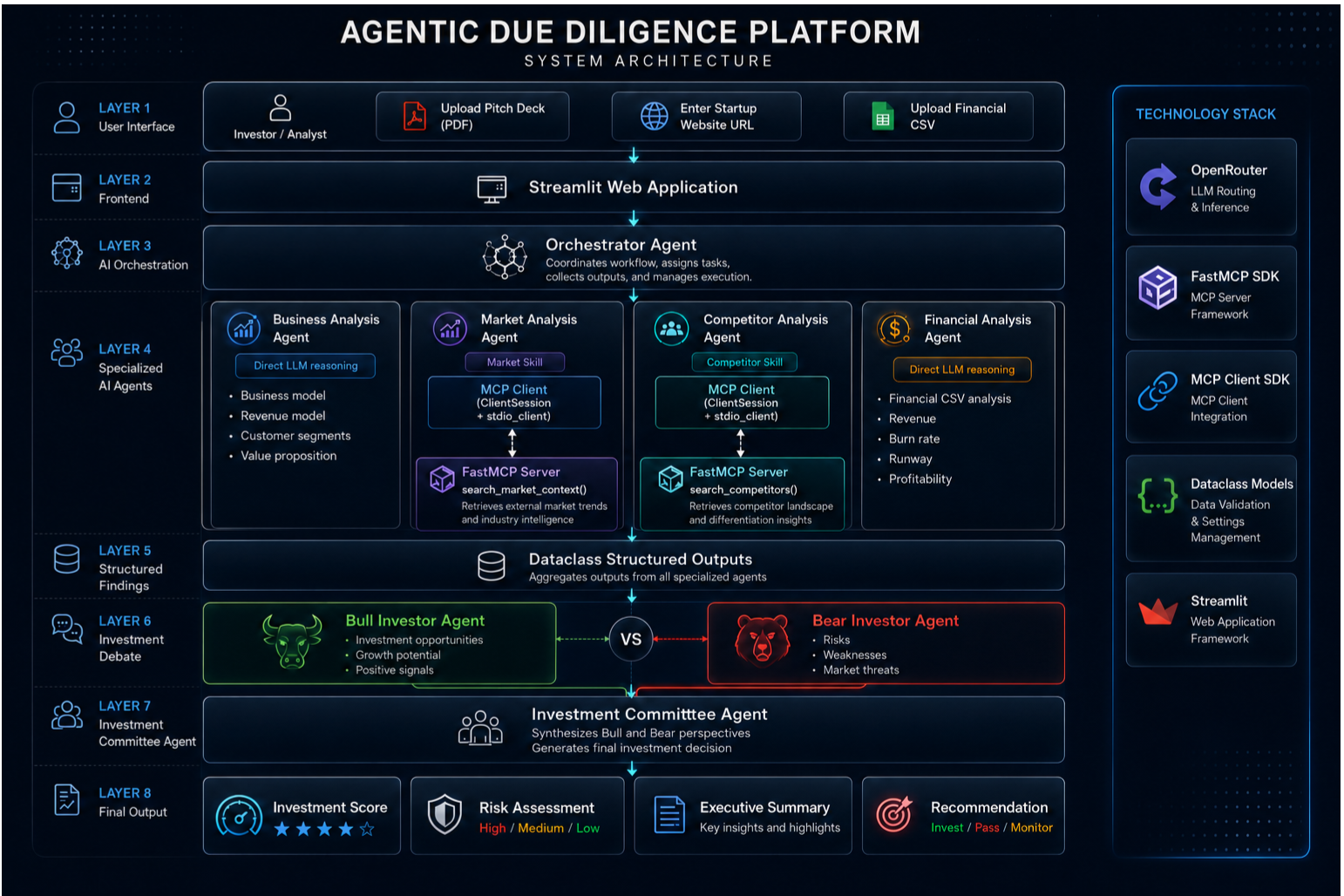
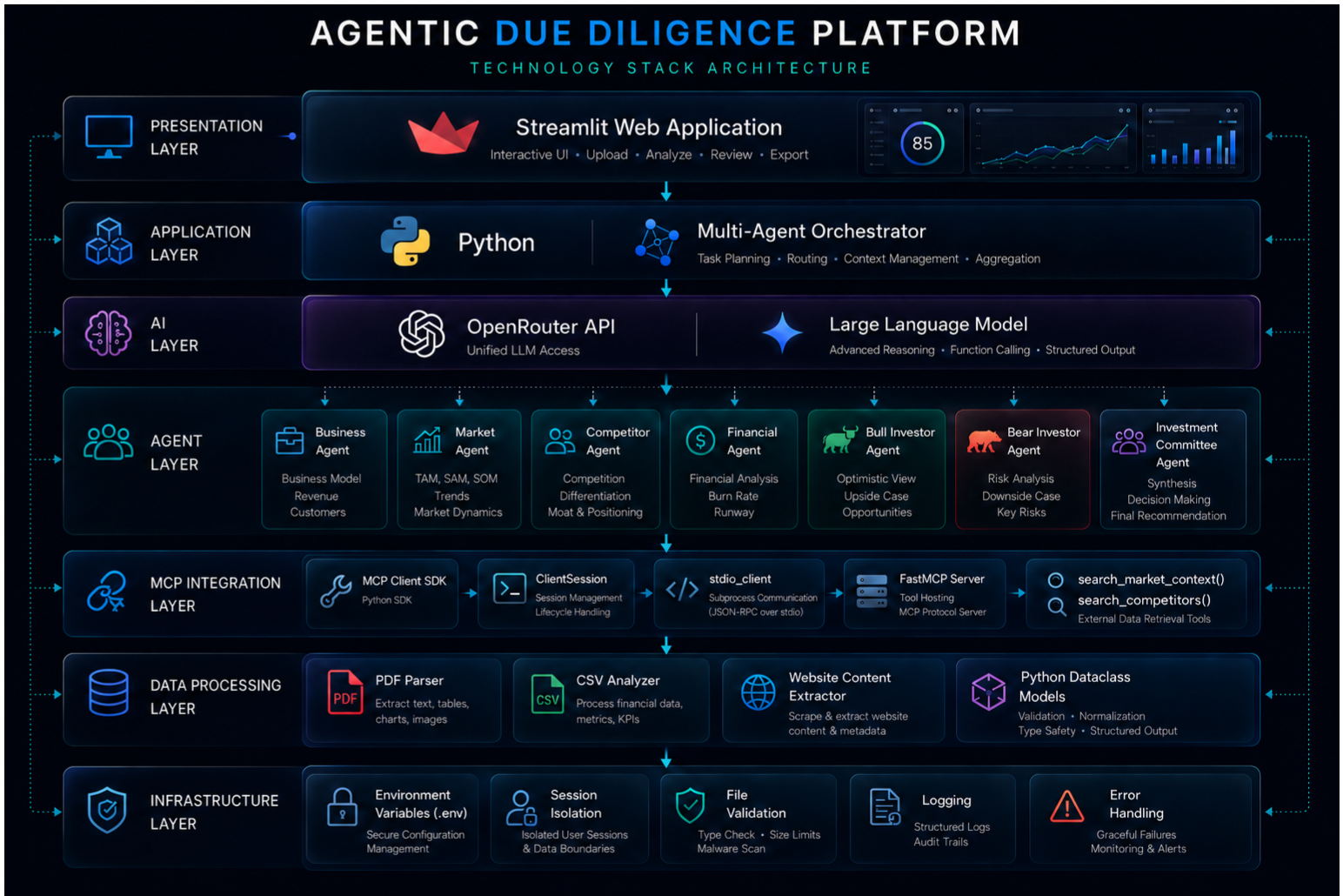
architecture
-
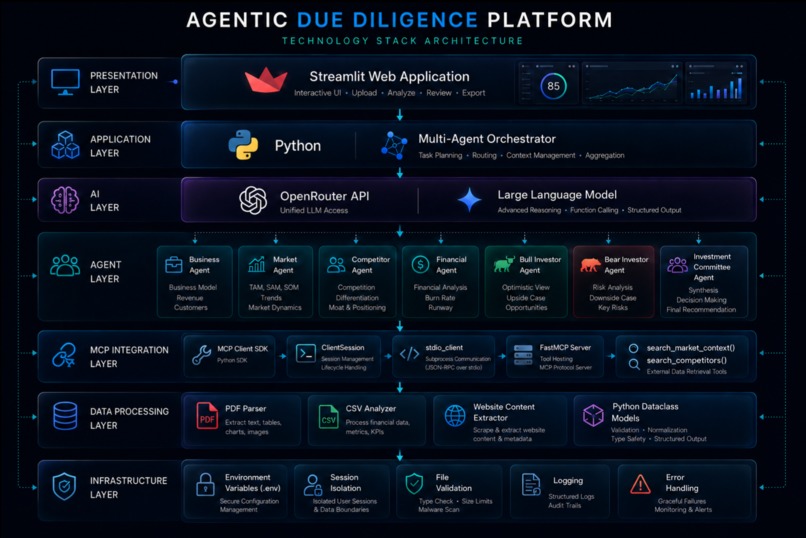
techstack
-
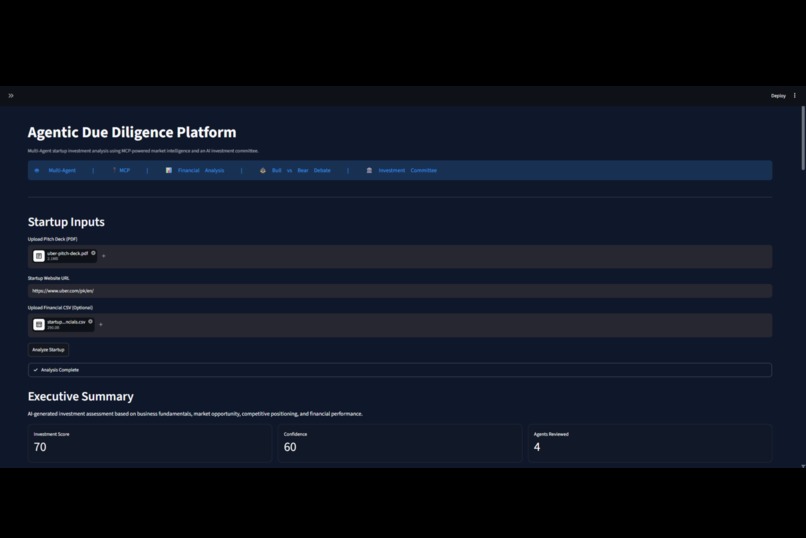
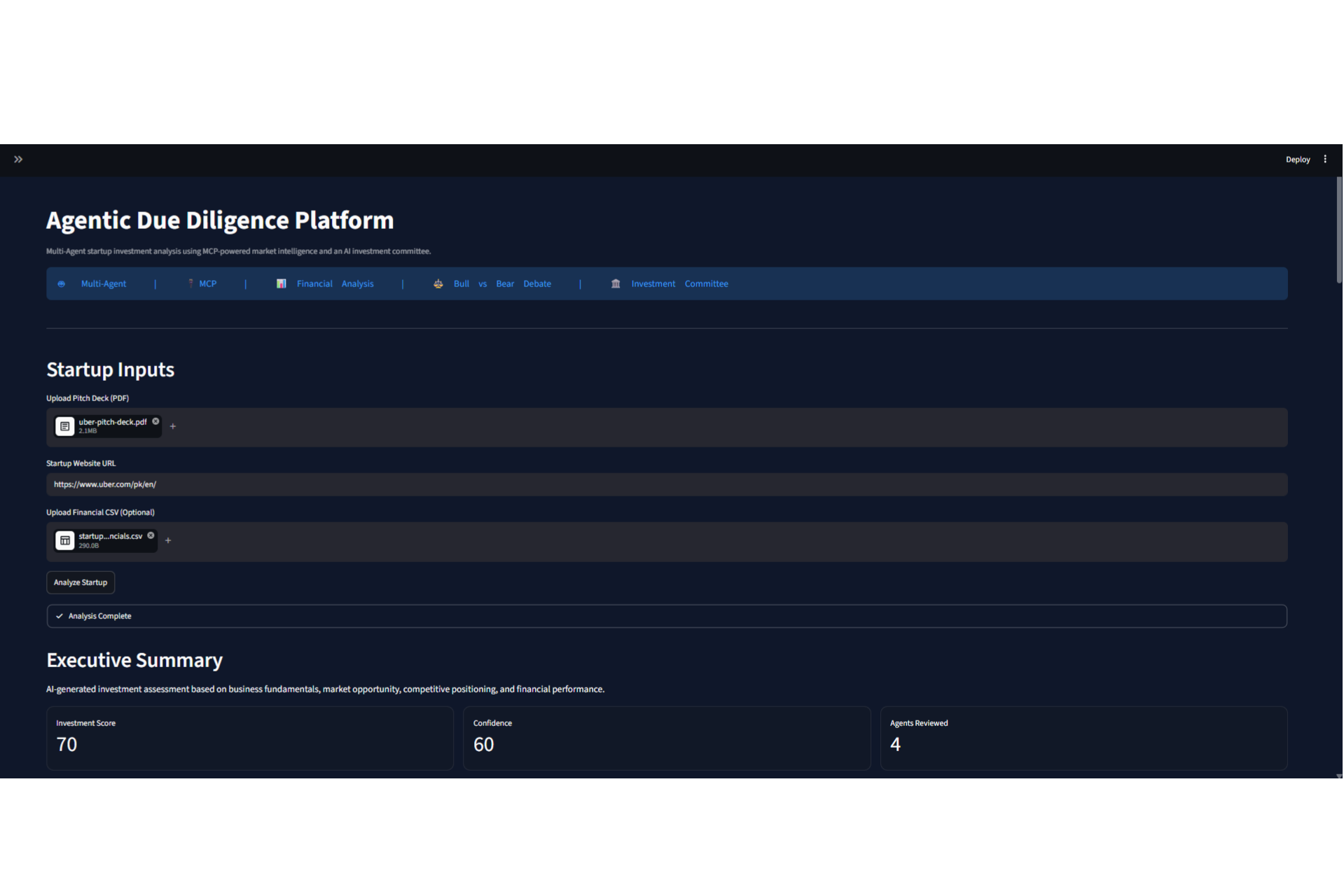
executive-dashboard
-
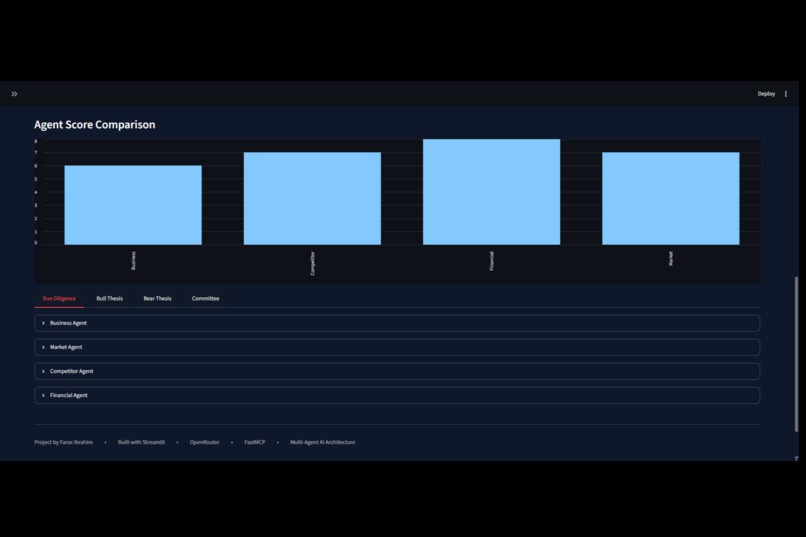
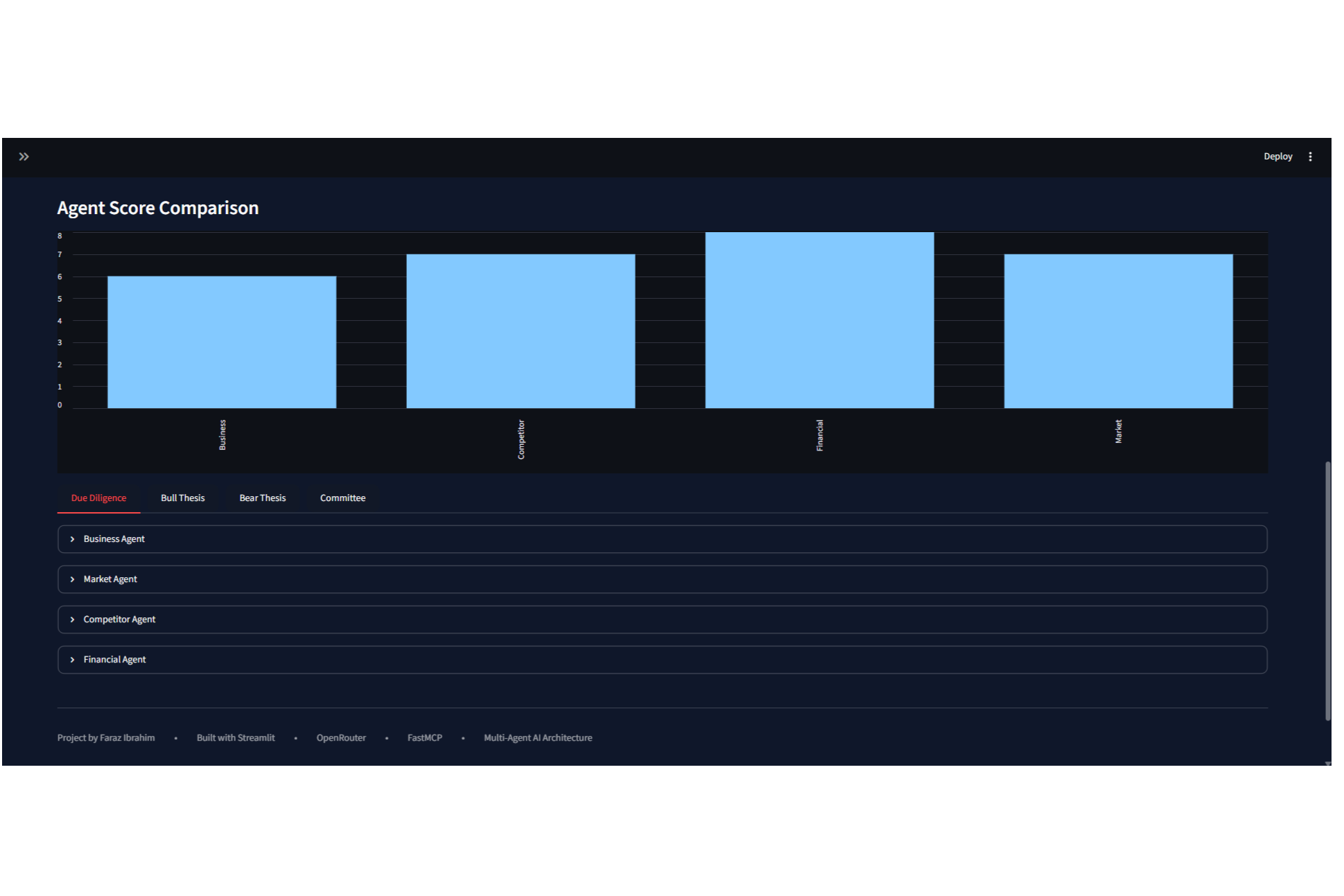
due_diligence-analysis
-
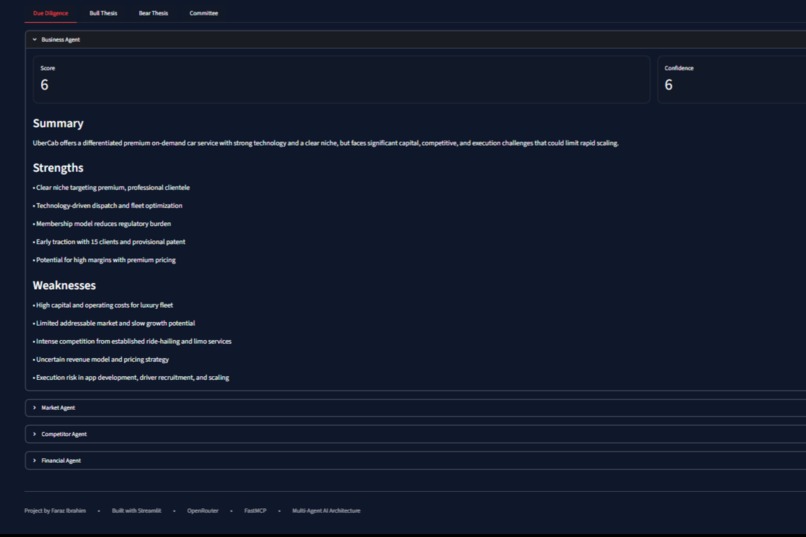
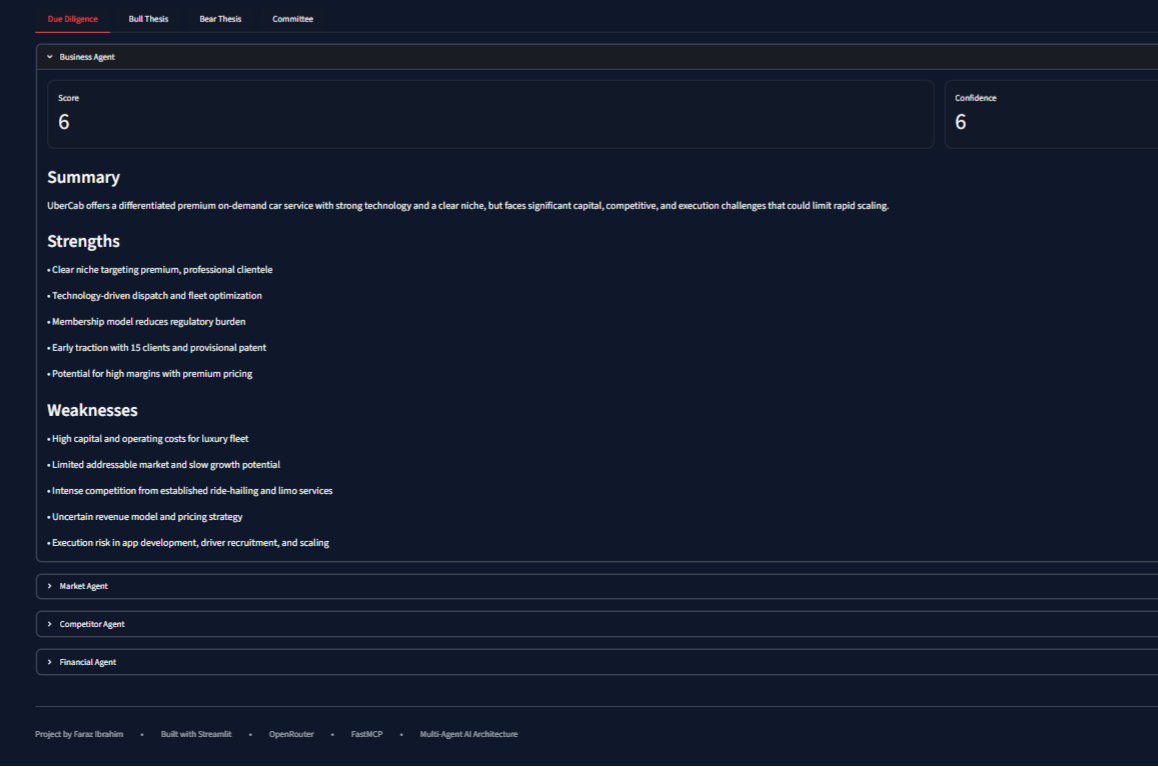
business-agent-analysis
-
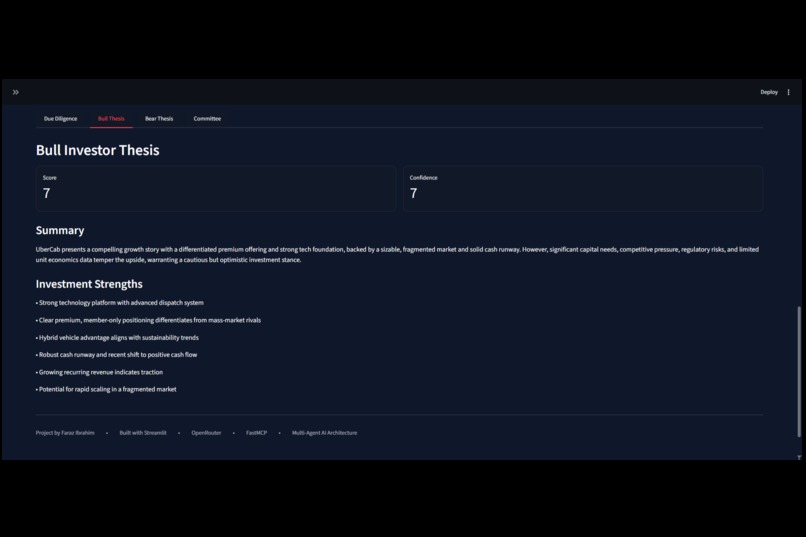
bull-thesis
-
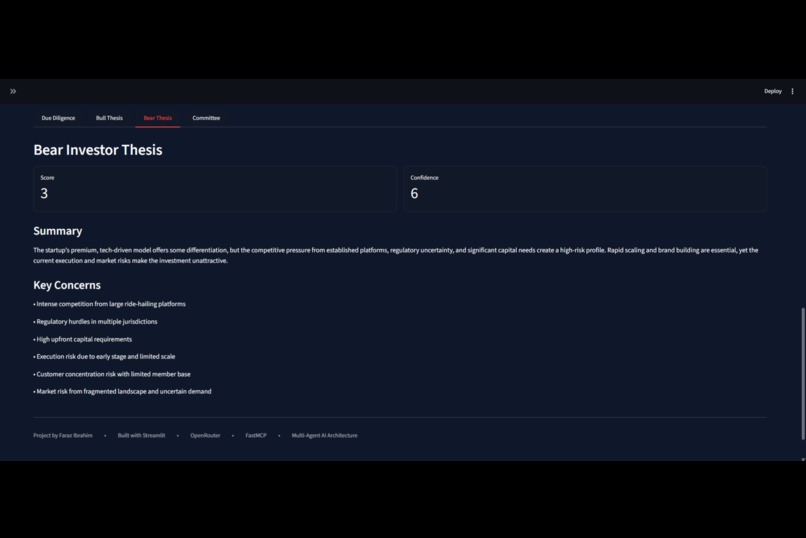
bear-thesis
-
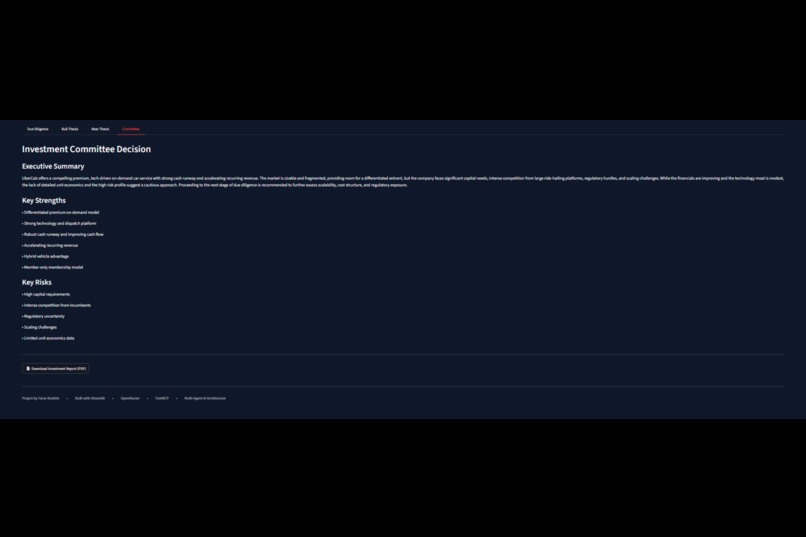
committee
-
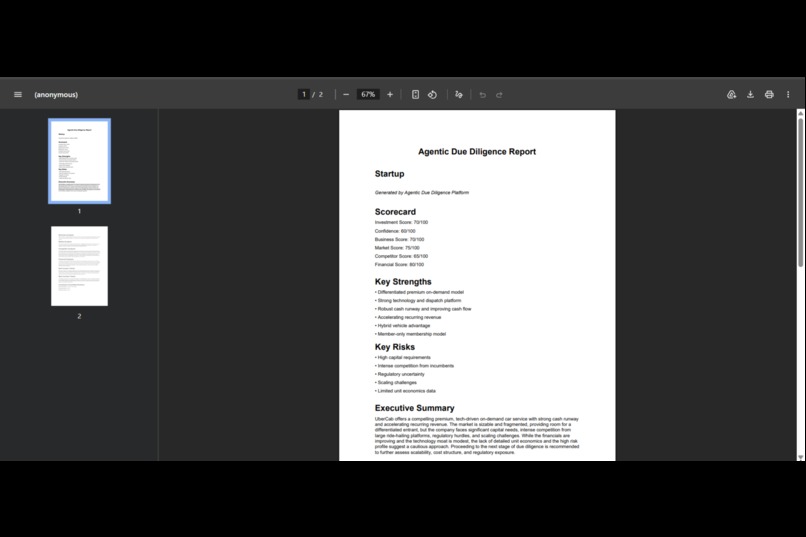
pdf-report
Agentic Due Diligence Platform
Inspiration
Startup investing is one of the most information-intensive decision-making processes in business. Before investing in a company, investors must analyze pitch decks, business models, market opportunities, competitors, financial performance, growth potential, and risk factors.
In practice, this process is often manual, time-consuming, and difficult to scale. Analysts spend significant amounts of time gathering information and preparing reports before decision-makers can even begin evaluating opportunities.
I wanted to explore how Agentic AI could transform this workflow. Rather than building another chatbot, I wanted to create a system capable of reasoning through a complex business problem using multiple specialized AI agents working together toward a common objective.
The result was the Agentic Due Diligence Platform, an AI-powered system that automates startup evaluation through specialized agents, structured debate, and investment committee decision-making.
The Problem
Traditional startup due diligence faces several challenges:
- Large volumes of information spread across documents, websites, and financial data
- Significant analyst time required for research and evaluation
- Inconsistent evaluation frameworks across opportunities
- Human bias in decision-making
- Slow investment cycles that limit scalability
As startup ecosystems continue to grow, venture capital firms, angel investors, accelerators, and innovation teams are evaluating more companies than ever before.
This creates a strong opportunity for intelligent automation.
My Approach
Instead of relying on a single AI model to perform every task, I designed the platform around a Multi-Agent Architecture.
Each agent is responsible for a specific area of expertise:
Business Agent
Evaluates business models, revenue strategies, customer segments, and scalability.
Market Agent
Analyzes market opportunities, industry trends, TAM, SAM, SOM, and growth potential.
Competitor Agent
Assesses competitive positioning, differentiation, and potential threats.
Financial Agent
Reviews financial indicators, growth metrics, burn rate, runway, and sustainability.
After the analysis phase, two additional agents introduce structured debate:
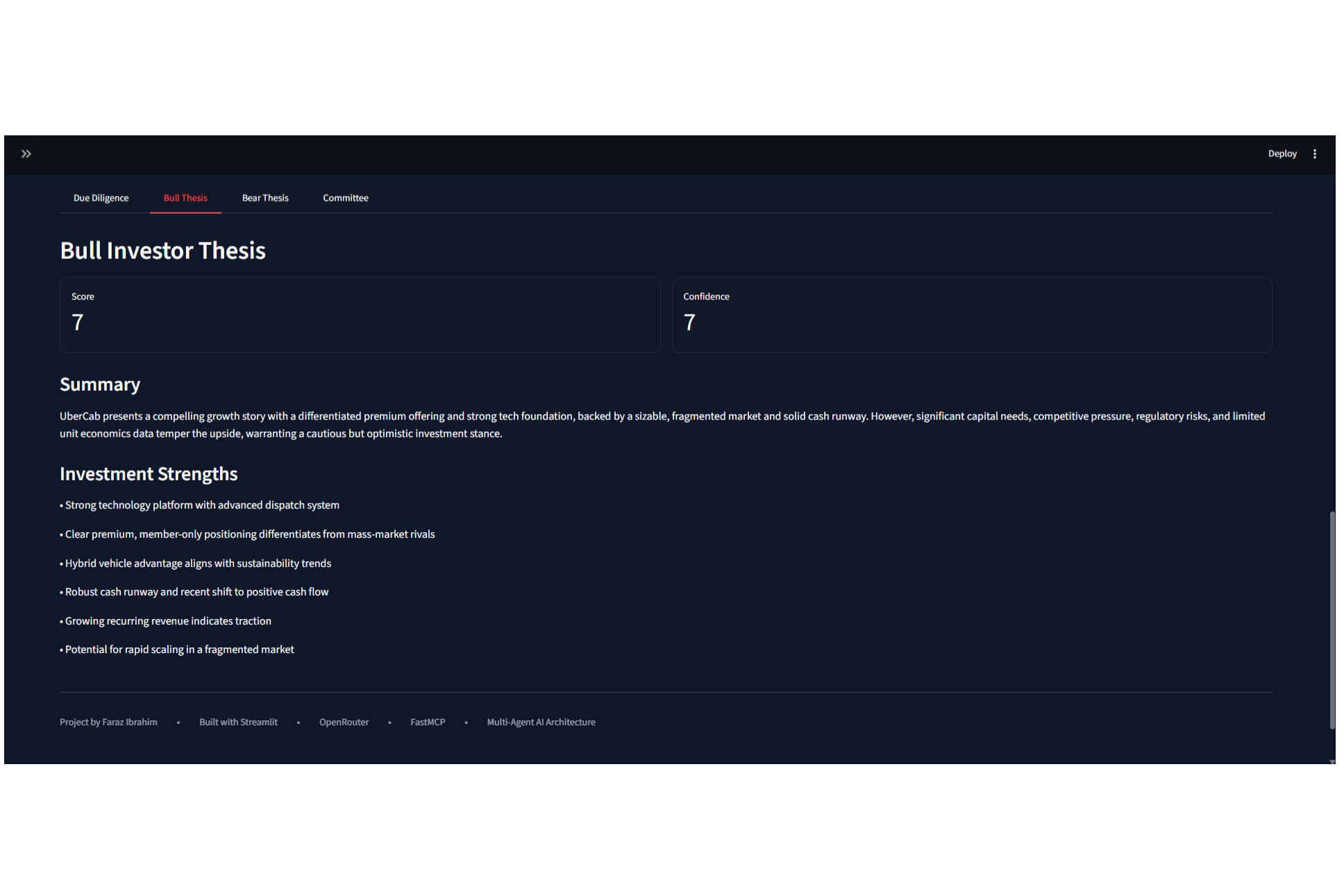
Bull Investor Agent
Generates arguments supporting investment.
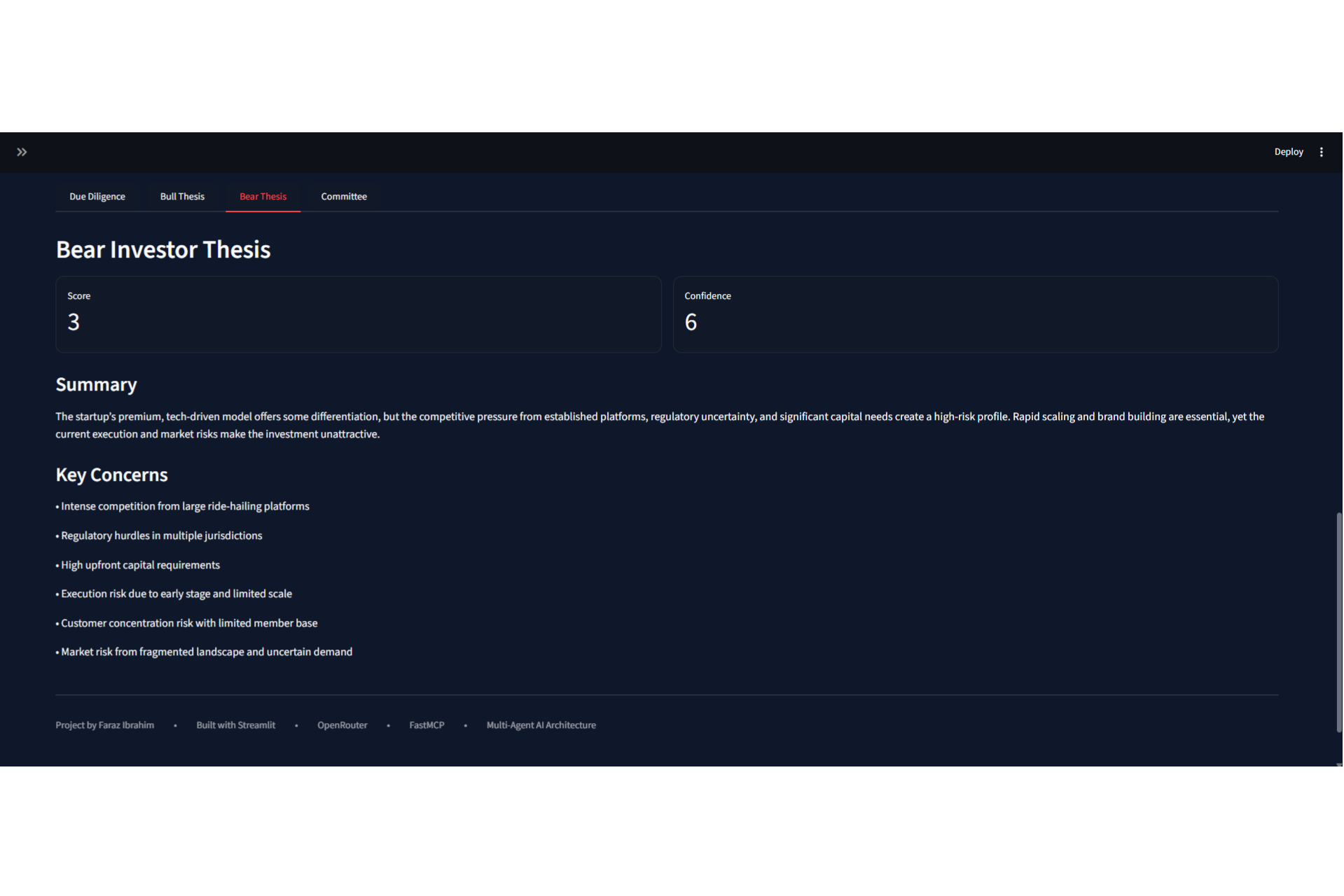
Bear Investor Agent
Highlights risks, concerns, and downside scenarios.
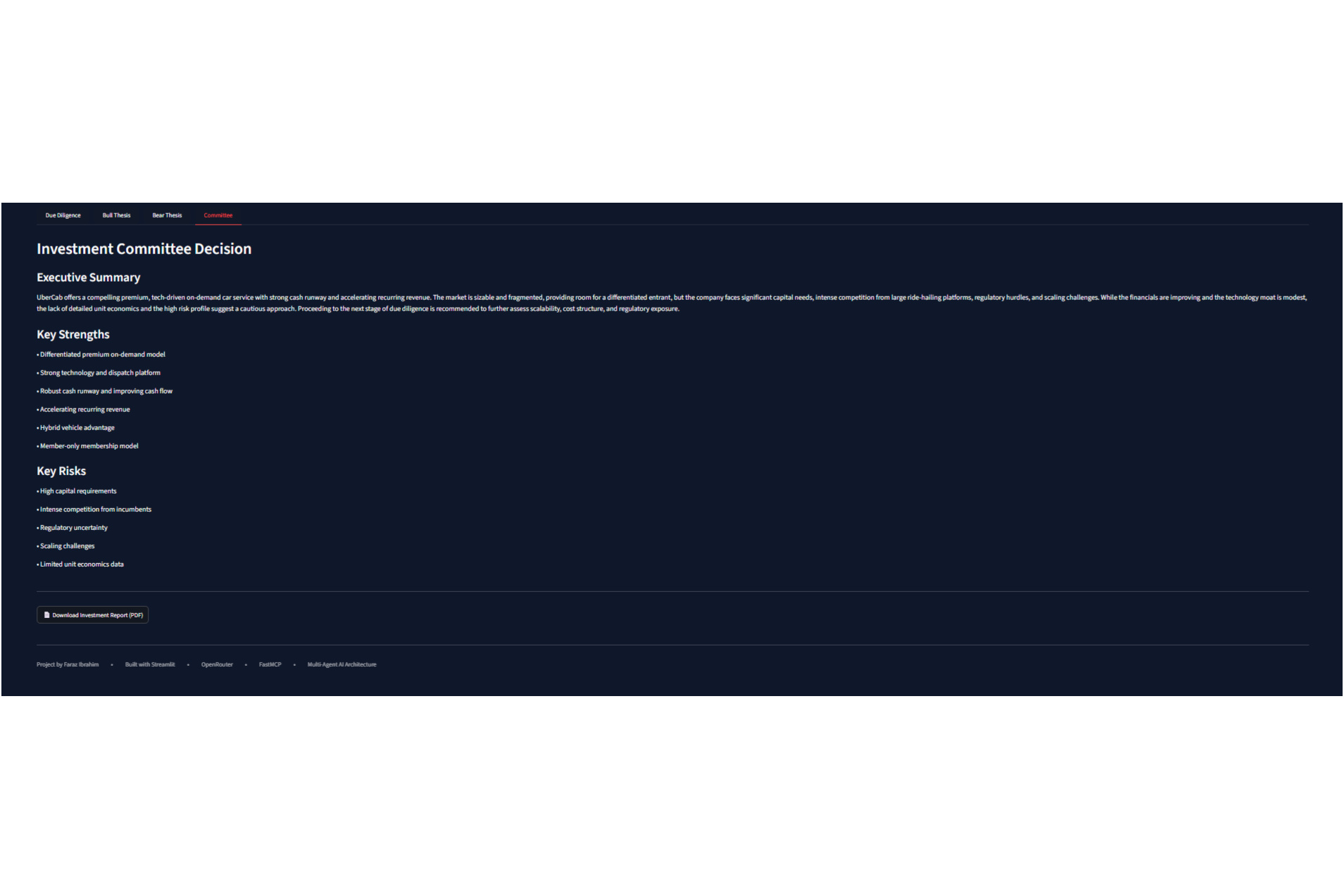
Finally, an Investment Committee Agent synthesizes all findings and produces a final recommendation supported by confidence metrics and structured reasoning.
This architecture mirrors how many real-world investment organizations evaluate opportunities.
How I Built It
The platform was built using a modular Python architecture.
Frontend
I used Streamlit to create an interactive user interface that allows users to:
- Upload startup materials
- Trigger analysis workflows
- Review agent outputs
- Export PDF reports
Backend
The backend consists of multiple specialized agents coordinated through a structured workflow.
The system processes:
- Pitch Deck PDFs
- Company Website URLs
- Financial Data Files
and converts them into structured inputs for analysis.
MCP Integration
One of the most interesting aspects of the project was implementing Model Context Protocol (MCP).
The platform includes a dedicated MCP client-server layer using:
- FastMCP
- ClientSession
- stdio Transport
This allows agents to access external tools through a clean and modular interface.
Currently, the MCP server provides:
- Market Context Research
- Competitor Discovery
The architecture was intentionally designed to support future integrations with search engines, research platforms, and external data providers without changing agent logic.
Reporting
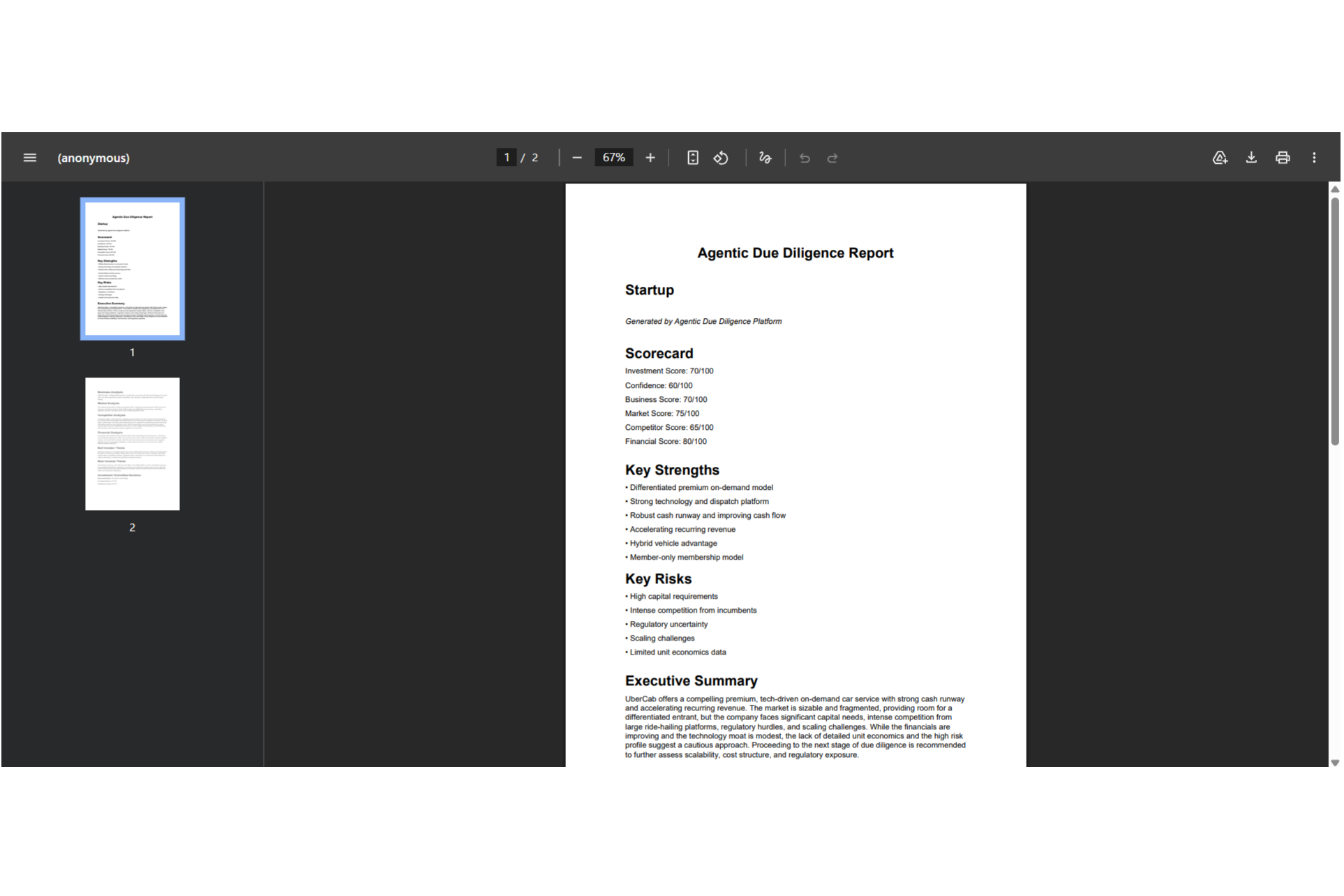
The final stage generates a professional PDF due diligence report containing:
- Executive Summary
- Agent Findings
- Investment Scores
- Risks
- Recommendations
This transforms raw analysis into a format that can be easily reviewed and shared.
Challenges Faced
Designing Agent Collaboration
One of the biggest challenges was determining how agents should communicate and contribute to the final decision.
I wanted each agent to provide independent expertise while ensuring the overall system remained coherent and explainable.
Finding the right balance between specialization and coordination required multiple iterations.
Structuring Investment Reasoning
Investment decisions rarely have a single correct answer.
Strong opportunities often have both compelling strengths and significant risks.
To address this, I introduced Bull and Bear Investor Agents that generate opposing viewpoints before a final committee decision is made.
This produced more balanced and realistic outcomes compared to a single recommendation approach.
Building MCP Communication
Implementing MCP required designing a clean separation between agents and tools.
Although the current implementation uses mock intelligence sources, the architecture now supports future expansion without major system redesign.
Maintaining Explainability
Another challenge was ensuring that recommendations remained transparent.
Rather than generating a simple investment verdict, the platform provides scores, confidence levels, strengths, weaknesses, risks, and supporting evidence to help users understand how conclusions were reached.
What I Learned
This project taught me several important lessons about Agentic AI systems.
First, specialized agents can often outperform a single generalized agent when solving complex, multi-dimensional problems.
Second, structured debate creates better reasoning. Generating both optimistic and skeptical perspectives improves the quality of decision-making.
Third, modular architectures are essential for building scalable AI systems. Separating agents, tools, workflows, and reporting components makes future development significantly easier.
Finally, I learned how powerful MCP can be for connecting AI agents with external capabilities while maintaining a clean architecture.
Agentic AI Capabilities
This project was designed around the core principles of agentic systems.
Reasoning
Each agent independently analyzes information and generates domain-specific insights.
Planning
The platform follows a structured workflow that coordinates multiple stages of evaluation.
Decision Making
The Investment Committee Agent weighs evidence from all participants before generating a recommendation.
Taking Action
The system produces actionable outputs, including investment recommendations and downloadable due diligence reports.
Future Improvements
There are many opportunities to extend the platform:
- Real-time startup intelligence gathering
- Search engine integrations
- Portfolio monitoring agents
- Historical investment outcome learning
- Multi-modal analysis of charts and images
- Additional financial modeling capabilities
- Collaborative investment workflows
- Production-scale deployment
These enhancements would move the system closer to a fully autonomous investment intelligence platform.
Conclusion
The Agentic Due Diligence Platform demonstrates how autonomous AI agents can collaborate to solve a real-world business problem.
By combining specialized analysis agents, structured debate, MCP-powered intelligence, and committee-based decision-making, the platform transforms startup due diligence from a manual process into an intelligent and scalable workflow.
More importantly, it explores how Agentic AI can move beyond conversational interfaces and become a practical tool for supporting complex, high-stakes decisions.
Built With
- agenticai
- aiagents
- artificial-intelligence
- autonomousagents
- beautiful-soup
- decisionintelligence
- documentprocessing
- duediligence
- fastmcp
- generativeai
- github
- mcp
- multi-agentsystems
- openai
- openrouter
- pandas
- pypdf
- python
- reportlab
- requests
- startupanalysis
- streamlit
- streamlitcommunitycloud
- venturecapital
- workflowautomation

Log in or sign up for Devpost to join the conversation.