-
-
-
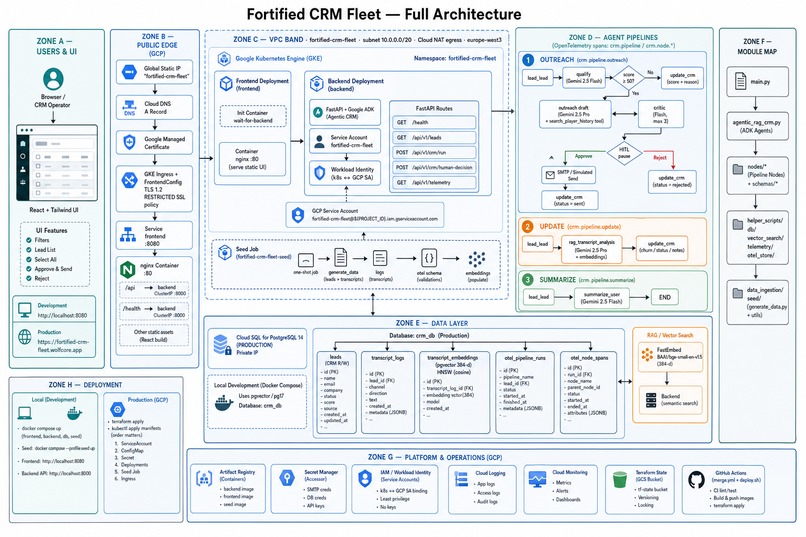
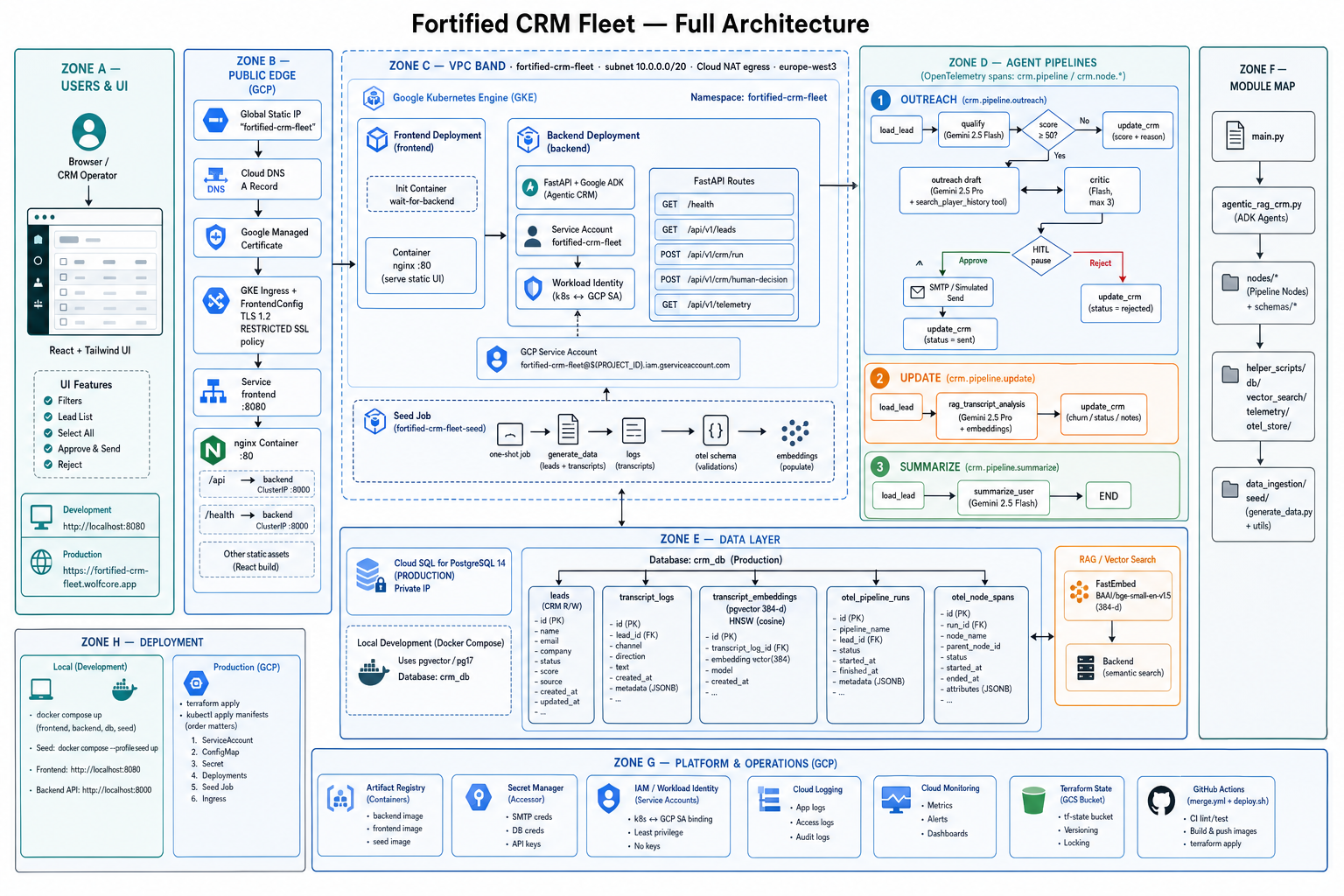
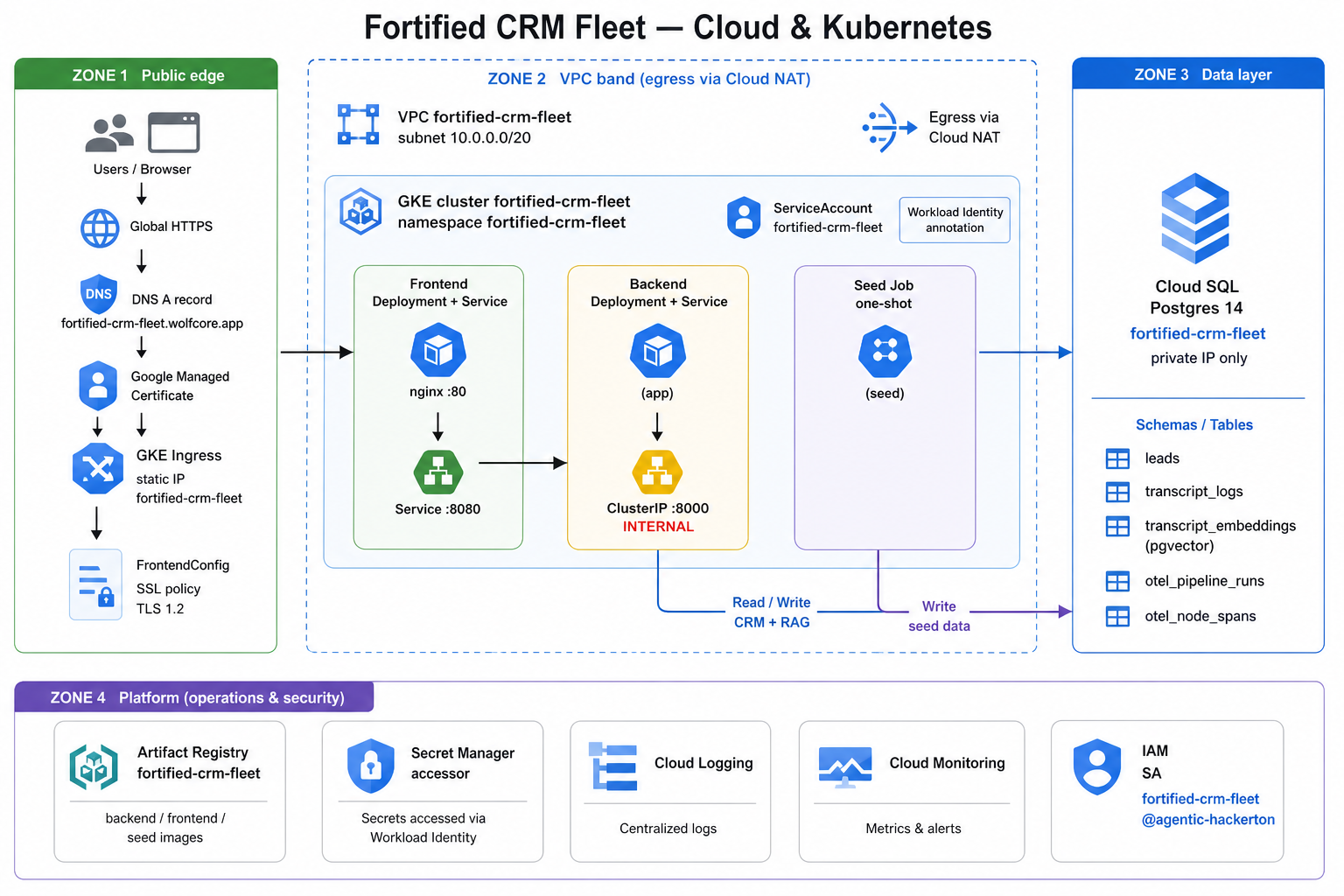
Full Architecture
-
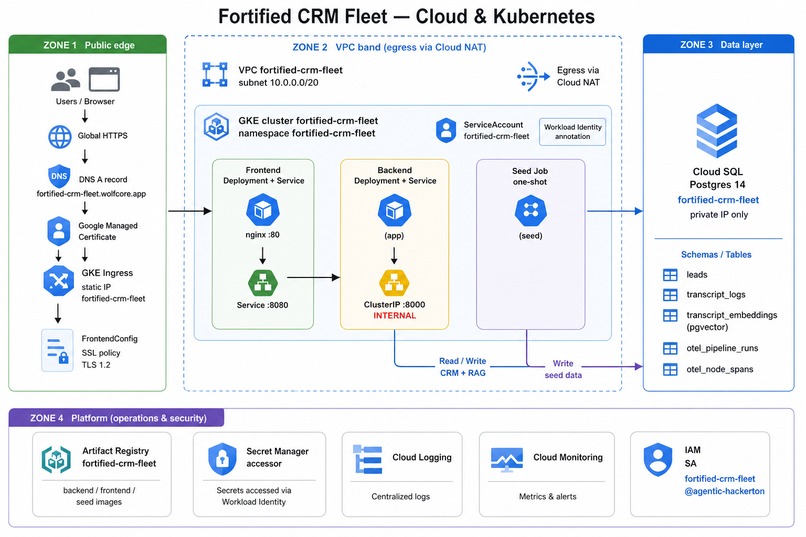
Platform
-
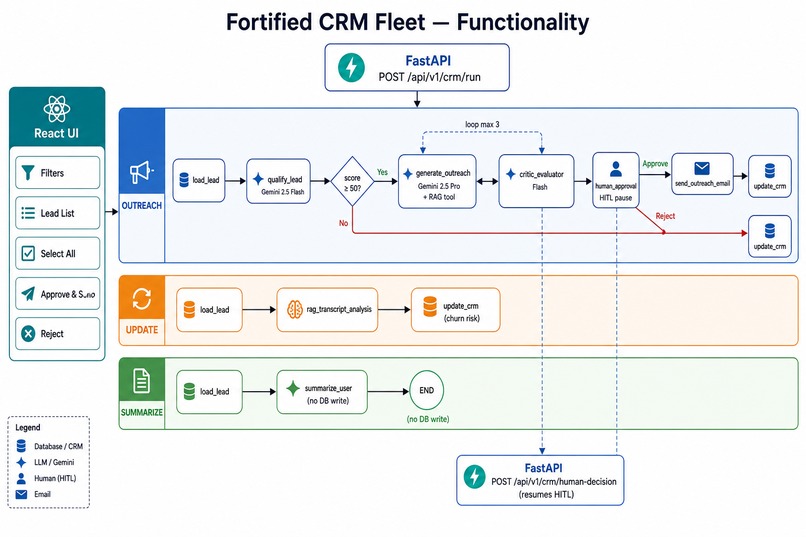
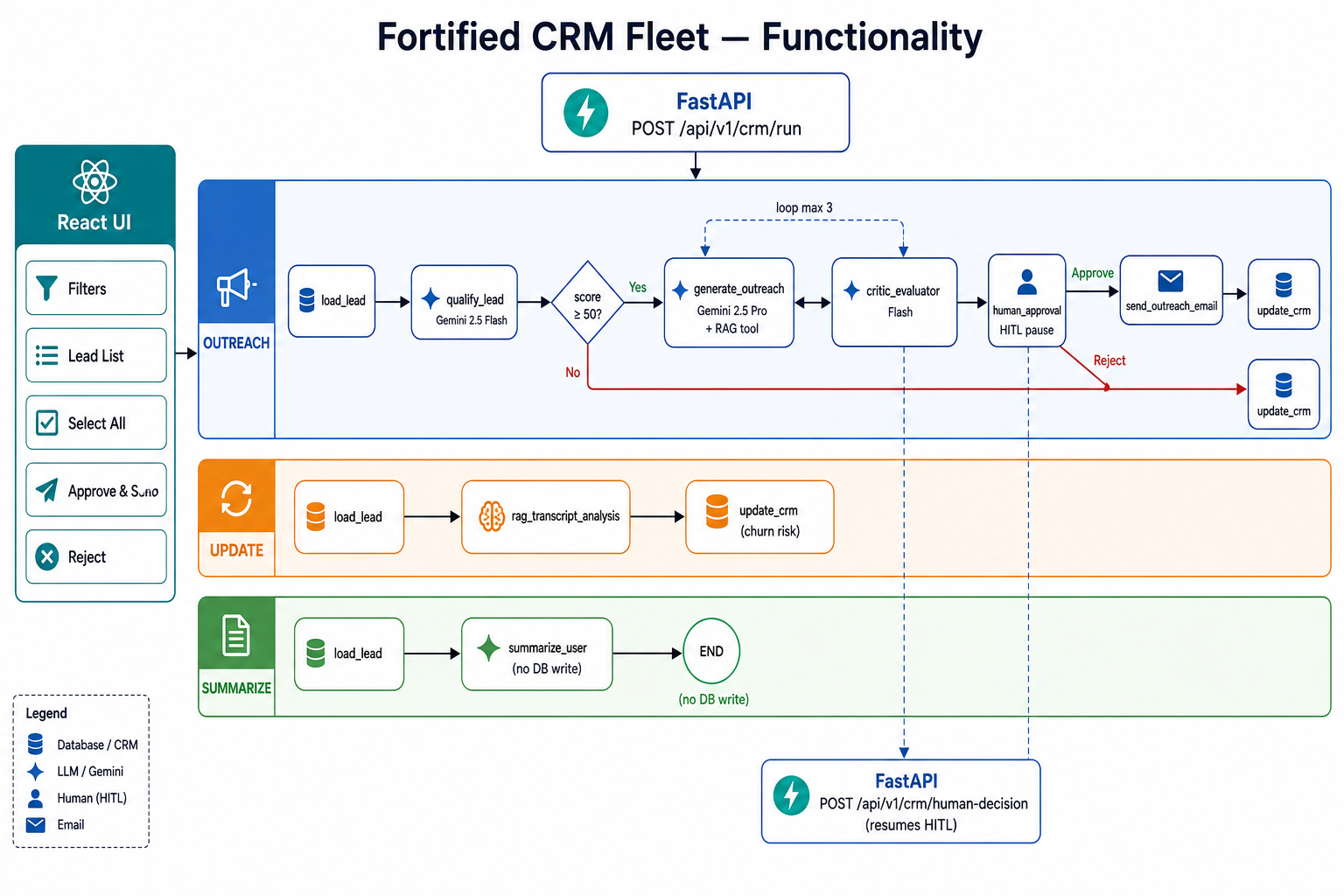
Functionality
-
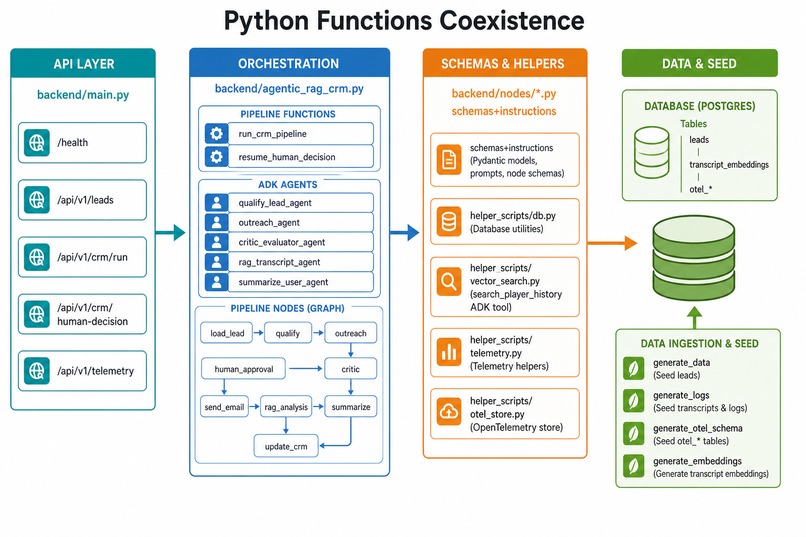
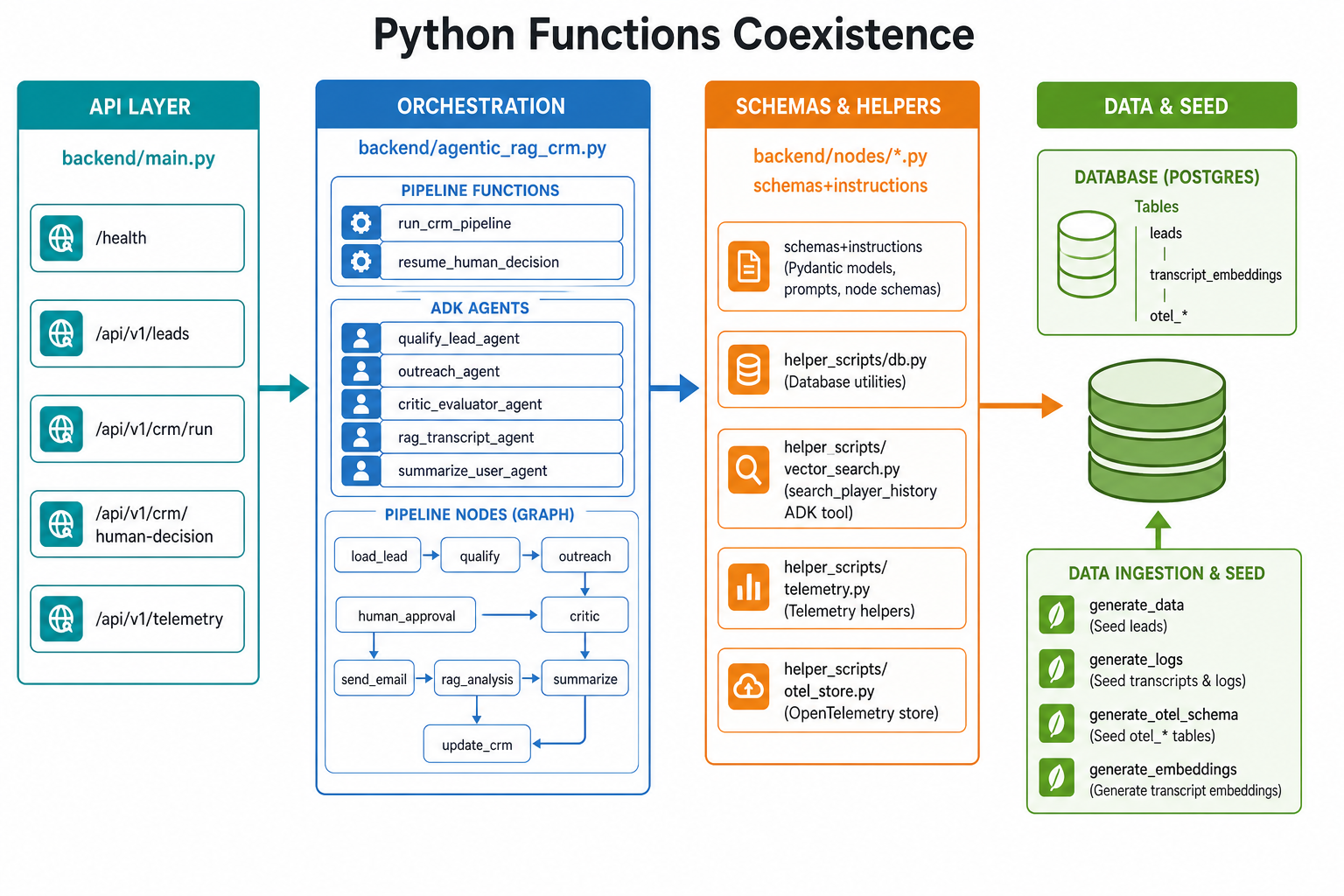
Code Structure
-
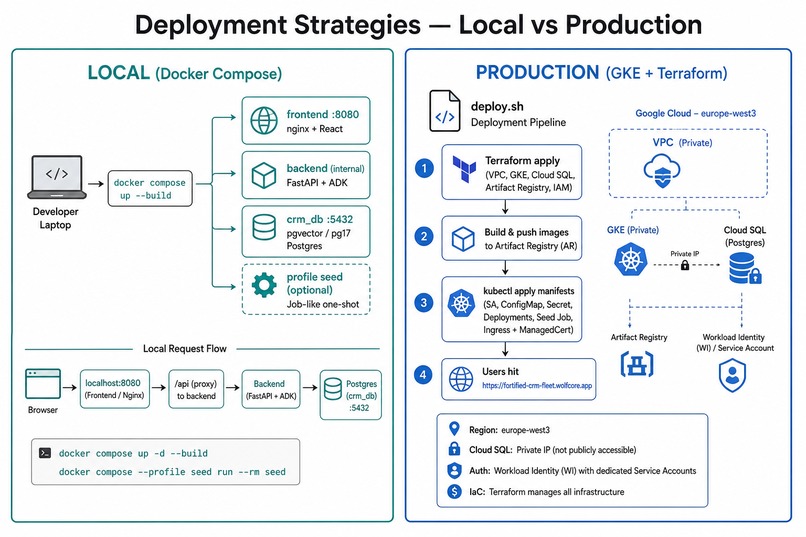
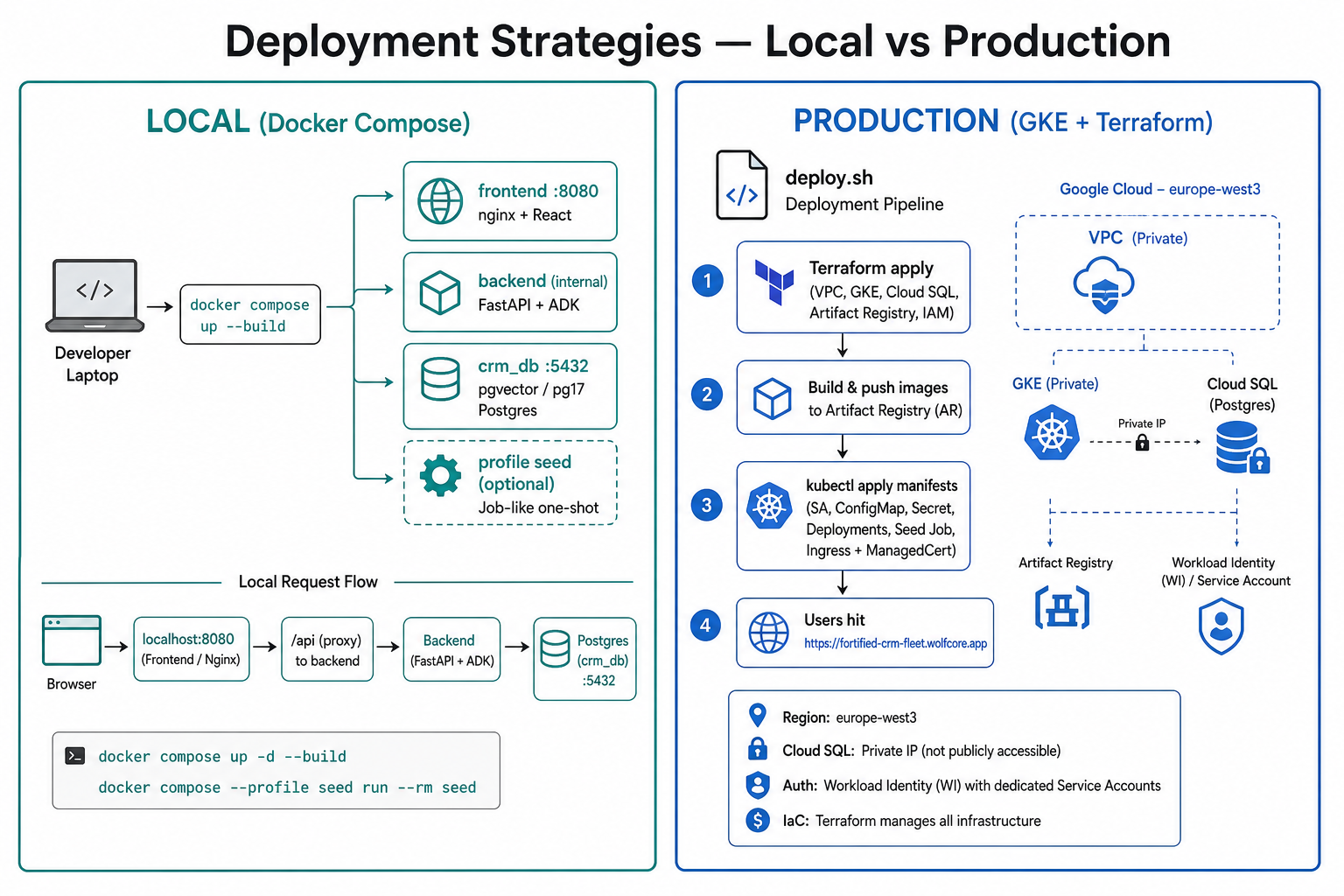
Deployment
Inspiration
I work as a data platform engineer at an iGaming company. My days are pipelines, warehouses, and keeping player data trustworthy. The gap I kept noticing was not “more dashboards”—it was the CRM motion on top of that data.
We already know spend, play hours, genre preference, and often why someone opened a support ticket. Still, outreach starts from templates. Churn shows up late. VIP summaries get pasted together by hand. I wanted something that closes that loop the way a platform person thinks: qualify → draft → critique → pause for a human → send → write back, with the same Postgres/vector habits I trust in production.
The Google Hackathon was the excuse to build it properly not a single chat box, but FastAPI + React, Google ADK + Gemini, pgvector RAG, HITL, OpenTelemetry, and a real path from Docker Compose to GKE. That became the Agentic CRM Platform (Fortified CRM Fleet).
What it does
Three actions over one lead profile:
| Action | What happens |
|---|---|
| Outreach | Score the player, draft a genre-aware email, run a critic loop, wait for Approve/Reject in the UI, then send (or simulate SMTP) and update CRM |
| Update | RAG over chat history → sentiment / churn / recurring issues → persist churn risk |
| Summarize | Profile + transcript context → actionable briefing (no CRM write) |
The UI filters leads, supports multi-select outreach/update, and surfaces Approve & send / Reject when a draft is waiting on a human.
Under the hood the rules stay explainable. Qualification is $s \in [0, 100]$; we only generate outreach when
$$ s \ge 50 $$
Critic revisions are bounded so agents cannot thrash forever:
$$ n_{\mathrm{rev}} \le 3 $$
How I built it
Data first. Tables for
leads,transcript_logs,transcript_embeddings, andotel_*. Seed jobs load players/logs and embed history—no empty vector index pretending to be smart.Thin API, sharp agents. FastAPI exposes
/api/v1/crm/runand/api/v1/crm/human-decision. Orchestration lives inagentic_rag_crm.pywith Google ADK agents: Flash for qualify/critic/RAG/summary, Pro for outreach, plussearch_player_historyas an ADK tool.HITL on the critical path. In iGaming a bad email is a brand/compliance issue. Critic can reject; humans still gate send.
Two deploy stories. Local Compose (UI
:8080, backend, pgvector, seed profile). Production-shaped Terraform (VPC, GKE, Cloud SQL, Artifact Registry, WI) + Kubernetes manifests +deploy.sh/ GitHub Actions aligned to the same apply order.Migration when the rules required it. We started closer to a LangGraph/OpenAI sketch, then moved LLM calls to ADK + Gemini 2.5 while keeping Postgres, FastAPI, and OTel.
Challenges I ran into
- Scope vs honesty. Easy to add more agents; harder to ship three clear actions with one HITL gate.
- Docker build context. Backend image needs repo root (
backend/+helper_scripts/). Building with context../backendfrom Terraform failed until we fixed-f+ context like Compose. - GCP identity. ADC scope crashes after a suspended login; wrong project/account → “no permission to access Project…”. Half of deploy is IAM hygiene.
- CI ↔
deploy.shdrift. Manifests, secrets, and Actions each wanted a different story. Aligningmerge.ymlto the same render (:v1.0.0→ tag) and apply order removed a lot of “works locally” pain. - Critic-tight copy. Genre mention, CTA, and word-count bounds rejected a lot of first drafts until instructions and feedback loops tightened.
Accomplishments that I am proud of
- An end-to-end agentic CRM that writes back to the database—not just chat.
- Human-in-the-loop before send, with a critic loop capped at three revisions.
- RAG over real-ish support history (lag vs billing queries) grounded in pgvector.
- Observability (pipeline/node spans, tokens, cost) persisted for review even when the UI stays operational.
- A deploy path that looks like work I would show a platform team: Compose → Terraform → GKE Ingress, plus architecture diagrams and a seed Job.
What I learned
- Agents are only as good as retrieval + write-back. Pretty drafts that never update
leadsare toys. - HITL changes architecture. In-memory pause/resume is fine for a demo; multi-replica needs sticky sessions or a shared store.
- Domain language beats model size. iGaming fields and RAG seeds (“server lag…”, “refund billing…”) mattered more than swapping Flash for a larger model everywhere.
- Platform habits transfer: change the agent runtime, keep the data plane; treat CI like another environment, not a special case.
What's next for Fortified CRM Fleet
- Shared HITL store (Redis / DB) so pause/resume survives multiple backend pods.
- Cloud SQL Auth Proxy / private connectivity as the default prod DB path; tighten secrets via Secret Manager + External Secrets.
- Richer OTel in the UI (cost/latency per action) for CSMs and platform owners.
- More channels (in-app / push) with the same critic + HITL gate.
- Evaluation harness: golden leads, critic pass-rate, retrieval hit-rate so we can improve agents without vibes-only demos.
- Closer coupling to warehouse signals (LTV bands, responsible-gaming flags) so qualification uses the same truth the rest of the iGaming data platform already trusts.
Built With
- adk
- artifact
- cloud
- docker
- fastapi
- fastembed
- gemini
- github
- gke
- human-in-the-loop
- kubernetes
- opentelemetry
- pgvector
- postgresql
- python
- rag
- react
- registry
- sql
- terraform
- typescript


Log in or sign up for Devpost to join the conversation.