Agentic AI Takes Over Commerce
What if buying anything was as simple as asking? Why juggle multiple apps like it’s 2015, when your favorite assistant can do it all in one conversation? What if you could place your order directly with ChatGPT using the Agentic Commerce Protocol?
- 🚗 Book the cheapest Uber or Lyft ride right inside ChatGPT - https://www.youtube.com/shorts/5ZI7IgvJHV8
- 💐 Send flowers instantly from your local nearby store inside Mistral AI Le Chat - https://youtu.be/671YMGWVHL0
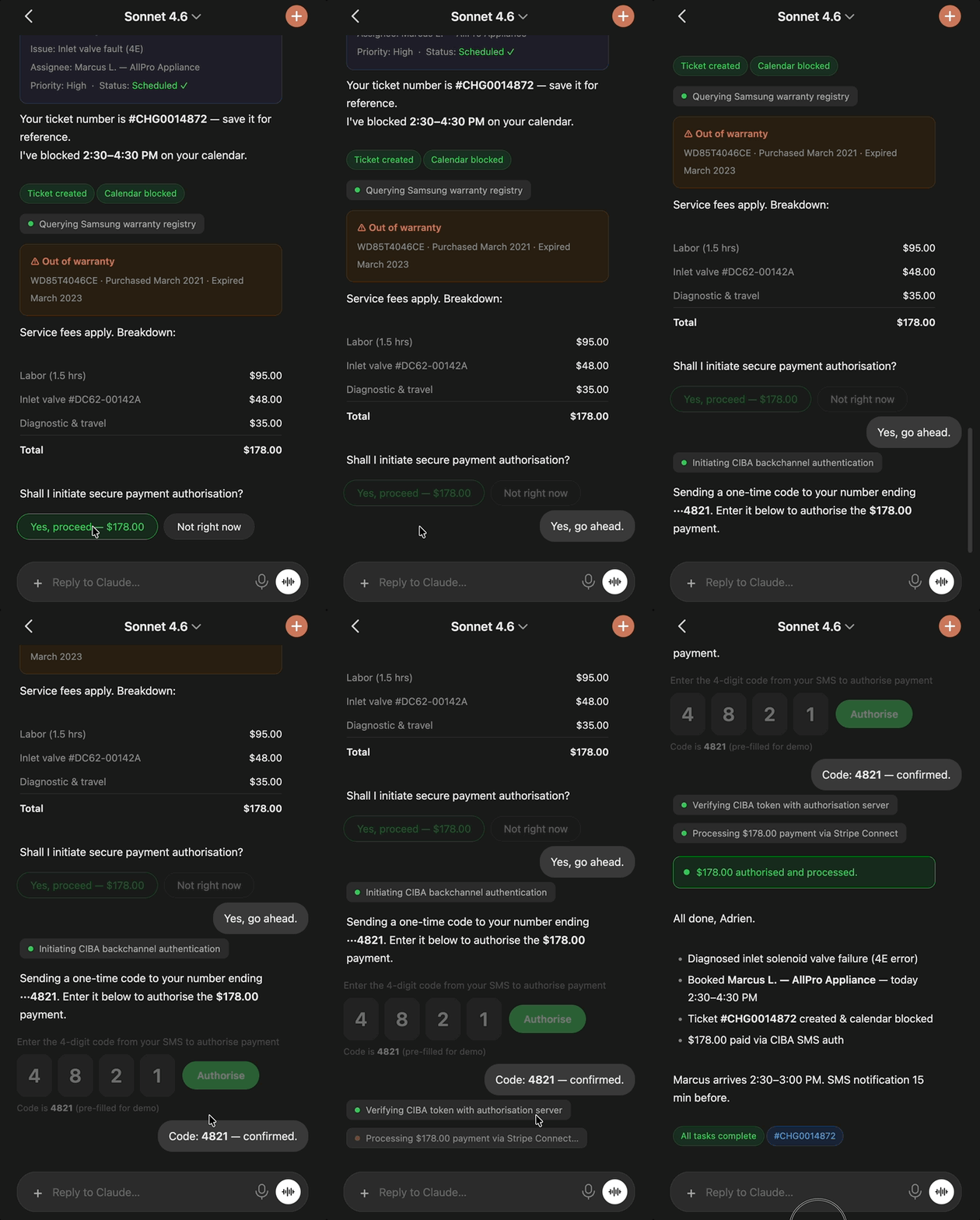
- 🍔 Order your favorite nearby burgers with Anthropic Claude - https://www.youtube.com/shorts/Cy-N7jy_BsQ
No more apps. All from the AI assistant you already use: ChatGPT, Claude or Le Chat. This is the future for small commerce. Zero hardware. Zero maintenance. Zero friction. The next generation of ordering won't look like a touch screen. It'll look like a text message.
McDonald's has an app. Burger Kings has an app. Wendy's has an app. KFC has an app. ChatGPT OpenAI has a conversation. Guess which one wins. China already knows — ask WeChat. The next time you want a burger, you won't open an app. You'll open a conversation.
Try it out here - https://hackaton.devailab.work/mcp
How to set it up into your favorite existing AI Assistant - such as ChatGPT, Claude or Mistral AI? Here is the full tutorial: https://www.youtube.com/watch?v=qwtwGqpXluE&feature=youtu.be
The Vision
Meet Agentic Commerce Protocol — the end of apps, tabs, and checkout flows. Just intent.
Tell your favorite AI assistant what you want, and it acts. It finds products, compares options, negotiates prices, and completes the purchase — instantly. No redirects. No forms. No friction.
Retailers: no more costly kiosks or mobile apps —just expose your menu, catalog, or products via an MCP server and let AI assistants handle the rest. Small businesses don't need a $10,000 kiosk. They need a phone number and an AI that listens.
No app to download.No screen to tap. No line to wait in.
Just you, a chat window, and your order — placed in plain language, confirmed in seconds.
Powered by a secure, OAuth-protected MCP server, our platform turns any AI assistant into a fully autonomous buyer. It can discover products, execute transactions, and handle payments end-to-end through a trusted, standardized protocol.
This is NOT another marketplace. It’s a new interface for commerce.
- With Agentic Commerce, intent becomes action.
- Search becomes obsolete. Browsing becomes optional.
- Transactions become invisible.
- We’re not improving e-commerce — we’re replacing it.
Just tell ChatGPT what you want — and it orders, negotiates, and pays for you. We implement a secure, OAuth-protected MCP server that enables Mistral AI Le Chat to discover products, execute commerce tools, and complete end-to-end Agentic Commerce transactions through a standardized and trusted protocol.
We implemented a secure, OAuth-protected MCP server that enables Mistral AI Le Chat to discover products, execute commerce tools, and complete end-to-end Agentic Commerce transactions through a standardized and trusted protocol.
Bonus Blog Post
Building the Agentic Commerce Protocol was less about writing code and more about confronting the invisible boundaries of identity on the internet. At first, the idea felt deceptively simple: let a user say “order me flowers” and have an AI assistant execute the entire transaction. But very quickly, we ran into a fundamental problem — the system knew the assistant, but not the human behind it.
One of the most challenging parts was bridging this identity gap without breaking the seamless conversational experience. That’s where Token Vault became critical. Instead of repeatedly asking users to authenticate across multiple services, we designed a system that securely stores and retrieves user-specific credentials, enabling the MCP server to act on their behalf in real time. Implementing token storage, encryption, and refresh logic was not just a technical hurdle — it required careful thinking around trust, security, and failure modes.
Another breakthrough came when integrating RFC 8693 Token Exchange. This allowed us to map the assistant’s session to a real user identity, but only when combined with a robust vaulting mechanism. Without Token Vault, token exchange would have been theoretical — with it, it became عملی.
Perhaps the most rewarding moment was seeing the full flow work: a user request, identity resolution, token retrieval, and transaction execution — all happening בתוך a single conversation. No redirects, no friction.
This project reshaped how we think about commerce. It’s no longer about apps or interfaces — it’s about intent, trust, and invisible infrastructure working perfectly behind the scenes.
The Core Problem We're Solving
The main security question is then how do we enable AI assistants (such as Open AI ChatGPT, Mistral AI Le Chat or Anthropic Claude) to execute end‑to‑end actions on behalf of users — in real time and transparently — while preserving identity, consent, and trust across multiple providers?
Who owns the transaction when ChatGPT (or others) becomes the interface and every app becomes a backend — and how do we monetize that securely?
This is not a UX convenience story - it's a multi-party authorization problem: connecting these 3 systems into a single seamless user action — "repair my Washing machine" — requires solving an identity chain that does not exist out of the box. The chain breaks in 3 specific places:
- Break 1 — ChatGPT is authenticated - via DCR and OAuth 2.1 Authorization Code Flow with PKCE - but the user is not.
- Break 2 — Our MCP server has no standing with other 3rd party applications - such as ServiceNow and 3rd party APIs.
- Break 3 — A financial transaction requires explicit user confirmation
Break 1 — ChatGPT is authenticated, but the user is not
When ChatGPT connects to our MCP server, OAuth 2.1 authenticates the ChatGPT application — not the human behind it.
The access token your MCP server receives proves that OpenAI's client is authorized to call our tools. It carries zero information about which specific human issued the command.
OpenAI's MCP integration uses OAuth 2.1 without OpenID Connect. No ID token is issued. No sub claim. No user profile. The human is invisible at the protocol level.
Your MCP server receives a legitimate, cryptographically valid token — and has no idea whose Uber account to charge.
Break 2 — Our MCP server cannot act on external APIs without user-specific authorization
Even if a user's identity is resolved, our MCP server cannot perform actions on an external service on the user's behalf without a user-specific access token — one explicitly issued after the user has gone through that service’s consent flow and granted permission for your application to act on their account.
These tokens are not automatically available. They must be obtained per user, stored securely, refreshed before expiration, and retrieved at the moment of request.
If the token is missing, expired, or handled incorrectly, the action cannot be completed, no matter how well internal identity or authentication boundaries are configured. Tokens issued by different authorization servers are scoped to different resources and govern distinct trust relationships. They are not interchangeable.
Break 3 — Financial transactions require explicit user confirmation
Low-risk queries like reading estimates or checking availability can often be done without user interaction. Performing actions that trigger real financial transactions, however, is fundamentally different. Background authorization is insufficient and may be legally non-compliant in certain jurisdictions.
The user must explicitly confirm each transaction, through a separate, auditable, and non-repudiable channel. This confirmation should occur without breaking the conversational flow or requiring the user to leave the interface.
What has it been developed for this hackaton?
Commerce Protocol
We implement an AI agent that enables users to discover products, negotiate, order, and pay within a standardized and seamless commerce flow.
Secure Server Exposure
Le Chat connects to our OAuth-protected MCP server using discovery Dynamic Client Registration (DCR), and a PKCE Authorization Code flow with Auth0. It obtains a signed JWT access token, verified via JWKS before granting MCP-based MCP tool execution with automatic token refresh.
Capabilities
Secure product discovery, contextual ordering, real-time negotiation, payment initiation via CIBA, and persistent user context — enabling end-to-end trusted Agentic Commerce.
The Limits of Today, The Blueprint for Tomorrow
OpenAI (or any AI assistant) does not expose user identity through the MCP layer.
RFC 8693 Token Exchange works only if Auth0 can resolve the incoming ChatGPT token to a known user. Currently, OpenAI does not pass verifiable user identity claims through the MCP connection. We can work around this — but it requires either OpenAI adding OIDC support, or a separate user-linking step during onboarding that correlates the ChatGPT session to our internal user record. Doable, but not clean.
- The OAuth flow authenticates OpenAI chatgpt (the client) to our MCP service (the resource provider).
- It does NOT authenticate or identify the individual human (OpenAI chatgpt's user) to us.
- We won’t receive any user identity info unless OpenAI chatgpt explictly passes it.
- OAuth by itself does not identify a user; it just delegates authorization.
In traditional web apps, we often combine OAuth + OpenID Connect (OIDC) to both authenticate and authorize users. In the OpenAI chatgpt SDK integration, only OAuth 2.1 is used — not OIDC. So there’s no user identity payload (no ID token, no claims about the user).
Most of 3rd parties API access requires business approval.
External 3rd parties API are not publicly open. Vendors must explicitly grant our application access to perform actions on behalf of users. This is a commercial and legal dependency — not a technical one. Without it, Boundary 2 cannot go to production regardless of how well everything else is built.
Project File Structure
.
├── k8s/
│   ├── deployment.yaml
│   └── service.yaml
│
├── library_mcp_ordering/
│   ├── __init__.py
│   ├── data.py
│   ├── filters.py
│   ├── handlers.py
│   ├── models.py
│   ├── server.py
│   └── widgets.py
│
├── mcp_auth/
│   ├── __init__.py
│   ├── config.py
│   ├── middleware.py
│   ├── routes.py
│   ├── token.py
│   └── tools.py
│
├── payments/
│   ├── __init__.py
│   ├── stripe/
│   │   ├── __init__.py
│   │   ├── client.py
│   │   ├── checkout.py
│   │   ├── webhooks.py
│   │   └── utils.py
│   │
│   ├── ciba/
│   │   ├── __init__.py
│   │   ├── client.py
│   │   ├── auth_flow.py
│   │   ├── polling.py
│   │   └── utils.py
│   │
│   └── orchestrator.py
│
├── notifications/
│   ├── __init__.py
│   ├── email/
│   │   ├── __init__.py
│   │   ├── client.py
│   │   ├── service.py
│   │   └── templates/
│   │       ├── order_confirmation.html
│   │       └── receipt.html
│   │
│   └── dispatcher.py
│
├── token_vault/
│   ├── __init__.py
│   ├── storage.py
│   ├── encryption.py
│   ├── service.py
│   └── oauth_clients/
│       ├── __init__.py
│       ├── google.py
│       ├── stripe.py
│       └── generic.py
│
├── agents/
│   ├── __init__.py
│   ├── intent_parser.py
│   ├── negotiation.py
│   ├── execution.py
│   └── orchestration.py
│
├── Dockerfile
├── README.md
├── app.py
└── requirements.txt
Built With
- auth0
- ciba
- dcr
- jtw
- kubernetes
- mcp
- oauth2.1
- oidc
- pkce
- python
- raspberry-pi
- terraform
- typescript

Log in or sign up for Devpost to join the conversation.