Inspiration A screenplay tells a story, but a production team needs much more than the story itself.
A single line such as "Sarah runs through a crowded street at night" immediately raises practical production questions: Does the location require a permit? Is traffic control needed? What lighting is required? How complex is the scene? How should it be scheduled with other scenes?
We realized that there is a gap between what a screenplay describes and what a production team needs to know before filming.
That inspired us to build Agentic Cinema a system that transforms screenplay information into practical production intelligence.
Our goal was not to build another chatbot that simply summarizes a script. We wanted to build an agentic production-planning workflow that could understand a screenplay, reason about production requirements, use tools and structured production data, create a shooting schedule, identify risks, and help filmmakers make decisions before production begins.
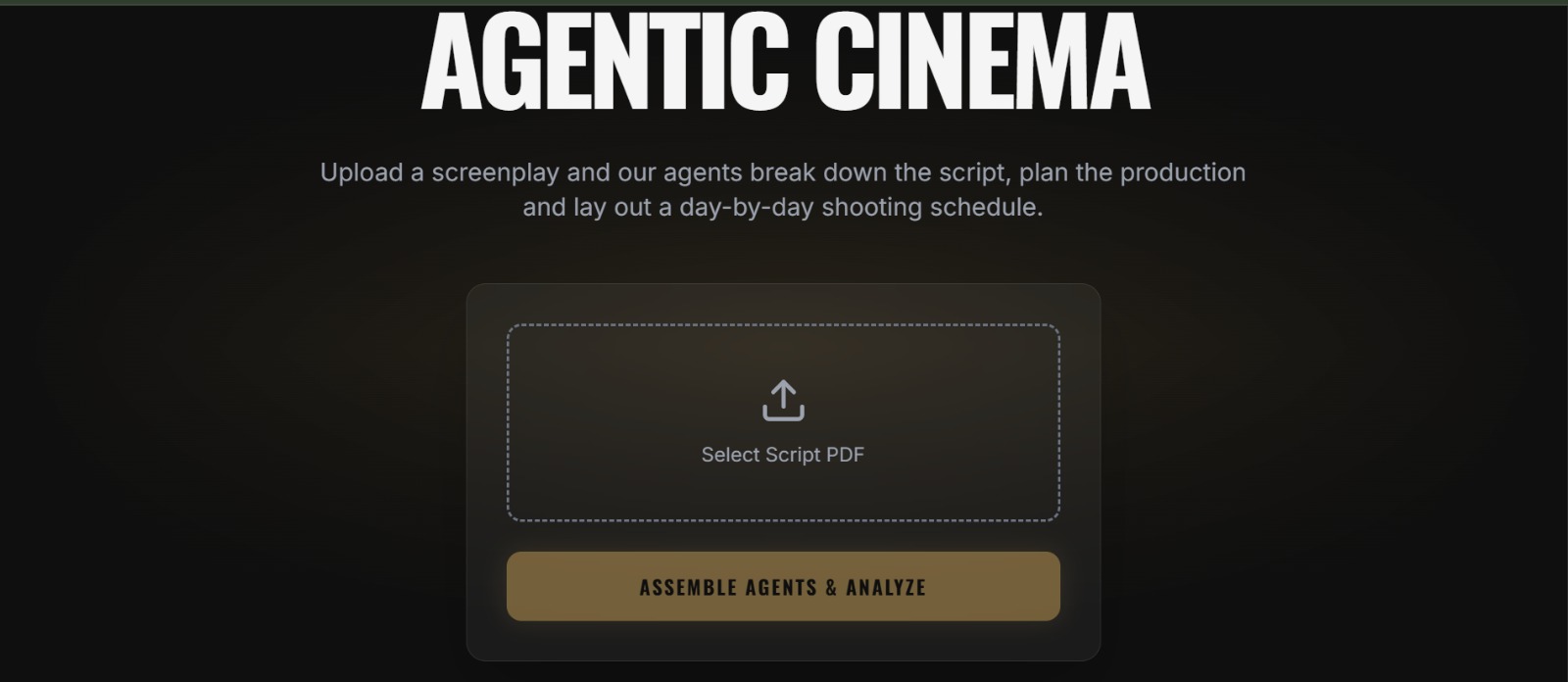
What It Does Agentic Cinema takes a screenplay PDF and transforms it into a structured production plan.
The workflow is:
Screenplay → Script Analysis → Production Planning → Scheduling → Readiness Evaluation → Production Dashboard
The system extracts:
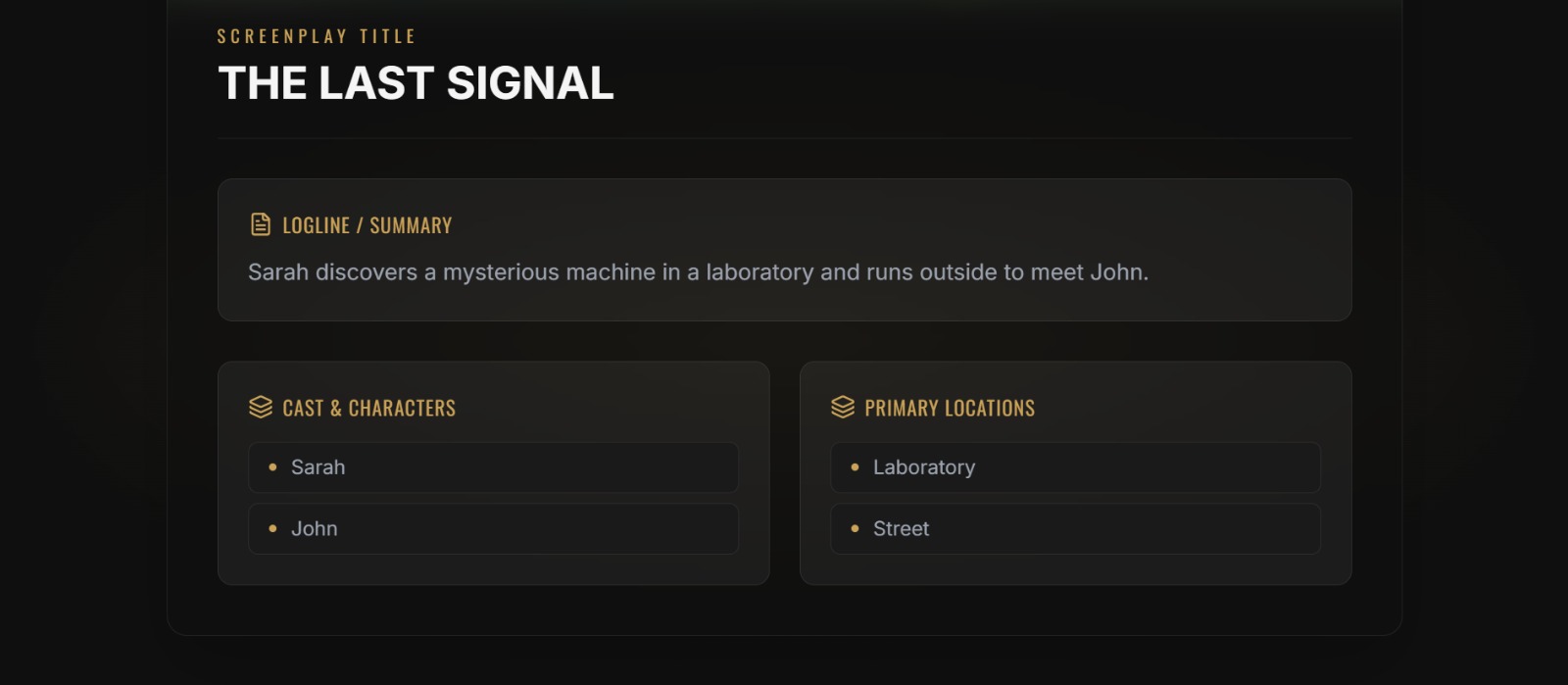
Characters Locations Scenes Story summary Production requirements Location complexity Permit requirements Lighting considerations Production notes Shooting schedule Production risks Recommended next actions
It also generates a Production Readiness Score and provides a Production Assistant where filmmakers can ask questions about their project.
For example:
"What are the production requirements for the Street scene?"
The assistant can identify the location and provide relevant information such as its complexity, permit requirement, lighting approach, and preparation requirements.
We also added an Agent Execution Trace so users can see the major processing stages instead of receiving an unexplained final answer.
How We Built It We built Agentic Cinema as a full-stack application with a React frontend and Python/FastAPI backend.
- Screenplay Processing
A filmmaker uploads a screenplay PDF through the dashboard.
The FastAPI backend validates the file and sends it to our PDF reader. We use PyPDF to extract the screenplay text.
The PDF reader is intentionally kept separate from the AI reasoning layer. Its job is simply to convert the document into text.
- Script Analysis Agent
The extracted screenplay is passed to the Script Analysis Agent.
Using the Google Gemini SDK, the agent analyzes the screenplay and produces structured information including the title, characters, locations, scenes, and summary.
We use Pydantic schemas to validate the structured data produced by the AI.
- Production Planning Agent
The Production Planning Agent converts screenplay information into production requirements.
For each location, it can determine information such as:
Location type Shooting complexity Lighting approach Permit requirements Production notes Preparation requirements
- Deterministic Production Tools
We did not want the AI to invent production rules.
So we created a deterministic Location Tool containing known production rules for locations such as streets, offices, and laboratories.
If an unknown location is encountered, the system uses a cautious fallback rather than confidently assuming that no production requirements exist.
- ClickHouse Production Data
We use ClickHouse to store structured production records such as scenes, locations, shooting days, complexity, permits, and lighting.
This allows the Production Assistant to work with project-specific production information.
- Scheduling Agent
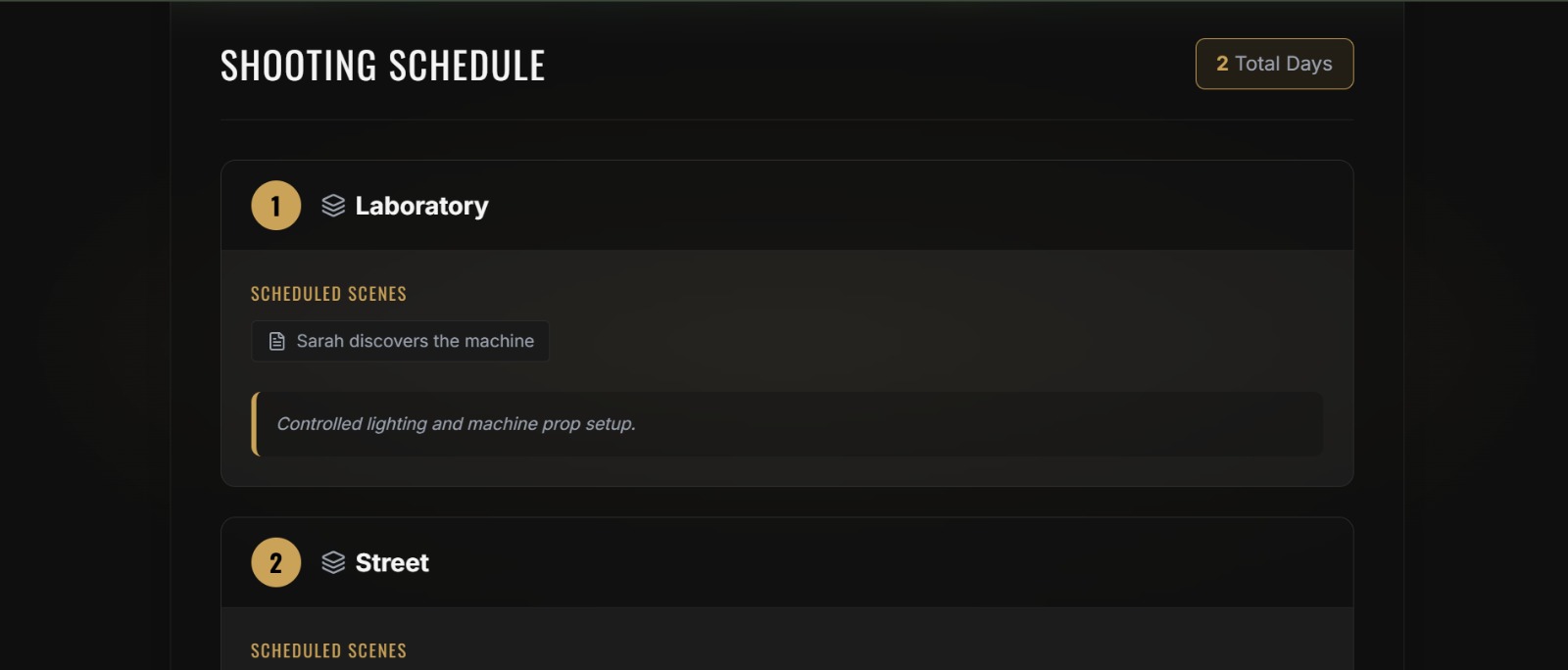
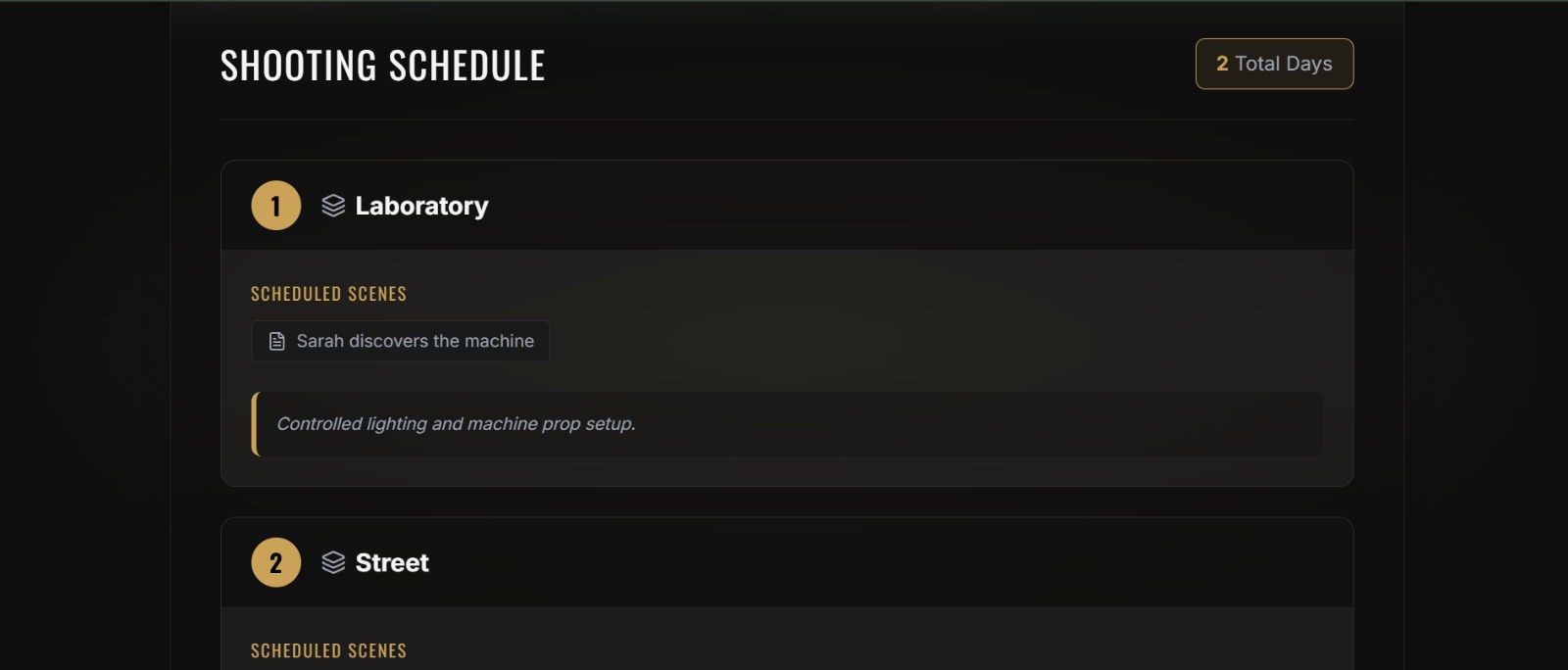
The Scheduling Agent creates a shooting schedule based on the analyzed screenplay and production requirements.
It considers factors such as location grouping, complexity, production requirements, estimated shooting days, and permit-sensitive locations.
Grouping scenes by location can help reduce unnecessary travel, equipment movement, setup changes, and crew downtime.
- Readiness Evaluator
We added a Production Readiness Evaluator to identify potential issues before filming.
It produces:
A readiness score out of 100 Production risks Recommended next actions
For example, if a street scene requires a permit and traffic control, those requirements can become visible before the schedule is locked.
Why It Is Agentic: A major part of our design was avoiding a single "ask the AI everything" approach.
Different stages have different responsibilities:
Script Analysis Agent Understands the screenplay.
Production Planning Agent Converts story information into production requirements.
Scheduling Agent Organizes scenes into a practical shooting schedule.
Readiness Evaluator Checks the production plan for risks and missing requirements.
Production Assistant Uses available production information to answer filmmaker questions.
The agents can also interact with deterministic tools and structured data.
This combination of AI reasoning + tools + structured validation + production data is what makes Agentic Cinema more than a simple chatbot.
Challenges We Faced Turning Unstructured Screenplays into Structured Data
Screenplays are designed for storytelling, not databases.
We needed to reliably transform free-form screenplay text into structured scenes, locations, and characters that later stages could use.
We addressed this with structured AI outputs and Pydantic validation.
Making AI Responses More Reliable
An AI model can produce an answer that sounds convincing even when important information is missing.
We therefore separated AI reasoning from deterministic production rules and added cautious fallbacks for unknown locations.
Handling External Dependencies
Gemini and ClickHouse introduce external dependencies that can affect reliability during a live demonstration.
To solve this, we created a Local Mode that uses deterministic local production rules.
This means the core application can still demonstrate its production-planning workflow without depending entirely on external services.
Connecting Multiple Agents
Another challenge was maintaining consistency between stages.
The output of script analysis becomes the input for production planning, which then feeds scheduling and readiness evaluation.
A malformed or incomplete response in one stage could affect everything after it.
Structured schemas, validation, error handling, and fallback behavior helped us make the workflow more robust.
What We Learned
The biggest lesson we learned is that building an agentic application is not just about connecting an LLM to a UI.
The real challenge is designing a reliable workflow around the model.
We learned how important it is to: Give each agent a clear responsibility Combine AI reasoning with deterministic tools Validate AI-generated data Use structured schemas between stages Build reliable fallbacks Work with project-specific data Make agent workflows observable Turn AI output into actionable decisions
We also learned that a strong AI application needs traditional software engineering practices alongside AI capabilities.
Accomplishments We're Proud Of
We are especially proud that Agentic Cinema does not stop at screenplay summarization.
It takes the screenplay through multiple stages and produces an actual production-planning workflow.
We built:
Multi-stage agentic processing Screenplay PDF analysis Production planning Location intelligence Shooting schedule generation Production readiness scoring Risk identification Recommended actions Production Assistant Local fallback mode Agent execution trace Structured data validation Interactive React dashboard
Together, these features turn an unstructured screenplay into something a production team can actually use for planning.
What's Next
Agentic Cinema is currently focused on early-stage production planning.
With more development, we would like to expand it with richer production data, more sophisticated scheduling constraints, additional location intelligence, stronger collaboration features, and deeper production-cost planning.
Our long-term vision is to make Agentic Cinema a production intelligence layer that helps filmmaking teams identify constraints and make better decisions before the cameras start rolling.
Final Vision
A screenplay begins with a story.
Agentic Cinema helps turn that story into a plan.
Screenplay → Production Intelligence → Schedule → Readiness → Action
Our goal is simple: help filmmakers plan faster, identify risks earlier, and make better production decisions before filming begins.
Built With
- clickhouse
- fastapi
- googlegemini
- pydantic
- pypdf
- pytest
- python
- react
- replit
- tailwindcss
- typescript
- vite

Log in or sign up for Devpost to join the conversation.