-
-
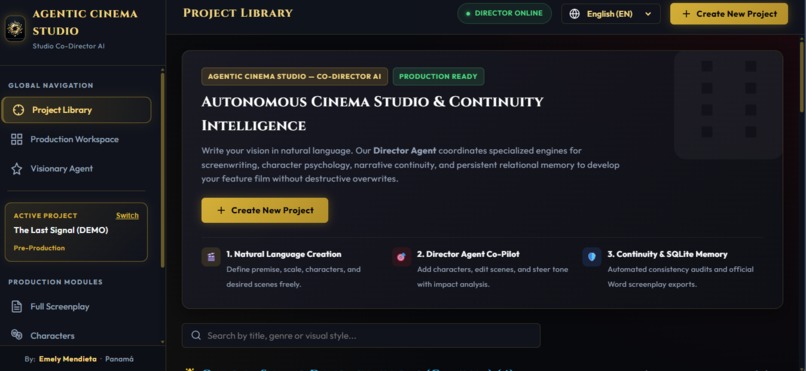
Main studio
-
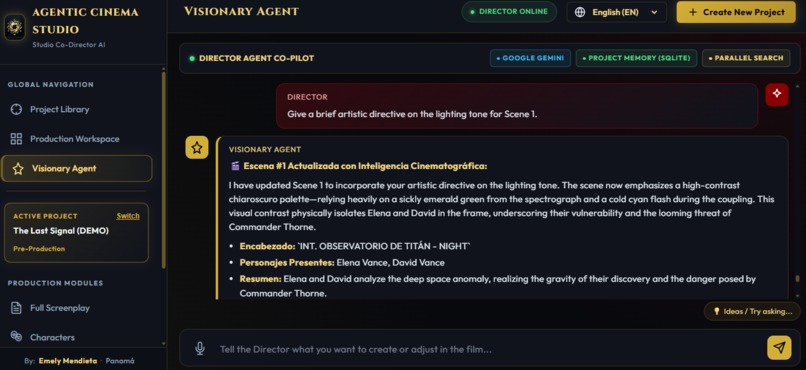
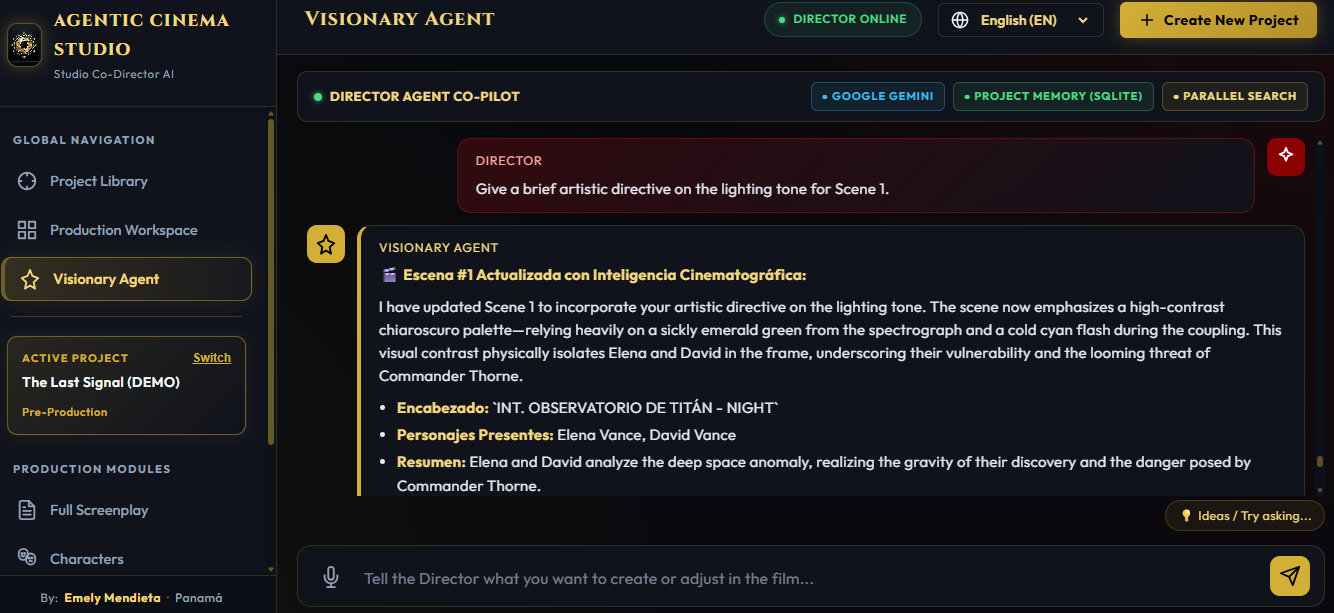
Studio Co-Director chat
-
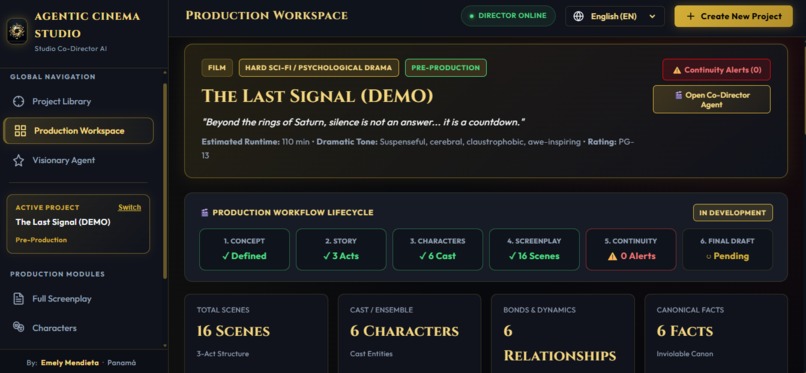
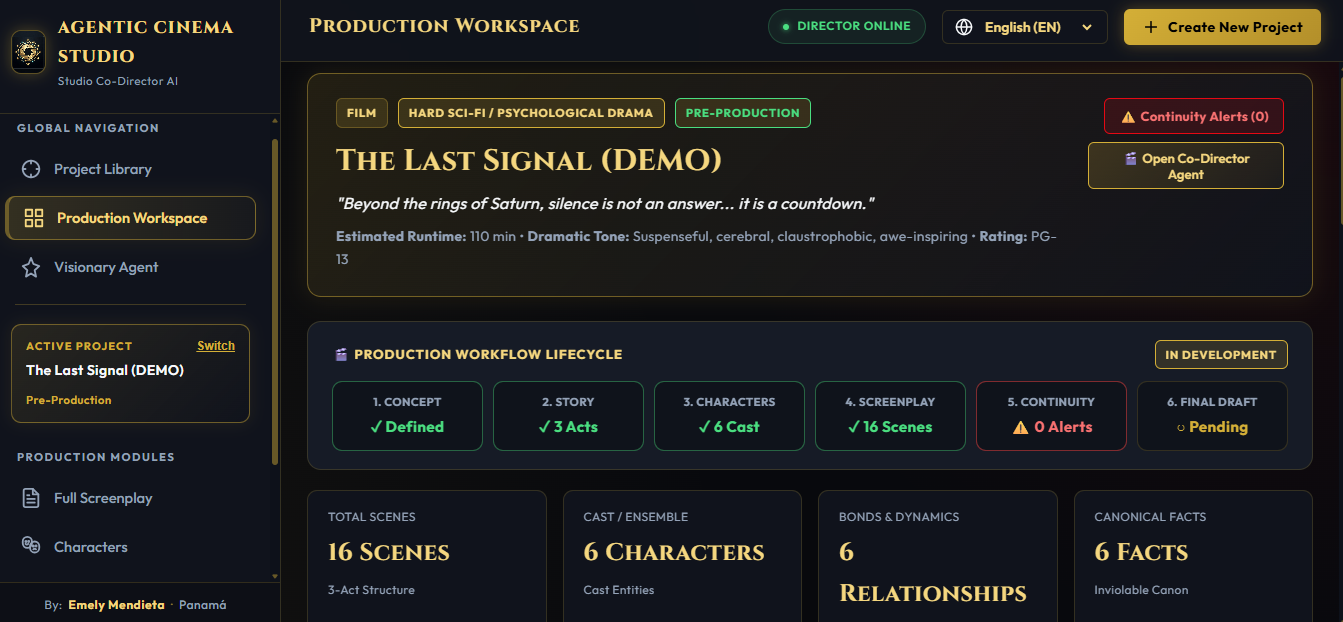
Production Workspace
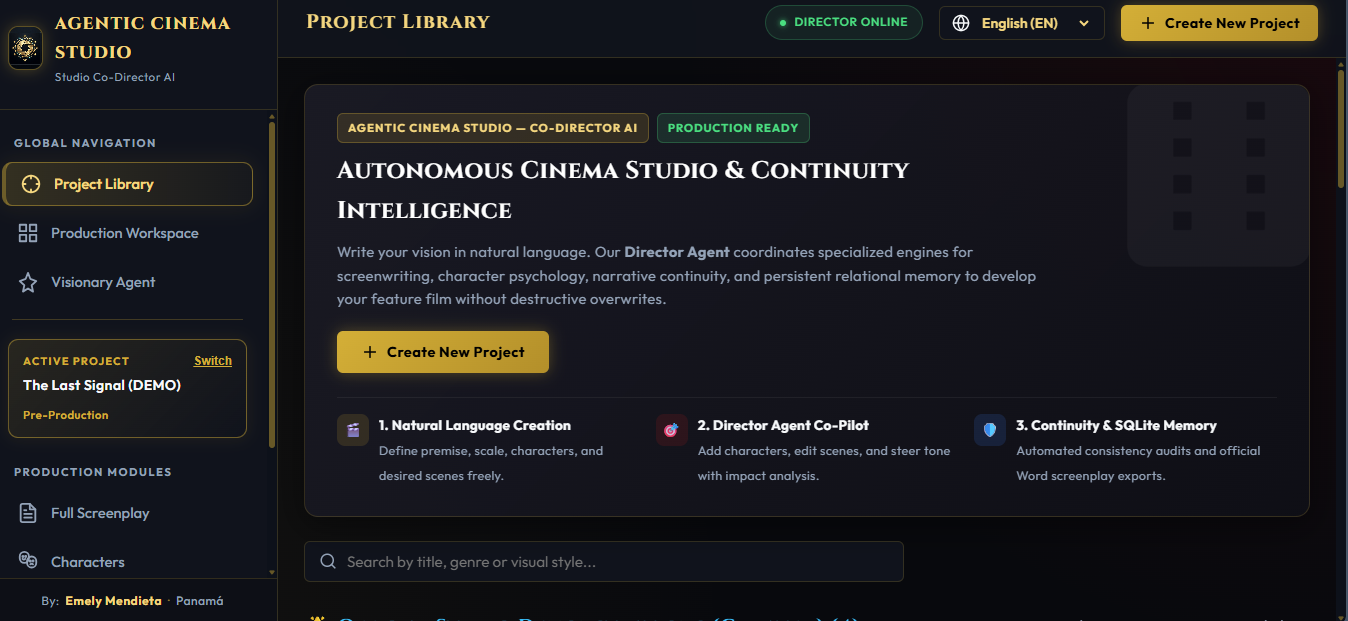
Agentic Cinema Studio
Agentic Cinema Studio is an AI-powered cinematic workspace designed to transform film pre-production from a fragmented process into an intelligent, interactive studio environment.
The platform acts as a Studio Co-Director that coordinates specialized AI capabilities across storytelling, characters, scenes, continuity, production intelligence, and real-world location research.
What it does
A filmmaker can start with a creative idea and progressively develop it into a structured production package. The platform can assist with:
- Story and screenplay development
- Character creation and character relationships
- Scene generation and scene breakdowns
- Narrative continuity and project memory
- Production and budget intelligence
- Real-world location scouting
- Multilingual studio workflows
- Hollywood-style screenplay exports
- Controlled application of AI-proposed changes with a confirmation step
- Rollback and project history for applied changes
One of the core workflows is "Scout with Parallel." For a selected scene, the system creates a scene-aware research objective and uses Parallel Search API to retrieve real-world locations and relevant information. Gemini then helps interpret the retrieved information in the context of the film and present useful options to the director.
The platform follows a Zero Mutation Gate principle: research results are treated as proposals first. The screenplay and project state are not changed until the director explicitly chooses to apply a proposed change.
Technology
The backend is built with Python, Flask, and Gunicorn, with SQLite used for relational project state and history.
The AI layer uses Google's Gemini through the Google GenAI SDK. The application contains a multi-agent orchestration layer with specialized engines for story, characters, scenes, narrative changes, continuity, project memory, and production intelligence.
The Parallel track integration uses the official Parallel Python SDK and Parallel Search API at runtime for real-world research and location scouting.
The frontend is built with HTML, CSS, and vanilla JavaScript, providing a responsive studio-style interface.
The project is deployed as a web application and uses Render for public hosting.
Data sources
The application combines structured project data stored in SQLite with information retrieved dynamically through Parallel Search API when the director requests real-world research.
The project does not require a proprietary movie database. Instead, it generates and manages the production state created by the filmmaker while using live web research when external information is needed.
What we learned
One of the biggest lessons from building Agentic Cinema was that an effective creative AI system needs more than a single conversational model. Different production tasks require different forms of reasoning, structured state, continuity, and controlled changes.
We also learned that autonomous behavior needs boundaries. The Zero Mutation Gate was introduced so that research and AI recommendations can remain exploratory until the filmmaker explicitly approves a change.
Another important lesson was the value of persistent project memory. A cinematic project is not a sequence of isolated prompts: characters, scenes, relationships, decisions, and previous changes need to remain connected throughout the workflow.
Agentic Cinema ultimately explores a simple question: what would a film studio look like if its creative and production workflows could collaborate with an AI co-director without giving up human creative control?

Log in or sign up for Devpost to join the conversation.