-
-
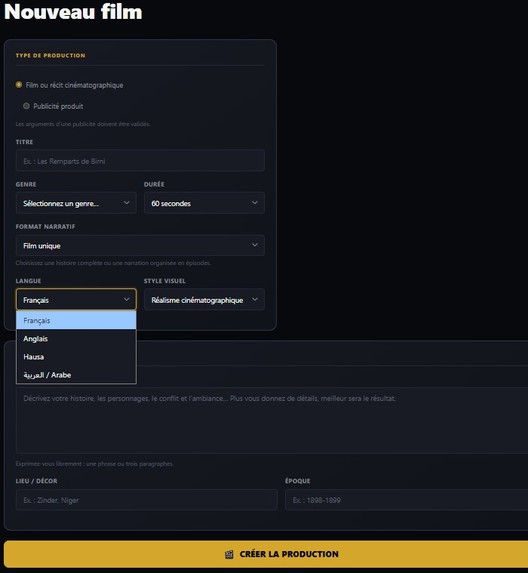
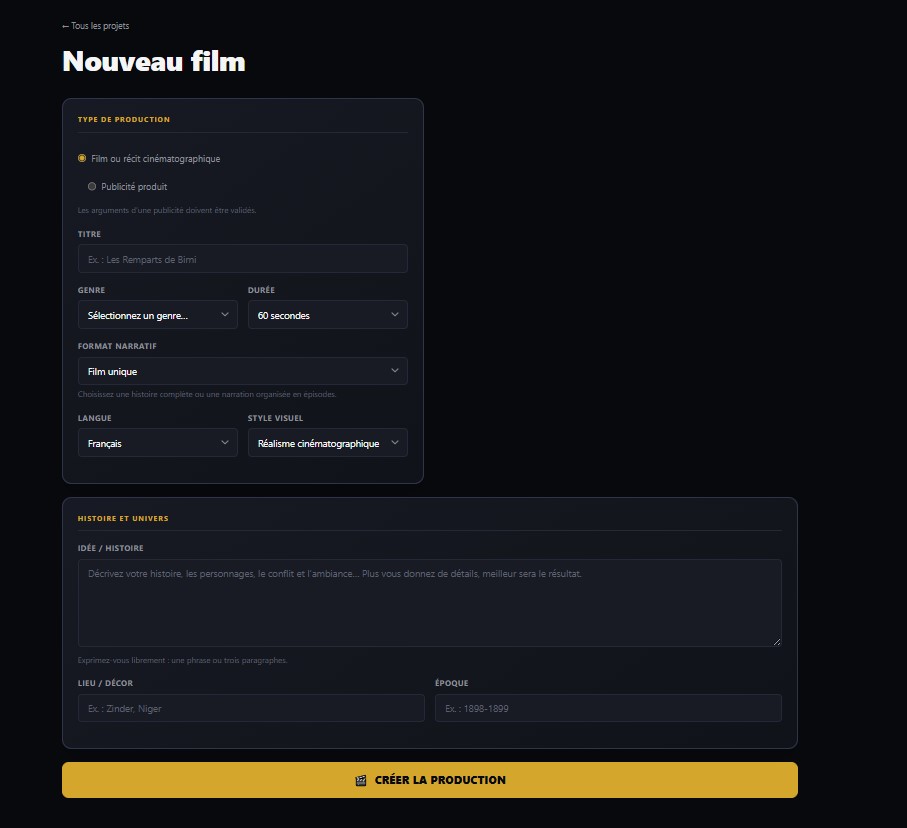
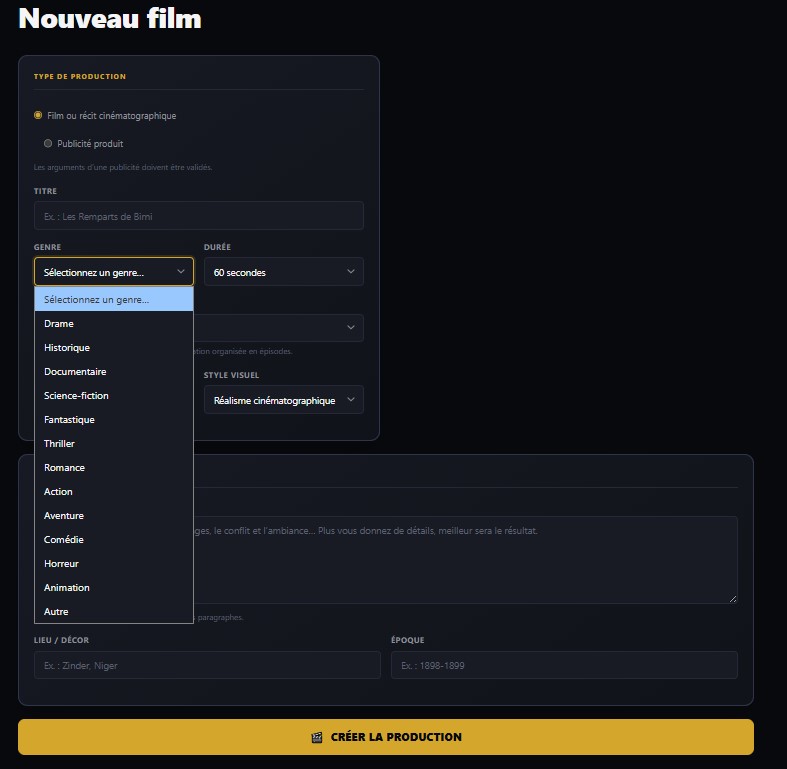
NEW FILM OPTION3
-
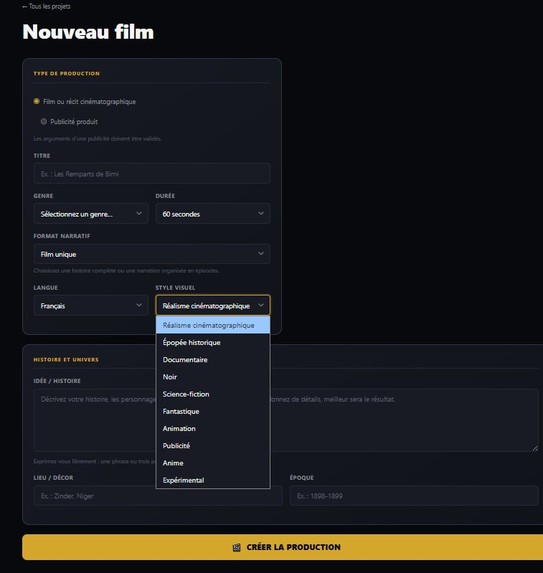
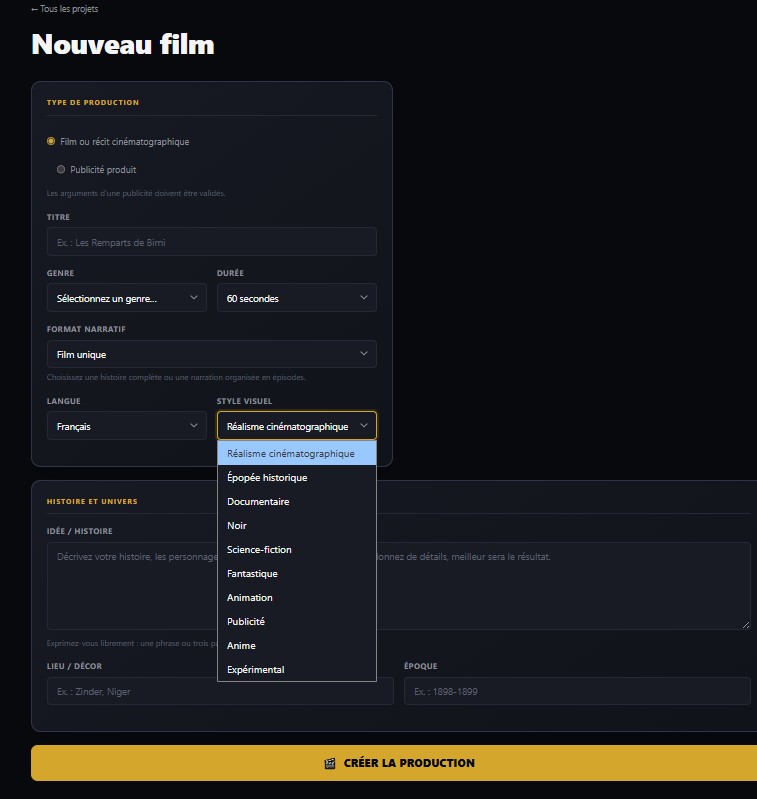
NEW FILM OPTION1
-
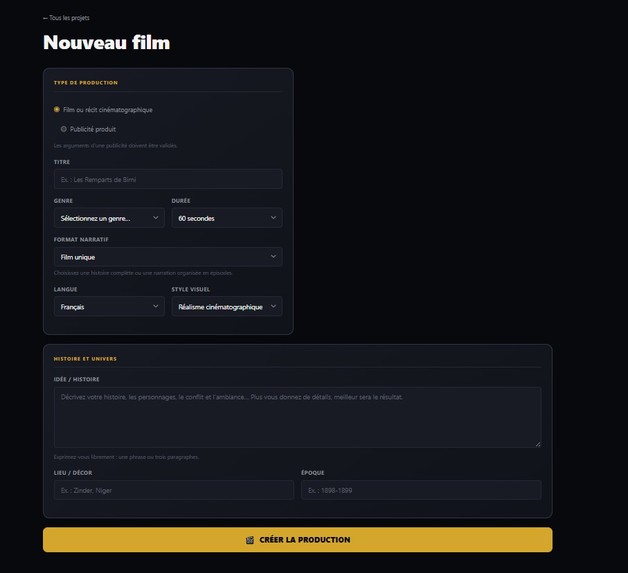
NEW FILM
-
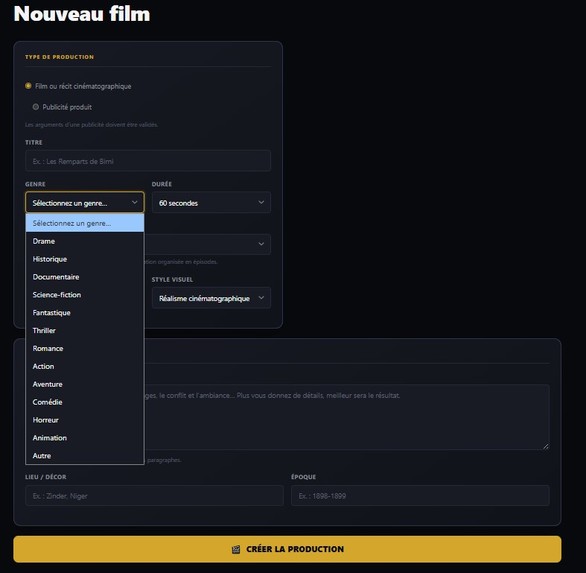
NEW FILM OPTION2
-
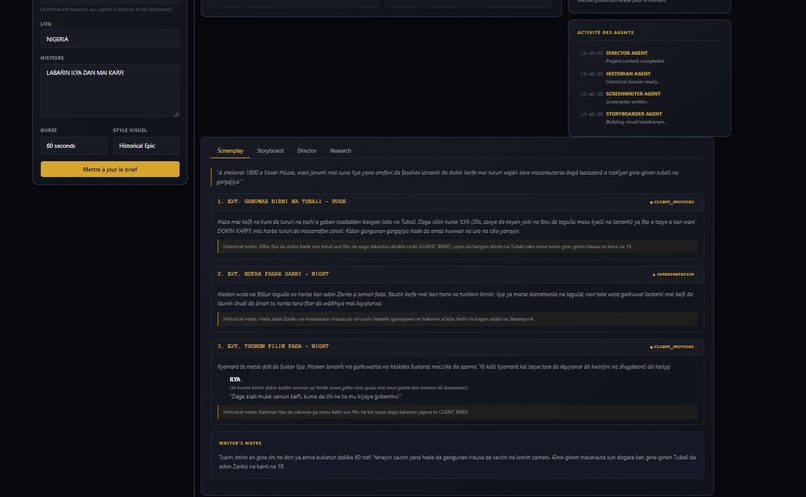
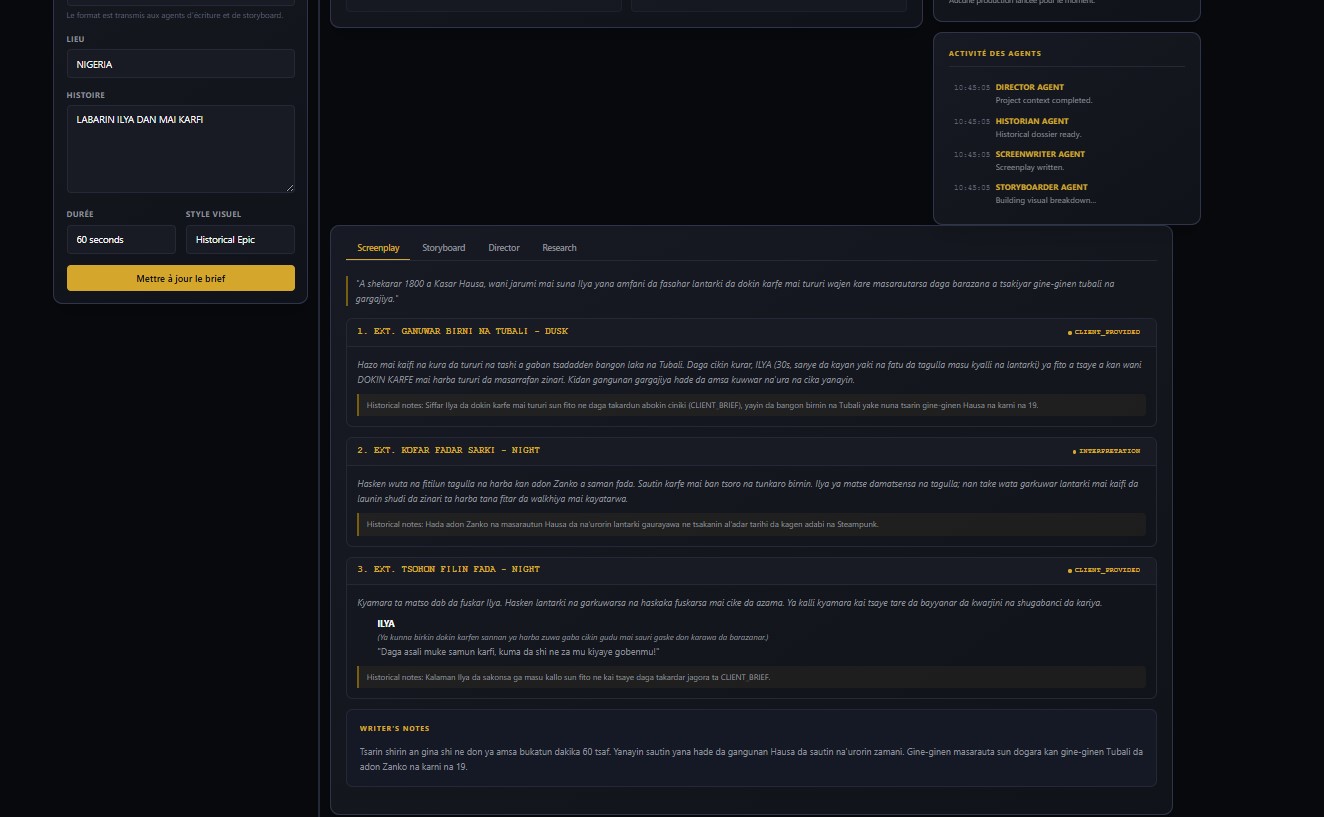
THE AGENTS
-
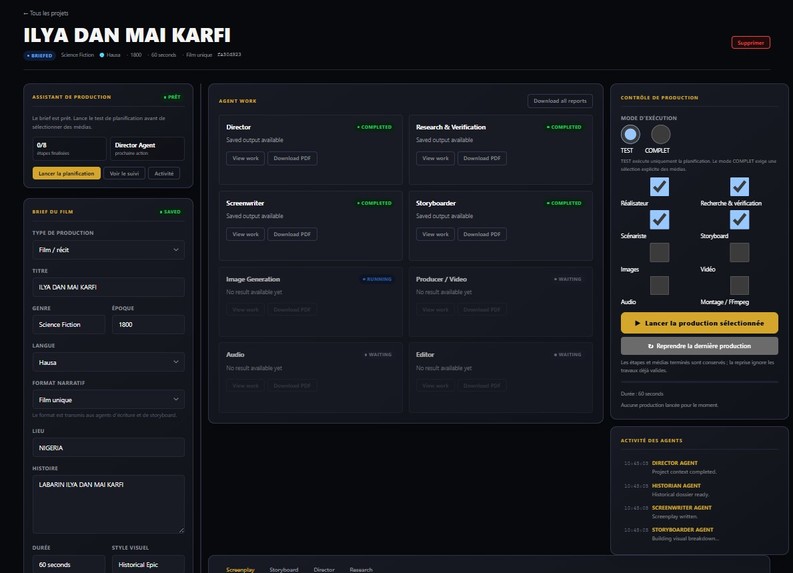
PRODUCTION STUDIO
-
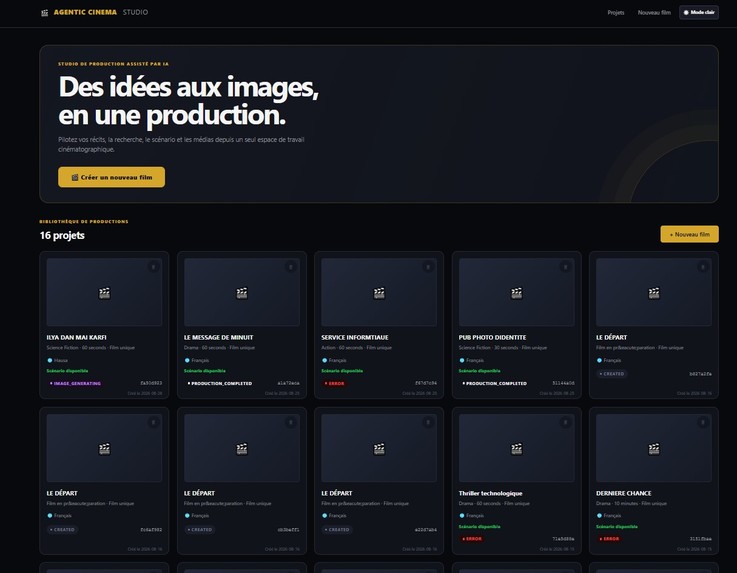
DASHBORAD
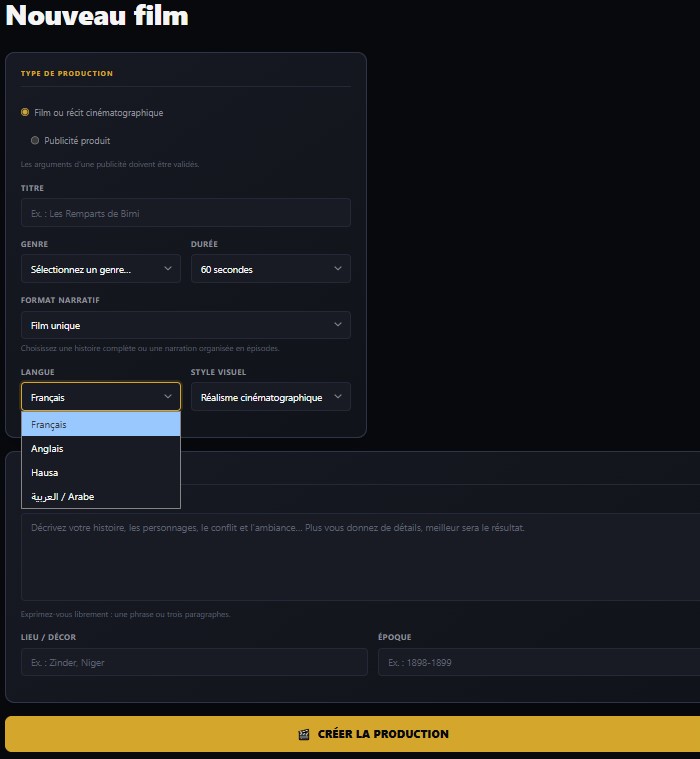
🎬 Inspiration
Film production is a complex process involving research, writing, visual planning, production, sound, and editing. Generative AI can help with each of these tasks individually, but most existing tools still require the creator to manually move information from one step to another.
We wanted to explore a different idea:
What if an entire virtual film studio could operate as a coordinated team of specialized AI agents?
That idea became Agentic Cinema Studio — a multi-agent filmmaking platform where the user acts as the creative director and AI agents collaborate to transform a simple brief into a structured cinematic production.
Our pilot story, Les Remparts de Birni, is inspired by the history of the Damagaram Sultanate in Zinder, Niger. Working with historical material also introduced an important challenge: AI-generated cinema should not present invented dramatic elements as documented history.
For that reason, historical research and source grounding became a core part of the architecture.
🚀 What it does
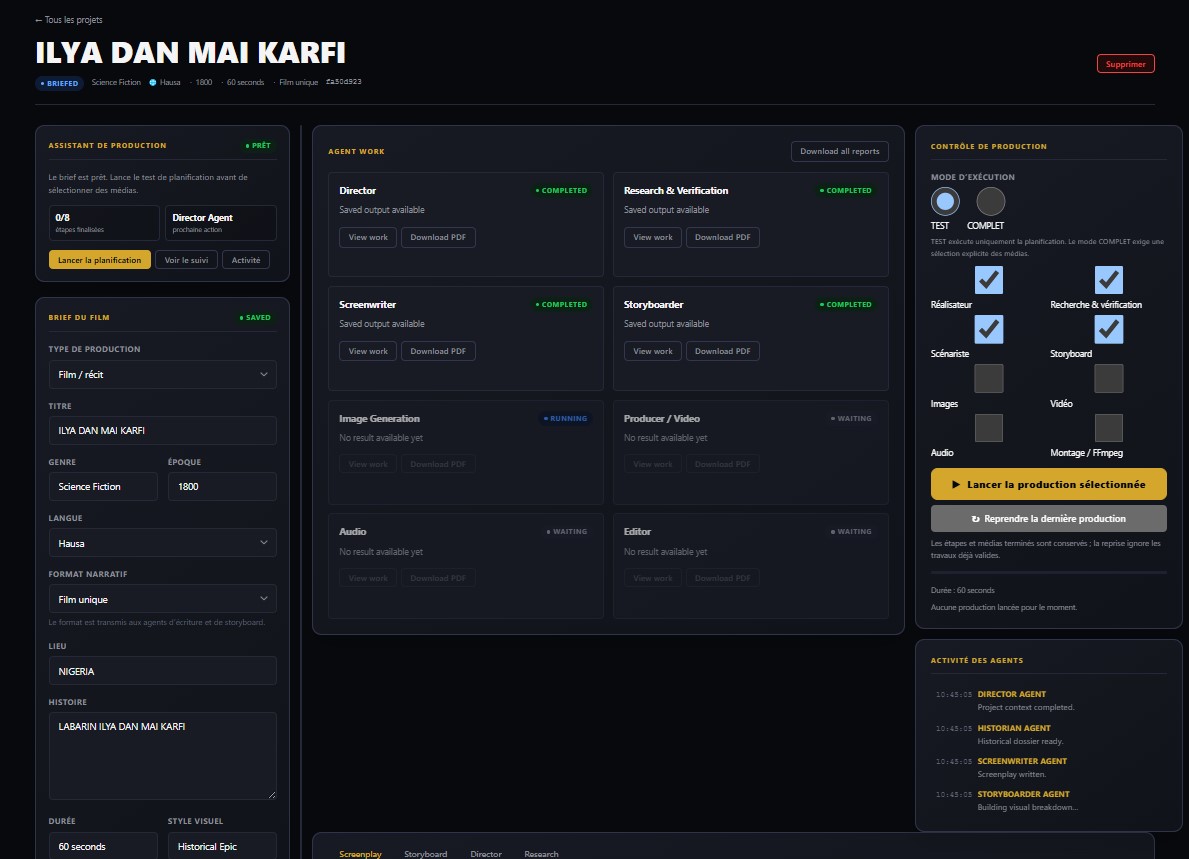
Agentic Cinema Studio transforms a creative brief into a cinematic production through a coordinated pipeline of specialized agents.
The workflow includes:
- Director Agent — analyzes the creative brief and defines the artistic direction.
- Historian Agent — researches historical context using Parallel Search and produces sourced material.
- Screenwriter Agent — transforms the creative and historical context into a structured screenplay.
- Storyboarder Agent — converts scenes into detailed cinematic shots and generation prompts.
- Image Generation Agent — generates visual references for individual shots.
- Producer Agent — creates video clips from the prepared shots.
- Audio Agent — prepares narration and audio elements.
- Editor Agent — assembles available media into the final cinematic output using FFmpeg.
Instead of behaving like a single chatbot, every agent has a specialized responsibility and consumes structured outputs produced by previous agents.
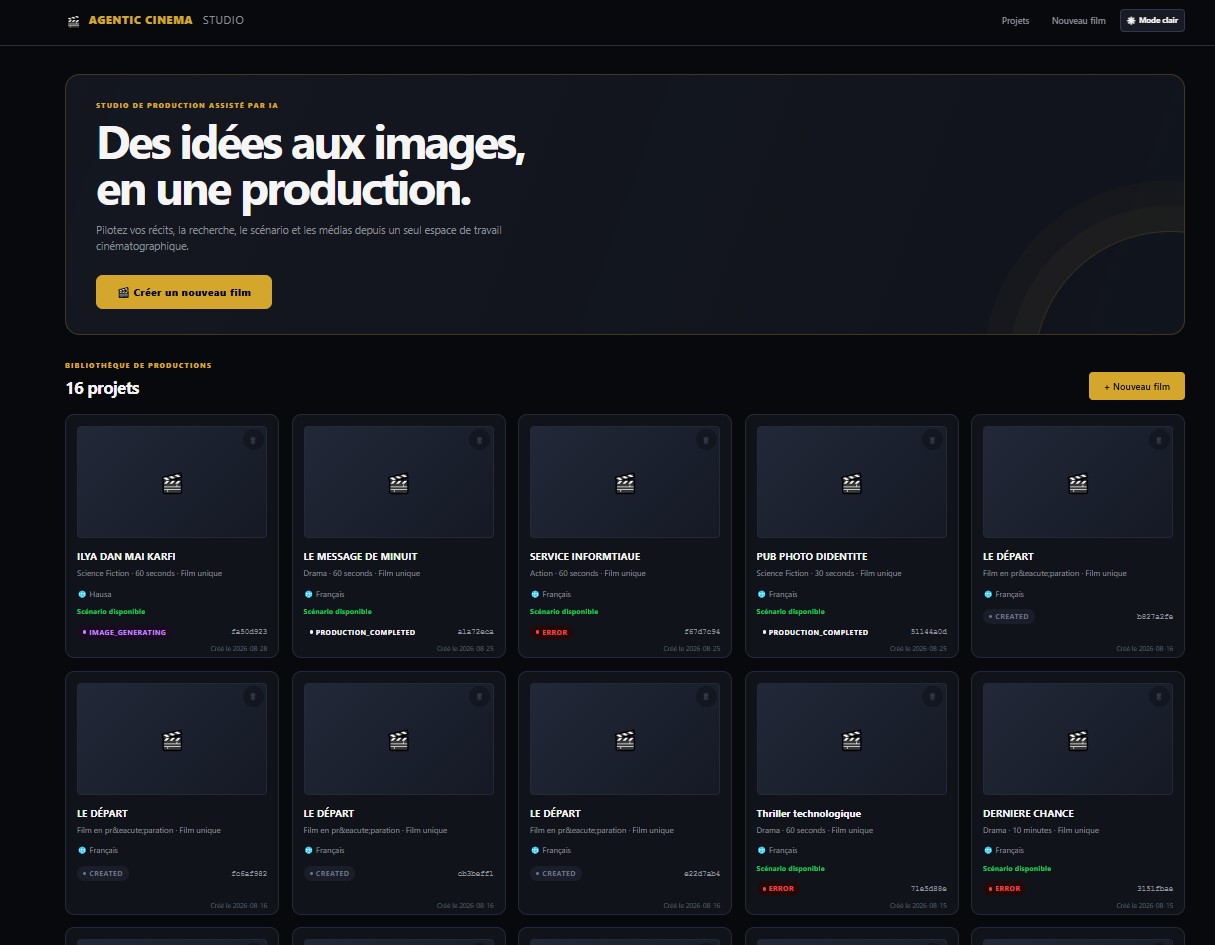
The platform also keeps production history, agent execution information, generated assets, and project state so a production can be inspected and resumed.
🔎 Parallel Search integration
Agentic Cinema Studio is submitted to the Parallel Track.
Parallel Search is used at runtime by the Historian Agent to retrieve relevant information and sources before the screenplay is generated.
The research layer helps the system separate content into categories such as:
- Historical facts
- Interpretations
- Fictional or dramatic elements
The resulting historical dossier is then passed downstream to the Screenwriter Agent.
This is especially important for projects based on real people, places, events, or historical periods because the creative pipeline should know the difference between documented information and cinematic invention.
Parallel is therefore not an isolated search feature — it contributes directly to the multi-agent production workflow.
🧠 How we built it
The multi-agent orchestration is built with the Google Agent Development Kit (ADK).
Specialized agents share production context through structured state, allowing the output of one agent to become the input of another.
A simplified workflow looks like this:
Creative Brief
      ↓
Director Agent
      ↓
Historian Agent
      ↓
Parallel Search
      ↓
Historical Dossier
      ↓
Screenwriter Agent
      ↓
Storyboarder Agent
      ↓
Image Generation Agent
      ↓
Producer Agent
      ↓
Audio Agent
      ↓
Editor Agent
      ↓
Final Production
The backend is implemented with Python and FastAPI, while structured data models are validated with Pydantic.
Google Gemini models power the reasoning and creative stages. Gemini image generation is used for visual production, while the video pipeline supports Veo.
FFmpeg handles final media assembly.
The platform also includes Grafana Cloud / OpenTelemetry observability to trace agent executions, duration, status, and production behavior without exposing creative prompts or API credentials.
A web interface provides access to projects, production runs, agent outputs, generated assets, and live workflow progress.
🧩 Multi-agent architecture
One of our main goals was to build an actual agentic workflow rather than wrapping one large prompt inside a web application.
Each agent has:
- A specialized role
- Its own instructions
- Defined inputs and outputs
- Access only to the tools needed for its task
- A position in the larger production workflow
Structured information is propagated between agents.
For example:
Director
→ project context

Historian
→ historical dossier + sources

Screenwriter
→ screenplay

Storyboarder
→ cinematic shot descriptions

Image Agent
→ shot images

Producer
→ video clips

Audio Agent
→ audio assets

Editor
→ final render
This architecture allows individual stages to be inspected, retried, resumed, or improved without restarting the entire creative process.
🎯 Challenges we faced
Coordinating multiple AI agents
The biggest challenge was ensuring that the agents behaved like a production team instead of eight independent AI calls.
We needed reliable state propagation, structured outputs, validation, execution tracking, and recovery when one stage failed.
Historical reliability
Creative AI can easily mix historical information with invented details.
For Les Remparts de Birni, we wanted creativity without pretending that fictional dialogue or dramatic scenes were documented facts.
The Historian Agent and Parallel-powered research layer help maintain that distinction.
Long-running media generation
Text generation is relatively fast, but image, video, audio, and final rendering can take much longer.
The production system therefore needed execution states, resumable runs, progress events, retries, and persistent asset metadata.
External model limitations
Real-world AI APIs introduce quota limits, temporary errors, model availability issues, and different generation durations.
We designed the application so that temporary media-generation failures do not destroy completed work from previous agents.
Observability
When many agents participate in one production, debugging becomes difficult.
Adding tracing and agent-level execution metadata made it much easier to understand where time was being spent and where failures occurred.
📚 What we learned
Building Agentic Cinema Studio taught us that multi-agent systems are less about simply adding more models and more about coordination.
The quality of the system depends heavily on:
- Clear agent responsibilities
- Structured communication between agents
- Tool selection
- Persistent state
- Failure recovery
- Source grounding
- Observability
We also learned that research can become part of the creative process rather than merely an external reference step.
By connecting Parallel Search directly to the Historian Agent, retrieved knowledge can influence the screenplay and storyboard while still allowing the creative agents to distinguish research from fiction.
Finally, we learned that an agentic application should allow users to inspect what the agents actually did. For this reason, Agentic Cinema Studio exposes individual agent outputs and production history rather than showing only the final result.
🏆 What we're proud of
We are especially proud that Agentic Cinema Studio goes beyond a simple text-to-video prompt.
It models filmmaking as a collaborative process involving several specialized AI roles.
A user can start with an idea and progressively obtain:
research → creative direction → screenplay → storyboard → images → video → audio → final edit
while still being able to inspect the work produced at each stage.
The pilot project also demonstrates how emerging AI filmmaking technology can be applied to stories and histories from regions that are still underrepresented in mainstream digital creative tools.
🔮 What's next
The next stages for Agentic Cinema Studio include:
- Stronger visual character consistency across scenes
- More advanced source verification
- Human approval checkpoints between production stages
- Improved multilingual filmmaking
- More video-generation providers
- Collaborative projects with multiple human creators
- Automatic trailer generation
- Production cost and token tracking
- Smarter agent retry and recovery strategies
- Expanded observability dashboards
- Support for documentaries, advertising, education, and other audiovisual formats
Our long-term goal is to make Agentic Cinema Studio a flexible AI-native production environment where humans define the vision and specialized agents coordinate the technical and creative work required to bring that vision to life.


Log in or sign up for Devpost to join the conversation.