Inspiration
Independent filmmakers and small creative teams often understand their story perfectly, but AI video systems do not share that human context. A screenplay may imply character identity, wardrobe, geography, lighting, emotional tone, and continuity without repeating those details in every shot. When each shot is generated separately, characters drift, costumes change, locations mutate, and connected actions lose visual continuity. Agentic Cinema — Continuity Crew AI was created to bridge that gap. The project turns a screenplay into an AI-production plan that makes implicit cinematic knowledge explicit, traceable, and actionable.
What it does
Continuity Crew AI transforms screenplay material into a structured, production-ready shot plan. It: separates script facts from verified context, uncertain inference, and cinematic inference; detects missing production information before generation; establishes character visual-DNA and wardrobe locks; checks cross-shot character, costume, prop, time, space, and visual-motif continuity; classifies assets as READY, PARTIAL, or MISSING; assesses AI-video feasibility and proposes fallback strategies for risky shots; flags creative or structural changes for human-director approval; prioritizes what the production team should create next. The public web application allows a reviewer to interact with the workflow through a Google Cloud-hosted interface.
How we built it
The core reasoning workflow was designed and tested in Google Cloud Agent Studio using Gemini 3.6 Flash. A public Python export uses the official google-genai SDK with Vertex AI and Application Default Credentials.
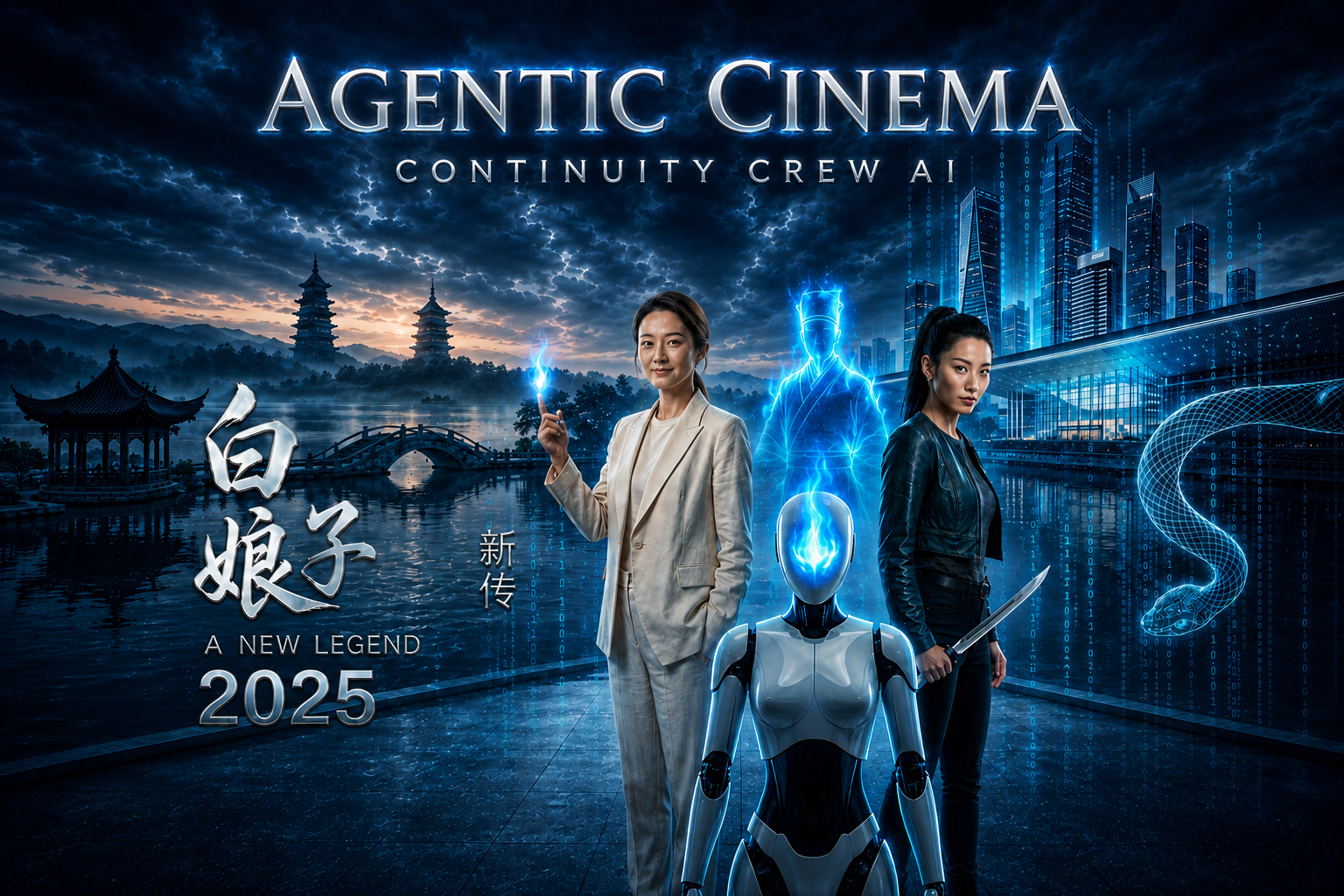
The production benchmark used The New Legend of White Snake 2025 as a real filmmaking dataset. Three benchmark samples were frozen for final verification:
Shot 01: reference-driven character generation followed by iterative visual correction; Shot 06: Bai Niangzi and one consistent YQ-S1 robot as the continuity source; Shot 07: video continuation from Shot 06 using Veo Extend.
Veo 3.1 Fast was used for reference-based video generation, correction, and continuation. Lyria 3 Pro produced the soundtrack. Canva was used for the final 2:56 demonstration edit.
IBM Bob participated in the development process as an independent technical QA reviewer. Bob inspected the saved generation evidence, identified real code defects, produced a corrected runnable Shot 01 copy, reviewed the Shot 06-to-07 continuation evidence, and performed a final re-check. Original provenance snapshots were preserved separately from corrected runnable files.
Challenges we ran into
The largest creative challenge was translating cinematic intent into instructions that an AI video model could execute consistently.
Shot 01 required several iterations. An early version made the characters appear to walk out of the lake. After correcting their movement, the background bridge drifted into a Western-style suspension bridge. The final accepted version required both movement correction and stronger location-geometry constraints.
The Shot 06-to-07 sequence required continuity across time rather than two visually similar independent clips. We solved this by extending directly from the Shot 06 video source.
The technical evidence also created challenges. One original UI code snapshot contained embedded Base64 reference images and was several megabytes long. IBM Bob correctly identified a missing import and a missing comma in the saved snapshot, while one Project ID finding was independently re-evaluated as a false-positive rationale. We preserved the original evidence and kept the corrected runnable version separate.
Accomplishments that we're proud of
- Deployed a publicly accessible Google Cloud Run web application.
- Built a reviewer-facing open-source repository with runnable Google Gen AI SDK code.
- Completed and passed all three benchmark samples.
- Verified reference-driven correction and genuine Veo Extend continuity.
- Completed an independent IBM Bob QA and correction cycle.
- Produced a public demonstration under the three-minute limit.
- Preserved a transparent evidence chain without overwriting original generation provenance.
What we learned
Text consistency is not visual continuity. Reliable AI filmmaking requires explicit identity locks, asset states, temporal links, provenance categories, feasibility checks, and human approval gates.
We also learned that evidence must be treated as a first-class production asset. A generated video, an original UI snapshot, a corrected runnable copy, and an independent QA report serve different purposes and should remain clearly separated.
Most importantly, agents are most useful when they do more than generate content: they should identify uncertainty, expose risk, preserve intent, and tell the creator what action has the highest production value next.
What's next for Agentic Cinema — Continuity Crew AI
The next version will add structured project persistence, reusable character and wardrobe manifests, richer multimodal QA, automated comparison between generated frames and approved visual references, and collaborative production dashboards for small filmmaking teams.
Built With
- canva
- gemini-3.6-flash
- github
- google-agent-studio
- google-cloud
- google-cloud-run
- google-gen-ai-sdk
- gradio
- ibm-bob
- lyria-3-pro
- nano-banana-2
- python
- veo-3.1-fast
- vertex-ai

Log in or sign up for Devpost to join the conversation.