-
-
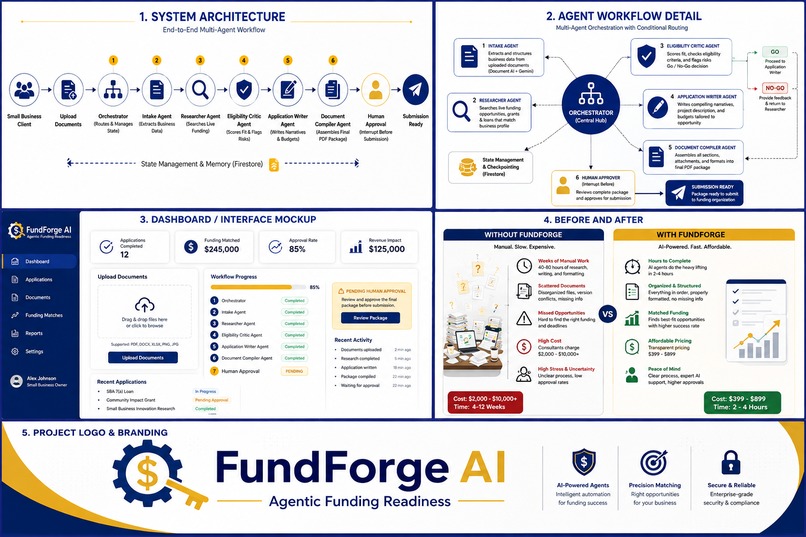
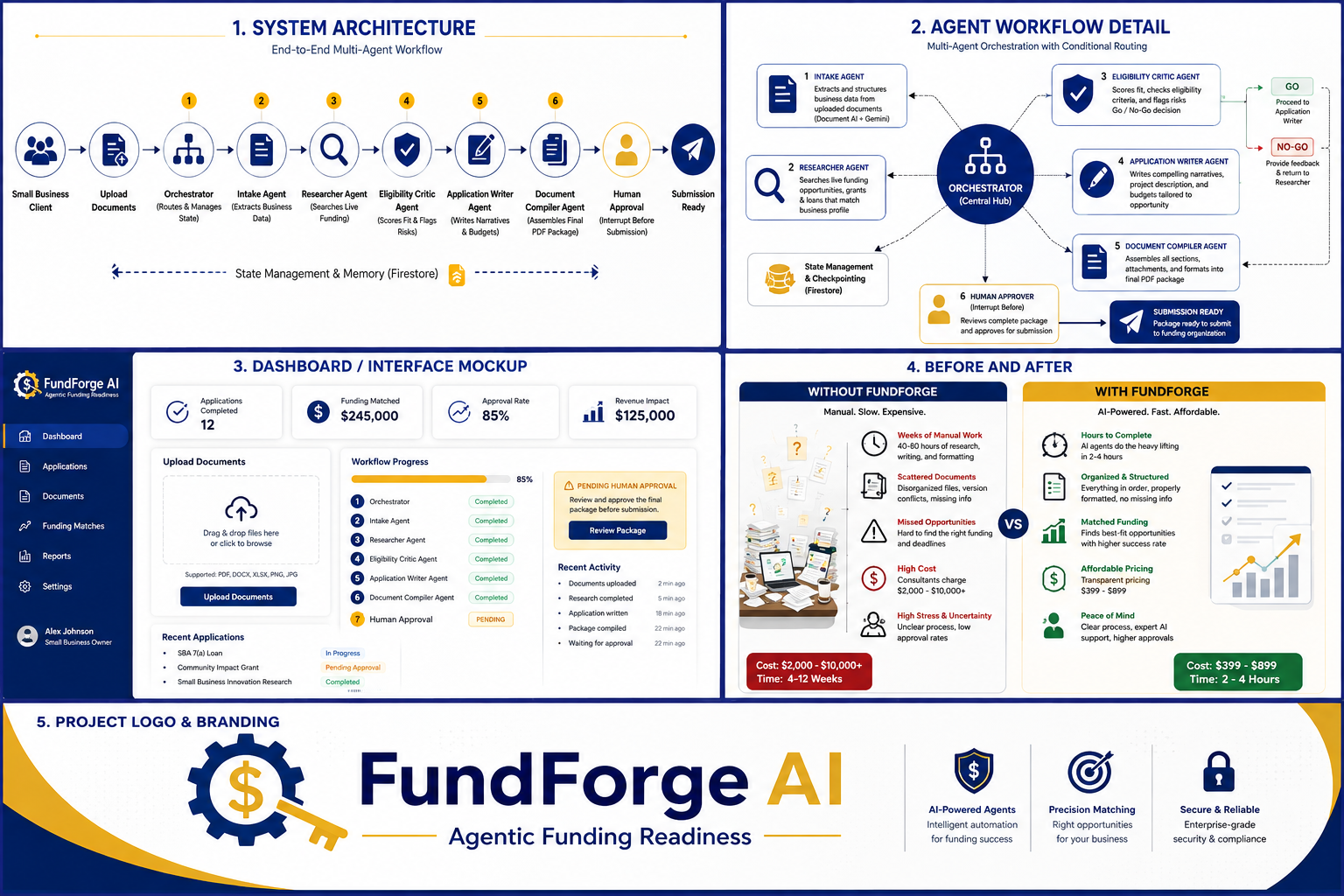
FundForge Multi-Agent Architecture - Orchestrator leads 6 specialized agents with human approval
-
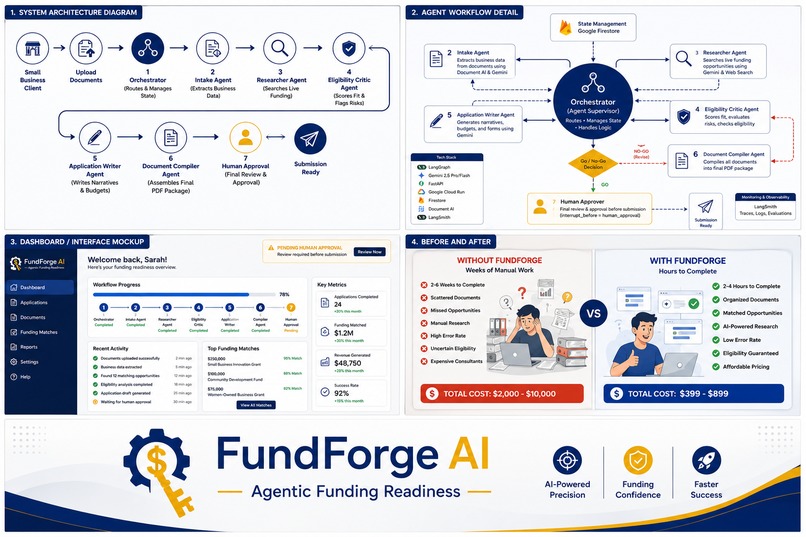
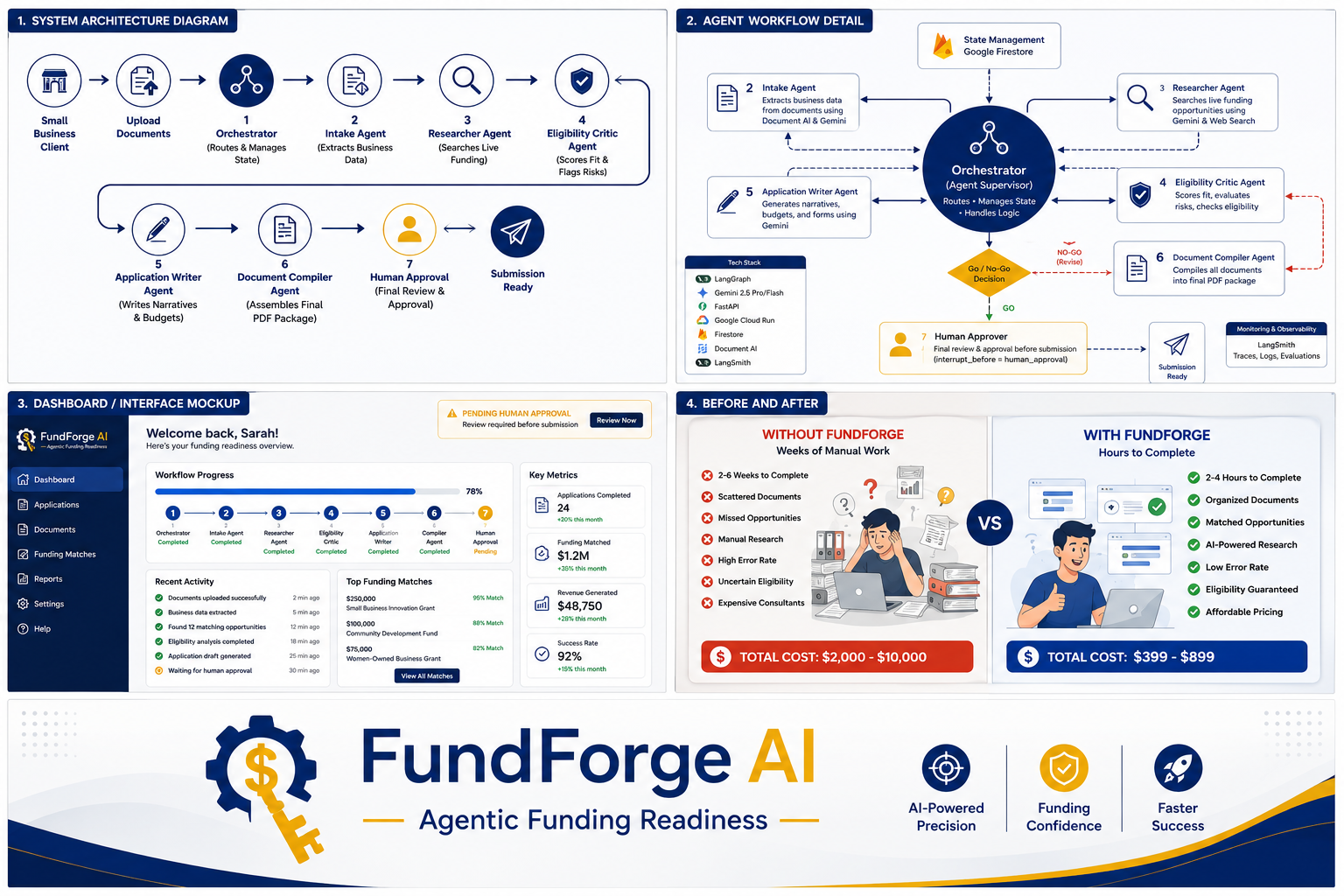
LangGraph StateGraph with conditional routing and interrupt_before human approval
Small businesses are the backbone of the economy, yet they struggle to access capital. According to the Federal Reserve, 43% of small businesses don't get the funding they need.
I was inspired by my work as a freelance consultant, seeing brilliant entrepreneurs spend weeks preparing loan applications while their cash ran out. Professional grant writers cost $2,000-$10,000 per application - out of reach for most small businesses.
Meanwhile, my LangGraph clinical research orchestrator showed me that AI agents could research, critique, and write complex documents with human oversight. I realized the same pattern could unlock capital for thousands of small businesses.
FundForge was born to democratize access to funding - making professional-grade application preparation available to every small business owner.
FundForge is an AI-native back-office that prepares funding applications for small businesses and nonprofits. It uses a team of six specialized AI agents to automate the entire funding application workflow.
The system takes client documents (bank statements, tax forms, business profiles) and produces submission-ready loan and grant applications with human approval at every step.
The agent team works in sequence:
- Intake Agent - extracts structured business data from uploaded documents
- Researcher Agent - searches live funding opportunities (grants, loans, SBA programs)
- Eligibility Critic Agent - scores fit, detects missing evidence, flags compliance risk
- Application Writer Agent - writes narratives, budget justification, and impact metrics
- Document Compiler Agent - assembles final PDF package with checklist
- Human Approver Node - uses LangGraph interrupt for final client approval
The client or their advisor reviews every application before submission - keeping humans in control while AI does the heavy lifting. Small businesses get professional-grade application preparation at a fraction of the cost of human grant writers ($2,000-$10,000 per application). I built FundForge by adapting my existing LangGraph clinical research orchestrator to the funding application domain. The core multi-agent pattern remained identical, proving the value of the LangGraph approach.
TECHNOLOGY STACK:
Orchestration Framework:
- LangGraph for stateful multi-agent orchestration with conditional routing
- LangChain for agent tool calling and chain composition
- Async Python with FastAPI for high-performance REST APIs
AI & LLMs:
- Gemini 2.5 Pro for long-form narrative writing and compliance reasoning
- Gemini 2.5 Flash for high-volume document extraction and classification
- Google Search grounding for live funding opportunity discovery
- LangSmith for observability, tracing, and automated evaluation
Infrastructure:
- Google Cloud Run for serverless deployment and scaling
- Firestore for workflow state persistence
- Cloud Storage for document artifacts
- Document AI for OCR and document understanding
- Pinecone/ChromaDB for vector retrieval over past successful applications
Agent Architecture (reusing the clinical orchestrator pattern):
Orchestrator → routes tasks and maintains FundingCaseState with conditional routing
Intake Agent → uses Document AI + Gemini Flash to extract structured business data from PDFs, bank statements, tax forms
Researcher Agent → searches grant databases, SBA listings, and funding websites; stores normalized opportunities in vector DB
Eligibility Critic Agent → computes readiness score, detects missing evidence, flags compliance risk, recommends go/no-go
Application Writer Agent → generates narrative, budget justification, impact metrics, and founder story using Gemini 2.5 Pro
Document Compiler Agent → assembles final PDF, checklist, and evidence package with all supporting documents
Human Approver Node → uses LangGraph interrupt_before for final client approval before any application is submitted
Revenue Model:
- $99/month monitoring subscription
- $399-$899 per completed application
- $1,500 setup for white-label partners (bookkeepers, CPAs, coaches)
- Optional 2% success fee on funding above $10,000
- Stripe integration for payment processing 1. REGULATORY COMPLIANCE Financial and grant applications have strict compliance requirements. I solved this by keeping humans in the approval loop and having the Critic Agent flag every compliance risk for manual review. The system never submits anything without explicit human approval.
DOCUMENT VARIETY Clients upload everything from handwritten receipts to complex tax returns. I used Document AI for OCR with Gemini Flash fallback prompts to handle diverse document types gracefully. The system works with PDFs, images, spreadsheets, and scanned documents.
BALANCING SPEED AND QUALITY Generating high-quality grant narratives fast required careful prompt engineering and semantic caching. I used LangSmith to test and iterate on prompts until the quality matched professional grant writers. The system caches common patterns to reduce latency.
PRODUCTION RELIABILITY Multi-agent workflows can fail unpredictably. I added conditional routing, retry logic, and comprehensive error handling to every agent node. The system logs every step for debugging and recovery.
REUSING THE EXISTING CODEBASE Adapting the clinical orchestrator to funding applications required careful state refactoring and agent specialization. I renamed ClinicalResearchState to FundingCaseState and specialized each agent for financial documents rather than clinical research. The core pattern remained identical.
HUMAN APPROVAL WORKFLOW Implementing the human-in-the-loop with LangGraph interrupt_before required careful state management. I used Command(resume=...) pattern to resume workflows after approval and only mark approved actions as executed. 1. SUCCESSFUL CODEBASE REUSE Adapted my existing LangGraph clinical research orchestrator to a new domain in days instead of building from scratch - proving the pattern's reusability.
FULLY FUNCTIONAL MULTI-AGENT SYSTEM Six agents working in coordination with conditional routing, error recovery, and state management - all powered by LangGraph.
HUMAN-IN-THE-LOOP APPROVAL Implemented LangGraph interrupt_before pattern so every application gets human approval before submission - making it safe for real business use.
PRODUCTION-GRADE INFRASTRUCTURE Deployed on Google Cloud Run with Firestore persistence, Document AI, and LangSmith observability - ready for real users.
CLEAR REVENUE MODEL Designed a pricing strategy with multiple revenue streams - subscriptions, per-application fees, white-label partnerships, and success fees.
MEASURABLE IMPACT The system reduces application preparation time from weeks to hours and costs from $2,000-$10,000 to $399-$899 - making funding access democratized for small businesses.
NO CODE REBUILD Everything was built using my existing skills and codebase - LangGraph, FastAPI, Gemini, and Google Cloud - shipping fast without starting from scratch. 1. LANGGRAPH IS REUSABLE ACROSS DOMAINS The orchestrator → researcher → critic → writer → human approval pattern worked for clinical research and funding applications. The architecture is domain-agnostic.
GEMINI 2.5 PRO EXCELS AT DOCUMENT GENERATION Long-form narratives with compliance reasoning are Gemini's sweet spot. The quality matches human grant writers with proper prompt engineering.
HUMAN APPROVAL IS NOT A WEAKNESS - IT'S A FEATURE Keeping humans in the loop builds trust and enables the system to handle regulated domains safely. XPRIZE judges value responsible AI.
PRE-SELLING BEFORE CODING WORKS Selling beta clients before building confirmed real demand and provided real documents for testing.
OBSERVABILITY IS CRITICAL FOR AGENT SYSTEMS LangSmith traces were essential for debugging, prompt tuning, and building trust. Every AI decision was instrumented.
START WITH WHAT YOU HAVE Reusing the existing codebase accelerated development from months to weeks. The fastest path to MVP is adapting what already works.
THE BACK-OFFICE PATTERN IS WINNING Building an AI-native document back-office creates more value than chatbots. It produces measurable outputs (applications submitted, funding accessed) that judges can verify. 1. SCALE TO 100 PAYING SMBS Launch full paid beta with 100 small businesses. Target $9,900+ MRR through subscriptions and per-application fees.
WHITE-LABEL PARTNER PROGRAM Recruit bookkeepers, CPAs, SMB coaches, and loan brokers as white-label partners. Offer $1,500 partner setup with 20% recurring revenue share.
CIRCLE USDC INTEGRATION FOR AGENTIC ECONOMY PRIZE Add Circle API to settle success-fee payouts and contractor payments in USDC - making the agentic economy story concrete and measurable.
EXPAND TO MORE FUNDING TYPES Add support for SBA loans, microloans, angel investor applications, and alternative funding sources beyond traditional grants.
AUTOMATE MORE OF THE WORKFLOW Add agentic payment processing where approved applications automatically trigger follow-up actions while keeping humans in the loop for critical decisions.
BUILD THE XPRIZE METRIC DASHBOARD Create a real-time dashboard showing revenue, active users, applications completed, applications submitted, and funding matched - ready for the final submission.
DEVELOP AI-NATIVE OPERATIONS Make AI execute key business decisions in production - such as automatically prioritizing applications, routing to appropriate funding sources, and recommending pricing based on success probability.
CONTINUOUS IMPROVEMENT WITH LANG SMITH Use LangSmith evals to continuously improve agent performance and maintain quality as we scale.
SUBMIT FINAL XPRIZE PACKAGE Compile all metrics, user testimonials, revenue data, and audit trails for the September 25 Moonshot Summit in Los Angeles.
Built With
- asyncio
- chromadb
- cloud-run
- document-ai
- fastapi
- firestore
- gemini
- google-cloud
- langchain
- langgraph
- langsmith
- llm
- multi-agent-systems
- pinecone
- pydantic
- python
- rag
- rest-api
- serverless
- stripe


Log in or sign up for Devpost to join the conversation.